On the morning of my birthday the call came from a number I didn’t recognize. A calm voice said my father had left instructions that could only be opened on this exact date. I sat in that quiet office holding a sealed envelope with his handwriting on the front, and inside waited a single photograph that would force me to question every memory I had of the people who raised me.
Part 1
The phone rang while I was still in my robe, coffee cooling on the kitchen counter. I almost let it go to voicemail. Birthdays had become quiet affairs since my father died two years earlier, and I preferred the silence. But the number looked local, and something about the early hour made me answer.
“Is this Claire Ellison?” The voice was measured, professional.
“Yes.”
“My name is Robert Hale. I was your father’s attorney. He left specific instructions that I contact you today, on your birthday, and ask you to come to my office. There is something he wanted you to receive only on this date.”
I stood very still. The refrigerator hummed. Outside, a delivery truck rumbled past.
“Instructions for today?” I asked. “He wouldn’t explain?”
“I’m not at liberty to discuss the contents over the phone. He was quite clear about that. Can you come this morning?”
I went. There was no real decision to make. Curiosity and the leftover ache of missing him pulled me out the door.
The office was on the third floor of a modest brick building downtown. Hale’s secretary offered coffee; I declined. When he finally ushered me in, the room smelled of old paper and furniture polish. He was older than I expected, silver hair carefully combed, eyes that had seen too many family secrets.
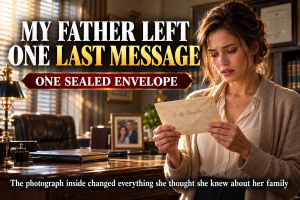
He opened a drawer and took out a cream-colored envelope. My father’s handwriting stretched across the front in the familiar slant I still recognized from grocery lists and birthday cards. My name. Nothing else.
“He asked that this be given to you in person, today only,” Hale said. “I haven’t opened it. Neither has anyone else.”
I took it. The paper felt thicker than ordinary stationery. My fingers trembled slightly as I slid a fingernail under the flap.
Inside was a single photograph. No letter. No explanation.
It showed three people standing in front of a modest house with white siding and a small porch. My father on the left, younger, hair still dark. My mother in the center, smiling the way she used to before the illness took the light from her eyes. And a third person on the right—a woman roughly my mother’s age, dark hair pulled back, wearing a simple dress. Around her neck hung a thin silver chain with a small oval pendant.
I knew that necklace.
I had worn it as a child. My mother had given it to me when I turned seven, saying it had belonged to someone special. I had lost it years later during a move, or so I believed. The woman in the photograph wore it as if it had always been hers.
I looked up at Hale. He waited, patient.
“Is there anything else?” I asked.
“Only that. Your father said you would understand when the time was right.”
I didn’t understand. Not yet. But the photograph sat in my hand like a living thing, and the quiet office suddenly felt too small.
I thanked him and left, the envelope tucked carefully into my bag. Outside, the morning sun was bright and ordinary. People walked past with coffee cups and shopping bags. None of them knew that the ground under my feet had just shifted.
I sat in my car for a long time before starting the engine. The photograph rested on the passenger seat. Three faces. One necklace I had once believed was mine alone.
Somewhere in the back of my mind a memory stirred—my mother brushing my hair, telling me the pendant had a story she would share when I was older. She never did. She died when I was nineteen, and the story died with her.
Or so I had thought.
I drove home slowly, the sealed envelope now open, the single image waiting to be examined again under better light. Whatever my father had wanted me to see on this particular birthday, he had waited until both he and my mother were gone to show it.
The quiet of my apartment felt different when I walked back inside. The birthday cards from friends still sat on the table, unopened. The cake I had planned to buy later suddenly seemed unimportant.
I placed the photograph on the kitchen counter and stared at it until the faces blurred.
The third woman looked directly at the camera. Her expression was calm, almost knowing. And the necklace—my necklace—caught the light exactly the way I remembered.
Something important had been kept from me. Something my father had decided I needed to know only after he was no longer here to answer questions.
I picked up the phone, then set it down again. Who would I call? Hale had already given me everything he was allowed to give. My mother was gone. My father was gone.
Only the photograph remained, and the quiet certainty that my life had just been divided into before and after this ordinary birthday morning.
I made a second cup of coffee and sat down to look more carefully. The house in the background. The way my parents stood slightly apart from the third woman, as if an invisible line still existed between them. The date scrawled faintly on the back in my father’s hand: June 1987.
I had been three years old.
Whatever this was, it had started long before I could remember.
And now it had landed in my hands on the day I turned thirty-five, with no explanation except the one my father had chosen not to write down.
I turned the photograph over again, searching for more writing. There was none. Only that date and the three faces that refused to look away.
The rest of the day stretched ahead, quiet and altered. I would have to decide what to do next. But first I needed to understand what I was looking at.
The necklace. That was the place to start.
Part 2
I spent the afternoon searching through old boxes in the closet. Most of my childhood belongings had been packed away after my mother’s death and never fully unpacked. Dust rose as I opened the cardboard lids. School papers, a cracked music box, a stack of birthday cards with my father’s careful signatures.
No necklace.
I found a small jewelry box that had belonged to my mother. Inside were a few pairs of earrings, a broken watch, and a thin chain without a pendant. Nothing matched the oval shape in the photograph.
I sat on the floor with the picture propped against a stack of books and tried to remember. The pendant had been silver, smooth on one side, with a tiny engraved initial on the other. I had always believed the initial was a C for Claire. Now I wondered if I had misread it as a child.
The woman in the photograph wore it naturally, the way someone wears something that has always been theirs. My mother stood beside her with a smile that looked genuine but careful. My father looked younger than any version of him I carried in memory.
I called my aunt the next morning. She was my mother’s only sister and had lived two states away for most of my life. We spoke a few times a year, polite conversations that never went deep.
“Aunt Ruth, do you remember a woman who used to visit when I was little? Someone who wore a silver necklace with an oval pendant?”
There was a pause. “Why do you ask?”
“I found an old photograph. Dad left it for me. There’s a third person in it with Mom and him.”
Another pause, longer this time. “Claire, some things are better left alone.”
“That’s not an answer.”
“Your mother asked me not to talk about certain parts of the past. I respected that while she was alive. I still do.”
“She’s been gone sixteen years. Dad’s gone too. I’m the only one left who doesn’t know.”
Ruth sighed. “I can’t help you with this. I’m sorry.”
She hung up before I could press further.
The refusal told me more than any answer would have. Whatever the photograph showed, it was not a casual family friend. It was something people had agreed to keep quiet about.
I went back to the lawyer’s office two days later. Hale seemed unsurprised to see me.
“I need to know if my father left anything else,” I said. “A letter, a note, anything that explains this.”
He shook his head. “Only the envelope, and only to be given on your birthday. He was very specific. He said the photograph would be enough, and that you would know what to do when the time came.”
“I don’t know what to do.”
Hale folded his hands on the desk. “Your father was a careful man. If he left you this, he believed you were capable of finding the rest.”
I left with no new information and a growing sense that the quiet of the past two years had been an illusion. My father had been preparing this moment long before he died.
That evening I studied the house in the background of the photograph. White siding, small porch, a mailbox with numbers I could almost make out. I enlarged the image on my phone until the numbers resolved: 214.
I searched property records for houses matching the description near the town where I had grown up. There were several possibilities, but one address kept surfacing in connection with my mother’s maiden name.
214 Willow Lane.
I drove there the following Saturday.
The house still stood, smaller than it looked in the photograph, the paint faded, the porch sagging slightly. A young couple lived there now. They were polite but had never heard of my family. The previous owners had bought it from an estate sale in the early nineties.
I stood on the sidewalk afterward and looked at the place where three people had once posed for a camera. My parents and a stranger who wore the necklace I had been told was mine.
The air felt heavier than it should have. Somewhere in the years between that photograph and my childhood, a decision had been made. Someone had chosen what I would be allowed to know and what would remain hidden.
I drove home with the windows down, the photograph in my bag again. The birthday cake I had never bought still felt like a symbol of the ordinary life that had ended the moment the lawyer called.
That night I dreamed of my mother fastening the necklace around my neck, her hands gentle, her voice saying the words I could no longer hear clearly. When I woke, the dream slipped away, leaving only the certainty that the story she never told was now mine to uncover.
I began making a list of every relative, every old neighbor, every name that had ever appeared in my parents’ address books. Someone had to remember the woman in the photograph. Someone had to know why my father waited until both he and my mother were gone before placing that image in my hands.
The list was longer than I expected. And every name carried the quiet possibility that the truth had been sitting in plain sight for years, waiting for the right birthday to surface.
Part 3
The first person I contacted was Mrs. Lang, who had lived next door to my parents for twenty years. She was nearly eighty now and still sharp. When I showed her the photograph on my phone, her expression changed.
“That’s Elena,” she said quietly.
“Elena who?”
“Elena Voss. She used to come around when you were very small. Then she stopped. Your mother never spoke of her after that.”
“Do you know why?”
Mrs. Lang hesitated. “There was talk. People said she and your mother had a falling out over something personal. I never asked. It wasn’t my place.”
“Was she related to us?”
“I don’t think so. But she looked at you the way a mother looks at a child. I remember that.”
The words settled heavily. I thanked her and left with more questions than answers.
Elena Voss. The name felt unfamiliar and yet somehow expected, as if it had been waiting just outside the edge of memory.
I searched online. There were several women with that name, but one profile from a small town two hours away caught my attention. The age matched. A single photograph showed a woman with the same dark hair, older now, standing in a garden. No necklace visible.
I wrote the address down and sat with it for three days before deciding to go.
The drive took longer than the map suggested. Rain started halfway there, turning the highway into a gray ribbon. By the time I reached the town, the sky had cleared to a pale afternoon light.
The house was modest, white with green shutters. A woman answered the door after the second knock. She was older than in the online photo, hair streaked with gray, but the shape of her face was unmistakable.
She looked at me for a long moment without speaking.
“Claire,” she said finally. Not a question.
My name in her mouth felt like a door opening.
“You know who I am.”
“I’ve been waiting a long time to see if you would come.” She stepped aside. “You should come in.”
The living room was neat and quiet. A single framed photograph sat on a side table—my parents and her, the same image my father had left for me. The original, perhaps.
She made tea while I sat on the edge of a chair, the sealed envelope’s contents suddenly feeling heavier than paper.
When she returned she set the cups down and looked at me directly.
“Your father was a good man. He kept his word longer than most people would have.”
“What word?”
Elena folded her hands. “The agreement we made when you were three years old.”
I waited.
“I am your birth mother,” she said. The words were steady, practiced, as if she had rehearsed them for years. “Your mother—the woman who raised you—could not have children of her own. We were close once. Closer than sisters. When I found myself pregnant and alone, she and your father offered to raise you. I agreed, on the condition that I could see you sometimes in the beginning. That arrangement lasted until you were four. Then it became too difficult for everyone. I stepped back. Completely.”
The room seemed to tilt. I heard the clock on the wall. I heard my own breathing.
“The necklace,” I said.
“It was mine. I gave it to your mother to give to you when the time felt right. She told me she did. I always wondered if you still had it.”
“I lost it. Or thought I did.”
Elena nodded. “Your father wrote to me once a year. Just a short letter, no return address after the first few. He wanted me to know you were well. When he became ill, he wrote that he would leave you the photograph on your thirty-fifth birthday. He said that was the age your mother had been when she first held you. He thought it was fitting.”
I stared at the tea growing cold between us. Every memory of my childhood rearranged itself in the silence. The careful way my mother had answered questions about family. The absence of stories about pregnancy or birth. The quiet grief that sometimes appeared in her eyes when she looked at me too long.
“Why didn’t they tell me?”
“We all believed it was kinder. You had a stable home. I had very little to offer then. Your mother loved you as her own from the first day. Telling you would have complicated that love with questions none of us were ready to answer.”
“And now?”
“Now you’re old enough to decide what the truth means to you.”
I left an hour later with her phone number written on a scrap of paper and the original photograph still in my bag. The drive home passed in a kind of stunned quiet. Fields blurred past. The radio stayed off.
When I reached my apartment I sat on the couch with the lights off and let the new shape of my life settle around me. The woman who raised me was still my mother in every way that mattered. The woman who had given birth to me had carried a different kind of love for thirty-five years—distant, careful, unfinished.
My father had chosen the day and the method with deliberate care. No letter of explanation. Only the image and the trust that I would find my way to the rest.
I slept poorly that night. In the morning I called Hale one more time.
“Did you know?” I asked.
“Only that the envelope was important. Your father never shared the details. He said the photograph would speak for itself when the time was right.”
I thanked him and ended the call. The time was right. The photograph had spoken. And the quiet life I had known was no longer the only version of the truth.
I spent the next days moving between the two realities—the childhood I remembered and the one that had existed alongside it without my knowledge. Both were real. Both belonged to me now.
Elena’s number sat on the kitchen counter. I had not decided whether to call again. The choice, for the first time, was entirely mine.
Part 4
I waited a week before dialing the number. The conversation was careful, almost formal. We agreed to meet for coffee in a neutral town halfway between us. No promises beyond that.
The café was quiet on a Tuesday afternoon. Elena arrived first. She had brought a small box.
“These are letters,” she said after we ordered. “The ones your father sent. I thought you might want them.”
There were twelve envelopes, each postmarked in different years. Inside were short notes in my father’s handwriting—descriptions of school plays, a broken arm in third grade, the day I learned to ride a bicycle. Never my full name. Never an address. Just enough for her to know I was growing up well.
Reading them felt like overhearing a conversation that had continued without me for decades. My father’s voice, steady and kind, bridging two lives that were never supposed to meet again.
“I kept every one,” Elena said. “Even when it hurt.”
We talked for two hours. She told me about the year she was twenty-four, working night shifts, terrified of becoming a mother alone. She told me about the night she handed me to my parents and walked out of the hospital with empty arms. She told me about the years of silence that followed, and the way she had trained herself not to look for my face in crowds.
I listened. Sometimes I asked questions. Sometimes I simply sat with the new information.
When we parted, she hugged me briefly, carefully, as if testing whether the gesture was allowed. I did not pull away.
On the drive home I felt the weight of two mothers settling into place. One who had raised me with daily love and ordinary routines. One who had loved me from a distance and kept every letter as proof.
That night I opened the jewelry box again and stared at the empty chain. The pendant was gone, but the memory of it remained. I wondered if my mother had known, when she fastened it around my neck, that she was giving me a piece of the woman who had given me life.
I decided to visit my mother’s grave the following weekend. The cemetery was quiet, the grass newly cut. I stood in front of the stone that bore both my parents’ names and spoke aloud for the first time.
“I know now,” I said. “I don’t know if you wanted me to, but I know.”
The wind moved through the trees. No answer came, of course. But the act of saying it felt necessary.
In the days that followed I began sorting through the practical questions. Medical history. Family traits I had never been able to place. The quiet gaps in the story I had been told.
Elena answered what she could. Her own mother had died young. There was a history of heart issues on that side. Nothing dramatic, but useful to know.
I also began the slow work of telling the people who needed to know. My closest friend listened without interruption and then said the only thing that mattered: “You’re still you. This doesn’t change that.”
Aunt Ruth called me two weeks later. Her voice was softer than before.
“I heard you found Elena,” she said. “Your mother made me promise never to speak of it. I kept that promise too long. I’m sorry.”
“It’s all right,” I told her. And in that moment it was.
The photograph stayed on my bookshelf now, no longer hidden. Three people who had made a decision out of love and necessity. Two of them gone. One still here, waiting to see what I would do with the truth.
I did not rush. There was no deadline except the one my father had already set by choosing my birthday. The rest of the story could unfold at the pace I needed.
Some evenings I reread the letters. Other evenings I simply sat with the knowledge that the life I had lived was both exactly what I remembered and larger than I had known. The two versions did not cancel each other. They existed side by side, complete in different ways.
The sealed envelope had done its work. The single photograph had opened a door I had never realized was closed. And on the other side waited a quieter kind of understanding—one that did not demand I choose between the mother who raised me and the mother who had given me away.
Both had loved me. Both had kept their promises in the ways they knew how.
I was learning how to hold that truth without letting it break the life I already had.
Part 5
Three months after the birthday call, Elena invited me to spend a weekend at her house. The invitation was tentative, almost shy. I accepted.
The rooms felt familiar in a way I could not explain. She cooked simple meals. We walked through the small garden she kept. She showed me a box of photographs from the years before I was born—her own childhood, her parents, a version of herself I had never imagined.
On the second evening she brought out a small velvet pouch.
“I kept this,” she said. “I always hoped I might give it to you one day.”
Inside was the pendant. The silver oval, slightly worn, the engraved initial clearer now that I knew to look for an E instead of a C.
“I took it back after the visits stopped,” she admitted. “I couldn’t bear the thought of it being gone forever. Your mother understood.”
I held it in my palm. The metal was cool. The weight was exactly as I remembered from childhood.
“Would you like it?” she asked.
I nodded. She fastened the chain around my neck with careful hands. The pendant rested against my collarbone the way it had when I was seven.
Something quiet settled into place.
We spent the rest of the weekend talking about ordinary things—books, weather, the way the light fell across the kitchen table in the late afternoon. No grand revelations. Just the slow work of becoming known to each other.
When I left, she walked me to the car and stood watching until I turned the corner. I looked back once in the rearview mirror. She raised one hand, then let it fall.
The drive home felt different. The necklace rested against my skin, a physical link between the two halves of the story. I did not feel torn. I felt expanded.
In the following weeks I began integrating the new knowledge into daily life. I updated my medical records. I told a few more people when the moment felt right. Most responded with quiet curiosity rather than drama. The story was unusual, but it was not tragic. It was simply a different shape of family.
I visited my parents’ graves again, this time with the necklace visible. I told them both, out loud, that I understood the choice they had made. That I did not blame them. That the love they had given me remained intact.
Whether they heard or not did not matter. The words needed to be spoken.
Elena and I established a careful rhythm. A phone call every two weeks. An occasional visit. No pressure to make up for lost time. The past could not be rewritten. The present, however, was still open.
One afternoon she asked if I wanted to know more about the man who had been my biological father. I considered the question carefully.
“Not yet,” I said. “Maybe later. Right now this is enough.”
She accepted the answer without argument.
I began to notice small resemblances I had never recognized before—the shape of my hands, the way I tilted my head when listening, a certain stubbornness that had always felt slightly foreign in the family I grew up in. None of it erased the traits I had inherited from the parents who raised me. It simply added another layer.
The lawyer’s call on my birthday had felt like an ending at first—the final message from a father already gone. In time it revealed itself as a beginning. Not a replacement of the life I knew, but an enlargement of it.
I kept the original photograph on the shelf beside the letters. Sometimes I looked at the three faces and tried to imagine the conversation that had led to the agreement. The fear, the hope, the careful negotiations of love and practicality. Three adults making a decision that would shape a child’s entire understanding of belonging.
They had done the best they could with the information and the courage they had at the time. I was the living result of that decision. And now I was old enough to decide what the next chapter would contain.
The necklace stayed around my neck most days. On the days I chose not to wear it, I placed it carefully in the small dish on my dresser where I could see it. Either way, it remained present—a quiet reminder that some stories take decades to reach the person who needs them most.
Part 6
Autumn arrived with its usual turning of leaves and cooler evenings. Elena invited me to help her clear the garden beds before the first frost. We worked side by side in comfortable silence broken by occasional comments about the weather or the stubbornness of certain weeds.
Midway through the afternoon she sat back on her heels and looked at me.
“There’s something else I should tell you,” she said. “I almost didn’t. But secrets have already done enough damage in this family.”
I waited, trowel still in my hand.
“I was married once, briefly, after you were born. It didn’t last. There were no other children. But there is a cousin—my sister’s daughter—who has asked about you over the years. She lives nearby. If you ever want to meet her, I can arrange it. No pressure.”
Another thread. Another possible connection.
“I’ll think about it,” I said.
We finished the garden and shared a simple supper. Before I left she handed me a small notebook.
“These are names and addresses of people who knew me when I was young. Some of them knew about you. If you ever want a fuller picture of that time, they’re willing to talk. Again—only if you want.”
I took the notebook. The pages were filled with careful handwriting. Another map of a life that had run parallel to mine without ever quite intersecting until now.
On the drive home I thought about the careful way both of my mothers had tried to protect me from complexity. One by raising me in a complete and closed story. The other by stepping away so the closed story could remain intact. Both choices had been made from love. Both had carried costs.
I was the only one left who could decide how much of the cost still needed to be paid.
That winter I met the cousin. Her name was Mara. She was a few years younger than me, warm and curious without being intrusive. We met for lunch and talked for three hours. She told me stories about Elena that I had never heard—small kindnesses, quiet strength, the way she had carried the absence of a child without letting it sour the rest of her life.
Mara became a steady presence. Not a replacement for anything, simply another person who knew the full shape of the story and did not find it strange.
I began to notice that the people who loved me most adjusted easily to the new information. The ones who struggled were usually those who preferred simple narratives. I learned to offer the truth without demanding acceptance. Some people needed time. Others never fully understood. That was their work, not mine.
In early spring I received a letter from Hale’s office. My father had left a small additional provision in his will that only activated if I contacted Elena within a year of receiving the photograph. It was not money. It was a short recorded message, stored on an old cassette that Hale’s secretary had carefully digitized.
I listened to it alone in my apartment on a rainy afternoon.
My father’s voice filled the room, older than I remembered, slightly thinner, but unmistakably his.
“Claire. If you’re hearing this, then you found her. I hope you did. I hope the photograph was enough to start you looking. Your mother and I never stopped loving you. Neither did Elena, in her way. We made the best choice we could at the time. If we were wrong, I’m sorry. If we were right, then I’m glad you know the whole of it now. Be kind to yourself. Be kind to both of them. That’s all I ask.”
The recording ended. I sat in the quiet that followed and let the sound of rain fill the space where his voice had been.
He had planned for every possibility. The birthday. The photograph. The quiet hope that I would find the rest on my own. And the final message, waiting only if I chose to walk through the door he had left open.
I played the recording twice more, then stored the file carefully. Some things did not need to be shared. Some things were simply for the person they were meant for.
That evening I called Elena and told her about the message. She listened without interrupting. When I finished she was quiet for a long time.
“He was always more thoughtful than people gave him credit for,” she said at last. “I’m glad you heard his voice again.”
We talked a while longer about ordinary things—the garden, the cousin, the way spring was arriving earlier than usual. The conversation felt easy in a way it had not at the beginning. The careful distance was slowly being replaced by something steadier.
I hung up and sat with the necklace between my fingers. The engraved E caught the lamplight. For the first time the initial felt like it belonged to both of us—Elena who had given it, and Claire who now wore it with full knowledge of its history.
The story was no longer a secret. It was simply part of the larger truth of who I was.
Part 7
Summer brought an unexpected invitation. Elena’s sister—my biological aunt—asked if I would attend a small family gathering. Nothing formal. Just lunch in a backyard, a few relatives who had known about me for years and had respected the silence until now.
I went.
The afternoon was warm and unremarkable in the best way. People introduced themselves without fanfare. No one demanded emotional speeches. They simply made space for me at the table and included me in the conversation as if I had always been expected eventually.
Mara stayed close, a quiet buffer against any awkwardness. Elena moved through the gathering with the ease of someone who had waited a long time for this particular ordinary day.
I left with a sense of cautious belonging. Not the deep-rooted kind I had with the family who raised me, but a different texture of connection—newer, more deliberate, still forming.
In the months that followed I continued the slow work of weaving the two sides together. I did not try to force a single narrative. The parents who raised me remained the foundation of my childhood. Elena and the relatives who came with her became an additional chapter, one I could open or close as I needed.
Some days the dual reality felt natural. Other days it felt like carrying two maps of the same territory and trying to decide which landmarks to trust. I learned to live with the occasional disorientation. Truth, I discovered, was not always tidy. It was simply more complete.
I visited my parents’ house—the one they had sold years before I left for college. The new owners allowed me to walk through the backyard. The old swing set was long gone, but the tree where my father had built a birdhouse still stood. I stood beneath it and let memory and new knowledge settle side by side.
The woman who had raised me had stood in this same yard, watching me play, knowing the full story and choosing not to burden a child with it. The woman who had given birth to me had never stood here at all, yet her absence had shaped the quiet spaces in the family narrative.
Both were present in the air around me.
That evening I wrote a letter to both of them—one I would never mail. I thanked the mother who raised me for the daily love, the ordinary sacrifices, the decision to keep the complicated truth from me until I was strong enough to hold it. I thanked Elena for the original gift of life and for the long years of respectful distance. I thanked my father for trusting me with the final piece when the time was right.
Writing the words clarified something I had been circling for months. I did not need to choose. Love was not a limited resource that had to be divided. It could expand to hold more than one truth.
I sealed the letter and placed it in a drawer. Some conversations are meant only for the person writing them.
As the year marked the anniversary of the lawyer’s call, I found myself less haunted by the original shock and more curious about the quiet courage it had taken for three people to make and keep such an agreement. They had protected me. They had also protected each other. And when the protection was no longer needed, my father had made certain the truth would reach me.
I wore the necklace more often now. Sometimes people asked about it. Sometimes I told the short version of the story. Sometimes I simply said it had belonged to someone important. Both answers were true.
The photograph remained on the shelf. I no longer studied it with the intensity of those first weeks. It had done its work. It had become simply a picture of three people who had loved a child enough to make a difficult choice and keep it for as long as necessary.
I was that child, grown. And the choice, finally, was mine to live with in whatever way felt honest.
Part 8
In the second year after the birthday call, Elena’s health began to decline. Nothing sudden—a gradual slowing, the kind that comes with age and old grief. I found myself driving to her house more often, sitting with her through quiet afternoons, listening to stories she had never told anyone else.
She spoke about the night she decided to accept my parents’ offer. The fear that she would regret it. The deeper fear that she would not be able to give me the stability I needed. The way she had rehearsed walking away so that she would not change her mind at the last moment.
“I used to drive past your school sometimes,” she admitted one day. “Just to see if I could catch a glimpse. I never did. Your father asked me to stop, and I did. It was the hardest promise I kept.”
I held her hand and let the confession exist without judgment.
We began the practical conversations that come when time feels limited—medical wishes, the small treasures she wanted me to have, the names of people who should be told if anything happened. The conversations were sober but not bleak. They carried the weight of two people who had found each other late and did not want to waste what remained.
Mara and I shared the visits. The cousinship that had begun cautiously deepened into something reliable. We took turns driving Elena to appointments, cooking meals, sitting through the long silences that sometimes settled over the house.
One afternoon Elena asked me to bring the original photograph from my shelf. I did. We looked at it together for a long time.
“Your mother was braver than I was,” she said. “She took on a child who wasn’t hers by blood and loved her without hesitation. I don’t know if I could have done the same.”
“You loved me in a different way,” I answered. “Both ways mattered.”
She smiled, small and tired. “Your father used to say that. He was right more often than he knew.”
In the months that followed, the visits became a steady rhythm in my life. I rearranged work when necessary. I learned the quiet language of caretaking—the way to adjust a pillow, the timing of medication, the importance of simply being present without needing to fill every silence.
The necklace stayed around my neck through all of it. Sometimes Elena would reach out and touch the pendant lightly, as if confirming it was still there. The gesture needed no words.
I told her about the recording my father had left. She asked to hear it. We listened together on a still afternoon, his voice filling the room one final time. When it ended she was quiet for several minutes.
“He kept every promise,” she said at last. “Even the ones that cost him.”
I stayed until evening that day. When I left, she was sleeping, the photograph resting on the table beside her bed.
The drive home felt longer than usual. I understood that the story my father had set in motion on my birthday was approaching another turning point. The woman who had given me life was preparing to leave it, and I was the person she had waited decades to know.
I did not resent the timing. I only wished there had been more ordinary days before the difficult ones arrived.
That night I sat with the letters again—the ones my father had written across the years. His careful updates. His quiet hope that someday the full truth would find its way to me. He had succeeded. The photograph had done exactly what he intended.
Now it was my turn to decide how the remaining chapters would be written.
I called Mara and we made a plan for the coming weeks. We would take the days as they came. We would not rush the goodbyes, nor would we pretend they were not approaching. Honesty had brought us this far. It would carry us the rest of the way.
Part 9
Elena died on a quiet Tuesday in early autumn, almost two years after the lawyer’s call. I was with her. Mara arrived within the hour. The end was gentle, the kind that allows those present to speak the necessary words without urgency.
I told her I was glad she had waited. I told her the necklace would stay with me. I told her that the child she had given away had grown into a woman who understood the cost of the gift.
She could no longer answer, but the pressure of her hand against mine felt like acknowledgment.
In the days that followed, the practical tasks of loss took over—arrangements, notifications, the sorting of a life into boxes and decisions. Mara and I handled most of it together. The extended family gathered briefly, then dispersed. The house was sold. The garden was left to the new owners.
I kept the letters, the original photograph, and a few small objects that carried meaning only for me. Everything else found new homes or was released.
The grief was different from the grief I had carried for the parents who raised me. That earlier loss had been the ending of a known story. This one was the ending of a story that had only recently begun. Both left their own particular silence.
I returned to my ordinary life with the quiet knowledge that the circle my father had opened on my birthday was now complete. The photograph had led me to Elena. Elena had led me to a fuller understanding of the choices that shaped me. And now both of the women who had mothered me in different ways were gone.
What remained was the life I continued to live—the work, the friendships, the small daily decisions that had always been mine.
I visited both graves one afternoon in late autumn. I placed a single flower at each. I did not speak aloud this time. The words had already been said when they could still be heard.
On the drive home I touched the necklace and felt the familiar weight of the pendant. It no longer felt like a mystery. It felt like a finished sentence.
That evening I took the photograph down from the shelf and looked at it one final time with the intensity of those first days. Three faces. One decision. A child who had grown up not knowing, and then knowing, and finally understanding that both states had been necessary.
I placed the photograph in a drawer with the letters and the recording. Not hidden. Simply stored. The story no longer needed to be examined daily. It had been lived.
Winter arrived. I returned to the rhythms that had sustained me before the birthday call—work that mattered, friendships that required no explanation, the quiet of an apartment that was fully mine. The dual heritage settled into the background of my days the way any true thing eventually does. Present. Unremarkable. Complete.
Sometimes people still asked about the necklace. Sometimes I told the longer version. More often I offered the short one and let the conversation move on. The full truth belonged to me now. I no longer needed to prove it or defend it.
My father’s final gift had not been the photograph itself. It had been the trust that I would know what to do with the truth once it reached me. He had been right. I had found my way. I had held both loves without forcing them to compete. I had said the necessary goodbyes.
And on ordinary mornings, when the light came through the kitchen window the way it always had, I understood that the life I was living was the only one I needed—expanded by knowledge, grounded by the love that had raised me, and free at last of the secrets that had once seemed necessary.
The sealed envelope had done its work. The single image had opened every door that needed opening. What remained was simply the rest of the story, still being written in the quiet of ordinary days.
Part 10
Five years after the lawyer called on my birthday, I stood in my own small garden and watched the first spring bulbs push through the soil. The necklace rested against my skin beneath a light sweater. I no longer thought about it constantly. It had become part of the landscape of my body, the way certain memories become part of the landscape of a life.
I had not remarried. I had not had children of my own. Those possibilities remained open, but they no longer carried the urgency they once might have. The family I belonged to had already taken an unexpected shape. I was content to let the next chapters arrive in their own time.
Mara and I still spoke regularly. She had married and had a daughter of her own. Sometimes I visited. The child called me by my first name with the easy acceptance of someone who had never known a version of the story that excluded me. Watching her grow offered a quiet echo of the childhood I had lived and the one Elena had missed. Both feelings could exist without canceling each other.
I kept the letters and the photograph in a box on a high shelf. Once a year, usually near my birthday, I took them down and spent an evening with the past. The ritual was no longer about searching. It was about acknowledging. The three people in the photograph had made a decision that allowed me to exist in the particular way I did. I owed them the courtesy of remembering.
Hale had retired. I sent a brief note thanking him for the careful way he had carried out my father’s instructions. He replied with equal brevity. Some roles are complete once their single task is finished.
The house on Willow Lane still stood. I drove past it once, years later, without stopping. The porch had been repaired. The numbers on the mailbox were new. Whatever ghosts had lingered there had long since moved on. I felt no need to claim the place. My childhood had happened elsewhere, in the home my parents made, under the care of the woman who raised me and the quiet protection of the man who planned for the day I would need to know more.
I had learned that love does not require perfect information to be real. The mother who raised me had loved me with incomplete knowledge of how the story would end. The mother who gave me life had loved me with the knowledge that she would not watch me grow. My father had loved me enough to prepare a final truth and trust me to carry it.
All three loves remained. None of them had been erased by the others.
On quiet evenings I sometimes imagined the conversation the three of them might have had if they could sit together now. I liked to think it would be gentle. I liked to think they would look at the life I had made and find it sufficient.
The sealed envelope was long gone, its purpose fulfilled. The single photograph had done what no letter could have done—it had forced me to look, to ask, to find the rest of the story on my own terms. My father had understood that some truths cannot be handed over fully formed. They must be discovered.
I had discovered this one. I had lived with it. I had allowed it to change the shape of my understanding without destroying the foundation beneath it.
The birthday that began with a lawyer’s call had become simply another date on the calendar. I still marked it, but the marking was quieter now. A walk. A cup of coffee. Sometimes a few minutes with the old letters. The dramatic turn had settled into ordinary remembrance.
I no longer needed to choose between the two mothers. Both had given me what they could. Both had kept their promises in the ways available to them. The rest had been left to me—to live, to understand, to carry forward without the weight of secrecy.
On the morning of my fortieth birthday I woke early and sat by the window with the first light. The necklace caught a thin ray of sun. I touched the pendant and felt the familiar edges of the engraved initial.
E for Elena. And, in a different way, for everything that had followed from the choice she made.
I did not call anyone. I did not need to. The story was complete in the only way that mattered—it had been told, received, and folded into the larger fabric of a life still unfolding.
Outside, the day began the way ordinary days do. I made coffee. I opened the window to the spring air. Somewhere in the distance a neighbor’s child laughed. The sound was uncomplicated and good.
I stood there for a long time, the past and the present resting easily together, and understood that my father’s final instruction had been simpler than it first appeared.
He had wanted me to know the whole of it.
I knew.
And knowing, I was free to keep living.