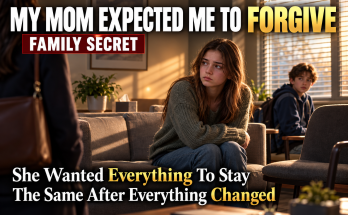
She wore the diamond necklace he had just given her. The table was still set for their fifteenth anniversary. Then she leaned across and kissed her trainer in front of her husband, his mother, and an entire restaurant that fell completely silent.
Part 1
The diamond sat heavy against Claire’s collarbone. Thirty thousand dollars of cold fire catching every candle flame in the private dining room. Richard had presented it with the same quiet formality he used in court—box open, eyes steady, voice low enough that only she could hear the words “fifteen years.”
Claire smiled the way she had practiced in the mirror. She let him fasten the clasp. His fingers brushed the back of her neck, warm and familiar and somehow distant, the same way they had been for the last three years.
Across the table, Richard’s mother, Margaret, raised her glass of Pinot. “To my son and the woman who has stood by him.” The toast landed like a verdict.
Claire lifted her own glass. The wine tasted metallic. She had been counting the minutes since the appetizers arrived, waiting for the moment the evening would either settle into the usual polished performance or fracture.
Her phone vibrated once against her thigh. She did not need to look. She already knew the message. Marcus had texted twenty minutes earlier: Shift ends at nine. You coming?
Marcus. Six months of late afternoons in the empty studio after group classes ended, the smell of rubber mats and his cologne, the way he never asked about her husband. The way she never offered.
Richard was talking about a case settlement. Something about discovery motions and opposing counsel. Claire nodded at the right intervals. She had learned the rhythm years ago—when to murmur agreement, when to look interested, when to touch his hand as if the gesture still meant something.
Margaret’s eyes kept returning to the necklace. “It’s exquisite, Claire. Richard has always had excellent taste.”
Claire’s smile held. She felt the weight of the stones and the weight of the lie sitting side by side on her skin.
The private dining room of Le Jardin was one of Richard’s preferred stages. Soft lighting, white tablecloths, servers who appeared and vanished without sound. Outside the tall windows the city moved in blue and gold streaks. Inside, everything was controlled.
Except Claire.
She had spent the afternoon at the gym the way she always did on Tuesdays and Thursdays. Marcus had spotted her on the final set of deadlifts, his hand light at the small of her back, voice close to her ear. “You’re stronger than you think.” Then the text later: drinks after his shift. The same invitation he had sent a dozen times. Sometimes she answered. Sometimes she didn’t. Tonight she had left the message unanswered.
Richard reached across the table and covered her hand. “You look beautiful.”
She met his eyes. For a second the old affection flickered—fifteen years of shared birthdays, late-night arguments about nothing, the quiet years when they had tried and failed to have a child and then stopped talking about it. The years when his practice grew and her days emptied.
“Thank you,” she said.
Margaret launched into a story about Richard’s father and the first house they had bought. Claire listened with half her attention. The other half tracked the time. 8:47. Marcus’s shift ended in thirteen minutes.
She did not plan what happened next. That was the strange part. There was no decision, no dramatic internal monologue. One moment she was sitting in her anniversary dress with a diamond necklace she had not asked for. The next moment she saw Marcus through the glass partition that separated their private room from the main dining floor.
He was in street clothes, dark jeans and a black shirt, hair still damp from a shower. He had come looking for her. He always did when she left a message unread.
Their eyes met.
Claire stood.
Richard’s hand slid from hers. “Claire?”
She walked around the table. Marcus had already been shown into the room by a confused hostess. He stopped two feet from her chair, uncertainty flickering across his face for the first time in months.
Claire rose onto her toes and kissed him.
Not a polite brush of lips. A full, deliberate kiss that lasted long enough for Margaret’s wine glass to slip from her fingers and shatter against the table edge. Long enough for the low murmur of conversation in the main dining room to die. Long enough for Richard to push his chair back so hard it scraped the floor.
When Claire stepped away, the only sound was the soft drip of red wine onto white linen.
She looked at her husband. His face had gone completely still, the expression he used in court when a witness said something unexpected.
Margaret’s hand was pressed to her mouth. A server stood frozen in the doorway with a water pitcher.
Marcus’s voice was barely a whisper. “Claire—what the hell—”
She did not answer him. She turned back to Richard, the diamond necklace still catching every light in the room, and waited for whatever came next.
Part 2
Richard did not raise his voice. That was the first thing Claire noticed. In fifteen years of marriage she had heard him angry exactly four times, and each time the volume stayed controlled. The danger lived in the quiet.
“Sit down,” he said.
Claire remained standing. Marcus took a half-step backward, hands open at his sides as if someone might accuse him of theft.
Margaret found her voice first. “What on earth is the meaning of this?” The words shook. Wine still dripped from the tablecloth onto the carpet.
A manager appeared in the doorway, face carefully blank. “Is everything all right in here?”
Richard answered without looking away from Claire. “We’re fine. Please give us the room.”
The manager retreated. The glass partition door closed. Outside, diners had resumed talking in lower tones, eyes sliding toward the private room and then away again.
Claire’s heart hammered so hard she could feel it in her throat. She had expected shouting. She had expected Richard to stand, to demand explanations, to order Marcus out. Instead he simply looked at her the way he looked at a contract with a missing clause.
Marcus spoke again, voice rough. “I didn’t know she was— I mean, I knew she was married, but I didn’t think—”
“Stop talking,” Richard said, still quiet. “You are not part of this conversation.”
Marcus glanced at Claire. For six months he had been the one person who never looked at her with expectation or disappointment. Now his expression held both.
Claire finally found words. “I didn’t plan it.”
Richard’s mouth twitched once, almost a smile and then not. “You didn’t plan to kiss your trainer in front of my mother on our anniversary.”
“No.”
Margaret made a small wounded sound. “Richard, we should leave. This is—”
“Mother. Please.” He never raised his voice at her either. Margaret pressed her lips together and stared at the broken glass as if it might reassemble itself.
Claire’s hands were trembling. She pressed them against the sides of her dress. The diamond necklace felt heavier than before, a cold weight reminding her of every careful gift Richard had given over the years—jewelry, trips, the renovated kitchen she had never asked for. Tokens instead of presence.
Marcus took another step back. “I’m going to go.”
Richard’s eyes flicked to him. “Yes. You are.”
Marcus hesitated, looking at Claire one last time. She gave the smallest shake of her head. He turned and left. The door closed behind him with a soft click that felt louder than the shattered glass.
Silence settled over the three of them.
Richard reached for his water glass, took a slow sip, set it down. “How long?”
Claire’s throat tightened. “Six months.”
Margaret closed her eyes.
Richard nodded once, as if confirming a number he had already suspected. “At the gym.”
“Yes.”
“While I was at the office.”
“Yes.”
He looked at the necklace still resting against her skin. “And tonight you decided the appropriate response to a fifteen-year anniversary gift was to demonstrate that fact in public.”
Claire’s voice came out thinner than she intended. “I didn’t decide. It just… happened.”
“Things do not ‘just happen,’ Claire. Not at this level.”
Margaret stood abruptly. “I cannot sit here and listen to this. Richard, take me home.”
Richard did not move. “Mother, the car will take you. I’ll call it now.” He pulled out his phone, spoke two quiet sentences to the driver, then set the phone face down on the tablecloth beside the spreading wine stain.
Margaret gathered her purse with shaking hands. She paused beside Claire’s chair. For a moment it seemed she might speak—some final condemnation or plea. Instead she simply looked at the diamond necklace, then at Claire’s face, and walked out without another word.
The private room felt larger once she was gone. The candles still burned. The shattered glass still glittered on the floor. Outside the partition, the restaurant continued its evening as if nothing irreversible had occurred.
Richard leaned back in his chair. The controlled stillness had not left his face, but something behind the eyes had shifted. “Sit down, Claire.”
This time she did.
He studied her for a long moment. “I am going to ask you questions. I expect honest answers. If you lie, I will know.”
Claire nodded. Her mouth had gone dry.
“Is he the first?”
The question landed harder than she expected. She had prepared herself for anger, for demands about the affair itself. She had not prepared for the quiet inventory of every possible betrayal.
“No,” she said.
Richard’s jaw tightened almost imperceptibly. “How many others?”
“Two. Before him. Years ago.”
He absorbed that the same way he absorbed unfavorable deposition testimony—without visible reaction, filing it away. “And the gym? Was that deliberate? Choosing a place I would never appear?”
Claire’s fingers found the edge of the tablecloth. “At first it was just exercise. Then it became… something else.”
“The thrill of sneaking around,” Richard said, quoting nothing she had spoken aloud, yet somehow knowing. “Did that make it better?”
She flinched. “Yes.”
He looked at the wine stain spreading across the white linen like a slow accusation. “I worked eighty-hour weeks so we could have this life. The house. The cars. The trips you stopped enjoying. The necklace you are still wearing while you tell me you slept with another man for half a year.”
Claire’s hand rose instinctively to the diamonds, then dropped. “I never asked for the hours. I asked for you.”
“You had me.”
“I had a schedule. I had a man who came home after I was already asleep and left before I woke up. I had anniversary dinners that felt like closing arguments.”
Richard’s eyes narrowed slightly. “So this is my fault.”
“I’m not saying that.”
“You are implying it.”
Claire drew a breath that felt insufficient. “I’m saying I was lonely. And then I wasn’t. And then I didn’t know how to stop.”
The candles flickered. Somewhere in the main dining room a server laughed. The ordinary world continued beyond the glass.
Richard reached into his jacket, removed a small black notebook he always carried for case notes, and opened it to a blank page. He wrote something short, tore the page out, and folded it once.
“What is that?” Claire asked.
He slid the paper across the table toward her. “The name of a hotel. Two nights. You will stay there while I decide what happens next. The house key stays with me. Your phone stays with you. Do not contact him. Do not contact my mother. Do not make any decisions about money or accounts. Am I clear?”
Claire stared at the folded paper. The diamond necklace caught the light again, cold and perfect and suddenly unbearable.
“Richard—”
“Am I clear?”
She nodded.
He stood, smoothed his jacket, and looked at her one last time. “Fifteen years, Claire. I thought we were building something that would last. Apparently I was the only one reading the same contract.”
He walked out of the private room without waiting for a reply. The door closed behind him with the same soft finality Marcus’s exit had carried minutes earlier.
Claire sat alone at the ruined table, the $30,000 necklace still around her neck, the taste of another man’s mouth still on her lips, and the folded paper sitting in front of her like a sentence she had not yet begun to read.
Part 3
The hotel was mid-range, the kind Richard chose when he wanted distance without spectacle. Claire checked in under her married name because the reservation was already made. The clerk handed her a key card and a practiced smile that did not reach his eyes. She rode the elevator to the seventh floor carrying only the small clutch she had brought to dinner.
The room smelled of industrial cleaner and faint lavender. She set the clutch on the desk, removed the diamond necklace, and laid it carefully on the bathroom counter. Without its weight her neck felt exposed. She stared at her reflection. The woman looking back still wore the anniversary dress, still had perfect hair and carefully applied makeup that now looked like a costume.
She changed into the hotel robe, sat on the edge of the bed, and finally allowed herself to check her phone.
Three messages from Marcus.
Are you okay?
Claire, what the hell was that?
Call me when you can.
She did not call. Richard’s instruction had been clear. She muted the thread and set the phone face down.
The silence of the room pressed in. She thought about the shattered wine glass, Margaret’s face, the way Richard had written the hotel name with the same precise handwriting he used on legal pads. She thought about the six months with Marcus—the first time he had kissed her in the empty studio after hours, the way secrecy had felt like oxygen after years of careful, airless marriage.
She had told herself it was temporary. A phase. Something that would burn out once the novelty faded. Instead it had deepened. Marcus asked questions Richard no longer asked. He noticed when she was tired. He made her laugh in ways that felt unguarded. And the risk of being discovered had become its own kind of intimacy.
Now the risk had become reality, and the intimacy felt suddenly thin.
Claire slept in short, restless stretches. At 3:17 a.m. she woke to the sound of a text notification. Not Marcus. Richard.
I will be at the house tomorrow at noon. Be there. We need to talk about next steps.
No greeting. No softening. Just the same controlled tone he had used in the restaurant.
She replied with a single word: Okay.
Morning arrived gray and damp. Claire showered, put the anniversary dress back on because she had nothing else, and left the necklace in the hotel safe. Walking into the house without it felt like arriving stripped of evidence.
The house was quiet when she unlocked the door with the spare key she kept in her clutch. Richard had taken the primary set, but she still had this one. The entryway smelled of the citrus cleaner the housekeeper used on Fridays. Everything was in its place—the console table, the framed photographs from their early years, the bowl where Richard dropped his keys every evening.
Claire moved through the rooms like a visitor. In the kitchen she found a single mug in the sink, rinsed and left to dry. Richard had been here after the restaurant. He had come home, made coffee or tea, and left again.
At 11:58 the front door opened.
Richard stepped inside carrying a slim folder. He wore the same suit from the night before, though the shirt was fresh. He set the folder on the kitchen island and looked at her for a long moment without speaking.
“You left the necklace,” he said finally.
“It’s in the hotel safe.”
“Bring it when you leave today. It belongs in the safe deposit box until we decide otherwise.”
Claire nodded. The formality of the instruction made her stomach tighten. This was no longer a marriage conversation. This was the beginning of something procedural.
Richard opened the folder. Inside were printed pages—bank statements, account summaries, a list of shared assets she recognized from their last tax filing. He had worked through the night.
“I am not filing anything yet,” he said. “I want clarity first. About what you want. About what is salvageable. About whether the last six months—or longer—are something we can recover from.”
Claire’s hands rested on the edge of the island. “I don’t know what I want yet.”
“That is not an acceptable answer for the long term. It is acceptable for today.” He turned one of the pages toward her. “These are the joint accounts. I have not moved money. I will not move money without notice. In return, you will not contact the trainer. You will not transfer assets. You will not discuss this with mutual friends until we have a clearer picture. Agreed?”
“Agreed.”
He studied her face. “Did you love him?”
The question arrived without warning. Claire felt heat rise in her cheeks. “I don’t know. I loved the way I felt with him. I loved not feeling invisible.”
Richard’s expression did not change, but something in the set of his shoulders shifted. “Invisible. That is the word you are choosing.”
“It’s the accurate one.”
“I was building a practice that supported this life. The hours were the cost.”
“And I was the one who paid it alone.”
They stood in the kitchen where they had once cooked together on weekends, where they had argued about paint colors and vacation plans and whether to try one more round of fertility treatments. The ordinary history of a marriage sat around them like furniture that no longer fit the room.
Richard closed the folder. “I need time. You need time. The hotel is paid for the rest of the week. After that we will reassess living arrangements. I suggest you speak with someone—a therapist, not a friend who will take sides. I will do the same.”
Claire almost laughed at the clinical tone. “You’re already managing the crisis.”
“It’s what I do.” He picked up the folder. “One more thing. My mother is devastated. She will not contact you. Do not contact her. Whatever happens between us, she is not a weapon or a messenger.”
“I understand.”
Richard walked to the door, then paused. “The kiss. In front of everyone. Was that about him, or about me?”
Claire met his eyes. For the first time since the restaurant she felt the full weight of what she had done—not only the affair, but the public nature of the reveal. “Both,” she said. “I think it was both.”
He nodded once, as if that answer fit the evidence, and left.
Claire stood alone in the kitchen for a long time after the door closed. The house felt larger than it had the day before. She walked upstairs to the bedroom they had shared for twelve years and opened the closet. His suits hung in precise order. Her dresses occupied the other side. She pulled out a pair of jeans and a sweater, changed out of the anniversary dress, and folded it carefully as if it might still be needed for something.
Her phone buzzed again. Marcus.
I need to know you’re okay. Please.
She stared at the message. Richard’s rules were clear. Contact would complicate everything. Yet the part of her that had spent six months choosing secrecy over honesty wanted to answer.
She typed three words and deleted them. Typed them again. Finally she sent:
I can’t talk right now. Give me space.
The reply came almost immediately.
Okay. I’m here when you’re ready.
Claire set the phone down and looked around the bedroom. The life she had been living—the careful surface, the hidden afternoons, the anniversary performance—had cracked open in a single public moment. Now the pieces lay everywhere, and she had no idea which ones she wanted to keep.
Part 4
The second night in the hotel felt longer than the first. Claire ordered room service she barely touched and sat by the window watching traffic lights change color on the street below. She thought about the early years with Richard—the cramped apartment near the law school, the way he used to read briefs out loud while she cooked, the night he proposed with a simple band and a promise that they would build something solid together.
Solid had become the problem. Solid had become rigid. Solid had become a structure that left no room for the person she had grown into while he was building his practice.
On the third morning she returned to the house to collect more clothes and the diamond necklace from the hotel safe as instructed. Richard was not there. A note on the kitchen island in his precise handwriting read: Therapist recommendation on the counter. First available appointment is Thursday 2 p.m. I have one at the same time with someone else. We will compare notes after if you choose.
Claire almost smiled at the efficiency. Even in crisis, Richard organized.
She took the recommendation, packed a small suitcase, and drove to the gym.
She did not plan to see Marcus. She told herself she needed the routine, the physical exhaustion, the familiar machines. The front desk clerk greeted her by name. The afternoon class was in progress. Marcus was not on the floor.
Claire changed and worked through a full circuit alone. Halfway through the deadlifts she felt the absence of his hand at her back like a missing limb. She finished the set, showered, and was walking toward the exit when he appeared from the staff hallway.
He stopped when he saw her. For a moment neither of them spoke.
“You shouldn’t be here,” he said finally.
“I pay membership dues.”
“That’s not what I mean.”
Claire looked at him—the same athletic frame, the same easy confidence that had once felt like freedom. Now it felt complicated. “Richard knows everything. He’s not filing yet. He wants time.”
Marcus ran a hand through his hair. “And what do you want?”
“I don’t know.”
“Claire.” He stepped closer, voice low. “That kiss—at the restaurant—what was that? Because it didn’t feel like you were choosing me. It felt like you were burning something down.”
The accuracy of the observation stung. She had not kissed him to claim him. She had kissed him to make the secret impossible to keep.
“I needed it to be real,” she said. “Not just something that happened in empty rooms after closing.”
Marcus’s jaw tightened. “So you used me to force the issue.”
“I used both of us.”
A group of members passed, laughing about something. Marcus waited until they were gone. “I’ve been thinking about the last six months. I knew you were married. I told myself it was your choice to make. But watching your husband’s face that night—I don’t know if I can keep being the guy who wrecks other people’s lives.”
Claire felt something cold settle in her chest. “Are you ending this?”
“I’m saying I need to know what this is. If you’re leaving him for me, say it. If you’re using me to leave him and then figure the rest out later, I need to know that too. I’m thirty-four. I don’t want to be a temporary exit strategy.”
The words landed with unexpected weight. Claire had never framed the affair in those terms, yet she could not deny the shape of them. Marcus had been the place she went when the marriage felt airless. She had not asked herself what he wanted beyond the next stolen hour.
“I don’t have an answer yet,” she said.
“Then maybe you shouldn’t come here for a while.” His voice was steady, but his eyes were not. “Give yourself the space your husband asked for. Give me the same.”
Claire nodded. She walked out of the gym without looking back. In the parking lot she sat in her car for ten minutes before starting the engine. The diamond necklace was still in the hotel safe. The house key was in her purse. The marriage was in some undefined holding pattern. And the man who had made her feel seen for six months had just asked her to stay away until she knew what she actually wanted.
She drove back to the hotel with the windows down, the late afternoon air cool against her face. For the first time since the restaurant she allowed herself to cry—not the dramatic sobs of a woman undone, but the quiet, exhausted tears of someone who had set a fire and was only now feeling the heat.
That evening she opened her laptop and searched for the therapist Richard had recommended. The profile was professional, neutral, focused on couples in transition and individual identity work. Claire booked the Thursday appointment. Then she sat with the cursor blinking in a blank email draft addressed to no one and tried to write the truth of the last six months in a way that made sense.
She deleted every attempt.
Around nine her phone rang. Richard.
“I’m not calling to discuss us,” he said without preamble. “I’m calling because the firm’s annual partner dinner is next Friday. Your name is on the RSVP list. I need to know whether you will attend as my wife or whether I should update the seating.”
The question was pure Richard—practical, forward-looking, already accounting for optics.
Claire closed her eyes. “I don’t know yet.”
“I need an answer by Monday. The firm notices these things.”
“I understand.”
A pause. Then, quieter: “Are you all right?”
The simple question nearly undid her. “No. But I’m managing.”
“So am I.” Another pause. “The necklace is still in the hotel safe?”
“Yes.”
“Good. Keep it there for now.” He cleared his throat. “I’ll speak with you Monday about the dinner. Good night, Claire.”
“Good night.”
After he hung up she sat in the quiet hotel room and realized that the most intimate exchange they had shared in months had just occurred over a logistics call about a partner dinner. The irony was almost enough to make her laugh. Instead she turned off the light and lay in the dark, listening to the distant sound of the city and wondering how two people who had once promised each other forever had arrived at a place where forever needed a calendar invitation and a seating chart.
Part 5
Thursday’s therapy session took place in a calm office with soft chairs and a box of tissues placed strategically within reach. Claire sat across from Dr. Elena Vargas, a woman in her fifties with kind eyes and a notebook she rarely opened.
“Richard suggested I come,” Claire said. “He has his own appointment at the same time.”
Dr. Vargas nodded. “That’s common when both people are still trying to understand the landscape. Tell me what brought you here in your own words.”
Claire told the story in pieces—the long hours, the quiet house, the gym, Marcus, the anniversary dinner, the kiss. She did not dramatize. She simply laid out the facts the way Richard might have laid out a timeline in court.
When she finished, Dr. Vargas was quiet for a moment. “You described the kiss as something that ‘just happened.’ Do you believe that?”
Claire considered. “No. I think some part of me needed the secret to end. I just didn’t choose a private way to end it.”
“What would a private ending have looked like?”
“Telling Richard at home. Ending things with Marcus cleanly. Sitting with the consequences without an audience.”
“And instead you chose the most public possible moment.”
Claire’s throat tightened. “I think I wanted him to feel it the way I had been feeling it—sudden, exposed, impossible to ignore.”
Dr. Vargas did not write anything down. “Loneliness in a marriage can become its own kind of identity. When someone else starts filling the space, the contrast is powerful. The question becomes whether the new connection is about the other person or about the relief of no longer being alone.”
Claire thought of Marcus’s words at the gym. I don’t want to be a temporary exit strategy.
“I don’t know which one it was,” she admitted.
“That’s honest. Honesty is a starting point.” Dr. Vargas leaned forward slightly. “You and Richard have fifteen years of shared history. That history includes both care and distance. The work now is deciding whether the care is still strong enough to rebuild on, or whether the distance has become the defining feature. Neither answer is a moral failure. Both require clarity.”
Claire left the office with a homework assignment: write two lists without editing. One titled “What I needed that I wasn’t receiving.” One titled “What I gave that may have been insufficient.” No audience. No performance. Just the lists.
She did the exercise that evening in the hotel room. The first list came easily—presence, curiosity, shared quiet time, being chosen when it was not convenient. The second list was harder. She had stopped initiating conversations that were not logistical. She had stopped asking about his cases in any depth. She had built a parallel life at the gym and then protected it with silence. She had accepted the necklace and the trips and the house as substitutes for the thing she actually wanted, and then resented the substitution.
When she finished, she sat with both pages in front of her and felt the uncomfortable recognition that the affair had not appeared out of nowhere. It had grown in the space both of them had allowed to empty.
Friday morning Richard texted: Partner dinner decision needed by end of day Monday. Also, the housekeeper comes Tuesday. Let me know if you need anything from the house before then.
Claire replied: I’ll have an answer Monday. I don’t need anything right now.
She spent the weekend in a strange limbo. She walked through a nearby park. She read half a novel without retaining any of it. She ignored two more messages from Marcus that simply said Thinking about you and Hope you’re okay. She did not reply.
On Sunday evening she drove past the house. The lights were on downstairs. Richard’s car was in the driveway. She did not stop. She circled the block once and returned to the hotel, the image of the lit windows staying with her like a question she was not ready to answer.
Monday morning she sat in the hotel restaurant with a cup of coffee and finally made the decision about the partner dinner. She texted Richard:
I will not attend. It would be dishonest to sit there as if nothing has changed. Update the seating.
His reply came twelve minutes later.
Understood. Thank you for the clarity.
No further comment. No pressure. Just acknowledgment.
Claire stared at the message and realized that clarity, once given, created its own momentum. She had closed one door. Others remained open, and the draft moving through them was beginning to feel less like chaos and more like the beginning of a shape she might eventually recognize.
That afternoon she returned to Dr. Vargas for a second session. This time she brought the two lists. They talked about the difference between loneliness and abandonment, between desire and escape, between the person she had been at twenty-five when she married Richard and the person she had become at forty while he was building a career that left little room for the marriage to breathe.
“You keep using the word ‘invisible,’” Dr. Vargas observed. “What would it look like to be visible to Richard again? Not the corrected version of yourself. The actual one.”
Claire did not have an answer. But for the first time the question felt like something she might eventually be able to explore rather than a door that had already closed.
Part 6
Two weeks after the anniversary dinner, Claire moved out of the hotel and into a short-term furnished apartment Richard found through a colleague. The arrangement was practical: she had space, he retained the house, neither of them had yet spoken the word divorce. Bank accounts remained joint. The diamond necklace stayed in the safe deposit box. Life continued in a carefully managed pause.
Marcus stopped texting. Claire stopped going to the gym. She found a different studio across town where no one knew her name and the instructors did not linger after class. The physical routine helped. The anonymity helped more.
Richard requested a joint session with Dr. Vargas. Claire agreed. They sat on opposite ends of the same couch while the therapist moderated a conversation that felt both intimate and formal.
Richard spoke first. “I did not know she felt invisible. I thought the life we were building was the point. The hours were the price. I assumed she understood the trade.”
Claire listened without interrupting. When it was her turn she said, “I stopped asking for what I needed because every request felt like an accusation against the career that supported us. So I stopped requesting and started disappearing instead.”
Dr. Vargas guided them through the early years, the fertility struggles that had quietly calcified into silence, the way both of them had begun performing the role of spouse rather than inhabiting it. Neither of them cried. The session ended with an agreement to continue individual work and to revisit the question of the marriage in thirty days.
In the parking lot afterward Richard stood beside his car and looked at Claire across the roof. “The partner dinner went forward without you. People asked. I said you were dealing with a family matter. It was not entirely a lie.”
Claire almost smiled. “Your mother still won’t speak to me.”
“She’s protective. Give it time. Or don’t. That’s her choice as much as yours.”
They stood in the cool evening air with the awkwardness of people who had once shared a bed and now shared only a therapist’s waiting room.
“Are you seeing him?” Richard asked.
“No. He asked for space until I knew what I wanted. I haven’t contacted him.”
Richard nodded. “I’m not seeing anyone. In case that matters.”
“It does.”
He unlocked his car. “Thirty days. We’ll talk again.”
Claire drove back to the furnished apartment and sat on the unfamiliar couch with a glass of water, replaying the session. The honesty had felt cleaner than the years of careful avoidance. It had also felt exhausting. Truth, once invited in, did not leave quietly.
The following week she received an email from the law firm’s events coordinator confirming that her name had been removed from future partner functions until further notice. The bureaucratic language made the separation feel more real than any conversation had. She was still married on paper. In the social architecture of Richard’s professional life she had already become a pending item.
She called her older sister in Portland, the only family member she had told. The conversation lasted two hours. Her sister listened, asked practical questions about money and living arrangements, and then said the thing Claire had been avoiding: “You kissed another man in front of your husband and his mother on your anniversary. That’s not a cry for help. That’s a declaration. The question is whether you declared the end of the marriage or the start of a different version of it.”
Claire had no answer. She hung up and walked the three blocks to a small park where children played under the early evening light. She sat on a bench and watched a father lift his daughter onto a swing. The ordinary tenderness of the moment made her chest ache. She and Richard had wanted that once. When it did not happen they had never fully grieved it together. They had simply moved the silence to a different room.
On the twenty-ninth day of the agreed pause, Richard texted.
Dinner tomorrow. Neutral location. No decisions required. Just conversation.
Claire replied: Yes.
They met at a quiet Italian place neither of them had been to before. Richard wore a sweater instead of a suit. Claire wore jeans and a blouse that did not try to impress. They ordered pasta and wine and sat with the menus between them like temporary shields.
“I’ve been thinking about the necklace,” Richard said after the waiter left. “I chose it because it was the most expensive thing in the case. I thought value equaled meaning. I see now that it was another substitute.”
Claire looked at him. The admission cost him something. She could see it in the way he held his glass.
“I kept accepting the substitutes,” she said. “That was my part.”
They talked for two hours. Not about Marcus. Not about divorce lawyers. About the early apartment, the first house, the year Richard made partner and came home at midnight for three months straight. About the way Claire had filled the empty evenings with classes and then with a person who made her feel chosen. About the fear that fifteen years might be too much history to salvage and the equal fear that walking away would mean admitting the entire structure had been hollow.
When the check came Richard paid without discussion. Outside on the sidewalk he said, “I don’t know if we can fix this. But I know I don’t want the next conversation to happen through attorneys if we can help it.”
Claire nodded. “Neither do I.”
He walked her to her car. For a moment it seemed he might reach for her hand. He didn’t. He simply said, “Drive safe,” and waited until she pulled away before walking to his own vehicle.
Claire drove back to the furnished apartment with the windows down again. The night air smelled of rain that had not yet fallen. She parked, sat in the car for several minutes, and then went inside. On the kitchen counter she placed the two lists from therapy side by side and added a third page titled simply: What I still want.
The first line she wrote was: To be known.
The second: To stop performing.
She left the rest blank for now. Some truths required more time than a single evening could give.
Part 7
The thirty-day mark passed without a dramatic decision. Instead, Claire and Richard settled into a strange new routine of weekly dinners at neutral restaurants and separate therapy sessions that occasionally overlapped in joint meetings. They did not move back in together. They did not separate accounts. They existed in a deliberate in-between that felt both fragile and necessary.
Marcus resurfaced once. A text at 11:40 on a Tuesday night:
I saw you at the other gym last week. You looked okay. I’m glad. I’m not going to keep reaching out. I just wanted you to know I don’t regret the time. I regret the way it ended for everyone else.
Claire read the message three times. She typed a reply, deleted it, and finally sent:
Thank you for saying that. Take care of yourself.
He did not respond. The thread went quiet for good.
In therapy Dr. Vargas asked Claire what she missed most about the marriage when she removed the loneliness from the equation. Claire thought for a long time.
“The way he remembers details,” she said finally. “Birthdays of people I mention once. The brand of tea I like when I’m sick. The fact that I hate the sound of plastic utensils. He files people the way he files cases—carefully, thoroughly. I used to find it distant. Now I think it was his version of care.”
“And what do you think he misses?”
Claire almost smiled. “Probably the version of me who used to wait up. Who asked about his day without checking the clock. Who didn’t need a crisis to become honest.”
They were rebuilding something, but neither of them could yet name what it was. Not the old marriage. Not a clean break. Something slower and more deliberate, with clearer language and fewer assumptions.
Richard’s mother remained distant. Claire sent a short handwritten note that simply said she was sorry for the pain caused at the restaurant and that she hoped, in time, there might be room for a different conversation. Margaret did not reply. Richard reported that his mother had read the note and placed it in a drawer. Progress, of a sort.
One evening in the sixth week Richard arrived at dinner with a small box. Claire’s stomach tightened. He saw her expression and shook his head.
“It’s not jewelry. Open it.”
Inside was a key. Not to the house. To a storage unit.
“I cleared out the guest room closet,” he said. “Your winter coats, the boxes of old photos, the things you said you wanted to sort through someday. They’re there if you want them. No pressure. Just available.”
Claire held the key. The gesture was practical and strangely tender. Richard had always solved problems by organizing them. This was his way of saying the past was still accessible even if the present remained uncertain.
“Thank you,” she said.
They talked that night about the fertility years—the appointments, the quiet grief neither of them had fully voiced, the way they had closed the door on the subject without ever walking through the room together. Richard admitted he had thrown himself into work partly to avoid the silence that followed each negative test. Claire admitted she had stopped initiating closeness because every intimate moment felt haunted by what had not happened.
The conversation left them both raw. They sat in the restaurant parking lot afterward with the engine off and the city lights blurred by a light rain.
“I don’t know if we get a second version of this,” Richard said. “But I know I don’t want the first version to be the only story we tell about us.”
Claire looked at him in the dim light. The controlled attorney face was gone. In its place was a man who looked tired and hopeful and still carefully measured.
“Neither do I,” she said.
They did not kiss. They did not make promises. They simply sat with the possibility that the marriage might still contain rooms they had never fully entered, and that entering them would require a different kind of courage than the courage it had taken to kiss someone else in a crowded restaurant.
Claire drove home to the furnished apartment and placed the storage key on the counter beside the three lists. The page titled What I still want now had several more lines:
To be known.
To stop performing.
To grieve the things we never said.
To find out if care can grow back in the same soil.
She did not add Marcus’s name. She did not add the diamond necklace. Some objects and some people belonged to the version of the story that had already ended. The new version, if it existed, would have to be built from quieter materials.
Part 8
By the third month the temporary apartment had begun to feel less temporary. Claire bought a better coffee maker. She hung two prints on the wall. She stopped living out of a suitcase. The changes were small, but they signaled something: she was no longer waiting for a single decisive moment to tell her who she was supposed to be next.
Richard noticed. At one of their weekly dinners he said, “You seem steadier.”
“I feel steadier. Therapy helps. Time helps. Not performing helps most of all.”
He nodded. “I’ve been thinking about the house. It’s too large for one person. I’ve looked at a smaller place closer to the office. If we decide to formalize a separation, the timing would make sense. If we decide something else, the conversation about living arrangements will need to happen anyway.”
Claire set down her fork. “Are you asking me to move back, or are you preparing for me not to?”
“I’m preparing for either outcome to be intentional rather than accidental.”
The honesty was almost startling. The old Richard would have made a decision and presented it as the reasonable path. This version was leaving space.
“I’m not ready to move back,” Claire said. “Not yet. Maybe not ever. But I’m also not ready to call a lawyer. Can both of those things be true at the same time?”
“They can.”
They finished the meal talking about safer subjects—his current case, a book she was reading, the weather. The ordinary topics felt less like avoidance and more like practice. They were learning how to be in the same space without the old scripts.
The following week Dr. Vargas suggested a different exercise for a joint session. Each of them was to write a letter to the other that would never be sent—an unedited accounting of what they had needed, what they had feared, and what they still hoped for. They wrote in silence for twenty minutes, then read the letters aloud to each other while the therapist listened.
Richard’s letter was precise and more vulnerable than Claire had expected. He wrote about the fear that if he slowed down the practice would suffer and the life he had built for them would erode. He wrote about the shame of not knowing how to talk about the failed fertility treatments. He wrote about watching Claire grow quieter over the years and choosing to interpret the quiet as contentment rather than withdrawal because contentment required nothing from him.
Claire’s letter was less structured. She wrote about the loneliness of being married to a man who was always almost home. She wrote about the way Marcus had made her feel chosen in small, daily ways that required no grand gestures. She wrote about the anniversary dinner and the kiss as an act of desperation disguised as defiance. She wrote that she did not know if she still loved Richard in the way she once had, but she knew she respected the man who was willing to sit in a therapist’s office and read a letter that admitted fear.
When they finished, the room was quiet for a long time.
Dr. Vargas spoke first. “You both described versions of the same wound—distance that grew while both of you told yourselves it was temporary or necessary or simply the cost of the life you wanted. The question now is whether you want to keep tending that wound separately or whether you want to try tending it together with different tools.”
Neither of them answered immediately. Claire looked at Richard. He looked back. Something passed between them that was not resolution and not despair. It was recognition.
After the session they walked to their cars in silence. At the edge of the parking lot Richard stopped.
“The storage unit,” he said. “If you want help sorting the boxes, I can make time. No agenda. Just the photos and the old coats.”
Claire considered. “I’d like that. This weekend?”
“Saturday morning.”
They parted without touching. Claire drove home with the letter still folded in her purse. She did not reread it. She already knew what it said. The act of speaking it aloud in front of him had been the point.
Saturday arrived cool and clear. They met at the storage facility, unlocked the unit, and spent three hours opening boxes. Old photographs from the early years. A sweater Claire had forgotten she owned. A box of holiday cards from people they no longer saw. Richard held up a picture from their first apartment—Claire in an oversized sweatshirt, Richard with longer hair, both of them laughing at something outside the frame.
“We look like we knew what we were doing,” he said.
“We had no idea,” Claire answered.
They laughed, and the sound felt foreign and welcome at the same time.
When they locked the unit again Richard handed her a smaller box he had set aside. “These are the letters you wrote me when I was studying for the bar. I found them in the guest room desk. I thought you might want them. Or not. Your choice.”
Claire took the box. Inside were envelopes in her own handwriting, the paper slightly yellowed. She had forgotten the intensity of those early letters—the belief that they could build anything as long as they built it together.
“Thank you,” she said.
Richard closed the storage unit door. “I meant what I said about the smaller place. I’m going to look at one next week. If you want to see it, you can. If you don’t, that’s fine too.”
Claire nodded. The offer sat between them without demand. For the first time in months she felt the possibility of a future that was not defined solely by what had broken.
Part 9
The smaller place Richard found was a two-bedroom condominium with good light and a view of the river. Claire walked through it with him on a Thursday afternoon. She did not pretend it was their future home. She simply noticed the way he measured the rooms with his eyes, the same way he had once measured the potential of a case.
“It’s practical,” she said.
“It’s a starting point,” he answered. “For whatever comes next.”
They stood in the empty living room with the real estate agent waiting discreetly in the hallway. Claire looked at the light on the floor and thought about the furnished apartment, the house that had become too large, the storage unit full of evidence of a life they had both half-abandoned.
“I still don’t know if I can move back into a shared life with you,” she said quietly. “But I also don’t know if I’m ready to close the door.”
Richard’s hands were in his pockets. “Then we leave the door open and we stop pretending the hallway is a destination.”
The agent cleared her throat. Richard told her they would be in touch. Outside on the sidewalk he asked if Claire wanted coffee. She said yes.
They sat at a small table by the window of a nearby café. The conversation turned, inevitably, to the night at Le Jardin.
“I’ve replayed it more times than I can count,” Richard said. “The glass breaking. My mother’s face. The way you looked at me after. I keep trying to locate the exact moment I lost the right to be surprised.”
Claire wrapped her hands around the cup. “There wasn’t one moment. It was a hundred small ones. You working late. Me stopping asking. Both of us deciding the other one was fine because it was easier than checking.”
“And him.”
“And him,” she agreed. “He was the symptom and the accelerant. Not the disease.”
Richard was quiet for a while. Then: “I read the letters you wrote during the bar exam week. All of them. You believed in us so completely. I want to know if any part of that belief is still available, or if it belongs only to the people in those photographs.”
Claire met his eyes. “Some of it is still here. It’s quieter. It’s more cautious. But it’s not gone.”
He nodded slowly. “That’s more than I expected. It’s enough to keep working with.”
They finished their coffee and walked back to their separate cars. The air between them felt less charged than it had in the restaurant that night, less brittle than it had in the early weeks of separation. Something had softened. Not resolved. Softened.
That evening Claire sat in her apartment and opened the box of old letters. She read three of them. The handwriting was hers, but the certainty felt like it belonged to a stranger. She set them aside and opened her laptop. For the first time since the anniversary she typed a message to Marcus that was not a reaction or a boundary.
I hope you’re well. I’ve been doing a lot of work on myself and on what the last year meant. I won’t contact you again after this. I just wanted to say that the way things ended was unfair to you, and I’m sorry for my part in that. Take care.
She sent it before she could revise it into something safer. The reply came two hours later.
Thank you for saying it. I hope you find whatever you’re looking for. No hard feelings from my side. Really.
Claire read the message, felt the finality of it settle, and closed the thread. Some doors needed to be shut with intention rather than left to drift.
The following week she and Richard had another joint session. Dr. Vargas asked them what they were most afraid would happen if they tried to rebuild.
Richard spoke first. “That we’ll recreate the same distance with better language and call it progress.”
Claire said, “That I’ll mistake familiarity for love and stay because leaving feels too large.”
Dr. Vargas nodded. “Both fears are useful. They keep you honest. The work is to build something that can hold both the history and the people you are now—not the people you were at twenty-five, and not the people who were performing for each other three months ago.”
They left the office with a new agreement: continued individual therapy, bi-weekly joint sessions, and a shared commitment to name needs before resentment had time to grow around them. No timeline for moving back in together. No pressure to define the relationship as marriage-in-repair or marriage-in-exit. Just the ongoing practice of telling the truth in real time.
Claire drove home through light rain. At a red light she caught her reflection in the rearview mirror. The woman looking back did not look like someone who had kissed her trainer in a crowded restaurant to force a crisis. She looked like someone who was slowly learning how to live without the crisis as a compass.
The light turned green. She drove on.

Part 10
Four months after the anniversary dinner, Claire stood in the entryway of the house she and Richard had shared for twelve years. The diamond necklace was no longer in a safe deposit box. It sat in a velvet pouch on the console table, waiting for a decision neither of them had rushed.
Richard came down the stairs carrying two mugs of tea. He handed her one. They had spent the morning packing the last of the items she wanted for the condominium he had purchased—the smaller place with the river view. Claire was not moving in with him. Not yet. Possibly not ever. But she had agreed to keep a key, to spend weekends when it felt natural, to let the shape of their relationship continue evolving without forcing it into a single category.
“Margaret called,” Richard said. “She asked if you would come to dinner next month. Just the three of us. No performance required.”
Claire held the warm mug. “Tell her yes. Tell her I’m still sorry, and that I’d like to try again slowly.”
He nodded. “I will.”
They walked through the house together one last time as its primary residents. The walls held the echo of arguments and quiet mornings and the long stretch of years when they had stopped seeing each other clearly. Claire paused in the kitchen doorway.
“I used to think the kiss was the worst thing I did,” she said. “Now I think the worst thing was everything that came before it—the years of not saying what I needed, the way I let loneliness become a secret identity. The kiss just made it impossible to keep pretending.”
Richard leaned against the counter. “I spent those same years telling myself that providing was the same as being present. I was wrong. I’m still learning how wrong.”
They stood in the quiet kitchen with the tea cooling in their hands. Outside, the late afternoon light slanted across the backyard where they had once talked about children who never arrived. The grief of that absence had finally been spoken aloud in therapy, named, given room. It had not disappeared. It had simply stopped living only in the silence between them.
Claire set her mug down and picked up the velvet pouch. She opened it. The diamonds caught the light the way they had on the night everything changed. She held the necklace for a moment, feeling its weight, then placed it back in the pouch and held it out to Richard.
“I don’t want this as a symbol of what we were trying to be,” she said. “If we keep going—whatever form that takes—I want the next things we give each other to mean something we can both stand inside.”
Richard took the pouch. “I’ll put it away. Properly this time. Not as a substitute.”
They locked the house and walked to their separate cars. At the curb Richard paused.
“The condominium has a second bedroom set up if you ever want to stay without it meaning everything. No assumptions. Just a place that isn’t temporary.”
Claire smiled, small and real. “I’ll keep that in mind.”
He hesitated, then reached out and touched her hand—brief, deliberate, without demand. “I’m glad you kissed him in that restaurant.”
She looked at him, startled.
“Not because of the pain,” he said. “Because it forced both of us to stop performing. I don’t know who we become from here. But I know I’d rather find out honestly than keep living the polished version.”
Claire felt the truth of the words settle somewhere deep. “So would I.”
They parted without promises of forever. Forever, they had learned, was too large a word for people who were still learning how to be present for a single ordinary evening. What they had instead was a series of smaller agreements: to keep talking, to keep telling the truth even when it was unflattering, to let the relationship become whatever it could honestly be.
Claire drove toward the furnished apartment that no longer felt like exile. The city moved around her in its usual indifferent rhythm. Somewhere across town Marcus was living his own life, no longer a secret or a weapon or a symbol. Somewhere behind her the house waited for new occupants. Somewhere ahead the condominium with the river view held a second bedroom and a key she had not yet used.
She parked, walked upstairs, and set her bag by the door. On the counter the three lists from the early weeks of therapy still lay under a magnet on the refrigerator. She took down the page titled What I still want and added one final line in ink that did not shake:
To keep choosing honesty over the comfort of being almost known.
Claire stood in the quiet apartment as evening settled in. The diamond necklace was gone from her life as a performance piece. The trainer was gone as a parallel existence. The marriage was no longer a contract written in assumptions. What remained was slower, less dramatic, and somehow more real—the ongoing work of two people who had broken something public and were now attempting, without guarantees, to build something private that might actually hold.
She turned on a lamp. She made a simple dinner. She did not check her phone for messages that needed to force a crisis. For the first time in years the evening belonged entirely to her, and the silence did not feel like absence. It felt like space.
And space, she was learning, was where the next true thing could finally begin.