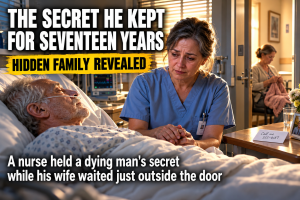
In thirty-one years of nursing I thought I had heard every kind of deathbed confession. Most faded by morning. One stayed with me forever—the man in room 614 who asked me to close the door and told me about a second family waiting in Kentucky, while his wife knitted a blanket just down the hall for the bed he was dying in.
Part 1
In thirty-one years of nursing I heard a lot of deathbed confessions. Most of them I forgot by morning. One I never will.
The night it happened started like so many others on the sixth floor. Fluorescent lights hummed above the nurses’ station. The air smelled of antiseptic and strong coffee that had sat too long. My shift had already stretched past twelve hours, and my feet ached in the way they always did after midnight. Room 614 had been quiet most of the evening. The patient, a man named Harold Whitaker, seventy-four years old, was fading. His chart said congestive heart failure, kidneys failing, everything slowing down the way it does when the body finally decides it has had enough.
I stepped in to check his vitals around one-thirty. The door was half open. The television was off. The only sound was the soft beep of the monitor and the occasional whisper of oxygen through the nasal cannula. Harold’s eyes were open. They found me the moment I crossed the threshold.
“Close the door,” he said. His voice was thin, but it still carried.
I did. The latch clicked softly behind me.
He looked smaller than he had the day before. The hospital gown hung loose on his shoulders. His hands rested on the blanket, fingers slightly curled as if they still remembered work. He had been a carpenter once. The calluses were still there, faded but present.
“I need to tell you something,” he said.
I pulled a chair closer and sat. Nurses learn early that when a patient asks for the door to be closed, the words that follow are rarely about the weather or the food.
“I have a family in Kentucky,” he said. “A woman. Two children. A house with a red mailbox.”
He paused, breathing carefully.
“Seventeen years.”
The words settled between us like something heavy that neither of us wanted to move.
I glanced toward the door. Beyond it, in the waiting room at the end of the hall, his wife sat with their two grandchildren. She had been knitting the same soft blue blanket for three days. Every time I passed, the needles clicked in steady rhythm. She never asked many questions. She just stayed.
Harold’s eyes followed my glance.
“She doesn’t know,” he said. “None of them do.”
I waited. The monitor kept its quiet rhythm.
“I met her when I was working a job down there. Thought it would be temporary. Then it wasn’t. The kids… they call me Dad. They don’t know about this life. About her.” He swallowed. “I kept meaning to end it. Or tell the truth. I never did either.”
His hand shifted on the blanket. I took it without thinking. His skin was cool and dry.
“Promise me you’ll never tell,” he said.
I looked at him for a long moment. Thirty-one years of nursing had taught me that some promises are easy. This one was not.
“I can’t promise that,” I said. “But I won’t go looking for trouble either.”
He held my gaze a second longer, then closed his eyes. The tension in his face eased a little, as if the confession itself had taken something from him he could no longer carry.
I stayed until his breathing evened into something closer to sleep. When I finally stood, the hallway felt colder than it should have.
At the nurses’ station I wrote a note in the chart that meant nothing to anyone else: “Patient restless. Emotional support provided.” Then I poured another cup of coffee I did not want and waited for the night to finish whatever it had started.
He died at 3 a.m. The monitor went flat while I was still in the room. I called the time, notified the charge nurse, and stepped into the hall to find his wife.
She was still knitting.
I told her as gently as I knew how. She set the needles down, folded the unfinished blanket carefully across her lap, and nodded once. The grandchildren, a boy of about ten and a girl a few years younger, looked up from their phones with the confused quiet that children wear when adults speak in soft voices.
“Can I see him?” she asked.
I walked her back to the room. She stood beside the bed for a long time without touching him. Then she smoothed the sheet over his chest the way someone smooths a tablecloth before guests arrive.
Dawn came slowly through the blinds. The sky outside turned the color of old paper. While she packed his things into a small duffel bag—slippers, a paperback novel, a pair of reading glasses—her hand brushed something in the inside pocket of his wallet.
She pulled it out. A scrap of paper, folded small, the edges soft from being carried too long. A phone number written in careful block letters. No name.
She held it up between two fingers and looked at me.
“Do you know who this belongs to?”
I knew exactly who it belonged to.
I looked at her face and felt the weight of the closed door from hours earlier settle across my shoulders all over again.
Part 2
The paper looked ordinary. White, slightly yellowed at the crease, the kind of scrap someone tears from a notepad without thinking. The numbers were written in a steady hand. Harold’s hand, I was certain. He had the careful writing of a man who measured twice before he cut.
Mrs. Whitaker—Margaret, she had told me to call her on the first day—kept her eyes on my face. The grandchildren had been taken to the cafeteria by a kind aide who understood that some conversations needed space. The room felt larger without them and somehow smaller at the same time.
“I don’t recognize it,” I said. The words came out even. Thirty-one years had taught me how to keep my voice steady when the truth was anything but.
She studied the number a moment longer, then slipped it into the side pocket of her purse. “Maybe an old coworker. Or a doctor from somewhere.” She tried a small smile that did not reach her eyes. “Harold kept everything. Receipts from 1987. Business cards from people he met once.”
I helped her finish packing. The paperback went in next to the glasses. A half-empty bottle of cologne that still smelled faintly of cedar. The unfinished blue blanket she folded with deliberate care and placed on top of everything else, as if it might still be needed.
When the bag was zipped, she stood in the middle of the room and looked at the empty bed.
“He was a good man,” she said. “Most of the time.”
I did not answer. There was nothing useful to say.
She left with the bag and the quiet dignity of someone who had already begun the long work of rearranging a life. I watched her walk down the hall until the elevator doors closed behind her. Then I returned to the nurses’ station and wrote the final notes in Harold’s chart. Time of death. Personal effects released to next of kin. Nothing about Kentucky. Nothing about a red mailbox. Nothing about the number that still lived in the side pocket of a widow’s purse.
The rest of the shift passed in the usual blur of medications and call lights. By the time I clocked out, the sun was fully up and the day shift was already moving through the halls with the bright energy of people who had slept. I drove home with the radio off. The confession sat in the passenger seat like an uninvited guest who refused to leave.
At home I made toast I did not eat and sat at the kitchen table staring at the phone. The number was still in my head. I had not written it down, but I had seen it clearly enough when Margaret held it up. Area code 270. Kentucky. Western part of the state, if I remembered right.
I told myself it was none of my business. Harold had asked me not to tell. I had not promised, but I had also not volunteered. The secret was his to keep or release. Now that he was gone, it belonged to the living in ways I did not want to measure.
Still, the image of the red mailbox would not leave me. I could almost see it at the end of a gravel driveway, paint faded by sun and rain, a place where someone waited for a man who would never come home again.
I went to bed with the curtains drawn and slept poorly. When I woke in the late afternoon, the first thing I thought of was the folded paper and the question Margaret had asked with such quiet trust.
Do you know who this belongs to?
I had looked at her face and chosen silence. The choice felt heavier in daylight than it had in the soft dark of the hospital room.
That evening I pulled an old atlas from the bookshelf and found Kentucky. The map was outdated, but the counties were still there. I traced a finger along the western edge and wondered which small town held a house with a red mailbox and two children who called a dead man Dad.
I closed the atlas and put it away. Then I made a cup of tea and tried to convince myself that some stories were better left unfinished.
The phone rang just after eight. It was the hospital. A scheduling mix-up. Someone needed coverage for the night shift two days from now. I said yes because saying no felt like one more complicated decision I did not have the strength for.
When I hung up, the quiet of the house pressed in. I thought of Margaret packing the duffel bag at dawn. I thought of the grandchildren who would grow up with only one version of their grandfather. And somewhere in Kentucky, I thought of a woman who did not yet know that the man she loved had stopped breathing at 3 a.m. in a hospital bed six hundred miles away.
The number was still in my head. I had not written it down. I told myself that meant I could still choose not to use it.
I went to bed early and dreamed of red mailboxes standing empty under a gray sky.
Part 3
Two days later I was back on the sixth floor. The room that had been 614 was already occupied by someone else. A different name on the whiteboard. A different set of flowers on the windowsill. Hospitals move quickly when the living need the space.
Margaret called the nurses’ station that afternoon. Her voice was steady, the kind of steady that comes from practicing the words beforehand.
“I found something else,” she said. “In the glove box of his truck. A small notebook. Addresses. Dates. Nothing that makes sense to me.”
I asked if she wanted me to look at it. She hesitated, then said she would bring it by the next day if I was working. I told her I would be there.
When she arrived the following morning, the notebook was smaller than I expected. Black cover, spiral binding, the kind sold in packs of three at office supply stores. She set it on the counter between us and opened it to a page marked with a folded corner.
The handwriting was Harold’s. Neat block letters. Dates going back seventeen years. Addresses in a town I had never heard of. A woman’s name written once, then never again: Lena. Below it, two names that could only be the children. A boy and a girl. Birth years that made them teenagers now, or close to it.
Margaret watched my face while I read.
“You know something,” she said. It was not a question.
I closed the notebook carefully and slid it back toward her.
“I know he asked me to keep a confidence,” I said. “I also know you’re his wife and you deserve whatever truth is left.”
She sat down in the plastic chair beside the desk. The fluorescent light made the lines around her eyes deeper.
“He was gone a lot for work,” she said. “Carpentry jobs out of state. Sometimes two weeks. Sometimes a month. I never asked too many questions. We needed the money. The kids were young. It seemed normal.”
She touched the edge of the notebook with one finger.
“Seventeen years is a long time to live two lives.”
I did not argue. There was no argument that would make the math kinder.
She stayed for nearly an hour. We talked about small things—the grandchildren’s school, the way Harold used to hum while he worked in the garage, the blue blanket that still sat unfinished on her dining table. When she finally stood to leave, she left the notebook with me.
“Keep it for now,” she said. “I can’t look at it anymore today.”
After she was gone I sat with the notebook open in front of me. The dates formed a pattern. Every few months, a stretch of time in Kentucky. Birthdays noted. School events. One entry simply said “red mailbox fixed” with a small smiley face drawn beside it.
I closed the book and put it in the bottom drawer of the desk where we kept lost-and-found items that no one ever claimed. Then I went to check on a patient who needed pain medication and tried to let the ordinary work of the floor pull me back into the present.
That night, after shift, I sat in my car in the hospital parking garage and stared at my phone. The number from the wallet was still clear in my memory. I typed it into a note app and saved it without calling. Just having it written down felt like crossing a line I had promised myself I would not cross.
I drove home with the windows down even though the air was cool. The city lights blurred past. Somewhere between the hospital and my street I realized I was already choosing sides without meaning to. Margaret had the notebook. Lena, whoever she was, still had the red mailbox and no idea that Harold was gone.
I parked in my driveway and sat for a long time with the engine off. The house looked the same as it always did. Quiet. Ordinary. The kind of place where secrets could stay buried if no one decided to dig.
Inside, I made dinner and left half of it uneaten. Then I opened the notebook again at the kitchen table and read every entry from beginning to end. Seventeen years of careful double life, written in the same steady hand that had once measured lumber and driven nails.
When I finished, I closed the book and set it aside. The phone number sat in my notes app like a door I had not yet decided to open.
I went to bed knowing that tomorrow I would have to choose whether to walk through it or leave it closed forever.
Part 4
The next morning I called the number.
I told myself it was only to confirm it still worked. That if someone answered I would hang up. That confirmation was not the same as interference. The excuses felt thin even as I made them.
It rang four times. A woman’s voice answered, warm and slightly out of breath, as if she had come in from outside.
“Hello?”
I almost ended the call. Instead I said, “I’m looking for someone connected to Harold Whitaker.”
Silence stretched on the other end. Then, carefully, “Who is this?”
“My name is Ellen. I was one of his nurses. In the hospital.”
Another pause, longer this time.
“Is he all right?”
The question landed with the weight of someone who had been waiting for news and dreading it at the same time.
“He passed away three nights ago,” I said. “I’m sorry.”
I heard a soft intake of breath, then the sound of a chair scraping across a floor. When she spoke again her voice had changed.
“How?”
I told her the medical truth without the private details. Heart failure. Peaceful at the end. She listened without interrupting. When I finished she asked only one more question.
“Did he… say anything about us?”
I looked at the notebook still sitting on my kitchen table. “He told me about a house with a red mailbox. And that he had been keeping a second life for seventeen years.”
She was quiet for so long I thought the call had dropped. Then she said, “The mailbox is still red. I painted it last spring.”
Her name was Lena, just as the notebook had said. The children were seventeen and fifteen now. The boy was already talking about college. The girl still believed her father would be home for Christmas the way he always managed to be, even when the visits were short.
“I knew there was someone else,” Lena said. “He never lied about that part, not really. He just never gave her a name. Said it was complicated. Said he would fix it someday.” She gave a short, tired laugh. “Someday never came.”
I asked if she wanted the details of the funeral. Margaret had mentioned a small service at the funeral home near their house. Lena was silent again.
“I don’t think I can go,” she said finally. “But the kids… they should know. Or maybe they shouldn’t. I don’t know anymore.”
We talked for nearly forty minutes. She told me about the first time Harold fixed the porch steps and stayed for dinner. About the way he taught their son to use a level. About the quiet Christmases when he managed to be there for two days and then disappeared again with a vague story about a job that needed finishing.
When the call ended I sat with the phone in my hand and felt the shape of the secret change. It was no longer only Harold’s. It belonged to two women now, and to four children who had grown up with different versions of the same man.
That afternoon Margaret came by the hospital again. She had found more papers in a toolbox in the garage. Receipts from a hardware store in Kentucky. A birthday card signed by two children whose names matched the ones in the notebook.
She set them on the counter and looked at me.
“You called the number, didn’t you?”
I did not deny it.
“What did she say?”
I told her the truth in careful pieces. The red mailbox. The seventeen years. The two teenagers who still expected their father to come home. Margaret listened with her hands folded tightly in her lap. When I finished she nodded once, the same way she had nodded when I told her Harold was gone.
“I always wondered about the long jobs,” she said. “I told myself I was being suspicious for no reason. It turns out I wasn’t suspicious enough.”
She stood and gathered the papers.
“I need to think,” she said. “About the funeral. About what to tell the grandchildren. About whether this woman has any right to be there.”
I walked her to the elevator. Before the doors closed she turned back.
“Thank you for not lying to me,” she said. “Even if the truth hurts more than the silence did.”
After she left I returned to the floor and tried to lose myself in the ordinary work of checking blood pressures and changing IV bags. But the two women stayed with me—one packing a life into boxes in a house six hundred miles away, the other standing in a hospital hallway trying to decide how much of the past she could still claim.
That night I wrote both phone numbers in the front of the notebook and closed it again. The secret was no longer something I could put back in a drawer and forget.
It had already begun to live in the open air.
Part 5
The funeral was scheduled for Friday morning. Margaret called me the night before and asked if I would come. Not as a nurse, she said. Just as someone who had been there at the end.
I said yes.
The service was small. A handful of relatives, a few old coworkers from the construction company Harold had worked for locally, the two grandchildren sitting close to their grandmother in the front row. The blue blanket, now finished, was folded neatly across the back of a chair near the casket. Margaret had completed it in the days since he died. The stitches were tight and even.
I sat near the back. Halfway through the short eulogy, the door at the rear of the room opened. A woman stepped in alone. She was younger than Margaret by ten or twelve years, dark hair pulled back, wearing a simple dark dress. She did not look for a seat. She stood against the wall and listened with her hands clasped in front of her.
I knew who she was before Margaret turned and saw her.
The service continued. No one spoke to the woman at the back. When it ended, people filed past the casket and then gathered in small clusters near the door. Margaret stayed where she was, one hand resting on the finished blanket. The grandchildren hovered close.
Lena waited until most of the room had cleared before she walked forward. She stopped a respectful distance from the casket and looked at Harold’s face for a long time. Then she turned to Margaret.
“I’m sorry for your loss,” she said. Her voice was quiet but clear. “And I’m sorry for the way you had to find out.”
Margaret studied her for several seconds. The grandchildren watched with the serious attention children give to adult conversations they only half understand.
“You came a long way,” Margaret said.
“I needed to see him one more time. And I needed to look you in the eye.”
They stood like that for a moment that stretched longer than comfort allowed. Then Margaret nodded toward a side room where the funeral director had set out coffee and cookies no one was eating.
“We should talk,” she said.
I followed at a distance, close enough to be present if either of them needed something, far enough to give them space. They sat at a small table with paper cups of coffee neither of them drank. The conversation was low and careful. I caught pieces of it—names of children, years of absences, the practical question of what, if anything, still needed to be settled between two households that had never known the other existed.
At one point Lena took a folded photograph from her purse and set it on the table. Two teenagers standing in front of a house. A red mailbox visible at the edge of the frame. Margaret looked at it for a long time without touching it.
“They’re good kids,” Lena said. “They loved him. Even the parts of him that were never fully there.”
Margaret’s fingers tightened around her cup. “My grandchildren loved him too. The version they had.”
They sat with that truth between them until the funeral director gently reminded everyone that the cemetery procession would leave in fifteen minutes. Lena stood first.
“I won’t come to the graveside,” she said. “This was enough.”
Margaret rose as well. For a moment it seemed she might offer her hand. Instead she simply said, “Drive safe.”
Lena left the way she had come, alone. Through the window I watched her walk to a modest car with Kentucky plates and drive away without looking back.
Margaret remained in the side room after most people had gone. The grandchildren were outside with an aunt. She looked at me across the empty coffee cups.
“She seems decent,” she said. “That almost makes it harder.”
I sat down opposite her. The finished blue blanket was still draped over the chair in the main room, waiting to be taken home.
“What happens now?” I asked.
Margaret stared at the table for a long time before answering.
“Now I decide what kind of story I tell the children,” she said. “And whether the other children ever meet them.”
She gathered her purse and stood. At the door she paused.
“Thank you for coming. And for not making this any uglier than it already is.”
I watched her walk out to the parking lot where the family cars were lining up for the short drive to the cemetery. Then I went back into the main room, picked up the blue blanket, and folded it one more time before leaving it where Margaret would find it when she returned for the last of Harold’s things.
Outside, the sky was clear and cold. I sat in my car for several minutes before starting the engine. Two families. One man. Seventeen years of careful separation that had collapsed in less than a week.
The secret was no longer a secret. It was simply the complicated truth that the living now had to carry.
Part 6
A week after the funeral Margaret called and asked if I would meet her for coffee. Not at the hospital. Somewhere ordinary. I suggested a small place near the river that stayed quiet in the mid-morning.
She was already there when I arrived, sitting by the window with both hands wrapped around a mug. The notebook lay on the table between us, closed.
“I’ve been reading it again,” she said. “All the dates. All the little notes about school plays and porch repairs. He was careful. Almost tender about the details.”
I ordered tea and sat across from her. Outside, the river moved slowly under a gray sky.
“I keep trying to hate him,” she continued. “It would be simpler. But the man who came home to us was also the man who fixed their mailbox and taught their son how to use a saw. Both versions were real. That’s the part I can’t make sense of.”
She opened the notebook to a page near the middle. A short entry: “Emma’s science fair. Second place. Proud.” The date matched a week when Harold had told Margaret he was finishing a job in another state.
“Their daughter is named Emma,” Margaret said. “My granddaughter is named after my mother. Different girls. Same man writing about them like they both belonged to him equally.”
I asked how the grandchildren were doing. She shrugged.
“They ask why Grandpa had another phone number in his wallet. I told them it was an old friend. The lie felt worse than the truth, but they’re still young. I’m not ready to give them the whole story.”
She closed the notebook again and pushed it toward me.
“I want you to keep this for a while. I can’t have it in the house right now. Every time I see it I start calculating the years and the lies and the money that went to a second life while we were pinching pennies for new shoes.”
I took the notebook. The cover was soft from handling.
“Have you spoken to Lena again?” I asked.
Margaret shook her head. “Not yet. She left a number with the funeral home in case anything needed signing. I haven’t called. I’m still deciding whether the children should ever know about each other.”
We sat with that possibility between us. Four children. Two households. One complicated inheritance of memory and absence.
“I keep thinking about the red mailbox,” Margaret said after a while. “It’s such a small detail. But I can picture it. I can picture her checking it every day the way I used to check for his truck in the driveway when the jobs ran long.”
She finished her coffee and set the mug down carefully.
“I’m not a vengeful person. I don’t want to destroy what those kids had with him. But I also don’t want to pretend the last seventeen years didn’t happen the way they did.”
I told her there was no clean answer. Only the next right step, whatever that turned out to be for her.
She nodded and stood to leave. At the door she paused.
“If she calls the hospital looking for me, you can give her my number. I’m not ready to dial it myself, but I won’t hide either.”
After she was gone I sat with the notebook and the quiet of the café. Outside, a barge moved slowly down the river. I thought about the two women and the different kinds of waiting they had both done. One waiting for a husband to come home from work. The other waiting for a man who only ever arrived for short visits and left again with promises he never fully kept.
That evening I placed the notebook in a drawer at home beside the old atlas. The phone numbers were still written in the front. I did not call either of them. Some spaces need time before the next conversation can happen without breaking something that still has a chance of holding.
The days that followed returned to ordinary hospital rhythms. New patients. New charts. The sixth floor kept moving the way it always did. But every time I passed room 614 I felt the echo of the closed door and the confession that had started everything.
Seventeen years. A red mailbox. Two families who had never known they shared the same man until it was too late to ask him why.
The living were left to sort the pieces.
Part 7
Three weeks after the funeral the phone rang while I was folding laundry. The number on the screen was Kentucky.
Lena’s voice was quieter than before. “I hope it’s all right that I called. The hospital gave me your number. I didn’t want to bother Margaret directly yet.”
I sat down on the edge of the bed. “It’s all right.”
She told me the children had taken the news hard in different ways. The boy had gone silent for days, then asked practical questions about the will and whether there was anything left that belonged to them. The girl had cried in the way teenagers cry when the last of childhood’s certainties disappears. Both of them wanted to know if their father had loved them or if they had only ever been the convenient second life.
“I told them the truth as I understand it,” Lena said. “That he loved them. That he also loved the life he kept separate. That people are capable of both at the same time, even when it doesn’t make sense.”
She paused. I could hear a television playing softly in the background, the sound of a house continuing around grief.
“I keep the red mailbox. It feels foolish, but I painted it again last weekend. Bright red. The way he liked it. The kids think I’m being sentimental. Maybe I am.”
I asked how she was managing the practical things. Bills. The house. The sudden absence of the money Harold had quietly sent every month for years. She was managing, she said. She had always managed. The difference now was that the managing no longer included waiting for a man who arrived with tools and left with excuses.
“I need to ask you something,” she said. “Did he ever talk about ending it? About choosing one life over the other?”
I thought of the night in room 614, the way Harold’s hand had rested in mine, the careful way he had measured his words.
“He said he kept meaning to. He never did.”
Lena was quiet for a moment. “That sounds like him. Meaning to was always easier than doing.”
We talked a little longer about ordinary things—the weather, the way grief moved through a house in waves, the strange relief of no longer living with a secret even when the secret’s absence left a larger hole. When the call ended I sat with the laundry half-folded and felt the weight of being the hinge between two lives that had never been meant to touch.
The next day Margaret came to the hospital during my shift. She looked tired but clearer than she had at the funeral.
“I called her,” she said without preamble. “We talked for almost an hour. It was… not terrible.”
They had decided, for now, not to introduce the children to each other. The teenagers in Kentucky were still raw. The grandchildren here were still young enough that the full story would only confuse them. Maybe later, Margaret said. Maybe when everyone was older and the sharp edges had worn down.
“She asked if I wanted any of the things he left there,” Margaret continued. “Tools. A jacket. A photograph of the four of them at some lake. I told her to keep what the kids might want and donate the rest. I don’t need more ghosts in the house.”
She handed me a small envelope. Inside was a single photograph I had not seen before. Harold standing between two women who did not know each other, though of course the picture showed only one of them. Margaret and the local grandchildren at a birthday party years earlier. Harold smiling the same careful smile I imagined he wore in Kentucky.
“I thought you should have something,” she said. “Since you were the one who had to carry the secret first.”
I thanked her and put the envelope in my locker. After she left I stood in the supply room for a long minute with my hands pressed against the cool metal shelves, letting the ordinary sounds of the floor settle around me.
Two families were beginning the slow work of living with the truth. The red mailbox still stood in Kentucky. The finished blue blanket still lay across the back of Margaret’s couch. And somewhere between them, the man who had kept both lives running was simply gone, leaving the rest of us to decide what honesty looked like after the fact.
I finished my shift and drove home under a sky that was beginning to turn the soft purple of early evening. The notebook was still in the drawer. I left it there. Some records did not need to be reread every day. Some truths were better carried quietly until the people who needed them were ready to hold them without breaking.
Part 8
Autumn settled in with its usual mix of bright leaves and earlier dark. The hospital corridors smelled of pumpkin candles from the gift shop and the sharper scent of the approaching flu season. I worked my shifts and kept the notebook in the drawer at home like a stone I had decided not to throw.
In early October Margaret invited me to the house. It was the first time I had been there. A modest two-story place with a porch that needed new paint and a yard where the grandchildren’s bikes lay on their sides in the grass. She met me at the door with a tired smile and led me into the kitchen where a pot of coffee was already brewing.
“I cleaned out the garage,” she said. “Found more things. Letters he never sent. A second set of tools that didn’t match the ones he kept here. I don’t know what to do with any of it.”
We sat at the table with mugs between us. The finished blue blanket was draped over the back of a chair in the living room, visible through the doorway. It looked softer now, as if it had been used.
“The kids in Kentucky sent a card,” Margaret said. She slid it across the table. A simple thank-you note written in two different handwritings, one neater than the other. They had not asked for anything. Only said they were sorry for her loss as well as their own.
Margaret traced the edge of the card with one finger. “I keep expecting to feel angrier. Some days I do. Most days I just feel the size of the years we all lost to the lie.”
She told me she had started going through Harold’s local accounts. There was less money than she had expected. Some of it had clearly been diverted over the years. Not enough to destroy them, but enough to explain why certain repairs around the house had always been postponed.
“I’m not going after anything,” she said. “The other family needs what they need. I’m tired of measuring losses.”
We talked for a long time that afternoon. About the practical shape of the coming months. About whether the grandchildren would ever meet their half-siblings. About the strange relief of no longer wondering where Harold was when he was gone, even though the answer had turned out to be more complicated than absence.
Before I left, Margaret walked me out to the porch. The air was cool and smelled of woodsmoke from somewhere nearby.
“You didn’t have to get involved,” she said. “Most people would have kept the confidence and walked away.”
I looked at the quiet street. “He asked me to promise I wouldn’t tell. I couldn’t make that promise. But I also couldn’t pretend I hadn’t heard it.”
She nodded. “I’m glad you didn’t. The truth is heavier, but at least it’s real.”
I drove home with the card from the Kentucky children in my bag. That night I placed it inside the front cover of the notebook beside the phone numbers. The record of the secret was becoming a record of what came after—the careful, imperfect work of two families learning how to live with the same man in different ways.
A few days later Lena called again. The boy had decided he wanted to write to Margaret. Nothing dramatic. Just a letter saying he was sorry for the way things had been and that he hoped the grandchildren were all right. Lena had told him to wait until he was sure, but he was already drafting it at the kitchen table.
“I don’t know if it’s a good idea,” she said. “But I also don’t know how to tell him no when he’s trying to do something decent.”
I told her that decent was rare enough that it was worth protecting when it appeared. She was quiet for a moment, then laughed softly.
“You sound like a nurse.”
“I am a nurse.”
“Lucky for both of us, I guess.”
After the call I sat on my own porch as the last light faded. The neighborhood was settling into evening. Somewhere a dog barked. Somewhere else a car door closed. Ordinary sounds. The kind Harold had lived between for seventeen years while keeping another set of ordinary sounds alive six hundred miles away.
I thought about the red mailbox and the blue blanket and the two sets of children who would grow up with different pieces of the same story. The secret had done its damage. But the people left behind were still choosing, day by day, not to let the damage be the only thing that remained.
That felt like something worth holding onto.
Part 9
Winter arrived early that year. The first real snow fell on a Tuesday while I was finishing a double shift. By the time I clocked out the parking lot was a soft white field under the sodium lights. I scraped my windshield and drove home carefully, the notebook still in the drawer where I had left it for weeks.
Margaret called the next evening. Her voice sounded lighter than it had in months.
“The letter came,” she said. “From the boy. His name is Jacob. He writes like someone who thinks carefully before he puts words down.”
She read parts of it to me over the phone. He apologized for existing in a way that complicated her life. He said he did not expect anything. He only wanted her to know that his father had spoken of “the other family” with a kind of quiet respect, even when he could not be honest about the details. He hoped the grandchildren were well. He hoped she was finding some peace.
Margaret had written back the same night. A short note. No accusations. Just the truth that she was still sorting through the years and that she appreciated the courage it took to reach out.
“I don’t know if we’ll ever meet,” she said. “But the door feels less closed than it did.”
I asked about the girl, Emma. Margaret said Lena had mentioned she was quieter about the whole thing, still deciding how much of her father’s second life she wanted to claim or reject. Teenagers moved through grief in their own weather systems. There was no rushing them.
After we hung up I took the notebook out of the drawer for the first time in weeks. The entries looked different now. Less like evidence and more like a map of a man who had tried, however imperfectly, to love two places at once. The map had failed. The people left on it were still walking.
In December Lena sent a small package to the hospital addressed to me. Inside was a photograph of the red mailbox after the first snow, bright against the white, and a short note.
“Thank you for telling the truth when it would have been easier not to. The kids and I are learning how to live with the whole story instead of the half we had. It’s harder. But it feels more honest. Merry Christmas, if that’s something you celebrate.”
I kept the photograph on my kitchen windowsill for a week before tucking it into the notebook with the other pieces. The collection was growing into something that no longer belonged only to the secret. It belonged to the aftermath.
Christmas itself was quiet. I worked the holiday shift by choice. The sixth floor was half empty. The patients who remained were the ones with nowhere else to go or no one left to claim them. I thought of Harold in room 614 and the way he had asked me to close the door. I thought of Margaret knitting the blue blanket in the waiting room while the truth sat unspoken between them. I thought of Lena checking a red mailbox that would never again hold a letter from the man who had painted it.
Near the end of my shift I stood for a moment in the doorway of 614. A different patient slept there now. The whiteboard had a different name. The room had been cleaned and reset the way hospital rooms always are. But the memory of the confession still lived in the air for me.
I finished the night, drove home through empty streets, and slept until noon the next day. When I woke, the notebook was the first thing I saw on the table where I had left it. I opened it to the last blank page and wrote a single line.
The living keep going.
Then I closed it and made coffee. Outside, the snow had stopped. The world looked clean in the way it only does after a storm, before the footprints start again.
Part 10
Spring returned the way it always does in our part of the country—slowly, then all at once. The river lost its ice. The trees along the hospital parking lot pushed out the first pale green. I had been a nurse for thirty-two years by then. The extra year sat on my shoulders with the familiar weight of all the others.
Margaret and I still met for coffee every few months. The conversations had changed. We talked less about Harold and more about the ordinary progress of lives that had continued without him. The grandchildren were growing. The oldest had started asking more pointed questions about the phone number in the wallet. Margaret answered them with carefully measured honesty, enough truth to respect their intelligence without drowning them in adult complications they were not yet ready to carry.
In April a letter arrived at the hospital for me from Kentucky. Jacob had been accepted to a state college. He wrote that he was studying engineering, the same practical line of work his father had loved. He did not mention Harold by name. He did not need to. The letter was simply a quiet update from one life to another, the kind of bridge that forms when people decide the past does not have to be a wall.
I forwarded the news to Margaret. She sent a short congratulatory card of her own. No drama. Just acknowledgment that the boy existed and was moving forward. It was enough.
Lena called once more as the weather turned warm. The red mailbox had needed new paint again after the winter. She and Emma had done it together on a Saturday. Bright red, the same shade Harold had always chosen. Emma had been quiet while they worked, then had said, almost casually, that she was glad they still kept it. The mailbox had been part of the only version of her father she had fully known. Keeping it did not erase the other life. It simply refused to pretend the years in Kentucky had been nothing.
“We’re all right,” Lena said. “Not the same. But all right.”
I told her I was glad. We did not talk long. Some conversations reach their natural end and do not need to be stretched.
That summer I finally cleared the notebook from my drawer. I drove to Margaret’s house on a clear Saturday and gave it back to her, along with the photograph of the red mailbox and the card from the children. She held the collection for a long moment, then carried it to a box in the hall closet where she kept the things that still mattered but no longer needed to live in the open.
“I used to think the truth would destroy everything,” she said. “It didn’t. It just made the ground uneven for a while. We’re learning how to walk on it.”
I stayed for lunch. The blue blanket was folded on the back of the couch, slightly faded from use. The grandchildren’s laughter came through an open window from the backyard. Ordinary sounds. The kind that continue after the dramatic parts of a story have finished.
When I left, Margaret walked me to the car.
“Thank you for being the one who wouldn’t promise,” she said. “I know it cost you something. But it gave the rest of us a chance to start from solid ground instead of sand.”
I drove home along the river road. The water moved steadily under the summer light. I thought about the man in room 614 who had asked me to close the door and tell no one. I thought about the two women who had loved different versions of him and the four children who would carry pieces of those versions into whatever lives they built next.
Thirty-two years of nursing. Hundreds of deathbed confessions. Most of them forgotten by morning. This one had stayed because it refused to stay small. It had asked the living to do the harder work of honesty after the dying was done.
I parked in my driveway and sat for a moment with the engine off. The house looked the same as it always had. Quiet. Ordinary. Capable of holding whatever came next.
Inside, I made tea and stood at the kitchen window. Somewhere in Kentucky a red mailbox still stood at the end of a driveway. Somewhere across town a blue blanket still rested on the back of a couch. Between them, the space where a secret had lived was no longer empty. It was filled with the careful, imperfect efforts of people who had chosen to keep going with their eyes open.
That felt like the only ending that made sense.
I finished the tea, washed the cup, and went about the rest of the ordinary day. The story was complete. The living were still living. And the nurse who had once refused a promise continued, one shift at a time, to carry the ones that mattered.