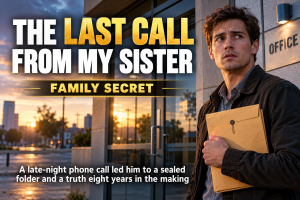
My sister’s voice on the phone at 11:48 p.m. was calm, almost businesslike, when she asked me to write down an address. She refused to explain. Then she said four words that still echo: “Whatever happens, don’t tell Mom.” The line went dead. The next morning that address led me to a sealed folder, an eight-year-old handwritten statement, and a single sentence that rewrote everything I thought I knew about our family.
Part 1
The phone buzzed against the nightstand at 11:48 p.m. on a Thursday. I almost let it go to voicemail. I had work in the morning and the kind of week that already felt longer than it should. But the name on the screen was Elena, and Elena almost never called after ten.
I answered on the third ring.
“Can you write something down?” she said. No hello. No apology for the hour.
I sat up, the sheets sliding off my shoulders. “What?”
“An address. Just write it.”
I reached for the notepad I kept by the bed for grocery lists and half-finished thoughts. My pen scratched across the paper while she dictated numbers and a street name I didn’t recognize. When she finished, silence stretched between us.
“Why?” I asked.
“I don’t have time to explain.”
The words landed flat, practiced. I waited for more. Instead she said, very quietly, “Whatever happens, don’t tell Mom.”
Then the line went dead.
I stared at the glowing screen. Called back once. Twice. Three times. Each attempt ended in the same impersonal voicemail greeting. Elena’s voice, bright and professional, promising she would return the call as soon as she could.
I sat on the edge of the mattress for a long time after that, the notepad still in my hand. The address looked ordinary. A building number, a street, a city I had driven through a hundred times without ever stopping. Nothing about it explained the late hour or the warning.
Sleep did not come easily. When it did, it was shallow and full of half-formed images: Elena’s face as a teenager, the way she used to stand between me and our mother’s sharper comments, the sealed look she sometimes wore when the conversation turned toward our father.
By six-thirty the next morning I was already dressed. The city was still soft with early light when I left the apartment. Traffic was light. The building appeared sooner than I expected, a low two-story structure of beige brick and dark glass, the kind of place that could have been an insurance office or a dental clinic or nothing at all. No sign on the front. Only a small brass plaque near the door with a suite number.
I stood on the sidewalk longer than necessary, the notepad folded in my jacket pocket. Part of me wanted to turn around, go to work, pretend the call had been a dream. The larger part of me remembered Elena’s voice when she said those four words.
A man opened the glass door before I reached it. He was older, maybe sixty, with silver hair and a carefully pressed gray suit. He did not smile.
“You’re early,” he said. “That’s good.”
I stopped. “I’m looking for—”
“You’re Elena’s brother.” It was not a question.
I nodded once.
He stepped aside and held the door. “Come in. We should talk inside.”
The lobby was small and quiet. A single receptionist desk sat empty. The man led me down a short hallway and into an office that smelled faintly of paper and old coffee. He closed the door, gestured to a chair, and did not sit himself.
“My name is Mr. Harrington,” he said. “I’ve represented your sister for several years. She asked me to give you this if certain conditions were met.”
He opened a drawer and removed a thick sealed folder. The edges were crisp. No label on the front.
“What conditions?” I asked.
He set the folder on the desk between us. “She will explain inside. Or rather, she already has. Eight years ago.”
I looked at the folder. Then at him. “Is she all right?”
Something flickered across his face, too quick to name. “She is safe. For now. That is all I am authorized to say.”
He pushed the folder closer. “Take it. Read it somewhere private. And remember what she told you last night.”
I took the folder. It was heavier than it looked.
Outside, the morning had brightened. People walked past with coffee cups and headphones, living ordinary lives. I sat in my car with the engine off and the sealed edges of the folder pressing against my palms.
I almost opened it right there. Almost.
Instead I drove home, climbed the stairs to my apartment, locked the door, and sat at the kitchen table with the folder in front of me. The silence of the room felt different than it had the night before.
I broke the seal.
Inside were photocopies of bank statements, several photographs, and a thin stack of lined notebook paper covered in Elena’s careful handwriting. The date at the top of the first page was from eight years earlier.
The first line stopped me cold.
“I have been protecting our family from the truth.”
I read those words twice. Then I turned the page.
She wrote about our mother. About our father. About a decision that had been made before either of us was born.
The photographs showed people I half recognized and places I had never been. The bank records listed accounts under names that were almost ours but not quite.
I kept reading, the apartment around me growing quieter with every paragraph.
When I reached the final page, only one sentence remained.
I read it once. Then again.
The coffee I had poured earlier had gone cold. My hands were unsteady.
Suddenly the late-night call made sense. The address. The warning. The sealed folder waiting in a lawyer’s office for the moment she decided I needed to know.
I sat very still at the kitchen table and understood, for the first time, that the life I thought I had been living had been built on something carefully hidden.
And that Elena had been carrying the weight of it alone for years.
Outside the window a bus sighed to a stop and pulled away again. Ordinary life continued, unaware.
I closed the folder carefully, as if the paper itself might break.
Then I picked up my phone and stared at Elena’s name.
She still was not answering.
Part 2
The rest of the morning passed in a strange kind of stillness. I called out of work with a vague story about a family emergency. My supervisor asked no questions. People rarely do when the word “family” is involved.
I spread the contents of the folder across the kitchen table again, this time more carefully. The bank records went in one pile. The photographs in another. Elena’s handwritten pages in the center, weighted at the corners with salt and pepper shakers so they would not curl.
The statement was longer than I had first realized. She had written it in sections, some pages denser than others, as if she had returned to it over several days or weeks. Certain passages were underlined. Others had small stars in the margin.
She began with our parents’ early years. Details I had never heard. Our mother had been working nights at a hospital. Our father had been finishing a degree he later abandoned. There had been money problems. There had always been money problems, but these seemed sharper, more desperate.
Then the tone shifted.
Elena wrote about a meeting that took place before either of us existed. A conversation between our parents and someone else. She did not name the third person at first. She only said that a choice had been made, and that the choice had consequences that stretched forward through every year of our lives.
I turned a page and found a photograph of a young woman who looked almost exactly like our mother, only thinner, with different eyes. On the back, in faded ink, someone had written a name I did not recognize and a year that predated my birth by nearly a decade.
I set the photo down carefully.
The bank statements told a quieter story. Regular transfers. Modest amounts. Always to the same account. Always marked with the same four-digit code in the memo line. The transfers had stopped abruptly eight years earlier, the same year Elena dated her statement.
I leaned back in the chair and pressed the heels of my hands against my eyes. The apartment felt too small. The ordinary objects around me— the half-empty coffee mug, the unopened mail, the jacket draped over the opposite chair—seemed to belong to a different person.
My phone buzzed once. A work email. Nothing from Elena.
I tried calling her again. Voicemail. I left a message this time, short and careful. “I have the folder. Call me when you can.”
Then I sat with the silence.
Around noon I forced myself to eat something. Toast. Black coffee. The food tasted like paper. I kept returning to the final page of Elena’s statement, the single sentence that had rewritten the shape of everything.
I will not write that sentence here yet. Not until the rest of the pieces are in place. But it explained the late call. It explained the sealed folder. It explained why she had spent years keeping a careful distance from certain conversations, certain photographs, certain questions about the past.
By early afternoon I could no longer sit still. I drove back to the beige brick building. The same brass plaque. The same quiet lobby. The receptionist was there this time, a young woman with a polite smile that faded when I gave my name.
“Mr. Harrington is with a client,” she said. “Would you like to leave a message?”
“Tell him Elena’s brother is here. Tell him I read the folder.”
She hesitated, then reached for the phone. A moment later she nodded toward the hallway. “He can see you for ten minutes.”
Harrington’s office looked the same as it had that morning. He did not offer me a seat this time.
“You have questions,” he said.
“Many.”
“I can answer very few of them. Attorney-client privilege remains in effect. Your sister was extremely clear about that.”
“Is she in danger?”
He considered the question longer than I liked. “She is managing a difficult situation. That is as far as I can go.”
“The transfers,” I said. “The ones that stopped eight years ago. What were they for?”
Harrington’s expression did not change. “I cannot discuss the contents of the file with you beyond what your sister authorized.”
“She authorized me to have the file.”
“She authorized you to receive it. Interpretation is your responsibility.”
I wanted to argue. Instead I asked the question that had been sitting under everything else since the moment I finished reading.
“Does our mother know?”
For the first time something like sympathy moved across his face. “Your sister has worked very hard to make sure that certain truths never reached her. Whether that effort can continue is no longer entirely in her hands.”
The words settled heavily between us.
I left without shaking his hand. Outside, the afternoon light had turned hard and bright. I sat in the car again, the folder on the passenger seat like a living thing.
My phone rang. For one wild second I thought it was Elena. It was our mother.
I let it ring three times before I answered.
“Have you heard from your sister?” she asked. No greeting, the same way Elena had spoken the night before. “She was supposed to call me this morning. She always calls on Fridays.”
I closed my eyes. The notepad with the address was still in my jacket pocket. The folder was still warm from the sun through the windshield.
“I’ve been trying to reach her too,” I said. It was the truth, carefully measured. “I’ll let you know if I hear anything.”
There was a pause. Then, softer: “Is everything all right?”
The question was ordinary. The answer was not.
“I don’t know yet,” I said. “I’ll call you later.”
I hung up before she could press further. Across the street a woman pushed a stroller and laughed at something on her phone. Life continued, indifferent.
I started the car and drove without a destination, the sealed truth of Elena’s statement riding beside me like a passenger who refused to speak.
Somewhere in the city my sister was dealing with whatever had forced her to place that call at 11:48 the night before. Somewhere our mother was waiting for a Friday phone call that might never come.
And I was the only person who now knew why.
Part 3
That evening I returned to the handwritten pages with a clearer head and a growing sense of unease. Elena had not written the statement as a confession exactly. It felt more like a record, something she had needed to set down so that the weight of it would not live only inside her.
She described a winter afternoon when she was nineteen. I would have been sixteen then, still in high school, still believing that the quiet tension in our house was simply the way some families functioned. Elena had come home early from college that weekend. She found our mother sitting at the kitchen table with a stack of old letters and a look on her face that Elena had never seen before.
Our mother had not noticed her at first. When she did, she gathered the letters quickly and said it was nothing. Just old papers. Nothing important.
Elena did not believe her.
Over the following months she began asking careful questions. Not to our mother. To relatives who still lived in the town where our parents had grown up. To a former neighbor who remembered our father before he left. The answers came slowly, in fragments, often reluctant.
There had been another woman.
Not a brief affair. Something more complicated. A relationship that had existed before our parents married, and that had continued, in some form, afterward. The woman had become ill. There had been medical bills. Our father had helped. Quietly at first. Then less quietly. The money had to come from somewhere.
Elena wrote that she had confronted our father once, the last summer before he disappeared from our lives for good. He had not denied it. He had only said that some debts are not the kind you can walk away from, and that our mother already carried enough.
I paused there, the kitchen clock ticking too loudly in the quiet apartment. I remembered that summer. Elena had been quieter than usual. Our father had spent long hours in the garage, the radio on low, the door half closed. I had assumed it was ordinary distance. The kind that grows between people who have run out of easy things to say.
I had been wrong.
The photographs in the folder showed the other woman’s face at different ages. In the earliest one she was young, laughing, standing beside a car I did not recognize. In later ones the smile was still there but thinner, the eyes tired. One photograph showed her holding a small child. The child’s face was turned away.
Elena’s handwriting grew tighter in the next section.
She had discovered that the child was not ours. Not in the way that would have rewritten our family tree. But the child’s existence had shaped decisions our parents made long before Elena or I arrived. Decisions about money. About silence. About what could be spoken aloud and what had to remain buried.
The bank transfers had been for the child’s care after the woman died. Our father had set them up. When he left, Elena—then barely twenty—had taken them over without telling anyone. She had used money from summer jobs, then from her first real salary, then from careful budgeting that left her with less than she should have had.
Eight years ago the transfers stopped because the child, by then a young adult, no longer needed them. Elena had written the statement the same month the final payment went through. She said she needed a record in case the truth ever surfaced on its own.
I set the pages down and walked to the window. The city lights were coming on, one building at a time. Somewhere out there Elena was still unreachable. Somewhere our mother was waiting for a call that Elena had decided, for reasons still only partly clear, could not happen yet.
I called Harrington’s office. The receptionist had gone home. The answering service took a message.
Then I did something I had been avoiding all day. I opened the old family photo albums we kept in a box under the bed. Most of the pictures were ordinary: birthdays, holidays, the three of us on a beach one summer when I was small. But near the back of one album I found a photograph I had never paid attention to before. Our father standing with a group of people at what looked like a workplace picnic. On the far edge of the frame, slightly out of focus, was a woman whose face matched the ones in Elena’s folder.
I closed the album carefully.
The past was no longer a closed room. It had a door, and Elena had left it unlocked for me.
My phone remained silent. No messages. No missed calls from her number.
I made a second cup of coffee I did not drink and returned to the final page of the statement. The single sentence waited there, patient and unchanging.
I still was not ready to say it aloud. Not even to myself in an empty kitchen.
But I understood now why she had called at 11:48. Why she had refused to explain. Why she had chosen a lawyer’s office and a sealed folder instead of a conversation.
Something had changed. Something that made the old arrangement no longer safe.
And whatever it was, it had forced her to decide that I needed to know the truth she had been carrying alone for most of her adult life.
I slept poorly that night. When I woke, the first thing I did was check my phone.
Still nothing from Elena.
The second thing I did was look at the address she had given me again. The beige brick building. The quiet lobby. The man in the gray suit who had answered almost none of my questions.
I was beginning to understand that the folder was only the beginning.
The rest of the story was still out there, waiting for me to find it.
Part 4
On the third day I drove to the town where our parents had grown up. It was a two-hour trip through flat countryside and small clusters of houses that looked as if they had not changed in decades. Elena had mentioned a few names in her statement. I started with the easiest one: a woman named Ruth who had lived next door to our grandparents.
The house was still there, white siding faded to the color of old bone. Ruth answered the door herself. She must have been in her eighties, but her eyes were sharp.
“You’re one of the boys,” she said after a moment. “No. The brother. Elena’s brother.”
I nodded. “I was hoping I could ask you a few questions about my parents. About the years before Elena and I were born.”
She studied me for a long moment, then stepped aside. “Come in. I’ve been wondering when someone would finally ask.”
We sat in a living room that smelled of lemon polish and old books. She did not offer tea. She simply waited.
I told her, carefully, that Elena had given me some papers. That certain names and dates did not match the version of the past I had always known. I did not mention the folder or the lawyer. I did not mention the late-night call.
Ruth listened without interrupting. When I finished she was quiet for a while.
“Your father was a complicated man,” she said at last. “Kind in the ways that showed. Less careful in the ways that mattered. There was a woman named Claire. They were close before he met your mother. Afterward too, in a fashion. When Claire got sick, he did what he could. Your mother knew more than she let on. She chose not to speak of it. Some people prefer the shape of a life they can live with over the full weight of the truth.”
I absorbed that. “And the child?”
Ruth’s expression softened. “Claire’s. Not your father’s blood, if that’s what you’re asking. But he felt responsible all the same. After Claire died, the arrangements continued. Quietly. Your sister took them over when your father left. She was very young for that kind of weight. I told her once she didn’t have to carry it alone. She said someone had to, and that your mother had already carried enough.”
The words matched Elena’s statement almost exactly.
“Do you know where Elena is now?” I asked.
Ruth shook her head. “She called me last week. Sounded tired. Said she might need to put some old papers in order. I didn’t press. Your sister has always preferred to handle difficult things herself.”
I left with more pieces and no clearer path. On the drive back I stopped at a gas station and tried Elena’s number again. Still voicemail. I left another message, longer this time. I told her I had spoken with Ruth. That I understood more than I had three days earlier. That I needed to know she was safe.
That night our mother called again. She sounded smaller than usual.
“I went by Elena’s apartment,” she said. “The lights were off. Her neighbor hasn’t seen her since Wednesday. I’m starting to worry.”
Wednesday. The day before the 11:48 call.
I closed my eyes and chose my words with care. “I’ve been trying to reach her too. I’ll drive over tomorrow and check again. Maybe she had to leave town for work.”
“She would have told me,” our mother said. The certainty in her voice was fragile.
After we hung up I sat with the folder open on the table and the photographs arranged in a rough timeline. Claire’s face looked back at me from different years. The child appeared in only two images, always turned slightly away, as if the camera had caught her at the wrong moment.
Elena’s final sentence still waited on the last page.
I was beginning to see the shape of the decision she had made eight years earlier when she stopped the transfers and wrote everything down. She had been preparing for a day when the careful silence might no longer hold.
That day had apparently arrived.
The next morning I went to Elena’s apartment. The building was quiet. Her door was locked. No mail overflowing from the box. No package on the mat. I knocked longer than was polite. No answer.
A neighbor across the hall opened her door a crack. “She left a few days ago,” the woman said. “Had a small suitcase. Said she’d be gone a little while. Asked me to hold any packages.”
“Did she say where?”
The neighbor shook her head. “Just that it was family business. She looked tired.”
Family business. The phrase settled coldly in my chest.
I thanked her and left. In the car I called Harrington’s office and insisted on speaking with him. This time he took the call.
“I need to know if Elena is all right,” I said. “Our mother is asking questions. I can’t keep giving her half-answers.”
There was a long pause. Then, carefully: “Your sister is dealing with a matter that required her presence. She is not in immediate danger. That is all I can confirm.”
“Is it connected to the folder?”
Another pause. “Everything is connected, in the end. Read the statement again. Pay attention to the dates. And to the name that appears only once.”
He hung up before I could ask which name.
I drove home and spread the pages out once more. Most of the names were familiar now. Claire. Ruth. Our parents. The child, referred to only as “her” or “the girl.”
Then, near the middle of the statement, a single unfamiliar name appeared in a short paragraph about legal arrangements. A name I had skipped over the first two times because it seemed minor.
I said the name aloud in the quiet kitchen.
It did not answer.
But something about it felt like a key turning in a lock I had not known was there.
I opened my laptop and began to search.
The results that came back made the late-night call, the sealed folder, and Elena’s absence suddenly make a different kind of sense.
Something had surfaced. Something that the eight-year silence had been designed to prevent.
And Elena had decided that I needed to know before it reached our mother.
Part 5
The name led me to a small legal notice published two weeks earlier in a regional paper I would never have read on my own. It concerned the settlement of an estate. Claire’s name appeared in the older documents attached to the notice. So did a reference to a trust that had been quietly maintained for years and then closed.
The notice itself was ordinary. The timing was not.
Elena’s call had come three days after the notice appeared.
I printed the pages and added them to the growing pile on the kitchen table. The story was no longer only about the past. Something in the present had forced Elena’s hand.
I spent the afternoon reconstructing a timeline. Claire’s illness. The quiet help. Our father’s departure. Elena stepping into the gap at nineteen and carrying the responsibility until the need ended. The statement written as a safeguard. Then years of ordinary life—Elena building a career, me finishing school, our mother continuing in the careful version of the past she preferred.
Until the legal notice.
I called Ruth again. This time she answered on the first ring.
“I wondered if you’d find it,” she said when I mentioned the notice. “Elena called me the day it appeared. She was calm, but I could hear the weight in her voice. She said the silence might not hold much longer. That certain people might start asking questions. She wanted to make sure you had the full picture before anyone else did.”
“Who would ask questions?”
Ruth was quiet for a moment. “People connected to the estate. Lawyers. Perhaps the young woman herself, if she ever decides to look backward. Elena has always been careful about protecting your mother from the full story. She was afraid that if it came out the wrong way, the shock would be worse than the truth.”
I thought of our mother’s voice on the phone, the fragile certainty that Elena would have told her if something was wrong.
“Is Elena safe?” I asked.
“She said she was handling it. That’s all I know.”
After the call I sat with the new information and the old photographs. The child—now a young woman—had a name in the legal documents. I did not say it aloud. It felt like crossing a line I was not yet ready to cross.
Instead I drove to our mother’s house that evening. She lived in the same place we had grown up, the rooms smaller somehow with time. She looked tired when she opened the door.
“Any word?” she asked immediately.
“Not yet. I’m still looking.”
She led me to the kitchen. The same table where Elena had once found her with the old letters. I wondered how many other private moments had taken place in this room without my knowing.
“She always calls on Fridays,” our mother said, almost to herself. “Even when she’s busy. It’s our thing.”
I nodded. The lie of omission sat heavy between us. I wanted to tell her everything. The folder. The statement. Claire. The years of quiet responsibility Elena had carried. But Elena’s warning from the first night still held: Whatever happens, don’t tell Mom.
Not yet. Not until I understood the full shape of the present danger.
We talked about ordinary things for a while. The weather. A neighbor’s new fence. The way the garden was doing this year. Underneath the conversation I could feel her worry like a third presence in the room.
When I left she hugged me longer than usual. “Call me the moment you hear anything.”
“I will.”
In the car I checked my phone again. Still nothing from Elena. I sent a short text: I found the notice. I understand more now. Please just let me know you’re okay.
The message sat unread.
That night I returned to the final page of the statement. The single sentence. I read it slowly, aloud this time, in the empty apartment.
The words did not change. But their meaning had deepened with every new piece of information.
Elena had written that sentence eight years earlier as a kind of closing. A way of saying that the responsibility had ended and the truth, if it ever needed to surface, could do so through her words rather than through silence or shock.
She had not expected to need the statement so soon. Or perhaps she had. Perhaps the careful preparation had always been for a moment exactly like this one.
I slept in short stretches, waking often to check the phone. Toward morning I dreamed of the beige brick building and the sealed folder and Elena’s voice saying four words that had rewritten the shape of the week.
When I woke for good, the first light was soft against the window. My phone showed one new message.
It was not from Elena.
It was from Harrington.
Two words: Call me.
I dialed before I was fully out of bed.
He answered on the first ring. “Your sister has asked me to arrange a meeting,” he said. “Today. If you’re willing.”
My pulse jumped. “Where?”
He gave an address. Not the beige brick building. Somewhere else. A quiet place, he said. Neutral.
“Is she all right?”
“She will explain what she can. Be there at two.”
He hung up.
I sat on the edge of the bed with the phone still in my hand and the folder waiting on the table in the other room.
The waiting was almost over.
Whatever had forced the late-night call, whatever had kept her silent for three days, was about to step into the open.
I dressed carefully, as if the day required a different version of me. Then I gathered the folder, the printed legal notice, and the photographs, and placed them in a bag.
At the door I paused and looked back at the quiet apartment.
In a few hours I would see Elena.
And the single sentence on the final page would no longer be the only version of the truth I carried.
Part 6
The address Harrington gave me belonged to a small public garden on the edge of the city, the kind of place people visited for quiet more than for spectacle. I arrived early and sat on a bench near a fountain that had been turned off for the season. The bag with the folder rested at my feet.
At five minutes to two I saw her.
Elena walked along the path with the same measured stride she had always had, but there was a tiredness in the set of her shoulders that I had never noticed before. She wore a dark coat and carried nothing. When she reached the bench she did not sit immediately. She simply looked at me for a long moment, as if confirming that I was still the person she expected.
“You read it,” she said.
“All of it.”
She nodded once and sat beside me, leaving a careful space between us. For a while neither of us spoke. The garden was nearly empty. A woman walked a small dog in the distance. The air smelled of damp leaves and approaching autumn.
“I’m sorry about the call,” she said at last. “I didn’t have better options. Things moved faster than I expected.”
“The legal notice.”
“Yes. Claire’s estate had loose ends I thought were finished. Someone started asking questions about the old trust. About the transfers. About who had authorized them and why. I needed you to have the full picture before any of it reached Mom.”
I watched her face. The same careful composure she had always worn when the subject of our father came up. Only now I understood how much work that composure required.
“Why didn’t you just tell me years ago?”
She was quiet for a moment. “Because the arrangement was finished. The need was gone. And because telling you would have meant deciding whether to tell her. I wasn’t ready to make that choice for both of us.”
“And now?”
“Now the choice may not be ours much longer.” She turned slightly toward me. “There’s a possibility that certain documents will become public as part of the estate process. Nothing dramatic. Nothing criminal. Just the kind of paper trail that curious people can follow if they want to. I needed you to understand the history so that if questions come, we can answer them the same way.”
I thought of our mother’s voice on the phone, the way she had said Elena always called on Fridays.
“She already knows something’s wrong,” I said. “She’s been to your apartment. She’s calling me every day.”
Elena’s eyes closed briefly. “I know. I’ve been trying to keep the circle small until I understood the legal side. Harrington has been helping. We’re close to a resolution that keeps the old arrangements private. But I couldn’t risk you finding out through someone else.”
The fountain remained silent beside us. A leaf drifted down and landed on the empty basin.
“The final sentence,” I said. “In the statement. Did you mean it?”
She looked at me then, fully. “Every word. I wrote it when I believed the responsibility was over. I still believe that. But responsibility and silence are not the same thing. I needed a record that the silence had been a choice, not an accident.”
We sat with that for a while. The woman with the dog disappeared around a bend in the path. The garden felt larger in the quiet.
“What happens now?” I asked.
“I meet with the other side’s attorney tomorrow. If the remaining questions can be answered without involving Mom, then the folder stays between us. If not…” She did not finish the sentence.
“You’ll tell her.”
“We’ll decide together,” Elena said. “That’s why I called you. I didn’t want to carry the next part alone.”
The admission landed softly. For years she had carried the earlier part alone. The transfers. The quiet checks. The knowledge of Claire and the child and the decisions made before we were born. She had done it to protect the version of the past our mother preferred. Now the protection itself required sharing the weight.
I reached down and touched the bag at my feet. “I brought everything. In case you needed it.”
She smiled, small and tired. “Keep it. It’s yours now too.”
We talked for another hour. Not only about the past. About her work. About a trip she had postponed. About the neighbor who was holding her packages. Ordinary details that made the larger truth feel less isolating.
When it was time to leave she stood first. “I’ll call you after the meeting tomorrow. One way or another.”
“And Mom?”
“Not yet. Not until we know what’s necessary.”
I watched her walk back along the path until the dark coat disappeared among the trees. The bag with the folder felt heavier when I lifted it.
That evening I did not answer our mother’s call. I sent a short text instead: Still looking into a few things. I’ll call you tomorrow with an update. The message felt like another small silence, but it was the only one I could manage.
I returned to the apartment and placed the folder back on the table. The photographs. The bank records. Elena’s careful handwriting. The single sentence on the final page.
For the first time since the 11:48 call, the story felt shared.
Not finished. But no longer carried by only one person.
I made coffee I actually drank and sat with the quiet, waiting for tomorrow.
Part 7
The next day moved slowly. I went to work for the morning because the alternative was pacing the apartment. Colleagues asked if everything was all right. I gave the same vague answer I had given all week. Family matter. Under control. By noon I could no longer pretend to focus. I left early and drove to a coffee shop near the garden where Elena and I had met. I wanted to be close to something that already held part of the truth.
Elena’s message came at 3:17 p.m.
Meeting went as well as it could. Details still settling. Can you meet me at Mom’s at six? We need to talk to her together.
I read the message twice. The careful silence was ending. Not because the legal questions had forced it, but because Elena had decided the cost of continued silence was higher than the cost of truth.
I replied: I’ll be there.
The hours until six stretched. I returned to the apartment, showered, changed into a shirt that felt more deliberate than my usual clothes. I placed the folder in the bag again, then took it out. Then put it back. In the end I left it at home. The papers were evidence of a history. The conversation we were about to have needed to begin with words, not documents.
Our mother’s house looked the same as it always did in the early evening. Lights on in the kitchen. The porch light glowing against the growing dusk. Elena’s car was already in the driveway.
She met me at the door. For a moment we simply looked at each other. Then she stepped aside so I could enter.
Our mother was at the kitchen table with a cup of tea she did not appear to be drinking. She looked between us and the worry that had been building all week settled into something sharper.
“You’re both here,” she said. “That means it’s serious.”
Elena sat first. I took the chair across from her, the same arrangement we had used for a hundred ordinary conversations that now felt like practice for this one.
“I’ve been dealing with something connected to Dad,” Elena began. Her voice was steady. “Something that started before either of us was born. I kept it from you because I thought the need for it had ended. This week I learned it might not stay quiet forever. So I told him.” She nodded toward me. “And now we need to tell you.”
Our mother’s hands rested on either side of the teacup. She did not speak. She only waited.
Elena told the story cleanly, without the extra weight of the handwritten statement. Claire. The early relationship. The illness. The quiet help. The child who was not ours by blood but who had shaped decisions that rippled forward. The transfers. The years Elena had maintained them after our father left. The statement written when the responsibility ended. The legal notice that had surfaced two weeks ago. The possibility that old questions might be asked again.
She did not rush. She did not soften the parts that were difficult. When she finished, the kitchen was very quiet.
Our mother looked at the surface of her tea for a long time. Then she said, almost gently, “I knew about Claire.”
Elena’s posture changed by a fraction. I felt my own breath catch.
“Not everything,” our mother continued. “Not the child. Not the money after he left. But I knew he had cared for her when she was sick. I knew there were things he carried that he never fully set down. I chose not to ask for the rest. Some truths are easier to live beside than to examine too closely.”
She looked up then, first at Elena, then at me. “You carried this alone.”
“I thought I was protecting you,” Elena said. The composure she had worn for years thinned. “I thought if the need was over, the silence could stay.”
“And now?”
“Now the silence might not be ours to keep. There may be questions from the estate. Nothing that harms anyone. But enough that I didn’t want you to hear it from a stranger or a document.”
Our mother nodded slowly. The worry that had lived in her face all week had shifted into something else—tired, clear-eyed, almost relieved.
“I should have asked more questions years ago,” she said. “I told myself I was keeping the peace. Maybe I was only keeping the quiet.”
We sat with that for a while. No one reached for the past as a weapon. No one demanded explanations that could not change what had already been lived. The kitchen, which had held so many unspoken things, simply held us.
Eventually our mother asked about the young woman connected to Claire’s estate. Elena answered what she could. The legal side was nearly settled. Privacy could likely be maintained. If anything further arose, we would handle it together.
When it was time to leave, our mother walked us to the door. She hugged Elena first, longer than usual. Then me.
“Thank you for telling me,” she said. “Both of you.”
Outside, the porch light cast a soft circle on the steps. Elena and I stood for a moment in the driveway after the door closed.
“She took it better than I expected,” Elena said.
“She already knew part of it. That helped.”
Elena nodded. The tiredness was still there, but the sharp edge of isolation had eased. “I’ll call Harrington in the morning. Confirm the last details. Then maybe we can all have a normal weekend.”
I almost smiled. “Define normal.”
“Quiet,” she said. “Ordinary. The kind that doesn’t require sealed folders.”
We parted with a brief hug. In the car I sat for a moment before starting the engine. The bag with the folder was still at home on the table. The single sentence on the final page no longer felt like a secret I was keeping. It felt like a record of a responsibility that had been shared at last.
I drove home through streets that looked the same as they had the night of the 11:48 call. Everything was different.
The truth was out. Not fully public. Not sensational. Simply known by the three people it most concerned.
And the sky had not fallen.
Part 8
The following days brought a quieter kind of waiting. Harrington confirmed that the remaining questions around the estate could be answered without further involvement from our family. The old trust was closed. The paper trail, such as it was, would remain private. No one would be contacting our mother. No one would be asking Elena to explain the transfers again.
The relief was real, but it arrived with its own complicated aftertaste. For years the silence had been a form of care. Ending it had been another form of care. Both had cost something.
Elena came by my apartment two evenings later with takeout and a bottle of wine neither of us particularly needed. We ate at the kitchen table with the folder still sitting at one end, no longer sealed, no longer urgent.
“I’ve been thinking about the statement,” she said after a while. “Whether I should have written it differently. Or not at all.”
“I’m glad you wrote it,” I said. “It gave me a way in when everything was still unclear.”
She nodded, turning her glass slowly. “I was nineteen when I took over the transfers. It felt like the only responsible thing to do. Dad was gone. Mom had already been through enough. The girl needed the help. It was simple in the way hard things sometimes are when you’re young and certain.”
“And later?”
“Later it became habit. Then it became a secret I didn’t know how to set down without creating a larger conversation. The statement was my way of making sure the secret had a shape. In case it ever needed to be understood.”
I thought of the single sentence on the final page. The way it had landed when I first read it. The way it had continued to land as more pieces appeared.
“Do you regret not telling me sooner?”
Elena considered the question. “I regret the loneliness of it. Not the intention. The intention was always to keep the hardest parts from landing on people who hadn’t chosen them.”
We sat with that. Outside, the city made its evening noises. Inside, the folder no longer felt like a threat. It felt like an artifact of a chapter that had closed.
Later, after Elena left, I opened the statement one more time and read the final sentence slowly. Then I placed all the pages back in order, returned the photographs to their envelope, and closed the folder. I did not seal it. There was no longer anything to seal away.
The next morning I called our mother. We talked about ordinary things—a leak in the porch roof, a recipe she wanted to try, the possibility of a family dinner on Sunday. The conversation carried none of the careful measuring of the previous week. When we hung up, the silence that followed felt lighter.
Sunday dinner happened. The three of us at the same table where the truth had finally been spoken. No one reopened the subject of Claire or the transfers or the legal notice. We did not need to. The knowledge existed between us now, settled rather than sharp. We talked about work and weather and a movie Elena had seen. At one point our mother laughed at something small, and the sound was uncomplicated.
Afterward Elena and I washed the dishes while our mother rested in the living room. The domestic rhythm of it felt almost strange after the intensity of the previous days.
“You going to be all right?” I asked her quietly.
She glanced toward the living room, then back at me. “I think so. It helps that it’s shared. Even the parts that still feel complicated.”
I nodded. The plates stacked neatly in the drainer. The ordinary work of cleaning up after a meal continued.
In the days that followed, life resumed its previous shapes with small differences. Elena answered her phone when I called. Our mother no longer left messages full of unspoken worry. I returned to work without inventing excuses. The beige brick building became just another place I had once visited. Harrington’s name faded from my recent calls list.
Yet the folder remained on a shelf in my apartment, not hidden, not displayed. A reminder that some stories take years to surface, and that the surfacing itself can be an act of care rather than destruction.
One evening I took the photographs out again and looked at Claire’s face across the years. Then at the two images of the child, still turned slightly away. I wondered what her life looked like now. Whether she had ever known the quiet help that had followed her. Whether she would ever have reason to look backward.
The questions did not demand answers. They simply existed, the way certain questions do after a long silence ends.
I put the photographs away and turned off the light.
The apartment settled into its nighttime quiet. For the first time in weeks, the quiet did not feel like it was waiting for something.
It simply was.
Part 9
Weeks passed. The legal matters remained closed. No further notices appeared. No unexpected calls came from attorneys or distant relatives. The careful boundary Elena and Harrington had worked to maintain held.
In that quieter stretch I found myself returning to the statement less as a source of revelation and more as a record of Elena’s younger self—the nineteen-year-old who had decided that responsibility mattered more than comfort, and the twenty-something who had later written everything down so the responsibility would not disappear without a trace.
I asked her about it one afternoon when we met for coffee near her office.
“Did you ever consider stopping the transfers earlier?” I said. “Before the need ended on its own?”
She shook her head. “Once I started, stopping felt like abandoning something. Even when the amounts were small. Even when it meant I ate a lot of instant noodles for a few years.” She smiled faintly at the memory. “It wasn’t noble. It was just the shape of the commitment I had made.”
“And writing the statement?”
“That was different. That was me admitting the commitment had a natural end. And that the truth of it deserved a place to live outside my head.”
We talked for a while about other things—her work, a possible promotion, a trip she was finally planning to take. The conversation moved easily. The old tension that had once lived under certain topics had eased.
Later that week I visited our mother on my own. We sat on the back porch as the light faded. She had been sorting through boxes of old photographs and had set a few aside.
“I found these,” she said, handing me a small stack. “I thought you might want to see them.”
They were pictures from the years before Elena and I were born. Our parents younger. Friends I did not recognize. And in one, almost at the edge of the frame, a woman whose face I now knew.
Claire.
Our mother watched me look at it. “I kept it,” she said simply. “Even after everything. It felt dishonest to erase her completely.”
I handed the photograph back. “You don’t have to explain.”
“I know. But I want to. For a long time I told myself that not speaking about certain things was the same as protecting the life we had. I’m not sure that was true. Silence can be a kind of care. It can also be a kind of distance. I’m still learning the difference.”
We sat with the porch light and the sounds of the neighborhood. No grand conclusions. Just the quiet acknowledgment that the past had more rooms than we had previously walked through, and that walking through them together had not destroyed the present.
When I left, she hugged me at the door and said, “I’m glad you and Elena told me. Even if it was hard.”
“Me too.”
In the car I thought about the 11:48 call, the notepad, the beige brick building, the sealed folder, the single sentence. All of it had led here—to ordinary evenings and conversations that no longer required careful measuring.
Elena texted me that night: Dinner next week? Just us. I want to hear about that project you mentioned at work.
I replied that I would be there.
The message felt simple. Unburdened.
I realized then that the story had shifted. It was no longer primarily about the secret or the protection or the late-night urgency. It had become about what remained after the truth was shared: the relationships that held, the care that continued, the ordinary days that followed the extraordinary ones.
The folder stayed on its shelf. I did not feel the need to open it again. Its work was done.
Yet I was glad it existed. Glad Elena had written the words when she did. Glad she had trusted me with them when the moment required it.
Some truths arrive like storms. Others arrive like the slow turning of a key in a lock that has been waiting for years.
This one had been the second kind.
And the door it opened had led not to ruin, but to a clearer room.
Part 10
Months later, on an ordinary Thursday evening, Elena called me at a reasonable hour. No urgency in her voice. No careful instructions. Just the sound of someone checking in because checking in had become easy again.
“I’ve been thinking about the statement,” she said after we had covered the usual ground. “I might put it away for good. Or burn it. Or leave it with Harrington in case it’s ever needed. I haven’t decided.”
“Whatever you choose is fine,” I said. “It already did what it needed to do.”
She was quiet for a moment. “It still surprises me that Mom already knew part of it. All those years I thought I was carrying the whole weight alone.”
“You carried the part she couldn’t. That still mattered.”
“Maybe.” Another pause. “I’m glad you were the one who got the call that night. I’m glad it was you who opened the folder.”
I thought of the notepad, the address, the early morning drive, the man in the gray suit, the sealed edges under my hands. “I’m glad too.”
After we hung up I took the folder down from the shelf one last time. I did not read the pages. I simply held the weight of them for a moment, then returned them to their place.
The single sentence on the final page remained exactly as Elena had written it eight years earlier. I no longer needed to quote it to myself. Its meaning had settled into the shape of the months that followed: a record of care, a preparation for truth, a bridge between silence and speech.
Our mother began mentioning Claire occasionally, in small ways. A name in a story about the past. A photograph left out a little longer than necessary. The references were neither heavy nor hidden. They simply existed, the way certain people from the past continue to exist once the effort of erasing them ends.
Elena took the trip she had postponed. She sent photographs of ordinary beautiful places. When she returned we had dinner at her apartment, the three of us, and the conversation moved freely across years and subjects without any of the old careful detours.
I kept the notepad from that first night for a while. The address was still legible in my hurried handwriting. Eventually I recycled it. The information was no longer needed. The moment it represented had completed its work.
Sometimes, late at night, I still thought about the 11:48 call. The way Elena’s voice had sounded—calm, measured, carrying more than it could say in the moment. The four words that had set everything in motion. Whatever happens, don’t tell Mom.
She had been protecting the timing as much as the secret. Giving the truth a chance to arrive in the right order, through the right people, with enough context to be understood rather than simply endured.
It had worked.
The family we had afterward was not dramatically transformed. We still argued about small things. We still forgot to return calls. We still carried our individual complications. But the large unspoken weight that had lived under certain conversations was gone. In its place was a clearer kind of honesty—the kind that does not require sealed folders or late-night warnings.
One Sunday toward the end of the year we gathered at our mother’s house for no particular reason. The light was low and gold. Someone put music on. The kitchen filled with the ordinary sounds of people who belong to each other.
At one point Elena caught my eye across the room and smiled, small and real. I smiled back.
No folders. No statements. No careful silences.
Just the three of us, and the life that had continued after the truth was allowed to take its place among us.
I thought then of the first line Elena had written eight years earlier: I have been protecting our family from the truth.
She had. For as long as the protection was needed.
And when the time came to stop protecting and start sharing, she had done that too—carefully, deliberately, with a late-night call and a sealed folder and a trust that the people she loved could carry the weight together.
The story did not end with a dramatic confrontation or a sweeping revelation. It ended the way many true stories do: with ordinary days that felt lighter because the heaviest things had finally been set down in the open.
I still have the folder. I do not open it often. I do not need to.
Its presence on the shelf is enough—a quiet reminder that some of the most important conversations begin with four words spoken after midnight, and that the courage to speak them can change the shape of everything that follows.
Not by destroying the past.
By finally allowing it to be known.
And in the knowing, to be carried by more than one pair of hands.
That was the gift of the last call from my sister.
Not the secret itself.
The decision to stop carrying it alone.