At 2:14 a.m. my ex-wife sent a single video with no greeting and one quiet request. The man walking into the storage unit was my older brother. He had told the entire family he was out of state. Then the contract appeared—signed twelve years earlier, both our names still on it, payments continuing every month. What else had been kept from me?
Part 1
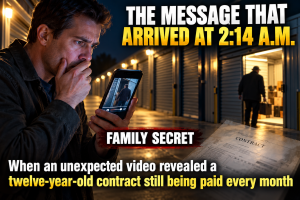
The phone lit up on the nightstand at 2:14 a.m. I almost ignored it. Four years of careful distance between my ex-wife and me had taught me that most messages could wait until morning. The ones that couldn’t usually involved the kids—a fever, a school form, a last-minute schedule change. This one carried no subject line, no context, only a video file and a single sentence in quotation marks: “Please watch this before you talk to anyone.”
I sat up. The apartment was quiet except for the soft hum of the refrigerator and the occasional car passing outside. My younger son’s backpack still sat by the front door from the weekend visit. I pressed play.
The video was grainy, shot from a distance, probably a security camera or a phone held at an awkward angle. A man walked across a concrete lot toward a row of small storage units. He moved with the same slightly uneven gait I had known since childhood, the result of a broken ankle in high school that never fully healed. He wore a dark jacket and carried nothing visible in his hands. He stopped at unit 47, unlocked it, and stepped inside. The door stayed open just long enough for the camera to catch the edge of cardboard boxes stacked against the far wall before the recording ended.
I recognized him immediately. My older brother, Daniel.
Two days earlier he had texted the family group chat from what he claimed was a hotel in Colorado. Work trip, he said. Client meetings. Spotty service. He would check in when he could. Our mother had replied with a string of worried emojis. I had simply liked the message and moved on.
I called my ex-wife. The phone rang four times and went to voicemail. I did not leave a message. A minute later a second text arrived: “I found this while going through the documents from our old house.” Then a photograph of a storage-unit rental contract. Daniel’s name appeared in the primary renter field. Mine sat beneath it as an authorized user. The signature dates were twelve years old—before I had met my ex-wife, before the children existed, before the slow unraveling that ended our marriage.
At the bottom of the page a payment history stamp showed the unit was still active. Monthly charges continued without interruption.
I stared at the image until the screen dimmed. Twelve years. Both of us listed. And Daniel had been standing in front of that exact unit two days ago while telling everyone he was hundreds of miles away.
I got out of bed and walked to the kitchen. The tile was cold under my feet. I poured a glass of water I did not drink. My hands felt steady, but something behind my ribs had begun to tighten in a way I recognized from other late-night discoveries—quiet, persistent, and unwilling to be ignored.
I opened the family group chat and scrolled back to Daniel’s last message. “Out of state for work. Will update soon.” The timestamp matched the day the video was recorded. No one had questioned it. We rarely did. Daniel was the reliable one, the one who handled arrangements when our father died, the one who remembered birthdays and sorted through paperwork when our mother could not.
I typed a short reply to my ex-wife: “Where did you find this?” The message showed as delivered. No answer came.
I returned to the living room and sat on the edge of the couch. The storage facility name on the contract was familiar in a vague way—something local, something I must have driven past without noticing. Unit 47. Both names. Still being paid for every month.
I tried to remember twelve years ago. I had been living in a rented duplex on the east side of town, working long hours at the logistics company, saving what I could. Daniel had already bought his first house. We spoke often then. We helped each other move furniture, shared holidays, argued over whose turn it was to visit our parents. At no point did I recall signing a storage contract. At no point did I recall agreeing to keep something locked away under both our names.
Yet the document existed. The video existed. And my brother had lied about where he was.
I set the phone face down on the coffee table and listened to the quiet of the apartment. Somewhere down the hall a neighbor’s television murmured through the wall. Outside, a truck downshifted at the intersection. Ordinary sounds. Ordinary night. Except for the knowledge that something I had never known about had been sitting in a metal unit across town, paid for month after month, while my brother walked in and out of it under a false story.
I picked the phone up again and opened the photograph of the contract. I zoomed in on the signatures. Daniel’s was unmistakable—the same looping D he still used. Mine looked like mine, or close enough that I could not immediately dismiss it. The facility address was listed. I copied it into the maps app. Fifteen minutes by car from my current place. Closer to the house where my ex-wife and I had lived before the divorce.
I did not go that night. Something about the hour, the unexplained video, the request not to talk to anyone yet, kept me in the apartment. I sat with the knowledge the way you sit with a bruise you have only just noticed—testing the edges, waiting to see how deep it reaches.
By the time the sky began to lighten, I had replayed the video twice more and read the contract text until the words blurred. The unit was still active. The payments continued. My name was on the paper. And the only person who had chosen to show me any of it was the woman I had once been married to, reaching across four years of careful silence at 2:14 in the morning.
I made coffee and waited for a reply that did not come. Outside the window the city woke in slow layers—streetlights clicking off, early buses, the distant sound of a dog. I kept the phone within reach. Whatever this was, it had already begun, and the only clear instruction I had been given was to watch before I spoke to anyone else.
I watched. Then I waited.
Part 2
By mid-morning the silence from my ex-wife felt deliberate. I sent one more message—short, careful: “I’m not talking to anyone. Just tell me what you know.” Delivered. Read. No reply.
I called Daniel’s cell. It went straight to voicemail. I did not leave a message. The family group chat remained quiet except for our mother’s daily good-morning heart. I liked it out of habit and closed the app.
The storage facility website listed business hours starting at nine. I drove over after dropping the kids at school—my week with them had ended the night before, and the apartment already felt too still. The place was small, a single-story row of units behind a chain-link fence and a modest office trailer. Unit 47 sat near the middle of the second row. The padlock looked ordinary. No one was around when I parked.
I stood in front of the door for a long minute. The morning sun threw sharp shadows across the concrete. I did not have a key. I did not even know if the combination or key code had ever been shared with me. The contract listed both names, but that did not mean equal access.
Inside the office a woman in her fifties looked up from a computer. I showed her a photo of the contract on my phone and explained, carefully, that I needed to confirm the account status. She asked for identification. I handed over my driver’s license. She typed, waited, then nodded.
“Active account. Payments current. Two authorized parties.” She glanced at the screen. “Daniel Reeves primary. You’re listed as secondary. We can issue a duplicate key if you fill out a request form and wait for verification.”
“How long does verification take?”
“Usually forty-eight hours. Sometimes longer if we need to confirm with the primary.”
I filled out the form. She said they would email once the key was ready. I thanked her and walked back to unit 47. The metal door was cool under my palm. I pressed my ear against it the way people do in movies, knowing it would tell me nothing. Silence.
On the drive home I tried Daniel again. Still voicemail. I considered calling our mother and asking if she had heard from him, but the instruction from the video—“before you talk to anyone”—kept stopping me. My ex-wife had chosen the words carefully. She had found the contract in documents from our old house. That meant the paperwork had been in our shared home at some point, then packed away, then rediscovered years later while she was sorting through boxes she had kept after the divorce.
I parked in the apartment lot and sat with the engine off. Twelve years ago I had been twenty-nine. Daniel was thirty-four. Our father had been gone three years by then. Our mother still lived in the house we grew up in. Money had been tight for all of us in different ways. I remembered a stretch of months when Daniel helped me cover rent after a temporary layoff. I remembered him saying once, almost casually, that he had some things in storage and would clear them out when he had time. I had not asked what. I had not offered to help. Life moved forward.
Now the unit was still paid for. My name was still on the paper. And two days ago my brother had walked into it while claiming to be somewhere else.
I opened the video again on my phone. The quality was poor, but the timestamp in the corner matched the day of Daniel’s group-chat message. The jacket he wore looked familiar—something he had owned for years. The way he glanced over his shoulder before unlocking the door was the only detail that felt off. Daniel rarely looked over his shoulder.
My ex-wife finally answered late that afternoon. Her voice was calm, the same measured tone she used when discussing school schedules or medical forms.
“I didn’t want to send it,” she said. “But once I saw the contract and then found the video on an old phone backup, I couldn’t just leave it.”
“What old phone?”
“One of the ones we kept in the junk drawer. I was clearing things out. There was a security-camera clip saved in the cloud storage under an old account. I don’t know how it got there. I only watched it because the thumbnail looked familiar.”
“Familiar how?”
“The jacket. The way he walked. I almost deleted it. Then I checked the date and remembered the text he sent the family.”
I asked where the original documents had been stored in our old house. She said a file box in the guest-room closet, mixed with tax papers and appliance manuals. She had taken several boxes with her when she moved out and never fully sorted them until now.
“Did you know about the unit while we were married?” I asked.
“No. I never saw the contract until last week. I thought maybe it was something from before us that you’d forgotten. Then the video made that harder to believe.”
We sat in silence for a few seconds. Outside my window a neighbor carried groceries up the stairs. Ordinary life continuing.
“I’m not telling the kids,” she said. “And I’m not telling your mother yet. I only sent it to you.”
“Why?”
“Because your name is on it. And because whatever is in that unit has been paid for every month for twelve years. Someone is still writing the checks or authorizing the charges. I thought you should know before anyone else decided what the story was.”
After she hung up I sat with the information. The unit existed. The payments continued. Daniel had been there while lying about his location. And the only person who had chosen to surface any of it was the woman who no longer shared my last name.
I did not sleep much that night. Every time I closed my eyes I saw the grainy image of my brother stepping into the dark rectangle of the open unit door, the brief glimpse of stacked boxes, the quiet click of the lock that must have followed once the recording ended.
In the morning the storage facility emailed. Verification would take longer than expected. They needed confirmation from the primary account holder. I stared at the message for a long time. Then I drove to the facility again and stood in front of unit 47 without going inside the office.
The padlock looked the same. The concrete looked the same. Nothing had changed except the knowledge that something inside had been kept from me for more than a decade, and the person who shared my blood had chosen to keep it that way.
I left without speaking to anyone. The instruction still held: watch before you talk to anyone. I had watched. Now the talking would have to wait until I understood what I was looking at.
Part 3
Three days passed before Daniel returned any of my calls. When he finally did, his voice carried the easy confidence that had always made people trust him.
“Hey. Just got back into cell range. Everything okay?”
I was sitting in my car outside the elementary school, waiting for the afternoon pickup I was not scheduled for. Habit, or nerves. I kept my tone even.
“Where were you, exactly?”
A short pause. “Colorado. Client site. Why?”
“Because two days before you texted the family, you were at a storage facility fifteen minutes from Mom’s house. Unit 47.”
Silence stretched long enough that I checked the screen to make sure the call had not dropped.
“How do you know that?” he asked finally.
“Someone sent me a video. And a copy of the contract. Both our names. Signed twelve years ago. Still active.”
Another pause, shorter this time. “Okay. Look, it’s complicated. Can we talk in person?”
“We can talk now.”
“I’d rather not do this over the phone.”
I almost laughed. The careful distance in his voice was new. Daniel had never been careful with me before.
“Fine,” I said. “Tomorrow. Somewhere public.”
We met at a coffee shop neither of us usually visited. He arrived ten minutes late, ordered nothing, and sat across from me with his hands flat on the table.
“I was going to tell you,” he began.
“When?”
“When it was the right time. It’s not what you think.”
“I don’t think anything yet. I only know you lied about where you were, and that a unit with both our names on it has been paid for every month since before I met my ex-wife.”
He looked down at his hands. The same hands that had helped me move into my first apartment, that had signed the papers when our father’s estate was settled, that had always seemed steady.
“Dad left some things,” he said. “Not money. Stuff. Papers. A few boxes of things Mom didn’t need to see. After he died I put them in storage so she wouldn’t have to deal with them while she was still grieving. I put your name on the contract in case something happened to me. It was practical.”
“That was nine years after he died,” I said. “The contract is twelve years old. Dad had been gone three years by then.”
Daniel’s jaw tightened. “I said it’s complicated.”
“Then uncomplicate it.”
He glanced around the coffee shop. A couple at the next table was laughing over something on a phone. The barista called out an order. Ordinary noise.
“There were debts,” he said quietly. “Not the kind that show up on credit reports. Dad had made some agreements that didn’t die with him. People who expected certain things to stay quiet. I handled it the only way I knew how. The unit holds the last of it. I check on it a few times a year. That’s all.”
“What kind of agreements?”
“The kind that are better left finished.”
I waited. He did not elaborate.
“And the payments?” I asked. “Who’s been paying?”
“I have. Every month. From an account that doesn’t touch anything else.”
“Why keep my name on it?”
“Because if something happened to me, someone in the family needed access. You were the logical choice.”
The explanation sat between us like a piece of furniture that did not belong in the room. It answered some questions and created others. I asked the one that mattered most.
“What’s inside?”
Daniel met my eyes. “Nothing that belongs to you. Nothing that will hurt Mom. That’s the point. It’s contained.”
“I want to see it.”
“No.”
The single word landed harder than any raised voice could have. Daniel rarely said no to me. When he did, it usually meant the subject was closed.
“My name is on the contract,” I said. “I have a right to know what I’m attached to.”
“You have a right to stay clear of it. That’s what I’m trying to give you.”
We sat without speaking for almost a minute. Outside the window traffic moved in the usual afternoon patterns. Somewhere a car horn sounded once and stopped.
“The video,” I said. “Who sent it?”
He shook his head. “I don’t know. I didn’t know there was a video until you mentioned it.”
I believed him on that point, or at least I wanted to. The rest of the story felt like a door only partially opened.
“I’m not dropping this,” I told him.
“I know.” He stood. “Just don’t go to the unit alone. And don’t tell Mom. Not yet.”
He left without ordering coffee, without the usual half-hug or shoulder clap. I watched him walk to his car and drive away. The conversation had given me more information and less clarity. Debts that did not appear on paper. Agreements that outlived our father. A storage unit that still required monthly payments and occasional visits under false pretenses.
I drove home with the windows down, letting the air move through the car. At a red light I opened the photograph of the contract again. Both signatures. Both names. Twelve years of quiet continuity.
That evening my ex-wife texted a single question: “Did you talk to him?”
I replied: “Yes.”
“And?”
“He says it’s about Dad. Old debts. Contained.”
She did not answer for almost an hour. Then: “Do you believe him?”
I typed and deleted three different responses before settling on the truth.
“I don’t know yet.”
The phone stayed quiet after that. I made dinner I barely tasted and sat on the couch with the television on mute. The storage unit existed whether I looked inside or not. The payments continued whether I understood them or not. And somewhere in the space between Daniel’s careful story and the grainy video of him unlocking that door, the real shape of whatever had been kept from me was still waiting.
I did not sleep easily. Every time I started to drift I saw the open unit door and the brief flash of cardboard boxes, and I wondered how many other things in our family had been labeled practical when they were actually something else entirely.
Part 4
The following week the storage facility called. Verification had been completed. A duplicate key was ready for pickup. I drove over during my lunch break, signed for it, and held the small metal object in my palm as if it might explain itself.
Unit 47 looked the same as it had the previous visits. I unlocked the padlock, rolled the door upward, and stood in the sudden rectangle of daylight that fell across the concrete floor.
The space was not large—roughly ten by fifteen feet. Cardboard boxes lined the left wall in neat stacks. A metal filing cabinet stood against the back wall. Two plastic bins sat near the center, lids sealed with packing tape. A folded moving blanket covered something rectangular near the right wall. The air smelled of dust and old paper.
I stepped inside and pulled the door most of the way down, leaving a foot of light at the bottom. My eyes adjusted. Nothing looked dangerous. Nothing looked valuable at first glance. Just the ordinary debris of a life packed away and left alone.
I started with the nearest box. Tax documents from more than a decade ago. Bank statements with account numbers blacked out in places. A manila envelope containing copies of our father’s death certificate and the original will. I set those aside carefully.
The second box held photographs—loose, unorganized. Childhood pictures of Daniel and me. A few of our parents when they were younger. One of our father standing beside a car I did not recognize, smiling in a way I rarely remembered seeing. I put the photos back without dwelling.
The filing cabinet was locked. No key on the ring I had been given. I moved to the plastic bins. The first contained old tools—screwdrivers, a hammer, a set of wrenches that had belonged to our father. The second held winter coats and a pair of boots, all carefully folded and long out of style.
I lifted the moving blanket. Underneath was a small wooden chest, the kind people used for keepsakes. It was locked with a simple padlock. I tried the key from the unit door. It did not fit. I set the chest aside for later.
Near the back of the unit, half-hidden behind the filing cabinet, I found a cardboard tube. Inside was a rolled set of architectural drawings—blueprints for a house I did not recognize. The address on the title block was in a town two hours north. The date was from the year before our father died. I had never heard of the property.
I photographed the title block with my phone and kept looking. In a smaller box beneath the blueprints I found a stack of letters, most of them addressed to our father in handwriting I did not know. The postmarks were old. Some envelopes were unopened. I did not open them then. The feeling of reading someone else’s private correspondence in a dusty storage unit felt like crossing a line I was not ready to cross alone.
I spent nearly two hours going through the space methodically. Most of it was ordinary. Some of it was not. The locked filing cabinet and the locked wooden chest stood out. So did the blueprints. So did the unopened letters.
When I finally rolled the door back up and locked the padlock, the sun had shifted. I sat in my car with the key in my pocket and the photographs of the blueprints open on my phone. Daniel’s explanation about old debts and contained problems felt thinner now. Blueprints for an unknown house. Letters. Locked containers. A unit kept active for twelve years under both our names.
I called him from the parking lot.
“I went in,” I said.
Silence. Then: “I asked you not to.”
“My name is on the contract. I have a key now. What’s in the locked cabinet?”
“Nothing you need.”
“That’s not an answer.”
He exhaled hard enough that the phone picked up the sound. “Some of Dad’s business records. Things that don’t matter anymore. Leave them.”
“And the wooden chest?”
“Personal. Leave that too.”
“There’s a set of blueprints for a house two hours north. Did you know about that?”
A longer silence. “Yes.”
“What is it?”
“A project that never happened. Drop it.”
I almost did. The old habit of deferring to Daniel’s judgment was still there, worn smooth by years of him being the one who handled hard things. But the video, the contract, the careful lies about being out of state—they had already broken the pattern.
“I’m not dropping it,” I said. “If this is about protecting Mom, fine. But I’m part of this family too. You don’t get to decide alone what I can and can’t know.”
He was quiet for so long I thought he might hang up. When he spoke again his voice was quieter.
“Come to my house tonight. I’ll explain what I can. Just… don’t bring anyone else into this yet.”
I agreed. We set a time. After the call I sat in the car a few minutes longer, looking at the storage facility through the windshield. Unit 47 looked ordinary from the outside. Most secrets do, until someone decides to open the door.
That evening I drove to Daniel’s place. His wife was out with their kids. The house felt larger than usual without the noise of family. He poured two glasses of water and set them on the kitchen table without offering anything stronger.
“The house in the blueprints,” he began, “was something Dad was working on with a partner. The partner pulled out after Dad got sick. There were disagreements about money that had already been spent. The letters you found are part of that. Some of them are threats. Soft ones, but still. After Dad died I made sure the partner understood the matter was closed. The unit holds the last copies of everything so nothing unexpected surfaces later.”
“And the locked chest?”
Daniel looked at the table. “That’s different. That’s not about the partner.”
“Then what?”
He did not answer immediately. Outside, a neighbor’s dog barked once and fell quiet. The refrigerator cycled on.
“There’s a reason I kept your name on the contract,” he said finally. “And a reason I kept checking the unit. Some things aren’t finished just because we want them to be. I need you to trust me a little longer.”
“I’ve trusted you my whole life,” I said. “That’s not the problem. The problem is you decided trust only flowed one direction.”
He nodded once, as if he had expected the words. “Fair. Give me a week. There’s one more piece I need to handle. After that I’ll show you everything that’s left.”
I wanted to refuse. The locked containers and the unopened letters sat in my mind like unfinished sentences. But the exhaustion in his face was real, and the history between us was longer than this one conflict.
“One week,” I said. “Then we open the rest together.”
He agreed. I left without looking at the rooms where my nieces and nephew usually left toys on the floor. The drive home felt longer than the miles. At a stoplight I checked my phone. A message from my ex-wife waited: “Any progress?”
I typed: “Some. Not enough.”
She replied with a simple acknowledgment. No pressure. No further questions. The restraint felt like its own kind of care.
That night I lay awake thinking about the wooden chest and the locked filing cabinet. Daniel had given me a version of the truth that covered the blueprints and the letters. He had left the rest deliberately untouched. One week. Then the rest of the story, or at least the parts he was willing to tell.
I set an alarm and tried to sleep. Somewhere across town unit 47 sat locked and quiet, holding whatever remained of the things our father had left unfinished, and whatever else Daniel had decided still needed protecting.
Part 5
The week passed slowly. Daniel checked in once by text to say he was still handling the last piece. I did not push. I went to work, picked up the kids on my scheduled days, and kept the duplicate key in a drawer I did not open.
My ex-wife and I spoke briefly when coordinating a school event. She did not ask about the storage unit. I did not offer updates. The shared silence felt deliberate on both sides—an agreement that some things were still in motion.
On the sixth day Daniel called. His voice was tighter than usual.
“Can you meet me at the unit tomorrow morning? Early.”
“I’ll be there.”
We arrived within minutes of each other. The facility was still quiet. Daniel unlocked the padlock with his own key and rolled the door up. Morning light spilled across the same boxes and bins I had already examined.
He went straight to the wooden chest, produced a small key from his pocket, and opened it. Inside were several envelopes, a small leather notebook, and a single photograph. He handed me the photograph first.
It showed our father standing beside a woman I did not recognize. She was younger than our mother by at least a decade in the image. They stood close but not touching. The background looked like a park. The date on the back, written in our father’s handwriting, was from the year before Daniel was born.
I looked up. Daniel’s expression was carefully neutral.
“There’s more,” he said. He opened the leather notebook. Pages of dates, short notes, amounts of money. Some entries referenced the partner and the unfinished house project. Others referenced names I did not know. Near the back were a few longer paragraphs in our father’s handwriting—reflections, not records. One mentioned regret. Another mentioned a choice he had made and the cost of keeping it.
Daniel set the notebook down and opened one of the envelopes. Inside was a letter addressed to both of us, written years earlier and never sent. Our father’s handwriting again. He wrote that he had made mistakes that could not be undone, that he had tried to protect the family by keeping certain things separate, and that if we were reading the letter it meant Daniel had decided the time had come.
I read it twice. The language was careful, almost formal. It did not name the woman in the photograph. It did not explain the money entries in detail. It simply acknowledged that the truth was more complicated than the version we had grown up with.
“The partner situation was real,” Daniel said. “The debts were real. But they weren’t the only reason I kept the unit. Dad asked me, before he died, to make sure certain papers never reached Mom. He said she already carried enough. I agreed. When the contract came up for renewal years later I added your name because I didn’t want the responsibility sitting only on me.”
“You could have told me.”
“I almost did. More than once. Every time I came close I thought about what it would do to the way you remembered him. And to Mom.”
I sat on one of the plastic bins. The photograph of our father and the unknown woman rested in my hands. The notebook lay open on the concrete floor between us.
“Who is she?” I asked.
“I don’t know her name. I only know she existed for a while and then didn’t. Dad never spoke about it directly. The letters in the other box are mostly from the partner. A few are from her. I read them once and put them away.”
I thought about our mother—her careful routines, the way she still spoke of our father with a mixture of love and the soft edges that time puts on hard memories. I thought about the version of him I had carried for years: imperfect, hardworking, present in the ways he knew how to be.
“Does Mom know any of this?”
“No. And I don’t plan to tell her unless something forces the issue.”
We sat in the open unit while the morning warmed. A truck passed on the street beyond the fence. Somewhere a bird called and was answered.
“The payments,” I said. “You could have stopped them years ago. Cleared the unit out.”
“I thought about it. Every time I came close I remembered the letter. Dad wanted the papers kept, not destroyed. He said destruction was its own kind of lie. So I kept paying. I checked the unit a few times a year. I told myself it was temporary.”
“And the trip to Colorado?”
Daniel almost smiled. “There was a real client meeting. I scheduled the storage visit for the day before I left so I could handle both without questions. The video was bad luck. Or good luck, depending on how you look at it.”
I looked at the photograph again. Our father’s face was younger than I remembered, less lined. The woman beside him was smiling at something beyond the camera. Whatever the relationship had been, it had left traces that outlasted both the moment and the man.
“I need time with this,” I said.
“Take it. The unit is yours as much as mine now. The key is yours. I’m not asking you to keep the same silence I did. I’m only asking you to decide carefully what gets shared and with whom.”
We locked the unit together. The metal door rolled down with a final solid sound. Daniel offered to buy breakfast. I declined. The weight of the new information needed space, not conversation.
I drove to a park near the river and sat on a bench with the photograph in my jacket pocket. The notebook and the unsent letter stayed with Daniel for the moment. I did not yet know what I wanted to do with any of it.
Later that day my ex-wife texted to ask if everything was all right. I replied that I had more of the story now and needed time to sit with it. She answered with a simple “Okay.” The restraint still felt like respect.
That night I took the photograph out again and looked at it under the kitchen light. My father’s face. A woman I would never meet. A set of choices that had rippled forward twelve years and more. The storage unit had held more than papers. It had held the gap between the story we were told and the one that actually happened.
I put the photograph in a drawer and went to bed. Sleep came slowly. When it did, it carried no clear dreams—only the sense of doors that had been closed for a long time and were now standing slightly open.
Part 6
Over the next several days I returned to the storage unit twice on my own. I read the remaining letters from the partner. They confirmed the unfinished house project, the money disputes, the soft threats that had followed our father’s illness. Nothing in them pointed to ongoing danger. The matter appeared, as Daniel had said, contained.
The letters from the woman were fewer and more careful. She never used her full name. She wrote about a season of their lives that had ended by mutual agreement. One letter mentioned a child who was not ours—conceived and lost early, according to the sparse details. The grief in the handwriting was quiet and final. I read them once and returned them to the envelope.
The leather notebook contained more of the same: dates, amounts, short observations. Near the end our father had written a single paragraph addressed to no one in particular. He said he had tried to live two versions of responsibility at once and had failed at the quieter one. He hoped his sons would do better with the truth than he had managed with the silence.
I photographed the paragraph and closed the notebook.
Daniel and I spoke once more that week. He asked if I had decided what to do with the information. I told him I had not. He did not push. The old pattern of him managing and me accepting had already shifted; neither of us seemed eager to force it back into place.
My ex-wife and I met for coffee after a school conference. The kids were with a sitter for two hours. We sat across from each other the way we used to when the marriage still had more ordinary days than hard ones.
“You look like someone who’s been carrying something heavy,” she said.
I told her the broad outline—our father’s unfinished business, the partner, the other relationship, the reason the unit had stayed active. I left out the most personal details from the letters. She listened without interrupting.
When I finished she was quiet for a while. Then she said, “I keep thinking about how many years that unit sat there while we were still married. Boxes of someone else’s secrets in a building we drove past without knowing.”
“I know.”
“Are you going to tell your mother?”
“I don’t know. Part of me thinks she has a right to the full picture. Part of me thinks the full picture might only hurt her for no practical reason.”
She nodded. “That’s the part no one else can decide for you.”
We finished our coffee and walked to the parking lot together. At her car she paused.
“For what it’s worth,” she said, “I’m glad the video reached you. Even if the timing was terrible. Some things shouldn’t stay locked up forever just because they’re inconvenient.”
I watched her drive away. The four years since the divorce had sanded away most of the sharp edges between us. What remained was a careful, functional respect and the shared fact of two children who still needed both of us. The storage unit and its contents had somehow fitted themselves into that same careful space—another piece of the past that required handling rather than ignoring.
That weekend the kids were with me. We went to the park, ordered pizza, watched a movie they had already seen twice. Ordinary hours. I did not mention storage units or old letters. They did not need the weight of their grandfather’s unfinished choices.
On Sunday evening after I dropped them off I sat in the apartment and opened the photograph of my father and the unknown woman one more time. The park behind them looked ordinary. The sky was clear. Whatever had existed between them had left almost no visible mark except this single image and a handful of careful letters.
I thought about the version of my father I had known—the man who coached my baseball team for one season, who taught me to change a tire, who sat through every parent-teacher conference even when work ran late. That man and the man in the photograph were the same person. The gap between them was the part that still needed room.
Monday morning I called Daniel.
“I’ve decided,” I said. “I’m not going to tell Mom. Not unless something changes and the information becomes necessary. The partner situation is closed. The rest is history that only hurts if we force it into the present.”
He was quiet for a moment. “Okay.”
“But I’m not leaving the unit the way it is. The personal letters and the notebook should be preserved if we want them, or destroyed if we don’t. The business papers can be shredded. The blueprints don’t matter anymore. I’m not willing to keep paying month after month for a room full of things we’ve already looked at.”
“Agreed,” he said. “We can clear it together. This weekend if you want.”
We set a time. After the call I felt a release that was not quite relief and not quite sadness. The storage unit had held a version of the past that no longer needed to stay locked. Closing it properly felt like the next honest step.
I texted my ex-wife a short update: the unit would be cleared, the ongoing payments would stop, and the most personal pieces would be handled quietly. She replied with a single word: “Good.”
That night I slept without the usual low-level tension that had followed me since the 2:14 a.m. video. The story was no longer a mystery waiting in the dark. It was a set of facts that could be sorted, kept, or released according to what they actually deserved.
Part 7
Saturday morning Daniel and I met at the storage facility with empty boxes and a shredder I borrowed from work. The day was clear and cool. We rolled the door up and stood for a moment looking at the space that had occupied so much quiet attention.
We worked without much conversation at first. Business records and partner correspondence went through the shredder. Bank statements followed. The blueprints were rolled and set aside for recycling. The tools and winter coats were sorted into keep or donate piles.
When we reached the wooden chest and the personal letters, the pace slowed. Daniel opened the notebook one last time and read the final paragraph aloud. Our father’s words about trying to live two versions of responsibility sounded different in the open air of the unit than they had in private.
“Do we keep this?” Daniel asked.
I thought about the kids, about the version of their grandfather they would grow up knowing. “We keep the photograph and the unsent letter to us. The rest of the personal correspondence can go. There’s no one left who needs those details, and no kindness in preserving them.”
He nodded. We shredded the letters from the woman and the remaining private notes. The photograph and the letter addressed to both of us went into a folder I would take home. The leather notebook, emptied of its most sensitive pages, was left for Daniel to decide later.
By early afternoon the unit was nearly empty. Dust patterns on the concrete marked where boxes had stood for years. We swept the floor, rolled the door down, and returned the keys to the office. The account would be closed at the end of the current billing cycle. No more monthly payments. No more reason for either of us to drive across town under false stories.
In the parking lot Daniel leaned against his car.
“I should have told you years ago,” he said.
“Maybe. Or maybe there was no clean time to tell it. Either way, it’s done.”
He looked older in the afternoon light than I usually noticed. The reliable older brother who had always seemed to have the next step figured out had been carrying a private ledger of his own. The storage unit had been part of that ledger. Now the page was turned.
We shook hands, then pulled into a brief, awkward hug that felt more necessary than either of us would have admitted. He drove one direction. I drove the other.
At home I placed the photograph and the unsent letter in a drawer with other family papers I rarely opened. I did not frame the photograph. I did not reread the letter that evening. Their presence was enough—acknowledged, contained, no longer hidden behind a monthly charge and a locked metal door.
My ex-wife called that night. The kids were already asleep on her end. She asked how the clearing had gone. I told her the practical details and the decision about what to keep.
“Do you feel different?” she asked.
“Lighter in some ways. Heavier in others. Mostly just clearer.”
“That’s something.”
We talked for a few more minutes about ordinary things—the kids’ upcoming school project, a leaky faucet at her place she was trying to fix. The conversation carried none of the old tension. When we hung up I realized the storage unit and its revelations had not reopened the divorce so much as they had given both of us a shared piece of unfinished family business that neither of us had caused and both of us had helped resolve.
I made a simple dinner and ate it at the kitchen counter. The apartment was quiet in the way it usually was on nights without the kids. The difference was the absence of the low, persistent question that had started at 2:14 a.m. weeks earlier. The question had been answered as fully as it needed to be. What remained was ordinary life, slightly altered by the knowledge of what had been kept and what had finally been released.
Before bed I opened the drawer and looked at the photograph one more time. My father’s face. The woman beside him. A moment that had existed and then ended, leaving only paper traces and the long, quiet effort of a son trying to protect the rest of the family from complications that no longer had power.
I closed the drawer. The story was no longer waiting in a storage unit across town. It was simply part of the past—acknowledged, sorted, and allowed to rest.
Part 8
In the weeks that followed, the absence of the storage unit settled into the background of daily life the way most resolved problems do. Daniel and I spoke more often than we had in the previous year, though the conversations stayed mostly practical—weekend plans, our mother’s upcoming birthday, a minor repair at her house that needed both of us. The shared work of clearing the unit had removed a barrier neither of us had fully named while it stood.
Our mother noticed the change in small ways. At Sunday dinner she commented that we seemed more relaxed with each other. Daniel and I exchanged a glance and let the observation pass. There was no need to explain the reason. Some truths protect more by remaining private than by being performed.
The kids asked once, in the casual way children do, whether Grandpa had ever had other secrets. The question came after a school project on family history. I told them that every life contains private chapters, and that the ones worth keeping are the ones that still teach something useful. They accepted the answer and moved on to asking about dessert. I was grateful for the short attention span of childhood.
My ex-wife and I continued the careful coordination that divorce requires. The video and the contract had not become a regular topic. When it surfaced at all it was only in passing, a shared reference point rather than an open wound. One evening after a particularly smooth handoff of the kids she said, “I’m glad I sent the message when I did. Even if the hour was terrible.”
“The hour was terrible,” I agreed. “The timing was right.”
She almost smiled. “Four years of mostly silence, and then that. Life has a strange sense of when to reopen things.”
We stood on the sidewalk outside her place for another minute. The kids were already inside. The streetlights had come on. For a moment the distance between us felt less like a finished chapter and more like a long pause that had finally found its next sentence.
I drove home thinking about the different kinds of silence families keep. There is the silence of protection, the silence of shame, the silence of simple forgetting. The storage unit had contained a mixture of the first two. Clearing it had not erased the past, but it had removed the ongoing cost of keeping the past locked and paid for.
At home I took the photograph out once more. I had not looked at it in days. The park, the clear sky, the two people standing close but not touching—it remained a single frame from a story that no longer needed further chapters. I returned it to the drawer beside the unsent letter. Their presence no longer felt like unfinished business. It felt like history properly filed.
Daniel called the following weekend to ask if I wanted to help him clear some old boxes from his own garage. The request was ordinary. The fact that he asked without the old weight of hidden knowledge made it feel different. We spent a Saturday afternoon sorting tools, sports equipment, and outgrown toys. No locked chests. No careful explanations. Just two brothers doing the ordinary work of making space.
When we finished he offered a beer on the back steps. We sat without talking for a while, watching the light change across the yard. Eventually he said, “Dad would have hated how long I kept that unit going.”
“Probably. He also would have understood why you did it.”
Daniel nodded. “I used to think protecting people meant keeping them from the complicated parts. Now I think it means deciding which complicated parts still have power and which ones are just paper.”
The distinction felt true. The partner’s threats had lost their power years earlier. The private relationship had ended long before either of us knew it existed. What had remained was the habit of protection, stretched past the point of usefulness. Ending the habit had been the final necessary act.
I left Daniel’s house as the evening cooled. On the drive I passed the street that led to the storage facility and did not turn. There was nothing left there that required my attention. The account was closed. The door was locked for the last time by someone else. The monthly charges had stopped.
At a red light I checked my phone. A message from my ex-wife waited: a photo of the kids at the kitchen table working on homework, both of them concentrating in the same slightly furrowed way. I sent back a simple acknowledgment. The ordinary exchange felt like its own form of resolution—life continuing without the need for dramatic declarations.
That night I slept deeply. When I woke the apartment was filled with ordinary morning light. No 2:14 a.m. messages. No grainy videos of people who should have been somewhere else. Just the next day, waiting to be lived without the weight of a locked unit and a story that had finally been allowed to end.
Part 9
Months passed. Seasons shifted. The storage unit became a reference point we rarely needed, the way certain family stories settle into the background once their active power is gone. Daniel and I helped our mother update some of the paperwork at her house—insurance, will, the ordinary documents of a life still being lived. Nothing in those files pointed back to the partner or the unfinished house or the woman in the photograph. The past we had cleared remained cleared.
One afternoon I found myself driving near the old facility for an unrelated errand. I did not stop. The rows of metal doors looked the same from the street. Unit 47 was indistinguishable from the others. Whatever new tenant occupied it now carried their own reasons for paying the monthly fee. The thought did not trouble me.
My ex-wife and I attended a school play together, sitting a few seats apart in the auditorium the way we had learned to do. Afterward, while the kids ran ahead toward the parking lot, she said, “Do you ever wonder what would have happened if I hadn’t sent that video?”
“Sometimes. Mostly I’m glad you did.”
“Even with everything that came with it?”
“Especially with everything that came with it. Some doors need opening even when the timing is wrong.”
She nodded. The kids were calling for us to hurry. We walked the rest of the way without further comment. The shared history of the storage unit had become one more thread in the complicated fabric of co-parenting—neither central nor forgotten, simply present.
Later that year Daniel’s oldest child asked about family history for a school assignment. Daniel told her the public version: grandfather who worked hard, loved his family, left behind the usual mix of practical lessons and unfinished projects. He did not mention the locked chest or the careful letters. When he told me about the conversation afterward, I agreed the public version was enough. The private one had already done the work it needed to do between the two of us.
I kept the photograph and the unsent letter in the same drawer. On rare evenings when the apartment felt particularly quiet I would take them out, look at the image, read a few lines of our father’s careful handwriting, and return them. The ritual was not about grief or revelation. It was about remembering that people are larger than the stories we tell about them, and that some enlargements are better left in quiet company.
The divorce remained what it had been—a finished chapter with ongoing responsibilities. The late-night video had not rewritten it. If anything, the process of handling the storage unit together had clarified the boundaries that already existed. We could share difficult information without reopening old wounds. We could respect each other’s privacy while still offering the pieces that mattered. The skill felt hard-won and useful.
One evening near the anniversary of the original message I texted my ex-wife a short note: “Two fourteen a.m. still feels like an odd hour for important news.”
She replied: “Some news doesn’t check the clock.”
I smiled at the screen. The exchange required nothing further. The story had moved from crisis to continuity, and continuity, I was learning, was its own form of resolution.
Daniel and I took our mother to lunch the following weekend. She talked about the garden, about a neighbor’s new dog, about a book she was reading. We listened. At one point she looked between us and said she was glad we were spending more time together. Neither of us corrected the assumption that the change had a simple cause. Some causes are better left unexplained when the result is peace.
After lunch Daniel and I stood by our cars for a few minutes.
“Any second thoughts about keeping the photograph?” he asked.
“No. It’s part of the record. Just not the part that needs an audience.”
He accepted that. We made plans to help with a fence repair at our mother’s house the following month. Ordinary plans. Ordinary brotherhood, slightly wiser than before.
I drove home through late-afternoon light. The city looked the same as it always had. The difference was internal—an absence of the low-level vigilance that had once accompanied the knowledge of a locked unit and unpaid truths. The vigilance had been replaced by something quieter: the understanding that families carry more than they show, and that the work of deciding what to carry forward is never finished, only paused between careful choices.
That night I did not open the drawer. The photograph and the letter could wait. The present had enough weight of its own, and for the first time in a long while the weight felt balanced.
Part 10
A year after the 2:14 a.m. video, the storage unit existed only as a closed account and a shared memory. The monthly payments had stopped. The keys had been returned. The papers that needed shredding were long gone. What remained were the photograph, the unsent letter, and the quieter understanding between Daniel and me that some protections outlive their purpose and must be set down.
I kept the photograph in the same drawer. On the rare occasions I took it out, I no longer felt the jolt of discovery. It had become simply another artifact of a life that contained more chapters than any single narrative could hold. Our father had been the man who coached baseball and changed tires and sat through parent-teacher conferences. He had also been the man who stood in a park beside a woman whose name we would never know and who wrote careful letters about choices that could not be undone. Both versions were true. The work had been learning to let them exist without forcing one to cancel the other.
Daniel and I never told our mother. The decision held. Her memories of our father remained intact in the ways that mattered to her. The complications we had sorted stayed between the two of us, a private ledger finally balanced. When she spoke of him at family gatherings the stories were the familiar ones, and we let them stand. There was no kindness in revising a completed life for the sake of completeness alone.
My ex-wife and I continued the long practice of co-parenting. The kids grew taller, their questions more complex, their need for both of us steady. The late-night message that had started everything became a reference we occasionally mentioned the way people mention storms that passed without destroying the house. It had changed the interior weather for a while. Then the weather moved on.
One evening the three of us—Daniel, my ex-wife, and I—ended up at the same school function by chance. After the event we stood in the parking lot while the kids collected their things. The conversation was easy, practical, lightly humorous in the way that only people with shared history can manage. At one point Daniel glanced at me and said, under the noise of departing cars, “Still glad you got the video?”
“Still glad,” I answered.
My ex-wife heard the exchange and smiled without asking for details. Some circles of knowledge did not need to expand further.
That night I drove home under a clear sky. The apartment was quiet. I made tea and sat at the kitchen table with the drawer closed. I did not need to open it. The photograph and the letter had already done their work. They had forced a conversation that needed to happen, revealed a protection that had outlasted its usefulness, and then settled into the background the way resolved things do.
I thought about the man walking into the storage unit in the grainy video—my brother, carrying a responsibility he had never fully shared until circumstances required it. I thought about the contract with both our names, signed in a different decade under different assumptions. I thought about the woman who had sent the video at an unreasonable hour because she understood that some truths, once found, cannot be put back unread.
The story had not ended with a dramatic confrontation or a public revelation. It had ended with a swept concrete floor, a closed account, and two brothers who understood each other a little better than before. It had ended with an ex-wife who had chosen to surface something difficult rather than leave it buried. It had ended with the ordinary continuation of lives that contained more than any single locked door could hold.
I finished the tea and rinsed the cup. Outside, the city moved through its usual late hours. Somewhere a storage facility sat quiet under security lights, its units holding other people’s reasons for keeping things. Unit 47 was no longer ours. The payments had stopped. The questions that had arrived at 2:14 a.m. had been answered as fully as they needed to be.
I turned off the kitchen light and walked down the hall. The apartment settled around me with the familiar sounds of a place that was simply home. No unanswered messages waited on the nightstand. No grainy videos required another viewing. The past had been sorted, the present was sufficient, and the future—whatever it held—would not be shaped by a monthly charge for a room full of paper that no longer required guarding.
In the morning the kids would be here for the weekend. There would be pancakes, arguments over screen time, a walk to the park if the weather held. Ordinary hours. Ordinary love. The kind that does not need locked units or careful lies to sustain it.
I slept without the old tension. When I woke the light was already coming through the blinds, and the day waited the way days do—open, unfinished, and free of the weight of things that had finally been allowed to rest.