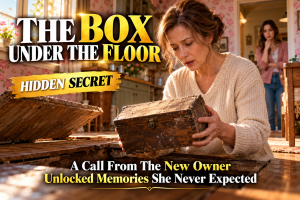
The woman who bought my childhood home called out of nowhere. She had found something sealed beneath the kitchen floor with my name on it. I thought it would be a forgotten toy. What waited inside that box forced me to face a part of my past I had carefully locked away for years.
Part 1
I was standing in the produce aisle of the grocery store when my phone rang. The number was unfamiliar, local but not one I recognized. I almost let it go to voicemail. Something about the timing, the ordinary fluorescent lights humming above the apples, made me answer anyway.
“Is this Elena Vargas?” a woman’s voice asked. It was careful, polite, a little uncertain.
“Yes,” I said.
“My name is Margaret Hale. I bought the house on Willow Lane last month. The one that used to belong to your family.”
My hand tightened around the phone. Willow Lane. The yellow house with the cracked porch steps and the maple tree that dropped leaves into the gutters every October. I had not set foot inside it for eleven years.
Margaret continued, her voice steady. “I was having some work done on the kitchen. The contractor lifted a section of the old floorboards near the sink and found something underneath. A sealed wooden box. Your name is written on the top in what looks like permanent marker. Elena Vargas.”
I stared at a display of oranges without seeing them. The fluorescent lights suddenly felt too bright.
“I assumed it was an old toy or some family keepsake,” I heard myself say, repeating the exact thought that had already formed in my mind.
“That’s what I thought too,” Margaret said. “But it’s sealed tight. No one has opened it. I wanted to call you before doing anything else. It felt like it belonged to you.”
I thanked her. My voice sounded distant even to me. We agreed I would come by the following Saturday morning. She gave me her address—my old address—and the call ended.
I finished shopping without remembering what I put in the cart. At the register the cashier had to repeat the total twice. Outside, the afternoon air felt thinner than usual. I sat in my car for several minutes before starting the engine.
The house on Willow Lane had been sold after my mother’s death. My brother and I had cleaned it out in a single exhausted weekend, boxing up what we could keep and donating the rest. The kitchen floor had never been mentioned. No one had ever spoken of anything hidden beneath it.
That night I lay awake listening to the ordinary sounds of my apartment—the refrigerator cycling on, a neighbor’s television through the wall. I kept seeing the kitchen as it had been when I was a child: the yellow Formica counters, the chrome faucet that dripped no matter how hard you turned it, the linoleum that had eventually been covered by the wooden floorboards someone installed later.
I wondered who had written my name on that box, and why it had been placed where no one was supposed to find it.
Saturday arrived gray and cool. I drove the familiar route almost without thinking. The neighborhood had changed in small ways—new paint on some houses, a taller fence here, a different car in a driveway—but Willow Lane still looked the same. The maple tree was larger. The porch steps had been repaired.
Margaret opened the door before I knocked. She was in her late forties, with kind eyes and a practical cardigan. She smiled as if we were already acquaintances.
“Thank you for coming,” she said. “Please, come in.”
The living room had been painted a soft gray. The old wallpaper was gone. New furniture sat where our worn sofa used to be. Yet the bones of the house remained. The same floorboards creaked under my feet as I followed her toward the kitchen.
The floor near the sink was open. Two boards had been carefully lifted and set aside. In the shallow space beneath them rested a small wooden box, the kind that might once have held tools or keepsakes. Dust coated the top. Across the lid, in black marker that had faded only slightly, was my name: Elena Vargas.
I crouched down. My hands felt unsteady.
“I haven’t touched it beyond moving it a few inches so the contractor could work,” Margaret said quietly. “It felt important to wait for you.”
I nodded. The box was heavier than it looked when I lifted it. The wood was solid, the lid sealed with old glue or perhaps a thin layer of paint that had hardened over time. There was no lock, only the tight seal of years.
Margaret offered me a chair at the small kitchen table. I set the box down carefully. For a long moment neither of us spoke.
“Would you like me to leave you alone with it?” she asked.
I shook my head. “No. It’s all right. I’d rather not be alone just yet.”
She sat across from me. The house smelled of fresh paint and coffee. Outside the window the maple tree moved slightly in the breeze.
I ran my fingers along the edge of the lid. The seal gave a little under pressure. With a soft crack the top lifted.
Inside, nestled in faded tissue paper, was a thick envelope and a small cloth-wrapped object. On the envelope, in the same handwriting as the name on the box, were the words: For Elena. When she is ready.
My mother’s handwriting.
I sat very still. The kitchen around me seemed to hold its breath. Margaret watched me with quiet concern but did not speak.
I opened the envelope.
Inside were several folded sheets of paper and a single photograph. The photograph showed me at about eight years old, standing in this same kitchen, holding a wooden spoon and laughing at something outside the frame. My mother stood behind me, one hand on my shoulder, smiling at the camera.
I turned to the first page of the letter.
The words blurred for a second. Then they came into focus, and the kitchen floor beneath me no longer felt solid.
Part 2
My mother’s handwriting was still familiar after all these years—the slight leftward slant, the way she looped her y’s. The letter began without greeting, as if she had been speaking to me already in her mind.
Elena,
If you are reading this, then the house has changed hands and someone found what I left. I hope it is you. I hope you are ready.
I set the page down for a moment. Margaret remained quiet, giving me space. The clock on the new stove ticked softly.
The letter continued.
There are things I never told you while I was alive. Not because I didn’t trust you, but because I didn’t know how to carry them and still be the mother you needed. Some truths are heavy. I chose to hold them alone for a long time.
I remember the summer you were nine. You asked me why your father left so suddenly. I told you he had work in another city. That was only partly true. The full story is more complicated, and it involves a choice I made before you were born.
I stopped reading. The photograph of the two of us in the kitchen suddenly felt heavier in my hand. I looked up at Margaret.
“She left this for me,” I said. My voice was low. “My mother.”
Margaret nodded once. “I thought it might be something like that. The way the box was sealed, the care that went into hiding it.”
I returned to the letter. The pages were dated nearly twelve years earlier, a few months before my mother had grown seriously ill.
The choice I made was to keep a part of our family history quiet. Your father’s family did not approve of me. There was money involved, land that had been in their name for generations, and expectations I never met. When things became difficult, your father chose to protect his inheritance rather than stay. I told you it was work because the truth felt too sharp for a child.
But there is more. The box contains something that belonged to your grandmother on your father’s side. She gave it to me in secret the week before she died. She asked me to keep it safe until you were old enough to decide what to do with it.
I lifted the small cloth-wrapped object from the box. The fabric was soft, faded blue, tied with a thin ribbon that had once been white. My fingers trembled as I untied it.
Inside was a gold locket on a delicate chain. The metal was warm from the closed space of the box. When I opened the locket, two tiny photographs looked back at me. One was a young woman I did not recognize, dark-haired and solemn. The other was a man who looked strikingly like my father, only younger.
Margaret leaned forward slightly. “May I?”
I handed her the open locket. She studied the faces for a long moment.
“They look like they belong together,” she said.
I turned back to the letter. My mother had written carefully, as if each sentence cost her something.
The locket was meant for you. Your grandmother wanted you to have it when the time was right. She believed that blood and history matter, even when the people involved have complicated the story. I disagreed with her for many years. I thought silence was kinder. Now I am not so sure.
If you choose to open the rest of what I left, you will find papers that explain the land, the money, and the reasons your father walked away. You may decide to do nothing with them. You may decide to reach out to people I have not spoken to in decades. That choice is yours now.
I folded the letter closed. The remaining pages stayed unread for the moment. The kitchen felt both familiar and strange. The same window looked out onto the same backyard, but the life that had once filled these rooms was gone.
Margaret spoke gently. “Would you like coffee? Or water? You’ve gone a little pale.”
“Coffee would be good,” I said.
While she moved around the kitchen, I sat with the open box and the locket in my palm. The gold was slightly scratched along the edges, the kind of wear that comes from being carried close to someone for years. I wondered how long my mother had kept it hidden before placing it under the floor.
Margaret set a mug in front of me. The coffee was strong and dark. I wrapped both hands around the warmth.
“I sold this house because I couldn’t keep it,” I said. “After my mother died, every room felt like it was waiting for her to walk back in. My brother and I thought selling would make it easier.”
“Did it?” Margaret asked.
“For a while. Then the ordinary days started again, and I realized I had left more than furniture behind.”
She nodded as if she understood something of that feeling. “When I first walked through this house with the realtor, I felt like the walls still held conversations. I bought it anyway. I needed a place that felt solid.”
We sat in comfortable silence for a few minutes. Outside, a neighbor’s dog barked once and then quieted. The maple tree’s leaves shifted in the light.
I picked up the remaining pages of the letter. My mother’s handwriting continued, more urgent now.
Elena, if you decide to look further, start with the deed copies I included. There is a parcel of land near the old family farm that was never properly transferred. Your father’s sister still lives in the area. Her name is Claudia. She may not welcome contact, but she knows the full story.
I stopped again. Claudia. I had heard the name once or twice as a child, spoken in low voices when adults thought I was not listening. I had never met her.
Margaret watched me carefully. “Whatever is in those papers, you don’t have to decide anything today.”
“I know,” I said. “But I think I need to read the rest.”
I unfolded the final pages. The letter ended with a single paragraph that made the room tilt slightly.
I am sorry I never told you while I could still look you in the eye. Some silences protect. Others simply delay the inevitable. I hope this box reaches you when you are strong enough to hold both the good and the difficult parts of our history. You always were stronger than you believed.
Love, Mom
I closed the letter and set it back in the envelope. The locket rested in my open hand. The two faces inside seemed to watch me with quiet patience.
Margaret refilled my coffee without asking. “Take as long as you need,” she said. “The house isn’t going anywhere.”
I looked around the kitchen—the new cabinets, the open section of floor, the same light falling across the same space where my mother had once stood behind me with her hand on my shoulder. The sealed box had waited years for this moment. Now it was open, and the past was no longer content to stay hidden.
I knew I would not leave until I understood what the papers meant, and what choice my mother had truly left me.
Part 3
I spent the next hour at Margaret’s kitchen table reading every page my mother had left. The papers were a mixture of old letters, a photocopy of a property deed, and a short handwritten note from a woman named Rosa—my paternal grandmother, according to the dates and the careful script.
The deed described a fifteen-acre parcel of land on the edge of a small town two hours north of the city. The ownership had been listed under my father’s family name for three generations. A handwritten annotation in the margin, in my mother’s writing, noted that the transfer to my father had never been completed after a family disagreement. The land remained in a kind of legal limbo, still tied to relatives I had never known.
Rosa’s note was brief and formal. It stated that the locket had been meant for the oldest granddaughter, and that the land carried responsibilities as well as value. She asked that the recipient of the box understand the history before making any decisions.
I looked up at Margaret. “There’s land,” I said. “And relatives I was never told about.”
She sat across from me, hands folded. “That must feel like a lot to take in all at once.”
“It does.” I touched the edge of the photograph again. “My mother always said my father’s side of the family was complicated. I thought that meant arguments and distance. I didn’t realize it meant actual property and people still living nearby.”
Margaret stood and walked to the window. “The contractor will be back on Monday to finish the floor. You’re welcome to leave the box here until you decide what to do, or take it with you. Either way is fine.”
I carefully replaced everything inside the wooden box and closed the lid. The seal was broken now. The past was no longer protected by floorboards and silence.
“I’ll take it,” I said. “I need time to think.”
Margaret walked me to the door. On the porch she hesitated. “If you ever want to talk about it, or if you need a quiet place to sit with the papers, you’re welcome back. This house seems to hold more than one story.”
I thanked her and carried the box to my car. The drive home felt longer than the journey there. Every few minutes I glanced at the passenger seat where the box rested, as if it might shift or speak.
That evening I spread the papers across my own kitchen table. The apartment was quiet. My brother Daniel lived two states away; I had not yet told him about the call or the discovery. Part of me wanted to keep the knowledge private a little longer, to understand it myself before sharing the weight.
I called him anyway.
He answered on the second ring. “Elena? Everything okay?”
“I’m not sure,” I said. “The woman who bought Mom’s house found something under the kitchen floor. A box with my name on it. Mom left letters and a locket and papers about land that belonged to Dad’s family.”
There was a long pause. I could hear the television in the background of his house, then the sound of it being muted.
“Land?” he said. “What kind of land?”
I explained what I had read. Daniel listened without interrupting. When I finished he was quiet for several seconds.
“Mom never mentioned any of that,” he said. “Not once. Not even when she was sick and we were going through the legal stuff.”
“I know. She wrote that she kept it quiet on purpose.”
Daniel exhaled slowly. “Do you want me to come out there? I can take a few days.”
“Not yet. Let me read everything again and maybe look into the deed. I’ll call you once I know more.”
After we hung up I sat with the locket open on the table. The two faces inside the gold frames looked calm, almost resigned. I wondered how many years the locket had waited in the dark under the floorboards, and whether my mother had ever opened the box again after she sealed it.
The next morning I drove to the county records office. The clerk was helpful but cautious. After reviewing my identification and the photocopy of the deed, she confirmed that the parcel still existed in the records under a trust related to my father’s family name. The last update had been more than twenty years earlier. No recent transfers had been filed.
“You’ll want to speak with the remaining trustee or any living relatives listed,” the clerk said. “I can give you the contact information that is still on file, but I can’t guarantee it’s current.”
She printed a single page. At the top was a name: Claudia Vargas Reyes. An address in the small town near the land. A phone number with a local area code.
I sat in my car outside the records office and stared at the paper. Claudia. The aunt my mother had mentioned only in the letter. The person who might know the full story of why my father left and why the land had never changed hands.
My phone felt heavy in my hand. I dialed the number before I could talk myself out of it.
It rang four times. A woman’s voice answered, older, measured.
“Hello?”
“Is this Claudia Vargas Reyes?” I asked.
“Yes. Who is this?”
“My name is Elena Vargas. I believe I may be your niece. My father was—”
The line went quiet for a moment. Then Claudia spoke again, her voice cooler. “I know who your father was. Why are you calling?”
I explained about the house, the box, the letter, and the deed. I kept my voice steady even though my pulse was racing.
Claudia listened. When I finished she said, “Your mother was always good at keeping secrets. I suppose she decided the time had come to stop.”
“I’d like to understand what happened,” I said. “And what the land means now.”
There was another pause. “Come to the farm next Saturday if you want answers. I’ll be here. Bring the papers. Don’t bring expectations.”
She gave me the address and ended the call without saying goodbye.
I sat in the parking lot for a long time after the call. The box was in the trunk of my car. The locket was in my pocket. The past my mother had carefully buried was no longer content to stay under the floorboards. It was rising, and it wanted to be faced.
I started the engine and drove home, already calculating the two-hour drive north and the conversation waiting at the other end.
Part 4
The week before my visit to Claudia passed in a strange mix of ordinary tasks and constant undercurrent. I went to work. I answered emails. I cooked simple meals and washed the dishes. Yet every evening I returned to the wooden box and the papers spread across my table. I read my mother’s letter again, then Rosa’s note, then the deed. Each time the words settled a little deeper.
Daniel called twice more. He offered again to fly out. I told him to wait. I needed to meet Claudia myself first. If the conversation went poorly, I did not want him standing in the middle of it.
Saturday morning arrived clear and cool. I packed the box carefully into a tote bag, along with a notebook and a bottle of water. The drive north took me through farmland that gradually opened into wider fields and older trees. The town near the parcel was small, the kind of place where the main street still had a hardware store and a diner with a faded sign.
Claudia’s address led me down a gravel road to a white farmhouse with a wide porch and a barn that had seen better decades. A woman in her seventies stood near the porch steps as I parked. She was tall, with silver hair pulled back and a posture that suggested she did not bend easily for anyone.
I got out of the car. “Claudia?”
“You’re Elena,” she said. It was not a question. “You look like your father around the eyes.”
She did not offer a hand or a smile. She simply turned and walked into the house, leaving the door open behind her. I followed.
The living room was neat and sparsely furnished. Old photographs covered one wall. I recognized none of the faces except, faintly, a younger version of my father in a group portrait near the center.
Claudia gestured toward a wooden chair. “Sit. Show me what your mother left.”
I opened the box and laid out the letter, the deed copy, and the locket. Claudia examined each item without speaking. When she opened the locket her expression shifted for the first time—something between recognition and regret.
“Rosa’s locket,” she said. “She always said it would go to the granddaughter. Your mother kept it all these years.”
“She said she was asked to hold it until I was ready.”
Claudia closed the locket and set it down. “Your mother and I never agreed on much. She believed silence protected people. I believed silence only delayed the reckoning.”
I waited. Claudia studied me for a long moment.
“Your father left because the family gave him a choice,” she said. “Stay with your mother and give up any claim to the land and the money that came with it, or return to the family expectations and keep the inheritance. He chose the inheritance. Your mother chose to raise you and your brother without that weight. She never asked for anything from us after he left.”
The words landed with the weight of something long expected yet still sharp. I had always known my parents’ separation was more complicated than the simple story of a job in another city. Hearing it stated so plainly made the childhood version feel thin and incomplete.
“And the land?” I asked.
“Still in the trust. Your father’s share was never transferred because the family refused to complete the paperwork after he remarried and moved away. The rest of us have managed it. It produces a modest income. Nothing dramatic. Enough to keep the taxes paid and the fences standing.”
Claudia leaned back in her chair. “Your mother left you those papers because she finally decided you deserved to know the full shape of things. Whether you want any part of it is another question.”
I looked at the open locket on the table between us. The two faces inside seemed smaller now, less like strangers and more like people who had made choices that still echoed.
“I don’t know what I want yet,” I said. “I only know I needed to hear the truth from someone who lived it.”
Claudia’s expression softened a fraction. “Truth is rarely clean. Your father was not a villain. He was a man who chose security over the life he had started. Your mother was not a saint. She was a woman who chose to protect her children from a family that had already rejected her. Both of them paid a price.”
We sat in silence for a while. Outside the window a tractor moved slowly across a distant field. The ordinary rhythm of the farm continued as if nothing significant was being said inside the house.
Claudia stood and walked to a small desk in the corner. She returned with a folder. “These are the more recent records. Income statements, tax documents, the current state of the trust. If you want to understand what exists, start here. You are under no obligation to claim anything. You are also free to walk away and leave the past where it was.”
I took the folder. The papers inside were neat, organized, the product of years of careful management. I felt the weight of decisions that had already been made by people I had never met.
“Thank you for seeing me,” I said.
Claudia nodded. “Your mother was stubborn. You seem to have inherited that. Use it carefully.”
She walked me back to the porch. As I reached my car she called out once more.
“Elena. The locket is yours. Rosa would have wanted that. The rest is up to you.”
I drove home with the folder on the passenger seat and the box in the trunk. The two-hour journey gave me time to turn the conversation over in my mind. My father had chosen the land and the security it represented. My mother had chosen silence and independence. Now the silence was broken, and the choice had passed to me.
That night I called Daniel and told him everything. He listened without interrupting. When I finished he was quiet for a long time.
“Do you want any of it?” he asked finally.
“I don’t know yet,” I said. “But I think I need to decide with my eyes open.”
We agreed to talk again after I had read the full set of records. After the call I placed the locket on the windowsill of my apartment. The gold caught the light from the streetlamp outside. The two faces inside looked back at me with the same quiet patience they had shown under the kitchen floor for years.
The past was no longer sealed. The next step would be mine.
Part 5
Over the following days I read every page in the folder Claudia had given me. The land generated a steady but modest income from a combination of hay leases and a small timber arrangement. Taxes were paid on time. The trust was managed conservatively. There were no dramatic fortunes waiting, only the quiet continuation of something that had existed longer than I had been alive.
I also researched the legal side. A local attorney who specialized in family property matters reviewed the documents and confirmed what Claudia had said. The trust still held the land. Any claim I might make would require formal notification of the other beneficiaries and a process that could take months. There was no guarantee of a favorable outcome. There was also no requirement that I pursue anything at all.
The attorney’s advice was practical. “You can request information. You can ask for a distribution of your father’s potential share if the trust allows it. Or you can decline any involvement and leave the management as it stands. The law does not force you to step into a story you did not choose.”
I left the office with a clearer sense of the options and a heavier sense of responsibility. Knowing the truth had been one kind of weight. Deciding what to do with it was another.
Margaret called one afternoon while I was still sorting through the papers. “I wanted to check on you,” she said. “The floor is finished now. The kitchen looks whole again. But I keep thinking about the box and whether you’ve found the answers you needed.”
I told her about Claudia and the land and the choice still waiting. Margaret listened with the same quiet attention she had shown the day I first opened the box.
“Houses hold more than we realize,” she said. “Sometimes the things left behind are meant to be found when the person is ready to carry them. Sometimes they’re meant to be released.”
After the call I walked through my apartment and tried to imagine what releasing the past might look like. I could put the papers in a safe place and never act on them. I could write a formal letter declining any claim and close the chapter. Or I could step into the complicated history and see what, if anything, still belonged to me.
That evening Daniel arrived without warning. He had taken a last-minute flight and rented a car from the airport. When I opened the door he simply said, “I couldn’t stay away any longer. Tell me everything again, and this time I’ll help you decide.”
We spent the next two days going through the documents together. Daniel was practical in a way that balanced my tendency to circle the same questions. He made lists. He calculated rough numbers. He asked hard questions about what we actually wanted from a piece of land we had never seen and relatives we had never known.
On the second evening we drove north together to look at the property itself. Claudia met us at the edge of the parcel. She did not seem surprised to see Daniel.
The land was quiet and open. Fields stretched toward a line of older trees. A small creek cut through one corner. There was no house, only the remnants of an old fence and a metal gate that had been repaired more than once.
“This is it,” Claudia said. “Fifteen acres. Nothing fancy. Good soil. Reliable water. It’s been in the family longer than any of us have been alive.”
Daniel walked a short distance into the field. I stayed near the gate with Claudia.
“Your mother never came here after the separation,” Claudia said. “She refused. Said the land had already cost her enough.”
“She was protecting us,” I said.
“She was protecting herself too. Both can be true at once.”
Daniel returned. His expression was thoughtful. “It’s beautiful in a quiet way. But beauty doesn’t answer the question of whether we belong to it.”
Claudia looked between us. “No one is asking you to belong. The offer is only to know, and then to choose.”
We drove back to the city in relative silence. The fields gave way to suburbs and then to the familiar streets of home. That night Daniel and I sat at my kitchen table with the locket between us.
“I keep thinking about Mom writing that letter and sealing the box,” I said. “She must have known there was a chance we would never find it. Or that we would find it and walk away.”
Daniel turned the locket over in his hands. “She left the choice with you for a reason. Your name was on the box. Not mine.”
“That doesn’t mean the decision is only mine.”
“No. But it means you get to decide first.”
I looked at the open pages of the letter again. My mother’s final paragraph still carried the same quiet weight it had the first time I read it. Some silences protect. Others simply delay the inevitable.
I closed the letter and set it aside. The decision was no longer abstract. It had a shape now—land, history, relatives, and the quiet possibility of either stepping forward or stepping back.
I needed one more conversation before I could choose.
Part 6
The next morning I called Claudia and asked if I could visit once more, alone this time. She agreed without comment. Daniel understood and stayed behind. He said he would be there when I returned, no matter what I decided.
The drive north felt different. The fields looked the same, the gravel road the same, yet something in me had shifted. I was no longer arriving as a stranger seeking answers. I was arriving as someone who already held the answers and needed to decide what to do with them.
Claudia met me on the porch. She had set out two chairs and a small table with glasses of water. We sat without preamble.
“I’ve read everything,” I said. “I’ve seen the land. I’ve talked to a lawyer. I understand the options.”
Claudia nodded. “And?”
“I need to know one more thing. Did my father ever regret the choice he made?”
She was quiet for a long time. A breeze moved through the trees near the barn. Somewhere a bird called and then went silent.
“He wrote to me once,” Claudia said. “Years after he left. The letter was short. He said he hoped your mother was well and that the children were growing strong. He never asked about the land. He never asked to come back. I think he made peace with the cost, or at least learned to live with it. Regret is a private thing. I cannot speak for what he carried in the quiet hours.”
I absorbed the answer. It was neither comforting nor devastating. It was simply human.
“And you?” I asked. “Do you regret how the family handled it?”
Claudia’s gaze moved toward the fields. “I regret that we forced a man to choose between his children and the only security he had ever known. I regret that your mother had to raise two children without the support she deserved. I do not regret protecting the land from being sold off in pieces by people who never loved it. Both of those things can live in the same heart.”
We sat with that honesty for a while. The ordinary sounds of the farm continued around us—the distant tractor, the wind in the grass, the creak of the porch boards under our chairs.
“I’ve decided,” I said at last. “I’m not going to make a formal claim on the land. It has been managed well. It belongs to the people who stayed and cared for it. But I want the locket. And I want the story. I want to know where I come from without needing to own the ground under my feet.”
Claudia studied me. For the first time since we met, something like approval softened her expression.
“Your mother would have understood that choice,” she said. “She never wanted the land. She wanted you free of the weight that came with it. Keeping the locket and the truth is enough.”
She went into the house and returned with a small envelope. Inside was a single photograph I had not seen before—my father as a young man, standing in the same field I had walked the day before, smiling at someone outside the frame. On the back, in faded ink, were the words: For the ones who come after.
“Take this too,” Claudia said. “History should not stay only with those who kept the silence.”
I placed the photograph with the locket. The two objects felt complete together.
Before I left, Claudia walked me to the edge of the property one last time. The fields stretched quiet and open under the afternoon light.
“You can visit if you ever want to see it again,” she said. “No claims. No expectations. Just the knowledge that the ground is still here.”
I thanked her. The drive home felt lighter than any of the previous journeys. The box in the trunk no longer carried unanswered questions. It carried a finished chapter and a choice I could live with.
Daniel was waiting when I arrived. I told him everything. He listened, then nodded.
“That sounds like the right ending,” he said. “Mom would have been proud of how carefully you handled it.”
We spent the evening packing the papers into a new folder—one that would stay with me, not under any floorboards. The wooden box itself I decided to keep. It had held the secret long enough. Now it could hold the memory of the day the secret ended.
Later that night I called Margaret. She answered on the first ring, as if she had been expecting the call.
“I made my decision,” I told her. “I’m keeping the story and the locket. I’m leaving the land where it belongs.”
Margaret was quiet for a moment. Then she said, “I’m glad the box found its way to you. And I’m glad the house could be part of the ending, even if it was only the beginning of the discovery.”
After we hung up I sat by the window with the locket open in my hand. The two faces inside no longer felt like strangers. They felt like the start of a longer line that included my mother, my father, Claudia, Daniel, and me.
The sealed box had done its work. The silence was broken. The choice had been made. What remained was the ordinary work of living with the truth instead of under it.
Part 7
In the weeks that followed, the intensity of the discovery settled into something quieter. Life returned to its usual rhythms—work, errands, the small conversations that make up most days—yet the knowledge of the land and the family history stayed with me like a low, steady note.
I wrote a formal letter to the trust, stating that I declined any claim to the property and requested no further correspondence on the matter. The attorney reviewed it, I signed it, and the letter was sent. A brief acknowledgment arrived a month later. The matter was closed.
Daniel and I talked more often than we had in years. The shared knowledge of our mother’s letter and the visit to the farm created a new kind of closeness. We no longer spoke only about the present. We could speak about the past without the old careful omissions.
One weekend he flew out again, and we drove north together one final time. Claudia met us at the gate. She had prepared nothing elaborate—only coffee and a quiet walk along the edge of the fields. We did not talk much about the old decisions. We talked about the weather, the condition of the fences, the way the light changed across the grass in late afternoon. It felt like the beginning of a different kind of relationship—one built on presence rather than inheritance.
Before we left, Claudia pressed a small packet of seeds into my hand. “From the meadow near the creek,” she said. “Plant them if you want. Or don’t. They’re only seeds.”
I planted them in a pot on my apartment balcony. Most of them grew. The flowers that appeared were simple and pale yellow, nothing dramatic, but they opened every morning toward the light. I found myself checking them the way I used to check the maple tree outside the kitchen window on Willow Lane.
Margaret invited me back to the house for coffee one Saturday. The kitchen floor was seamless again. No one would ever know a box had waited beneath it for years. We sat at the same table where I had first opened the letter. The conversation was easy. She told me about the small changes she was making—new curtains, a garden bed along the side of the house. I told her about the seeds and the quiet decision I had made.
“I’m glad the house could give something back,” she said. “Even if it was only a box and a truth.”
I left that afternoon with a sense of completion I had not expected. The house on Willow Lane no longer felt like a place I had abandoned. It felt like a place that had finished its part of the story and could now belong fully to someone else.
At home I placed the wooden box on a shelf in the living room. Inside it I kept the locket, the photograph Claudia had given me, my mother’s letter, and a copy of the formal letter declining the claim. The original deed papers I returned to Claudia for the trust records. The box no longer needed to be sealed. It simply needed to be present.
Some evenings I opened the locket and looked at the two faces. I no longer tried to invent stories about them. I let them remain what they were—people who had lived, chosen, and left traces that eventually reached me. That was enough.
Daniel called one night and asked whether I ever regretted not pursuing the land.
“No,” I said. “The land was never really the point. The point was knowing why things happened the way they did, and deciding I didn’t need to fix what was never mine to fix.”
He was quiet for a moment. “Mom did the best she could with what she had. So did Dad, in his way. We’re the ones who get to live with clearer eyes.”
After the call I stood at the window and watched the city lights. The sealed box under the kitchen floor had been a message from the past. Opening it had not rewritten the past. It had simply allowed me to stop carrying the weight of not knowing.
The story was no longer hidden. It was simply part of the longer story of a family that had made difficult choices and still managed, in the end, to leave something honest behind.
Part 8
Autumn arrived with its usual mix of cooler air and earlier evenings. The yellow flowers on my balcony began to fade. I collected the last of the seeds and saved them in a small envelope labeled with the year and the name of the meadow. It felt like a quiet way of keeping a connection without needing ownership.
I returned once more to the county records office, this time only to confirm that the formal letter had been properly filed. The clerk noted the update and wished me well. The file on the trust would continue without my name attached to any claim. That felt correct.
Claudia sent a short note a few weeks later. It arrived in a plain envelope with no return address beyond her name. Inside was a single sentence written in her careful hand: The fields are still here if you ever want to walk them. No signature beyond her first name. I placed the note with the other papers in the wooden box.
Margaret and I continued to speak occasionally. She told me about a community garden starting in the neighborhood and asked if I wanted to help with the planning. I said yes. Working in the soil of the same streets where I had grown up felt like a different kind of return—one that asked nothing of the past except the willingness to plant something new.
One afternoon while we were measuring beds in the garden plot, Margaret paused and looked at me.
“Do you ever wonder what would have happened if the box had never been found?” she asked.
I considered the question. “I used to think the silence was protection. Now I think it was just unfinished business. Finding the box didn’t fix anything that was already broken. It only gave me the chance to stop pretending the broken pieces weren’t there.”
Margaret nodded. “That’s a better kind of ending than most people get.”
Daniel flew out for the holidays. We spent Christmas in my apartment with the wooden box on the shelf and the locket nearby. We did not make a ceremony of it. We simply lived with the knowledge that the full story was finally shared between us. On Christmas morning he gave me a small framed print of the maple tree on Willow Lane, taken from an old photograph our mother had kept. I hung it near the shelf where the box rested.
In the new year I began writing down what I remembered of my mother’s stories, the ones she had told and the ones she had left unsaid. I did not write them for publication. I wrote them so that the next generation—if there was one—would not have to discover the truth under a kitchen floor. The pages accumulated slowly. Some days I wrote nothing. Other days the words came easily. The act of recording felt like the final step of opening the box: not just receiving the past, but deciding how to pass it forward.
Claudia invited Daniel and me to a quiet family gathering in the spring. It was not large—only a few relatives who still lived near the land. The conversation was careful at first, then gradually more open. No one asked about claims or inheritance. They asked about our lives, our work, the ordinary details that make people real to one another. When the afternoon ended, Claudia walked us to our car.
“You chose well,” she said. “The land will continue. So will you. That is enough.”
On the drive home Daniel was quiet for a long stretch of road. Finally he said, “I keep thinking about how close we came to never knowing any of this. One set of floorboards, one contractor, one phone call.”
“And one woman willing to call a stranger instead of throwing the box away,” I added.
He smiled. “Margaret. We should send her something.”
We did. A simple thank-you note and a small plant for her kitchen window. She replied with a photograph of the plant already growing toward the light.
The sealed box had started a chain of ordinary, careful choices. Each one had led to a clearer sense of where we stood and what we no longer needed to carry.
I no longer felt the pull of unfinished business. The past had been opened, examined, and set in its proper place. What remained was the ongoing work of living in the present with open eyes.
Part 9
By the following summer the wooden box had become simply part of the furniture of my life. Visitors sometimes asked about it. I told the story when it felt right—briefly, without drama. Most people listened, nodded, and moved on to other topics. A few asked more questions. I answered what I could and left the rest where it belonged.
I returned to the land only once more that year, alone. Claudia was away visiting a friend, but she had left the gate unlocked and a note on the porch: Walk if you want. The fields don’t mind. I walked the edge of the property for nearly an hour. The grass was high. The creek moved slowly under the trees. Nothing dramatic happened. I simply stood in a place that had shaped decisions long before I was born, and then I left.
On the drive back I stopped at the diner in the small town and ordered coffee. The waitress was young and friendly. She asked if I was visiting family. I said yes, in a way. It felt true enough.
Margaret’s community garden flourished. I spent several Saturday mornings there, pulling weeds and talking with neighbors I had not known as a child. One of them remembered my mother from the old neighborhood association meetings. She spoke of her with the easy affection of someone who had shared ordinary hours. Hearing those small stories felt like another kind of inheritance—one that required no legal papers and no difficult choices.
Daniel and I began a quiet tradition of meeting once a year near the anniversary of the day the box was found. We did not make speeches. We simply shared a meal and talked about whatever was current in our lives. The past no longer dominated the conversation. It simply sat at the table with us, acknowledged and no longer demanding.
One evening after one of those dinners, Daniel asked whether I ever opened the locket anymore.
“Sometimes,” I said. “Not to search for answers. Just to remember that the story is longer than the part we lived.”
He nodded. “That’s a good reason.”
I continued writing the pages about my mother’s life and the choices that had shaped ours. The stack grew slowly into a thin manuscript. I did not know what I would do with it. For now it was enough that the words existed outside my own memory.
In late autumn I received a short email from Claudia. She had decided to update the trust documents to include a provision for community education about the land’s history. She asked if I would be willing to contribute a brief written account of how the box had been found and what it had meant. I wrote the account carefully, focusing on the discovery and the decision to leave the land in the hands of those who had cared for it. Claudia replied with a single word: Perfect.
The email felt like a quiet closing of a circle. The secret that had waited under the kitchen floor had traveled outward into the open, and now it would become part of a larger, shared record.
I stood at my window that evening with the locket in my hand. The gold was warm from my skin. The two faces inside looked the same as they always had. I closed the locket and returned it to the box.
The story was complete in the ways that mattered. The rest would continue without needing me to hold every thread.
I turned off the light and went to bed. Sleep came easily. The past no longer required vigilance. It had been faced, honored, and released.
Part 10
Years later I still keep the wooden box on the shelf in my living room. The locket rests inside it, along with my mother’s letter, the photograph Claudia gave me, and the small packet of seeds from the meadow. Sometimes I open the lid simply to feel the weight of the wood and remember the afternoon Margaret first called.
The house on Willow Lane has new owners now. Margaret moved to be closer to her daughter. Before she left she invited me over one last time. We stood in the kitchen where the floorboards had once been lifted and talked about ordinary things—gardens, weather, the way neighborhoods change. When I left, she handed me a small keychain made from a piece of the original maple tree that had been trimmed during a storm. “For the road,” she said. I still use it.
Daniel and I remain close. We speak often about the present and only occasionally about the past. The land continues under the care of the trust. Claudia sends a Christmas card every year with a brief note about the fields. I reply with news of the yellow flowers that still grow on my balcony from the seeds she once gave me.
I never claimed the property. I never needed to. The real inheritance was the truth itself—the knowledge of why my parents’ lives had taken the shape they did, and the freedom to decide that I did not have to carry the same weight forward.
On quiet evenings I sometimes reread my mother’s final paragraph. Some silences protect. Others simply delay the inevitable. She was right about both. The silence she kept protected my childhood. The letter she left ended the delay. Opening the box did not erase the difficult choices that came before. It only allowed me to stop living as if those choices were still secret.
The sealed box under the kitchen floor had been waiting for the right moment and the right person. When the moment arrived, the person who answered the phone was ready enough. That was all the story required.
I no longer feel the pull of unfinished business. The past has been opened, understood, and set in its place. What remains is the ordinary, ongoing work of living with clearer eyes and a quieter heart.
The woman who bought my childhood home called me one ordinary afternoon and changed the shape of what I knew about my own life. In return I learned that some discoveries are not about gaining something new. They are about finally setting down what was never meant to be carried alone.
The box is open now. The silence is finished. The rest of the story belongs to the days still ahead.
