For decades, my grandfather kept one old doctor’s notebook hidden among ordinary family belongings. I expected faded medical notes, nothing more. Then I found the entry about a young mother, a newborn baby, and a name that belonged to my own family.
Part 1
The notebook was smaller than I expected.
I found it in the spring of 1975, while helping my mother clean out my grandfather’s house in Illinois. He had been gone for several months, and every room seemed to contain something he had decided was too useful, too sentimental, or too mysterious to throw away.
There were old receipts in kitchen drawers, broken watches in cigar boxes, letters tied with string, and photographs of people whose names I could no longer remember.
My grandfather had never been good at explaining why he kept things.
“If it survived this long,” he used to say, “there’s probably a reason.”
I remembered those words when I opened the bottom drawer of his desk.
The notebook was underneath several old insurance papers and a bundle of yellowed envelopes.
I almost put it back.
There was no name on the cover. Only a faint impression where something had once been stamped into the leather.
I carried it into the afternoon light and opened it.
The first pages were filled with handwriting so neat that it looked printed.
Patient names.
Dates.
Symptoms.
Prescriptions.
Observations.
Most entries were brief and ordinary.
A child with a persistent fever.
An elderly farmer with trouble sleeping.
A woman recovering from childbirth.
A young man complaining of headaches.
Nothing seemed unusual.
The dates placed the notebook in the late 1920s.
I turned page after page.
Then I reached an entry dated 1928.
The doctor’s handwriting became slightly less steady.
I read it twice.
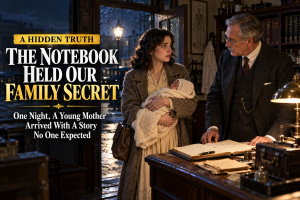
The doctor had written about a young woman who arrived at his office one night carrying a newborn baby.
The name stopped me.
I knew it.
Not because I had heard it recently.
Because I had seen it in my grandmother’s Bible.
The woman was my great-grandmother.
I sat down.
For several minutes, I simply stared at the page.
My great-grandmother had died long before I was born, and family stories about her were strangely limited. I knew she had married young. I knew she had raised children. I knew almost nothing about the years before her marriage.
My mother had once told me that people in her generation did not discuss everything that happened before a wedding.
I had laughed at the time.
Now I wondered what she meant.
I continued reading.
The doctor had written that the young woman seemed exhausted and frightened. She had asked him to examine the baby. She had also asked him to keep their visit private.
Then the entry ended.
Several pages were missing from the notebook.
I checked the binding.
The pages had not simply fallen out. They had been removed carefully.
I turned farther.
More ordinary notes.
Then, near the end of the book, I found another entry referring to the same woman.
My hands became cold.
The final page contained only three sentences.
My grandfather had underlined the last one twice.
I read the first sentence.
Then the second.
I stopped before the third.
For the first time, I understood why my grandfather had kept the notebook.
And I understood why he had never mentioned it to anyone.
Part 2
The next morning, I took the notebook to my mother.
She was sitting at the kitchen table sorting photographs into envelopes when I placed it beside her.
She looked at the cover.
Then she looked at me.
“Where did you find that?”
“In Grandpa’s desk.”
She did not touch it.
That frightened me more than if she had immediately opened it.
“Mom?”
She wiped her hands on a dish towel and finally picked up the notebook.
Her eyes moved over the leather cover.
“I haven’t seen this since I was a girl.”
“You knew about it?”
“I knew your grandfather had it.”
“Did you know what was inside?”
She hesitated.
“Not exactly.”
That answer was too careful.
I opened to the page with my great-grandmother’s name.
My mother read the entry.
Her expression changed.
Not dramatically.
She simply stopped breathing for a second.
Then she closed the notebook.
“Where did you get this page?”
“It was already there.”
She looked toward the window.
Outside, a neighbor was mowing his lawn. The ordinary sound seemed almost absurdly loud.
“Mom, what happened?”
“I don’t know.”
“You recognized her.”
“Of course I recognized her.”
“No. I mean you recognized what the doctor wrote.”
She remained silent.
I pushed the notebook toward her.
“The last page has three sentences.”
“I don’t want to read them.”
“Why?”
“Because sometimes knowing something doesn’t make it better.”
I had heard my grandfather say almost the same thing.
That was when I realized this secret was older than the notebook.
My mother finally opened the last page.
She read the first sentence.
Her lips tightened.
She read the second.
Then she reached the third.
Her eyes stopped.
She did not continue.
“What does it say?”
She closed the notebook.
“You should put this away.”
“That isn’t an answer.”
“It is the only answer I’m giving you.”
“Why?”
“Because your grandfather made a promise.”
“To whom?”
She looked at me.
“I don’t know.”
That was the strangest part.
My mother was not avoiding the question because she was angry.
She looked afraid of breaking something.
I asked her what she remembered about my great-grandmother.
She gave me the family version.
My great-grandmother had grown up in Illinois. She married young. She had several children. She was quiet, practical, and never spoke much about her childhood.
“Was she married when she had the baby in the notebook?”
My mother looked down.
“I don’t know.”
“But the doctor wrote that she arrived alone.”
“I said I don’t know.”
“Then why did Grandpa keep this?”
She stood and began collecting the photographs.
“Your grandfather believed some family stories belonged to the people who lived them.”
“And now they’re all gone.”
She stopped.
That sentence seemed to reach her.
After a moment, she sat down again.
“Not all of them,” she said.
I waited.
“My grandmother had a sister.”
I had never heard that before.
“What was her name?”
My mother shook her head.
“I don’t remember.”
“You never heard of her?”
“I heard something once. When I was little. My mother was talking to your grandmother, and they stopped when I entered the room.”
“About what?”
“I don’t know.”
“Mom.”
She looked directly at me.
“If you keep reading that notebook, you may find something nobody intended you to know.”
I looked at the leather cover.
“That is exactly why I need to read it.”
She sighed.
“Then don’t come back to me asking me to make it disappear.”
That afternoon, she gave me the name of an elderly woman who had once been a neighbor of my great-grandmother.
Before I left, my mother said one more thing.
“Ask her about the baby.”
I turned around.
“What baby?”
She looked at the notebook.
“The one your great-grandmother carried into that office.”
Part 3
The woman lived less than ten miles away.
Her name was Clara Bell.
She was eighty-six years old and lived alone in a small white house with a porch full of flowerpots.
When I introduced myself, she stared at my face for a long moment.
“You have her eyes,” she said.
“My great-grandmother?”
Clara nodded.
“Come inside.”
She remembered my family better than I expected.
She remembered my great-grandmother’s voice.
She remembered the blue dress she wore every Sunday.
She remembered that she had a habit of touching the edge of a table whenever she was nervous.
And she remembered the night the baby arrived.
“I was not there,” Clara said. “But I heard about it.”
“From whom?”
“My sister.”
“Who was your sister?”
“Margaret.”
The name meant nothing to me.
Clara noticed my expression.
“She knew your great-grandmother.”
“Were they friends?”
“They were more than that.”
“How?”
Clara looked toward the kitchen.
“My sister worked for the doctor.”
I sat forward.
“The doctor who wrote the notebook?”
“Yes.”
“What did she do?”
“Answered the telephone. Cleaned the office. Kept his appointments. Sometimes stayed late.”
I told her about the notebook.
She listened without interrupting.
When I mentioned the missing pages, her face became serious.
“They were removed?”
“Yes.”
“Then someone was afraid of what was written there.”
“Do you know what it was?”
“No.”
She paused.
“Not exactly.”
Everyone seemed to know exactly enough to frighten me but never enough to explain anything.
Clara told me that in 1928, my great-grandmother was very young.
“She came to the doctor because the baby was sick?”
“That is what I heard.”
“Was the baby hers?”
Clara stared at me.
“You know the answer to that.”
“I think I do.”
“You shouldn’t assume.”
“Then tell me.”
She folded her hands.
“Your great-grandmother had recently left home.”
“Why?”
“She was supposed to marry someone.”
“Did she?”
Clara shook her head.
“No.”
“Why not?”
“Because she disappeared.”
I looked at the notebook.
“Where did she go?”
“That was the question everyone asked.”
Clara’s voice lowered.
“She returned several weeks later carrying a baby.”
I felt a strange pressure in my chest.
“Was the baby mine?”
“Not exactly.”
“What does that mean?”
Clara stood and walked to an old cabinet.
She opened a drawer and removed a photograph.
It showed four people standing outside a wooden building.
One was the doctor.
One was a young woman I recognized immediately from family photographs.
My great-grandmother.
The third was a younger woman with a baby in her arms.
The fourth was Margaret.
I stared at the photograph.
“Who is the other woman?”
Clara did not answer.
I looked closer.
The two young women had similar eyes.
Similar mouths.
Similar expressions.
Then I understood.
“They’re sisters.”
Clara nodded.
“My great-grandmother had a sister.”
“Yes.”
“What happened to her?”
Clara returned the photograph to the drawer.
“She went away.”
“Where?”
“I don’t know.”
“Did she take the baby?”
Clara looked at me.
“That is the question your family spent decades avoiding.”
I felt suddenly dizzy.
“The doctor knew?”
“He knew more than most.”
“Then why didn’t he tell anyone?”
“Because he was asked not to.”
“By whom?”
Clara looked toward the window.
For a long time, she said nothing.
Then she whispered, “By your great-grandmother.”
That evening, I returned home and opened the notebook again.
The final three sentences were still there.
I read the first.
Then the second.
I forced myself to read the third.
My grandfather had underlined it twice.
The sentence did not name the baby.
It named the person who had come back for the child.
And that person was not my great-grandmother.
Part 4
I spent the next week searching through family records.
There were no computers, no searchable databases, and no easy way to discover a person’s history from a few words written nearly fifty years earlier.
I went through boxes.
Birth certificates.
Marriage records.
Old newspapers.
Church documents.
Letters.
My grandmother’s Bible.
I found almost nothing.
Then, tucked inside the back cover of the Bible, I found a folded piece of paper.
It contained three names.
My great-grandmother.
Her sister.
And the doctor.
Under the names was a date.
The same date as the notebook entry.
I took the paper to my mother.
She stared at it.
“Where did you find that?”
“In Grandma’s Bible.”
She sat down.
“Why didn’t anyone tell me about her?”
“About who?”
“My great-grandmother’s sister.”
My mother looked at the paper.
“I think her name was Evelyn.”
“Why do you say ‘think’?”
“Because nobody ever said it directly.”
“That’s impossible.”
“No. It isn’t.”
She told me that when she was a child, there had been one rule in her mother’s house.
Never ask about Evelyn.
She had assumed it was because Evelyn had left the family.
But there was something else.
“She came back once,” my mother said.
“When?”
“I don’t know. Before I was born.”
“What happened?”
“She stood outside the house.”
“Did she see my great-grandmother?”
“I don’t know.”
“Did she see the baby?”
My mother closed her eyes.
“I remember hearing my mother say, ‘She has no right.’”
I waited.
Then my mother continued.
“Your grandmother told me never to repeat it.”
I returned to Clara.
She was weaker this time.
I showed her the paper.
She immediately recognized the handwriting.
“That was Evelyn.”
“You knew her?”
“I knew of her.”
“What happened between the sisters?”
Clara took a long breath.
“They both loved the same man.”
I felt a chill.
“Who?”
She gave me a name.
It was the same man listed as my great-grandfather on the family marriage record.
“But he married my great-grandmother.”
“Yes.”
“Was Evelyn also involved with him?”
“That was what people believed.”
“Did she have the baby?”
Clara looked down.
“I don’t know.”
“Then who did?”
“The doctor knew.”
That sentence brought me back to the notebook.
I asked Clara why the doctor would keep such a record.
“Because he believed records mattered.”
“Even family secrets?”
“Especially family secrets.”
She explained that the doctor had treated both sisters.
He knew about Evelyn’s pregnancy.
He knew about my great-grandmother’s marriage plans.
And he knew about the child.
But the story had never been as simple as the family version suggested.
Evelyn had wanted to keep the baby.
My great-grandmother had wanted to protect the child.
The father had disappeared from the situation entirely.
Then something happened.
“What?”
Clara shook her head.
“You need to read the notebook.”
“I already did.”
“Not the final page.”
“I did.”
“No.”
She leaned closer.
“You read the final page as a granddaughter.”
“What does that mean?”
“You need to read it as if you were the doctor.”
I returned home and examined the notebook under a brighter lamp.
The final page had three sentences.
But beneath them was something I had overlooked.
A faint indentation.
Writing had been pressed into the paper before the page had been closed.
I held a pencil sideways and gently shaded the surface.
Letters appeared.
Not enough to form a complete sentence.
But enough to identify a word.
“Evelyn.”
I stopped.
There was another impression.
“Child.”
And another.
“Promise.”
I sat there until midnight.
Then I noticed something else.
The leather binding had a narrow gap near the back.
Something was hidden inside.
I carefully opened the seam.
A folded sheet of paper slid out.
It was not written by the doctor.
The handwriting was feminine.
The first line began:
Doctor, if I come back, please give her the letter.
There was no signature.
But I recognized the handwriting.
It matched the note in my grandmother’s Bible.
It was Evelyn’s.
And the letter was dated three days after the final entry in the doctor’s notebook.
Part 5
I did not open the letter immediately.
That surprised me.
After weeks of searching, I had finally found the thing I thought I wanted.
Yet I sat at my kitchen table with the folded paper in front of me and could not bring myself to touch it.
There is something different about discovering a secret and discovering that someone once deliberately wrote a message for the person who would eventually find it.
The letter had survived almost half a century before I was born.
It had survived my great-grandmother.
It had survived my grandfather.
It had survived every person who could have explained it.
And now it was waiting for me.
I opened it.
The writing was uneven.
Evelyn began by apologizing.
Not for leaving.
Not for the baby.
For what she had allowed other people to believe.
She explained that she and my great-grandmother had been closer than sisters.
They had shared a room as children.
They had shared clothes.
They had shared secrets.
When Evelyn became pregnant, my great-grandmother had been the first person she told.
The father was not my great-grandfather.
That part of the family story had been wrong.
Evelyn had met a traveling musician who passed through town. He left before she knew she was expecting a child.
When her pregnancy became obvious, the family feared scandal.
My great-grandmother was already promised to the man she would eventually marry.
Evelyn was sent away to stay with relatives.
The baby was born there.
But Evelyn returned to Illinois because she wanted her child near the only family she trusted.
That was when the doctor became involved.
The newborn had been weak.
Evelyn had brought the baby to the doctor’s office at night because she feared the child might not survive without care.
The doctor treated the baby.
He also warned Evelyn that she could not raise the child alone under the circumstances.
Then came the decision that had changed the family forever.
Evelyn asked her sister to take the baby.
My great-grandmother agreed.
But there was another condition.
Nobody could know the truth.
My great-grandmother would raise the baby as her own.
The child would grow up believing she was her mother’s daughter.
Evelyn would leave.
Not because she did not love her child.
Because she believed leaving was the only way to give the baby a stable life.
I stopped reading.
The baby was my grandmother.
I had to reread the sentence.
My grandmother had not been my great-grandmother’s biological daughter.
She had been Evelyn’s daughter.
The realization rearranged every photograph in my memory.
Every family story.
Every resemblance.
Every unexplained silence.
I continued.
Evelyn wrote that she had returned several years later.
She had wanted to see her daughter.
She stood outside the house.
But my great-grandmother refused to let her enter.
Evelyn accepted that.
She had promised not to disrupt the child’s life.
Then she wrote something that made me put the letter down.
She said she had returned one final time because she had learned that my great-grandmother was considering telling the child the truth.
Evelyn begged her not to.
Not because she wanted the secret for herself.
Because she feared the truth would make the child believe she had been unwanted.
Evelyn ended the letter with a request to the doctor.
If she ever returned again, he was to give the letter to her daughter.
But she never returned.
The final line was addressed not to the doctor, but to the child.
I read it three times.
“I loved you enough to leave you where you could belong.”
I sat in silence.
For years, my family had treated Evelyn as a missing person in the family story.
A woman who had left.
A woman whose name was never spoken.
But she had not simply disappeared.
She had made a choice.
A painful one.
A choice that allowed her daughter to grow up surrounded by people who believed she belonged there.
The question remained.
Why had my grandfather kept the notebook?
Why had he underlined the doctor’s final sentence twice?
I returned to the last page.
The third sentence said:
“Her sister took the child, but the child must someday know who first held her.”
That sentence was the reason my grandfather had preserved the notebook.
He had known.
And apparently, he had decided that someday someone in the family should know too.
Part 6
My grandfather had left another clue.
It was in the desk.
I found it because I had stopped looking for a dramatic secret and started looking for the habits of an ordinary man.
My grandfather labeled everything.
Receipts.
Photographs.
Tools.
Even old keys.
Inside the same drawer where I found the notebook was a small envelope marked with a year.
Inside were two photographs and a train ticket.
The first photograph showed Evelyn.
She looked younger than I had imagined.
The second showed my great-grandmother holding a baby.
On the back was written:
“For the child, when the time is right.”
I took both photographs to my mother.
She cried when she saw them.
Not loudly.
She simply held the photograph against her chest.
“That’s her,” she said.
“Evelyn?”
“Yes.”
“Did you ever see her?”
“No.”
“Then how do you know?”
“Because your grandmother had this photograph.”
“Where?”
“She kept it hidden.”
My mother told me something I had never known.
My grandmother had discovered the truth when she was nineteen.
Her mother had finally told her.
But she had not told her everything.
She said only that Evelyn was her biological mother and that she had left because she believed another family could give her a better life.
My grandmother spent the rest of her life wondering whether that explanation was true.
She never found Evelyn.
At least, that was what everyone believed.
I asked my mother whether my grandfather knew.
“He knew.”
“How?”
“My grandmother told him.”
“So why didn’t he tell us?”
“Maybe because he promised not to.”
I thought about the final sentence.
Then I noticed the train ticket.
It was dated 1934.
Six years after the doctor’s final entry.
The destination was Chicago.
The passenger name was Evelyn.
I searched newspapers.
Nothing.
I searched old directories.
Nothing.
Then I found a church record showing that a woman with Evelyn’s name had worked at a boarding house in Chicago during the 1930s.
There was no photograph.
No family record.
No obituary.
But there was a letter.
The boarding house had donated its old records to a local historical society.
One afternoon, I drove there.
The archivist brought out a box.
Inside were handwritten ledgers and correspondence.
I found Evelyn’s name in a guest register.
She had stayed there for eleven months.
Then she left.
But the address she gave for her next destination was not another city.
It was a small town in Wisconsin.
I drove there the following week.
The town was quiet.
The old address was now a hardware store.
But an elderly shopkeeper remembered the previous owners.
He remembered a woman named Evelyn.
“She lived behind the church,” he said.
“Do you know what happened to her?”
He thought for a moment.
“She became a schoolteacher.”
I almost laughed.
It was such an ordinary ending for a woman who had lived such an extraordinary secret.
Then he added:
“She had a daughter.”
My breath caught.
“Her daughter?”
“Yes.”
“Did she ever talk about her?”
The shopkeeper looked at me.
“She talked about her every Christmas.”
I stood there in silence.
“Do you know where the daughter lived?”
He pointed toward the church.
“She lived nearby.”
I drove home that evening with a new understanding.
The secret had not disappeared.
It had simply traveled through generations.
My great-grandmother had raised a child who was not biologically hers.
Evelyn had spent decades loving a daughter from a distance.
My grandmother had learned the truth but carried it quietly.
My grandfather had preserved the evidence.
And now I had become the next person holding it.
But there was still one thing I could not explain.
Why had my grandfather underlined the doctor’s final sentence twice?
I read it again.
The wording seemed strange.
The child must someday know who first held her.
Not who her mother was.
Not who her father was.
Who first held her.
I suddenly remembered something from my childhood.
My grandfather had once told me that my grandmother’s first photograph had been taken in a doctor’s office.
I had assumed he was joking.
Now I wondered.
Perhaps he had known exactly where that photograph came from.
Part 7
The next discovery came from an old photograph album.
It belonged to my grandmother.
My mother had kept it in a closet for years.
I had seen the album many times, but never opened every page.
Inside was a photograph of my grandmother as a baby.
She was wrapped in a pale blanket.
Behind her stood the doctor.
Beside him was my great-grandmother.
And in the corner, almost hidden behind the doctor’s shoulder, was Evelyn.
I stared at her face.
She was smiling.
Not at the camera.
At the baby.
The photograph answered something I had never known to ask.
Evelyn had not simply handed the baby over and disappeared.
She had stayed long enough to see her daughter safely placed in her sister’s arms.
The doctor had taken the photograph.
And my great-grandmother had kept it.
That meant the family secret was not built entirely from shame.
There had also been love.
Complicated love.
The kind that could make people do things they could never explain without sounding cruel.
I asked my mother why my great-grandmother never told the family.
“She was afraid,” she said.
“Of what?”
“That the truth would divide everyone.”
“Did it?”
“It divided her.”
My mother told me that in later years, my great-grandmother sometimes received letters.
They were always from the same woman.
Evelyn.
She never showed them to anyone.
But my grandmother had once found a bundle of them.
She read only one.
Evelyn had become a teacher.
She had never married.
She had never had another child.
Every year, she wrote about her daughter.
She asked whether the girl liked books.
Whether she was healthy.
Whether she had learned to play music.
Whether she smiled like her.
My grandmother never replied.
Not because she hated Evelyn.
Because she did not know how.
She had spent her childhood believing one woman was her mother.
Then, as a young adult, she learned that another woman had given birth to her.
Both truths were real.
Neither could erase the other.
My grandmother eventually became a mother herself.
She chose not to tell her children.
That was why my mother had known almost nothing.
The silence had been passed down like an heirloom.
I asked my mother whether she regretted not knowing earlier.
She looked at the old photograph.
“I regret that everyone thought silence was the same thing as protection.”
That sentence stayed with me.
I returned to the notebook one final time.
There was one page I had ignored.
It was not written by the doctor.
It was written by my grandfather decades later.
The handwriting was unmistakable.
He explained that he had found the notebook after my grandmother told him the family secret.
He had contacted the historical society.
He had searched for Evelyn.
He had found her.
My hands shook.
My grandfather had found her.
He had spoken to her.
And then I read the sentence that explained everything.
Evelyn had asked him not to tell the family where she lived.
She said she had spent her whole life keeping one promise.
She would not break it at the end.
But she gave my grandfather something.
A letter.
Not for my grandmother.
Not for my mother.
For the child who would someday discover the notebook.
My grandfather wrote that he did not know whether that child would ever find it.
He only knew that if someone did, they should be given the chance to understand.
At the bottom of the page was an address.
A small town in Wisconsin.
The same town I had already visited.
The same church.
The same woman whose life had become a quiet story of teaching children while secretly writing letters to a daughter who did not know she was her daughter.
Evelyn had been there all along.
My grandfather had found her.
And he had left me a trail to follow.
Part 8
The church was nearly empty when I arrived.
An elderly caretaker showed me the old records.
There, inside a ledger, was Evelyn’s name.
Underneath it was another name.
My grandmother.
I had expected to feel triumph.
Instead, I felt sadness.
The secret had become real in a way that photographs and letters could not make it real.
This was a place where Evelyn had lived.
Where she had walked.
Where she had taught.
Where she had spent ordinary mornings while my grandmother lived hundreds of miles away.
I asked the caretaker whether anyone still remembered her.
He smiled.
“Everyone who learned to read from her.”
He took me to a classroom behind the church.
The room had been preserved as a small historical display.
There was an old wooden desk.
A blackboard.
A shelf of children’s books.
And on the wall was a photograph of Evelyn.
Underneath it was a handwritten note:
“She taught us that every child deserved to know where they belonged.”
I had to sit down.
The words felt almost too deliberate.
As if someone had written them for me.
The caretaker told me Evelyn had died in the early 1970s.
I had missed her by only a few years.
“Did she have family?”
“Not that I know of.”
“Did anyone visit her?”
“Sometimes.”
“Who?”
He shrugged.
“People from Illinois.”
My grandfather.
I knew it immediately.
He had visited her.
Perhaps more than once.
I asked whether the caretaker had any old correspondence.
He brought me a box.
Inside were letters from former students.
Birthday cards.
Christmas notes.
Photographs.
And one sealed envelope.
My grandfather’s name was written on it.
I opened it carefully.
The letter was from Evelyn.
She thanked him for coming.
She said she had been afraid at first.
She had expected him to accuse her.
Instead, he had listened.
Then she wrote about my grandmother.
She had seen her once from a distance.
She had watched her leave a store with her children.
She had wanted to walk toward her.
But she didn’t.
She wrote that she had spent decades believing that love meant holding on.
Eventually she understood that sometimes love meant allowing another person to have a life without your presence.
Then came the sentence that made me cry.
“I never stopped being her mother. I only stopped asking her to prove that I was.”
The letter was dated 1971.
My grandfather had kept it.
He had carried it home.
He had put it in the notebook.
And then he had hidden both.
Not because he wanted to bury the truth.
Because he wanted the truth to survive until someone could receive it without destroying anyone else.
I returned to Illinois with the notebook, the letters, and the photographs.
My mother read everything.
She cried for a long time.
Then she said something unexpected.
“I wish my mother had known.”
“Known what?”
“That she was loved by both of them.”
I understood then that the family had spent decades treating the secret as a choice between two women.
Either my great-grandmother was the real mother or Evelyn was.
But the truth was more complicated.
My great-grandmother had raised the child.
Evelyn had given birth to her.
One had given her a home.
The other had given her life.
Neither relationship made the other meaningless.
The notebook had not uncovered a scandal.
It had uncovered a family trying, imperfectly, to protect a child.
And in doing so, they had created another problem.
They had protected her from a truth she might have wanted to know.
That was the part I struggled with most.
I spent that night reading every letter.
There were no accusations.
No bitterness.
Only small details.
Evelyn remembered her daughter’s birthday.
She remembered what flowers she liked.
She remembered that she once loved blue dresses.
She remembered hearing that she had become a mother.
She remembered my grandfather telling her that her daughter had a good life.
And she wrote:
“That is enough for me.”
I closed the letter.
For the first time, I understood why the doctor had written the words he did.
The child must someday know who first held her.
Not because biology was more important than love.
Because every person deserves the chance to understand the full shape of their own story.
Part 9
My mother and I spent the following months putting the family records together.
We created copies of everything.
The notebook.
The photographs.
The letters.
The church records.
The old train ticket.
We placed the originals in protective sleeves and wrote dates beside every document we could verify.
For the first time, the family story had a timeline.
And the timeline changed everything.
My great-grandmother had not been abandoned.
Evelyn had not simply disappeared.
My grandmother had not been unwanted.
My grandfather had not kept the notebook out of shame.
Each person had been carrying a different piece of the same story.
Then my mother found something I had never seen.
It was a small envelope addressed to my grandmother.
The handwriting belonged to my great-grandmother.
Inside was a single page.
She had written it near the end of her life.
She apologized.
Not for taking the baby.
For never explaining why.
She wrote that she had believed silence would protect her daughter from confusion.
But as she grew older, she realized that silence had protected herself too.
She had been afraid of losing the daughter she had raised.
She had been afraid that if the truth came out, her daughter would leave her.
So she chose silence.
That confession was harder to read than the others.
Because my great-grandmother had known the difference between protecting someone and protecting herself.
She simply had not been strong enough to admit it.
At the bottom of the page she wrote:
“If she ever learns the truth, tell her that I loved being her mother. Tell her I never regretted raising her. But tell her I was wrong to believe love gave me the right to decide what she should know.”
My mother folded the letter.
Neither of us spoke.
After a while, she said, “Now I understand why Grandpa kept the notebook.”
“He wanted someone to finish the story.”
“No.”
She looked at me.
“He wanted someone to stop the silence.”
That became our decision.
We would not hide the records again.
We would keep them together.
We would tell the younger members of the family the truth when they were old enough to understand it.
Not as a scandal.
Not as gossip.
As history.
A few weeks later, I visited my grandmother’s grave.
I brought the photograph of Evelyn.
I placed it beside the flowers.
For a long time, I stood there.
I thought about two sisters standing in a doctor’s office in 1928.
One holding a newborn.
One preparing to become the child’s mother in every way except biology.
I thought about Evelyn leaving.
I thought about my great-grandmother opening her home.
I thought about my grandmother growing up without knowing the full truth.
And I thought about my grandfather, decades later, finding the notebook and deciding not to destroy it.
He had understood something none of them had understood completely.
Secrets do not disappear when people stop speaking about them.
They simply become harder for the next generation to understand.
I placed the photograph carefully against the flowers.
“I know now,” I whispered.
The words were meant for both women.
Maybe also for my grandfather.
That evening, I opened the notebook one final time.
The doctor’s handwriting filled most of the last page.
The first sentence described the young mother.
The second described the baby.
The third was the one my grandfather had underlined twice.
I had spent weeks wondering why.
Now I finally understood.
The doctor had written:
“Someday the child may ask where her story began. Tell her that the first person to hold her was not the only person who loved her.”
That was all.
No accusation.
No judgment.
No dramatic revelation.
Just a warning against reducing a complicated family to a simple answer.
I closed the notebook.
For the first time since finding it, I felt that the story was complete.
Part 10
Years later, the notebook became one of the most important objects in our family.
Not because it contained a scandal.
Not because it exposed someone.
Because it taught us how easily love and secrecy can become tangled together.
We kept the leather notebook in a wooden box with the photographs and letters.
Every document was copied.
Every name was written down.
The story was no longer whispered.
It was told.
My mother eventually told my nieces and nephews.
She explained who Evelyn was.
She explained who my great-grandmother was.
She explained that my grandmother had been raised by the woman she believed was her mother, while another woman had carried the memory of her from a distance.
She explained that people sometimes make choices with the information and fears they have at the time.
That does not make every choice right.
But understanding why people made those choices can change the way we remember them.
The younger members of the family asked questions.
Some were simple.
Some were difficult.
Why didn’t Evelyn stay?
Why didn’t my great-grandmother tell everyone?
Why didn’t my grandmother search for her?
Why did Grandpa keep the notebook?
We answered honestly.
Sometimes we knew.
Sometimes we did not.
And for the first time, “I don’t know” did not feel like failure.
It felt like honesty.
My grandfather had once told me that if something survived long enough, there was probably a reason.
I finally understood what he meant.
The notebook survived because someone had believed the truth deserved a future.
The letters survived because Evelyn wanted her daughter to know that leaving had never meant forgetting.
The photograph survived because someone wanted proof that the two sisters had once stood together with the same baby between them.
And the story survived because eventually someone was willing to read it without choosing sides.
There was one last thing I did.
I wrote Evelyn’s name into our family Bible.
Not in the margins.
Not hidden inside the cover.
I wrote it beside my grandmother’s name.
Then I wrote my great-grandmother’s name beside it.
Three women.
One child.
Three different kinds of motherhood.
One family.
I did not write a long explanation.
Only a sentence:
“She belonged to all the love that carried her here.”
The notebook remained with us for the rest of my life.
Sometimes I opened it just to look at the handwriting.
The doctor had died in 1928.
He could never have known that his notes would be read in 1975.
He could never have known that the child he wrote about would become someone’s grandmother.
He could never have known that the baby would have grandchildren who would one day sit at a kitchen table and try to understand why two sisters had made the choices they did.
But he had understood one thing.
A medical record was not always just a medical record.
Sometimes a few sentences became the only bridge between generations.
My grandfather knew that.
That was why he underlined the final sentence twice.
He wanted whoever found the notebook to stop.
To read it again.
To understand that the truth was not simply about who gave birth.
It was about who stayed.
Who sacrificed.
Who remembered.
Who waited.
And who finally decided that the next generation deserved to know.
I still have the notebook.
The leather is softer now.
The pages have become more fragile.
The ink has faded slightly.
But the final page remains legible.
And whenever I read it, I think about that young woman arriving at a doctor’s office one night carrying a newborn baby.
She must have been frightened.
She must have wondered what would happen next.
She could not have known that nearly fifty years later, her decision would still be shaping the lives of people she would never meet.
She could not have known that the sister who took the baby would spend the rest of her life carrying both love and regret.
She could not have known that her daughter would grow up surrounded by people who loved her deeply.
And she certainly could not have known that one day, someone would open an old leather notebook and finally understand.
Evelyn had not disappeared from the family.
She had simply lived at its quietest edge.
She had watched from a distance.
She had written letters no one was meant to read.
She had remembered birthdays.
She had wondered about smiles.
She had loved a daughter without asking that daughter to love her back.
And perhaps that was the most important thing the notebook taught me.
Families are not always held together by perfect decisions.
Sometimes they are held together by imperfect people trying, with the little understanding they have, to protect someone they love.
Sometimes those choices create silence.
Sometimes the silence lasts for generations.
But eventually, someone finds the old notebook.
Someone opens the cover.
Someone reads the forgotten words.
And someone decides that the story should no longer be hidden.
That is what my grandfather gave me.
Not an answer.
A responsibility.
The responsibility to remember everyone.
My great-grandmother.
Evelyn.
My grandmother.
My grandfather.
And the doctor who wrote down three sentences because he believed that someday, someone would need them.
I no longer wonder why my grandfather underlined the last sentence twice.
He wanted me to understand it.
He wanted the family to understand it.
And perhaps, more than anything, he wanted the woman at the center of the story to finally have her name spoken again.
Evelyn.
My great-grandmother’s sister.
My grandmother’s first mother.
A woman who left so someone else could stay.
A woman whose story almost disappeared.
Until an old notebook brought it home.