An elderly Iowa farmer asked a young mechanic to restore a tractor that had sat silent since 1995. He didn’t want to sell it or use it. He only wanted to hear the engine one more time. What the mechanic discovered inside an old letter and a forgotten photograph revealed a family silence that had lasted nearly thirty years.
Part 1
I was twenty-four the summer Harold Whitaker walked into the small repair shop on the edge of town. The place smelled of oil and cut grass, the way Iowa workshops always did in July. Harold was seventy-eight, thin in the shoulders, with hands that still looked strong from years of work. He stood just inside the doorway for a full minute before speaking, as if he needed time to decide whether the words were worth saying.
“I have a tractor,” he said at last. “It hasn’t run since 1995. I don’t want to sell it. I don’t want to farm with it again. I just want to hear it start one more time.”
That was all. No long explanation. No bargaining. He left a scrap of paper with his address and a time I could come out the following Saturday.
I drove the gravel road south of town that weekend. The Whitaker place sat on a gentle rise, the white farmhouse faded but kept tidy, the barn leaning a little to the east the way old barns do when the wind has pushed them for decades. Harold met me at the gate and led me inside without much talk.
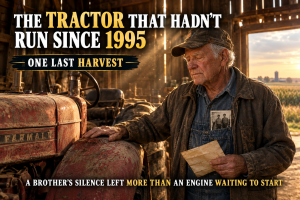
The tractor was a red International, late seventies model, parked in the far corner under a sheet of canvas that had gone stiff with age. When we pulled the cover back, dust rose in a slow cloud. The tires were flat. The paint had dulled to the color of old brick. Cobwebs stretched between the steering wheel and the seat. It looked like something that had been waiting longer than most people wait for anything.
I spent that first afternoon just looking. Checking the fuel tank, the battery terminals, the wiring that ran under the hood. Harold stayed nearby but didn’t hover. He sat on an overturned bucket and watched the light move across the dirt floor. Every so often he would clear his throat as if he meant to speak, then change his mind.
On the drive back to town I kept thinking about the way he had said it. He didn’t want the tractor to work again. He only wanted the sound. There are things people ask for that cost more than money, and this felt like one of them.
The next Saturday he was waiting again. I brought a short list of parts and a notebook. We worked in stretches of quiet broken by the soft clink of tools. When I asked about the years the tractor had sat unused, Harold only said, “My brother parked it. Then he left.”
He offered nothing more that day. But he began telling other stories. About the men who had helped with harvest when the weather turned mean. About a neighbor who once brought soup when Harold’s wife was sick. About the year the creek flooded and half the lower field went under. The stories never circled back to the brother. They circled everything else.
I started keeping a small log of the work. Fuel lines cleaned. New filter ordered. Battery tested and set aside for replacement. Each Saturday the list grew shorter, and each Saturday Harold talked a little longer about the land and the people who had walked it with him. The tractor itself remained the quiet center of the room, patient and unfinished.
By the fourth weekend I had the sense that restoring the engine was only part of what I had been asked to do. The rest was still waiting in the silence Harold carried with him, the same silence that had kept the tractor still since 1995.
Part 2
The parts arrived in stages. A gasket set. A rebuilt carburetor. Fresh belts. I stored them on a clean shelf in the shop and brought them out one Saturday at a time. Harold always inspected each piece the way a man inspects something that once belonged to someone else. He never asked the price. He simply paid what I wrote on the receipt and folded the carbon copy into his shirt pocket.
One afternoon, while I was under the tractor checking the starter, he said, “My brother was older by three years. Name was Raymond. We shared the work for a long time.”
I waited. The only sound was the scrape of my wrench against a stubborn bolt.
“He was better with the books,” Harold continued. “I was better with the ground. We argued about that more than we should have.”
He stopped there. When I looked up he was staring at the open barn door, where the light had turned the color of late wheat.
I didn’t push. In small towns you learn that some stories arrive in pieces, and the person telling them has to decide how many pieces to set down.
The following Saturday Harold brought a thermos of coffee and two chipped mugs. We sat on the bucket and a low stool while the coffee cooled. He talked about the last good harvest before the silence, the way the corn stood tall that year, the way the neighbors came to help when the combine broke down. He never said Raymond’s name again that day, but the absence of the name felt louder than the stories themselves.
I began to notice other small things. A second set of work gloves hanging on a nail near the door, stiff with age. A calendar from 1995 still tacked to a beam, the months after September left unmarked. A photograph frame turned face-down on a dusty shelf. I left it alone.
By the time the electrical system was sorted and the fuel lines were clean, the tractor looked less like a relic and more like something that might remember how to live. Harold walked around it slowly one evening, running his hand along the fender.
“He parked it right here,” he said. “Said he was done. Walked out the door and didn’t come back.”
I wiped my hands on a rag. “You ever try to find him?”
Harold shook his head once. “I waited. Waiting turned into years. Years turned into not knowing how to start the conversation.”
He left early that day. I stayed longer than usual, tightening the last connections, checking the oil one more time. When I finally locked the barn, the sky over the fields had gone the deep blue that comes just before true dark. I drove home with the sense that the engine was nearly ready, but the harder work still belonged to someone else.
Part 3
The first time we tried the key, nothing happened. The second time produced a weak click. On the third attempt the engine turned over once, then fell silent again. Harold stood with his arms folded, face unreadable.
I spent the next two Saturdays chasing the remaining problems. A bad connection at the solenoid. A small leak in the fuel pump. Ordinary failures that time and neglect create. Each fix brought us closer. Harold’s visits grew longer. He began bringing sandwiches and talking about the early years when he and Raymond still shared the same table after supper.
“He had a way of laughing that filled the kitchen,” Harold said one afternoon. “Even when the year was bad, he found something to laugh about.”
I asked what the disagreement had been about. Harold was quiet for a long time.
“Land,” he said finally. “And how to keep it. I wanted to stay the course. He thought we needed to change faster than I was willing. Words got sharp. Then they stopped altogether.”
He looked at the tractor. “He left the keys in the ignition. I never moved them.”
That detail stayed with me. Keys left in place, as if the leaving itself had been sudden and incomplete.
The following week I found the old photograph. It was tucked inside a metal toolbox under a layer of rags. Two young men standing beside the same red tractor, both wearing work shirts, both squinting into the sun. On the back, in careful handwriting, a date from the early nineties and the words: One last harvest together.
I showed it to Harold. He held it for a long time without speaking. His thumb moved once across the faces, then stopped.
“That was the year before,” he said. “We still thought we had time.”
He put the photograph in his shirt pocket and did not take it out again that day.
We kept working. The engine was close now. I could feel it in the way the systems responded, the way the tractor seemed less like a machine that had been abandoned and more like one that had simply been waiting for the right moment. Harold seemed to feel it too. His stories slowed. The silences between them grew longer and more thoughtful.
One evening, as the light faded, he said, “I kept thinking he would come back when he was ready. I didn’t want to be the one to chase. Pride is a poor reason, but it was mine.”
I nodded. There was nothing useful to say that he didn’t already know.
When I left that night the photograph was still in his pocket. The tractor sat under the single barn light, keys still in the ignition where Raymond had left them years before.
Part 4
The morning we finally got the engine to catch, the sound filled the barn like something returning from a long distance. It coughed once, twice, then settled into a steady idle that made the dust tremble on the windowsills. Harold closed his eyes. He stood that way for nearly a full minute, listening as if the sound itself carried a voice he had been waiting to hear.
When I shut the engine off, the quiet that followed felt heavier than before. Harold opened his eyes and reached into his jacket. He handed me a folded piece of paper, the creases soft from years of being opened and closed.
“I found this the winter after he left,” he said. “It was in the mailbox. No return address. Just the letter.”
I unfolded it carefully. The handwriting was steady, the ink faded but still clear. It began with an apology. Raymond wrote that he had spoken too quickly and left too soon. He wrote that the farm had always been both of them, even when they disagreed. He wrote that he hoped the silence would not last forever.
The letter ended mid-thought. The final paragraph was simply gone, the page torn cleanly across the bottom.
Harold watched my face. “I never knew what he meant to say next. I read it a hundred times looking for the rest. There was never any rest.”
I turned the paper over. The back was blank except for a faint impression where another sheet had once been pressed against it. When I held it to the light I saw the outline of more writing, too faint to read. Then I noticed the second page still lightly stuck along one edge. Age and humidity had sealed them together.
I eased the pages apart. The second sheet was shorter, written in the same hand. It contained only a phone number and three words: Call when ready.
The number belonged to a farm supply store on the far side of the county. I knew the place. It had closed more than twenty years earlier. The building was still there, windows boarded, sign faded to the color of old tin.
Harold stared at the number. “I never saw that page. I thought the letter was all there was.”
We stood in the barn with the smell of warm oil and the memory of the engine still in the air. Outside, the fields stretched quiet under the afternoon sun. Somewhere beyond those fields a man had once written an apology and a number, then walked away believing the rest of the conversation might still happen.
Harold folded the letter again, slower this time. “I don’t know if the number still means anything,” he said. “But I think I need to find out.”
I told him I would help. The tractor had started. The harder work was only beginning.
Part 5
The old farm supply store sat at a crossroads that had once been busier. The gravel lot was cracked and full of weeds. A hand-lettered sign still hung above the door, letters half-eaten by weather. I called the county records office the following Monday and learned the store had closed in 2003. The owner had moved south. No forwarding information beyond a name: Margaret Ellis.
Harold and I drove out on a weekday morning. The building smelled of damp wood and forgotten paper. Through a broken window we could see empty shelves and a counter still holding a dusty cash register. Harold stood on the porch for a long time, looking at the place as if it might open its mouth and speak.
We asked at the nearest occupied house. An older woman watering tomatoes remembered Margaret. “She went to live with her daughter in Missouri,” she said. “Keeps in touch with a few of us at Christmas. I can give you the daughter’s number if you want.”
Harold wrote it down with a careful hand. That evening he sat at his kitchen table and dialed. I waited in the next room, listening to the rise and fall of his voice. When he hung up he looked both younger and older at the same time.
“Margaret remembers Raymond,” he said. “He worked odd jobs for the store the year he left. She said he talked about a brother he needed to make things right with. Then one day he stopped coming in. She always wondered what happened to him.”
Margaret’s daughter had an old address book. In it was a note Margaret had written years earlier: Raymond Whitaker, last known in northern Missouri, working construction. No phone number. Only a town name and a vague recollection of a boarding house near the river.
It was thin information, but it was more than Harold had held in nearly three decades.
We spent the next two weeks making calls. Local libraries. Church directories. County clerk offices that still kept paper records. Each conversation led to another small piece. Raymond had lived in three different towns over the years. He had worked steady jobs. He had never married. In 2012 a man matching his description had volunteered at a community garden in a small town near the Iowa border. The garden coordinator remembered him as quiet, reliable, and fond of talking about corn when the weather was right.
Harold listened to every detail as if each one might be the last. At night he sat on his porch with the old photograph and the letter, turning them over in his hands. The tractor remained in the barn, ready now, waiting for a reason that had nothing to do with farming.
One evening he said, “I used to think the silence was his choice alone. I’m starting to see how much of it was mine.”
I didn’t answer. Some truths need room to settle before they can be spoken aloud.
Part 6
The first solid lead came from a retired postmaster in a river town twenty miles across the state line. He remembered a man named Ray who received general-delivery mail for several years and always asked after the price of farmland “back home.” The postmaster had kept an old forwarding card. The address on it led to a modest house on a quiet street at the edge of a larger town.
Harold and I drove there on a Saturday in early September. The house was small, white, well-kept. A late-model pickup sat in the driveway. An older man was raking leaves near the sidewalk. He straightened when he saw us, one hand resting on the rake handle.
Harold stepped out of the truck first. For a moment the two men simply looked at each other across the short distance of the yard. Then Raymond set the rake down and walked forward.
They did not embrace. They did not speak right away. They stood in the afternoon light the way men do when the years between them are heavier than any single sentence.
“You still have the tractor,” Raymond said at last. It was not a question.
Harold nodded. “It runs again.”
Raymond’s mouth moved as if he might smile, then settled. “I always wondered if you’d keep it.”
They went inside. The house was spare and clean. A single photograph of the old farm sat on a shelf beside a radio. Harold placed the letter and the second page on the table between them. Raymond looked at the torn edge for a long time.
“I meant to finish it,” he said. “I sat down three times and never found the right last words. Then I put the number on the back thinking you’d call when you were ready. I waited. After a while waiting felt safer than speaking.”
Harold’s voice was quiet. “I did the same.”
They talked until the light in the room changed. I stayed in the kitchen doorway, present but not part of the conversation. The words came slowly at first, then with the awkward rhythm of people remembering how to speak to each other. They talked about the argument that had ended everything. They talked about the years that followed. They talked about the land and the people who had worked it and the way silence can become a habit more stubborn than anger.
When we left, Raymond walked us to the truck. He looked at Harold and said, “I’d like to see the place again. If you’ll have me.”
Harold answered without hesitation. “The barn door’s never been locked against you.”
On the drive home Harold was quiet for a long stretch of road. Then he said, “He looks older than I expected. I suppose I do too.”
I kept my eyes on the highway. Some reunions do not need commentary. They only need the next day to begin.
Part 7
Raymond arrived the following weekend in the same pickup. He walked the farm slowly, stopping at the fence lines, the creek, the place where the old orchard had once stood. Harold walked beside him without speaking much. The silence between them had changed. It no longer felt like absence. It felt like the careful space two people give each other when they are learning the new shape of an old relationship.
They spent the afternoon in the barn with the tractor. Raymond ran his hand along the fender the same way Harold had done weeks earlier. When Harold turned the key the engine caught cleanly. Both men stood listening. Neither closed his eyes this time. They watched the machine as if it might tell them something the years had withheld.
Afterward they sat on the porch with coffee. I had been invited to stay. The talk moved from the tractor to the weather to the neighbors who were still around and the ones who were gone. Eventually it circled back to the letter.
“I tore the page because I couldn’t finish the thought,” Raymond said. “I wanted to say I was sorry for leaving the way I did. I also wanted to say I still believed we could find a way forward. The two things sat side by side and I couldn’t make them fit on the same page.”
Harold nodded. “I kept the letter in a drawer for years. Some days I almost threw it away. Other days I almost drove across the state to find you. I never did either.”
They were quiet again. Then Raymond asked about the photograph. Harold brought it out. The two of them looked at the younger versions of themselves standing beside the same tractor, the message on the back still clear after all the years.
“One last harvest together,” Raymond read aloud. “I wrote that thinking it was true. I didn’t know how true it would become.”
The light was fading when Raymond stood to leave. He paused at the edge of the porch. “I’d like to come back next week. Help with whatever still needs doing around the place.”
Harold’s answer was simple. “There’s always something that needs doing.”
After Raymond’s truck disappeared down the gravel road, Harold remained on the porch. I waited with him until the first stars appeared.
“I spent a long time believing the disagreement was the end of the story,” he said. “Turns out it was only the middle.”
Part 8
The weeks that followed settled into a new rhythm. Raymond came most Saturdays. Sometimes he worked on small repairs around the farm. Sometimes he and Harold simply walked the fields and talked. The conversations were not always easy. Old grievances surfaced, were examined, and then set down again with more care than before. They argued once about a decision made in 1994 and then laughed at how long the echo of that decision had lasted.
I continued to stop by, less as a mechanic now and more as a witness to something I had helped set in motion. The tractor remained in the barn, started occasionally, never used for work. Its purpose had changed. It was no longer a machine waiting to be useful. It was a place where two brothers could stand side by side and remember that they had once shared the same labor and the same hope.
One afternoon Harold asked me to help him clear the loft above the barn. We found an old metal box under a pile of feed sacks. Inside were papers from the years before the silence: receipts, a few photographs, a notebook Raymond had kept of crop yields and weather notes. Harold handed the notebook to his brother without comment. Raymond sat on a bale of hay and turned the pages slowly.
“I used to think the numbers would save us,” he said. “I thought if we just managed things better the land would stay safe forever. I didn’t understand that some things stay safe only if the people stay connected.”
Harold sat beside him. “I thought staying the same was the same as staying strong. I was wrong about that too.”
They did not need me for the rest of that conversation. I climbed down the ladder and left them with the dust and the old papers and the late-afternoon light coming through the loft window.
Outside, the fields were turning the color of early autumn. I stood for a while looking at the house and the barn and the long driveway that had carried both leaving and returning. The tractor’s engine note still lived in my memory, steady and familiar. It had done what Harold asked. It had run once more. Everything that followed had grown from that single sound.
When I drove away that evening the two brothers were still in the loft. Their voices carried faintly through the open window, low and unhurried, the way voices sound when there is finally enough time.
Part 9
By the time the first hard frost arrived, Raymond had begun staying overnight in the spare room of the farmhouse. The arrangement was temporary at first, then less so. He still kept his house across the state line, but the weekends stretched into longer visits. Harold never asked him to stay permanently. He simply left the door unlocked and the coffee ready in the mornings.
They spent one gray November day cleaning the tractor thoroughly, not for work but for the satisfaction of seeing it whole. They replaced a cracked seat cushion. They polished the faded red paint until it held a soft shine. When they finished they stood back and looked at it the way people look at something that has outlasted their worst decisions.
“I used to dream about this machine,” Raymond said. “In the dream it was always running and I could never reach the barn in time to stop it or start it. I woke up tired.”
Harold rested a hand on the steering wheel. “I used to hear it in the middle of the night even when the barn was quiet. Took me years to understand I was listening for you.”
They left the tractor under a clean canvas cover that winter. It no longer needed to prove it could run. Its work was finished.
I visited less often as the cold settled in. When I did come by, the two men were usually at the kitchen table with maps of the property or old photograph albums. They spoke of selling a few acres that had always been hard to work, of keeping the rest, of hiring help when the seasons demanded it. The plans were practical and modest. They were also shared.
One evening near Christmas, Harold walked me out to my truck. Snow was beginning to fall in slow, quiet flakes.
“I keep thinking about the missing paragraph,” he said. “All those years I believed the important words were the ones that never got written. Turns out the important part was just picking up the phone, or walking into a barn, or turning a key.”
He looked back toward the lighted windows of the house. “He’s in there reading the old yield notes again. Says the numbers still make sense if you know how to read them.”
I told him I was glad the tractor had started. Harold smiled, the first easy smile I had seen from him since the summer.
“The tractor was the easy part,” he said. “The rest took longer. But it started too.”
Part 10
Spring came late the following year. The fields greened slowly. Harold and Raymond worked side by side when the ground was ready, not with the urgency of men trying to reclaim lost time, but with the steady pace of people who had decided the remaining years were better spent together than apart.
I was called out one Saturday in May to look at a different machine on a neighboring farm. On the way home I stopped at the Whitaker place. The barn door stood open. The red tractor sat in the yard for the first time in decades, washed and shining in the sun. Harold and Raymond were replacing a section of fence near the road. They waved when they saw me.
We stood talking for a while about the weather and the price of seed and the way the creek had stayed within its banks after the spring rains. Then Raymond went inside to make coffee and Harold walked with me toward the tractor.
“We started it this morning,” he said. “Just to hear it. No work planned. Just the sound.”
He rested his hand on the fender the way he had the first day I met him. The metal was warm from the sun.
“I used to think the disagreement was the story,” he said. “Then I thought the silence was the story. Then I thought the letter was the story. Turns out the story was always the two of us deciding whether we still belonged to the same place.”
Raymond came back with three mugs. We drank the coffee standing in the yard while a light wind moved through the new leaves on the cottonwoods. No one felt the need to fill the quiet with more words than necessary.
When I left, the two brothers walked back toward the fence line together. The tractor remained in the yard, keys still in the ignition, ready if anyone needed it and content if no one did.
Years later I still drive past the Whitaker place when the road takes me that way. The barn has been painted. The house looks lived in. Sometimes the red tractor is visible near the outbuildings, sometimes not. I never stop unless I’m invited. Some restorations belong only to the people who needed them.
But I remember the sound of that engine catching after nearly thirty years of silence. I remember the way Harold closed his eyes the first time. I remember the second page of a letter that had waited longer than anyone expected. And I remember two men learning, late but not too late, that the hardest engines to start are the ones that live between people, and that sometimes all it takes is one more turn of the key.
The tractor that hadn’t run since 1995 runs when it is needed now. More importantly, the men who once walked away from each other have found their way back to the same ground. That, in the end, was the harvest they had been waiting for.