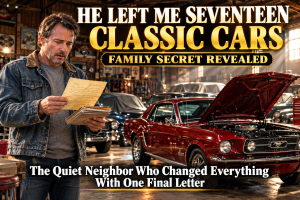
I only ever mowed his lawn and carried his groceries. After the memorial, his daughter told me the entire garage of seventeen classic cars now belonged to me. The handwritten letter explained why. It had nothing to do with friendship. It had everything to do with something I once refused to sell him, and a list of addresses that all led back to my father’s old factory.
Part 1
The house next door had always felt larger than it needed to be. White siding, dark green shutters, a wide front porch that sagged a little on the left side. For as long as I had lived on Maple Ridge Lane, the man who owned it kept mostly to himself. His name was Harold Whitaker. Seventy-eight years old the last time anyone asked, though he never volunteered the number. He walked with a slight limp that grew more pronounced each autumn, and his hands shook when he tried to lift anything heavier than a bag of oranges.
I started helping him the year my own father died. It began with the lawn. Harold’s mower was older than some of the cars in his garage, and the grass along the sidewalk would grow high enough to hide a bicycle before he managed to cut it. One Saturday I simply pushed my own mower over the property line and kept going. He watched from the porch for twenty minutes before raising one hand in a small wave. After that it became routine. Lawn in summer. Shoveling in winter. Groceries when the weather turned bad and his daughter stopped visiting as often.
I never went inside the house. The garage, though, was different. The big double doors stayed closed most days, but sometimes in the late afternoon the side door would stand open and the smell of oil and old leather would drift across the driveway. Inside sat seventeen cars. Not ordinary cars. Classic American machines from the fifties, sixties, and early seventies, each one restored until the chrome threw light like a mirror. Harold never talked about them unless asked, and even then his answers were short. “That one took three years.” “This one almost didn’t make it.” He never named prices, but collectors found him anyway. Men in pressed shirts and polished shoes would appear, offer numbers that made my eyebrows rise, and leave empty-handed. Harold always smiled the same thin smile and said the same quiet sentence: “Not today.”
The memorial service was held on a gray Tuesday in October. The church was only half full. Harold’s daughter, Margaret, stood near the front with two men I assumed were her brothers. They looked tired and slightly angry, the way people look when grief and inconvenience arrive at the same time. I sat in the back and left as soon as the last hymn ended. I expected that to be the end of it.
Margaret found me in the parking lot.
She was a tall woman with careful makeup and a navy coat that looked expensive. Her eyes were red but dry. “Daniel,” she said. My name sounded formal in her mouth. “Can we talk for a minute?”
I nodded. She led me a few steps away from the other cars.
“My father left you something,” she said.
I waited. I thought she meant the old push mower or the stack of gardening tools in the shed.
“The garage,” she said. “All of it. The cars. The tools. Everything inside.”
I stared at her. The words did not arrange themselves into sense.
“I think there’s been a mistake,” I said.
“There hasn’t. The lawyer confirmed it this morning. The will is clear. The house goes to us. The garage and its contents go to you.”
Behind her, one of the brothers turned and looked our way. His face tightened.
Margaret’s voice dropped. “They’re not happy. None of us are. But the papers are already filed.”
She handed me a business card with a lawyer’s name and a downtown address. Then she walked back to her family without another word.
I stood in the parking lot holding the card until the last cars pulled away. The sky had begun to spit light rain. I drove home slowly, parked in my own driveway, and sat with the engine off for a long time. Seventeen classic cars. Cars that collectors had offered six-figure sums for. Left to the neighbor who mowed the lawn.
It made no sense.
That night I barely slept. Every time I closed my eyes I saw the garage doors and the rows of polished metal behind them. By morning I had decided the simplest explanation was the most likely: Harold had been confused. Age does that. The lawyer would straighten it out and everything would return to the family where it belonged.
I was wrong.
Part 2
The lawyer’s office sat on the third floor of an older building downtown. Dark wood paneling. Framed certificates. A secretary who offered coffee I did not drink. The lawyer himself was a man in his sixties named Paul Hargrove. He had the careful voice of someone who had delivered difficult news many times.
“Mr. Whitaker was very clear,” he said after the preliminary paperwork. “The garage structure and all vehicles, tools, and related personal property contained therein are bequeathed to you, Daniel Reeves. The house and remaining estate go to his three children in equal shares.”
I shook my head. “I never asked for anything. I never even talked to him about the cars.”
“I understand. Nevertheless, the documents are properly executed and witnessed. There is also a personal letter he asked me to give you.”
Hargrove opened a folder and slid a single sheet of cream-colored paper across the desk. The handwriting was uneven, the letters larger than normal, the way an older person writes when the hand no longer cooperates fully.
I read it once. Then I read it again.
Daniel,
You never tried to buy anything from me. You never asked what they were worth. You simply helped when it was needed and left when the work was done. That is rarer than you think.
Years ago you refused to sell me something I wanted very much. You were polite about it, but firm. I respected that. I still do. The cars are yours now. Take care of them the way you took care of the lawn.
There is a second envelope. Open it when you are ready. It will explain the rest.
Harold
I looked up. Hargrove was watching me with a neutral expression.
“There’s more,” he said. He handed me a thick manila envelope sealed with tape. Inside was a typed list, seventeen lines long. Each line held a vehicle identification number, a date, and a street address. Some of the dates went back more than forty years.
I scanned the addresses. Three of them were familiar. One was only six blocks from the factory where my father had worked until the year he died. Another was across town near the old union hall. A third belonged to a man my father used to mention at the dinner table, a co-worker named Ray who had retired early after an injury.
My pulse moved into my throat.
“I don’t understand,” I said.
“Neither do I,” Hargrove replied. “Mr. Whitaker prepared this list himself and instructed that it be given to you with the letter. He did not explain further.”
I folded the papers carefully and put them back in the envelope. My hands felt cold.
Outside the office the afternoon light had turned thin and gray. I sat in my car and read the list again. Seventeen vehicles. Seventeen dates. Seventeen locations. And every location I recognized belonged to someone connected to the factory where my father had spent thirty-two years of his life.
The final entry stopped me cold.
VIN ending in 4921. Date: March 12, 1979. Address: the house I grew up in. The note beside it read simply: Still registered in the name of Thomas Reeves.
My father’s name.
My father had sold that car, or so the family story always went, the year before I was born. He had needed the money for the down payment on the house. That was the version everyone told. Yet according to Harold’s list, the car had never left my father’s name.
I started the engine and drove toward the factory district without deciding to. The old brick building still stood, though most of the windows were boarded and the parking lot had weeds growing through the cracks. I sat there until the light faded, staring at the place where my father had clocked in every morning for more than three decades.
Something had happened in that factory. Something that connected Harold Whitaker, seventeen classic cars, and a vehicle that was never supposed to still exist under my father’s name.
I did not yet know what it was. But the letter and the list made one thing clear: Harold had not left me the cars because I mowed his lawn.
He had left them because of something I once refused to sell him.
And whatever that something was, it reached farther back than either of us.
Part 3
Margaret called the next morning. Her voice was tight.
“The brothers want a meeting,” she said. “Tonight. Their lawyer will be there. You should bring yours.”
I told her I did not have a lawyer. She gave a short, humorless laugh.
“Then get one. They’re prepared to challenge the will on grounds of undue influence. They think you spent years manipulating an old man.”
“I carried his groceries,” I said.
“I know. But they don’t care about that. They care about the cars.”
We agreed to meet at Hargrove’s office at seven. I spent the afternoon calling the few people I still knew from my father’s years at the plant. Most numbers were disconnected. One man, a retired foreman named Ellis, answered on the third ring. His voice was rough with age and cigarettes.
“Thomas Reeves’ boy,” he said when I explained who I was. “Been a long time. What do you need?”
I told him about Harold Whitaker and the list of addresses. There was a long silence on the line.
“Whitaker,” Ellis repeated. “I remember that name. He used to come around the plant in the late seventies. Not an employee. Something else. Your dad knew him. They talked sometimes after shift.”
“About what?”
“Cars, mostly. Your dad always liked the old ones. Kept a little notebook with models and years. Whitaker was the same way. Obsessed, almost.”
I asked if he remembered any particular car my father had owned around 1979. Ellis was quiet for another stretch of seconds.
“There was a blue one,” he said finally. “Chevy, I think. Early sixties. Your dad was proud of it. Then one day it was gone. He said he sold it. Needed the money. We all believed him. Times were hard that year.”
“Did you ever see the car again?”
“No. But I remember something else. About a month after it disappeared, there was trouble at the plant. Inventory missing. Parts. Tools. Some finished assemblies that never made it to the loading dock. Nothing ever came of it officially. Management blamed poor record-keeping. A few men got laid off. Your dad wasn’t one of them.”
I thanked him and hung up. The blue Chevy. Still registered in my father’s name according to Harold’s list. Still out there, apparently, among the seventeen.
That evening the meeting at Hargrove’s office was tense from the first minute. Margaret’s brothers, Robert and James, sat on one side of the conference table with a sharp-eyed attorney named Vargas. Margaret sat slightly apart, as if she preferred not to be fully associated with either side. I sat across from them with Hargrove beside me.
Vargas opened with a polite smile that did not reach his eyes. “My clients believe Mr. Whitaker was not of sound mind when he altered his will last spring. They also believe Mr. Reeves cultivated a relationship specifically to influence that decision.”
Hargrove responded calmly. “The will was executed with full formalities. Two independent witnesses. Medical notes from Mr. Whitaker’s physician confirm he was competent. There is no evidence of undue influence.”
Robert leaned forward. He was the older of the two brothers, heavy-shouldered, face flushed. “You were over there every week. Cutting grass. Bringing food. Of course he left you the cars. You made yourself indispensable.”
“I never asked for anything,” I said.
“Convenient,” James muttered.
Margaret spoke for the first time. “Dad left a letter. It explains his reasons. Have you read it?”
Vargas waved a hand. “Personal letters are not legal instruments. They do not override the question of capacity or influence.”
Hargrove slid copies of the letter and the list across the table. “Mr. Whitaker prepared both documents himself. The list appears to document the acquisition history of each vehicle. Several of the addresses correspond to former employees of the same manufacturing plant where Mr. Reeves’ father worked.”
Vargas glanced at the papers, then pushed them aside. “Irrelevant to the will contest.”
The meeting ended without resolution. Vargas announced they would file a formal challenge within the week. Margaret lingered after the others left.
“I don’t think you took advantage of him,” she said quietly. “But my brothers are angry. They expected the cars. They’ve already calculated what they could sell them for.”
“I still don’t understand why he chose me,” I said.
She looked at the closed door her brothers had walked through. “Maybe the letter is true. Maybe it really is about something you refused to sell him. Do you remember what that was?”
I shook my head. “I’ve been trying. Nothing comes.”
She nodded once and left. I sat alone in the conference room with the list of seventeen vehicles and the growing certainty that the answer was buried somewhere in 1979, in a blue Chevrolet, and in whatever trouble had briefly touched the factory floor the month after my father claimed he sold it.
Part 4
Sleep came in short pieces that night. Each time I woke I saw the same image: my father standing in the driveway of the house I grew up in, wiping his hands on a rag, the blue Chevy gleaming behind him. In the dream the car was always there. In waking life it was a story told secondhand.
I spent the next morning at the county records office. Vehicle registration archives from the late seventies were incomplete, transferred years earlier to microfilm and then partially digitized. A patient clerk named Rosa helped me search under Thomas Reeves. One record appeared for a 1963 Chevrolet Impala, color listed as blue, VIN ending in the same four digits as Harold’s final entry. The registration had been active in 1978. Then the trail went quiet. No transfer of ownership. No reported sale. No title change. The last known address was the house where I had lived until I was eighteen.
Rosa raised her eyebrows. “If it was sold, someone forgot to file the paperwork. Or someone didn’t want the paperwork filed.”
I thanked her and drove to the old neighborhood. The house looked smaller than I remembered. New owners had painted it a pale yellow and added a screened porch. I sat in the car across the street and tried to reconstruct the year before I was born from the few stories my mother used to tell.
My parents had needed money for the down payment. My father sold the only thing of value he owned. The blue Chevy. He never spoke of it again with any particular regret. That was the official version. Yet the registration had never left his name, and Harold Whitaker had somehow ended up with the car among a collection of sixteen others, each one tied to addresses that all pointed back to the same factory.
I called Ellis again. This time I asked about missing inventory and the men who had been laid off.
“There were four of them,” he said. “All from the same shift. Good workers, mostly. Management said the numbers didn’t add up and someone had to go. Rumors went around that parts were walking out the door and ending up in private garages. Nothing was ever proven. The union pushed back hard enough that it stopped being discussed in public.”
“Did my father ever talk about it?”
“Not to me. But I remember him being quieter that winter. More careful. Like he was carrying something heavy and didn’t want anyone to notice the weight.”
I drove back to Maple Ridge Lane and stood in Harold’s driveway looking at the closed garage doors. The key was still in the envelope Hargrove had given me. I had not used it yet. Part of me did not want to. Opening those doors felt like stepping into a story that did not belong to me, a story that somehow included my father and a car that was never supposed to still exist.
I unlocked the side door and stepped inside.
The air was cool and smelled of oil, wax, and old rubber. Seventeen cars sat in two neat rows under soft fluorescent lights that Harold must have left on a timer. Each vehicle was covered with a fitted canvas. I walked the first row slowly, lifting corners. A deep green Corvette. A black Mustang. A red Plymouth Barracuda with white stripes. A pale blue Impala from 1963.
I stopped.
The paint was still the soft original blue. The chrome along the side was perfect. The interior looked untouched. On the dashboard sat a small metal tag with a handwritten number that matched the final entry on Harold’s list.
I rested my hand on the fender. The metal was cool and solid under my palm. This was the car my father had “sold.” This was the car that had never left his name. And somehow Harold Whitaker had kept it for more than four decades, polished and protected, waiting.
Waiting for what, I did not yet know.
But the refusal I had once given him, the one he mentioned in the letter, suddenly felt closer. I just could not remember what I had refused to sell.
Part 5
The will challenge arrived three days later. Vargas filed papers claiming undue influence and lack of testamentary capacity. Hargrove assured me the medical records and witness statements were strong. Still, the process would take months. In the meantime the cars remained in legal limbo. I was not to sell or move them. The brothers were not to enter the garage.
Margaret called once more. Her voice was softer this time.
“I found something in Dad’s desk,” she said. “A small notebook. Mostly car notes. Years, models, restoration costs. But near the back there are a few pages that look different. Names. Addresses. Dates from the late seventies. Some of them match the list he left you.”
She offered to bring it over. We met at a quiet diner halfway between our neighborhoods. She slid a worn black notebook across the table. The pages were filled with Harold’s careful script. Most entries were technical: engine numbers, paint codes, parts suppliers. Then the later pages changed. Columns of names. Factory employee numbers. Notes in the margin that read “paid in full,” “still holding,” and, once, “promised to return.”
One name appeared more than once: Thomas Reeves.
Beside it, in Harold’s hand: “Blue Impala. 1963. Held for safekeeping. Condition of agreement: silence.”
I stared at the words until they blurred.
Margaret watched my face. “Do you know what that means?”
“I think my father never sold the car,” I said. “I think he gave it to Harold for some reason. Or Harold took it for some reason. And they both kept quiet about it for the rest of their lives.”
She closed the notebook gently. “There’s more. A few pages later he wrote a short note to himself. ‘If the boy ever asks, tell him the truth. If he never asks, the cars will have to do the talking.’”
“The boy,” I repeated.
“I think he meant you.”
We sat in silence while the diner filled with the late lunch crowd. Outside the window a delivery truck rattled past. Inside, the notebook lay between us like a live wire.
“What did you refuse to sell him?” Margaret asked eventually.
I shook my head. “I’ve gone through every conversation we ever had. He asked about tools once. About an old radio I had in the garage. About a set of socket wrenches that belonged to my father. I said no to the wrenches. They were the only thing of his I still kept. He never asked again.”
Margaret’s eyes narrowed slightly. “Socket wrenches?”
“A complete set in a metal box. My father used them at the plant. I kept them after he died. Harold saw them once when I was fixing a lawnmower blade. He offered me money on the spot. A lot of money. I told him they weren’t for sale.”
She was quiet for a long moment. “Maybe it wasn’t the wrenches themselves. Maybe it was what they represented. Or what they could prove.”
I looked at her. “Prove what?”
“I don’t know. But my father was not a sentimental man about tools. If he wanted those wrenches badly enough to remember the refusal years later, there was a reason.”
That night I went home and opened the metal box I had not touched in years. The wrenches were still nested in their slots, slightly worn, the handles smooth from decades of use. Nothing looked unusual. No hidden compartments. No markings beyond the manufacturer’s stamp and my father’s initials scratched into the lid.
Yet Harold had wanted them. And when I refused, he had decided that one day the cars would belong to me instead.
I closed the box and sat in the quiet of my kitchen. Somewhere in the space between a missing inventory scandal at a factory in 1979, a blue Impala that never changed ownership, and a set of ordinary socket wrenches, the truth was waiting.
I just had to find the thread that connected them all.
Part 6
Ellis agreed to meet me at the old union hall the following week. The building was mostly empty now, used for storage and the occasional community meeting. He arrived with a manila folder under his arm and the careful walk of someone whose knees no longer trusted stairs.
“I dug around a little,” he said after we settled at a scarred wooden table. “Pulled some old shift records and a couple of incident reports that never went anywhere. Thought you should see them.”
The papers were yellowed and smelled of dust. One was a handwritten list of missing parts from March and April of 1979: carburetors, distributors, sets of specialized sockets, a few completed dashboard assemblies. The quantities were not huge, but they were consistent. Another page was a short internal memo noting that four men had been let go “for cause related to inventory discrepancies.” Their names were listed. None of them was Thomas Reeves.
A third document was a statement from a security guard who claimed he had seen a blue Chevrolet parked near the loading dock after hours on two separate nights. He could not identify the driver. The investigation went nowhere.
Ellis tapped the memo. “Your dad’s name doesn’t appear in any of the official trouble. But look at this.” He turned to a faded photocopy of a sign-out sheet for tool cribs. Thomas Reeves had signed out a complete set of specialty sockets on March 3. The return line was blank.
“He never brought them back,” Ellis said. “Or someone else signed them back in under a different name. Either way, those sockets disappeared the same month the other parts started vanishing.”
I thought of the metal box sitting on my kitchen table. The sockets inside looked ordinary. But ordinary tools could hide history.
“What if the car wasn’t payment?” I said slowly. “What if it was cover? Or collateral?”
Ellis shrugged. “Your dad was a careful man. If he was involved in something, he would have had a reason. And if Whitaker ended up with the car and kept it all these years, maybe the reason was shared.”
I drove home with the copies in a folder on the passenger seat. That evening I laid everything out on the dining table: Harold’s list, the notebook pages Margaret had photographed for me, the factory documents, the registration record for the Impala, and the socket set itself.
One of the addresses on Harold’s list belonged to a man named Victor Lang. I remembered the name dimly from my father’s stories. Lang had been a supervisor on the evening shift. According to the notebook, Harold had acquired a black Mustang from Lang in 1981. The note beside it read: “Final payment for silence. Agreed.”
Silence about what?
I called Margaret. She answered on the second ring.
“I need to see the rest of the notebook,” I said. “All of it.”
She hesitated only a moment. “Come tomorrow. The brothers are out of town for a long weekend. We can go through Dad’s study without an audience.”
The next afternoon I stood in Harold Whitaker’s study for the first time. The room was neat, almost sparse. A large desk. Bookshelves filled with automotive manuals and history volumes. A single framed photograph of a much younger Harold standing beside a half-restored car, smiling.
Margaret opened a bottom drawer and lifted out two more notebooks and a small lockbox. The lockbox required a key she did not have. We set it aside.
The second notebook contained more names and more notes about “agreements.” The third was different. It was a journal of sorts, entries spaced months and sometimes years apart. Most concerned the progress of restorations. A few were personal.
One entry from 1983 stopped me:
Spoke with T.R. again. He remains firm. The boy is still young. We wait. The cars will keep the truth until the boy is ready, or until I am gone. Either way the debt is paid.
T.R. Thomas Reeves.
The boy. Me.
I looked up at Margaret. Her face had gone pale.
“My father and your father had an arrangement,” she said quietly. “Something that started in 1979 and never really ended.”
I nodded. The shape of it was beginning to form, though the details were still missing. My father had been involved, somehow, in the missing parts. The blue Impala had left the factory parking lot and never officially changed hands. Harold had ended up with it and with sixteen other cars, each one connected to someone who needed silence or protection or payment. And when my father died, the arrangement continued in Harold’s mind until the day he decided the cars should come to me.
The only piece still missing was why the socket wrenches had mattered so much that my refusal to sell them had sealed the inheritance.
I picked up the lockbox. It was heavier than it looked.
“We need to open this,” I said.
Margaret found a thin metal file in her father’s toolbox. It took twenty careful minutes, but the lid finally gave.
Inside were three things: a single yellowed envelope addressed to me in Harold’s hand, a small key on a string, and a black-and-white photograph of my father standing beside the blue Impala in what looked like the factory parking lot at night. He was not alone. Harold Whitaker stood beside him, younger, thinner, one hand resting on the car’s roof. Both men looked serious. Neither was smiling.
I opened the envelope.
Daniel,
If you are reading this, then the time has come. The cars are yours. The truth is yours as well, if you want it. The key opens a safe deposit box at First National. The number is written on the back of the photograph. Inside you will find the original documents and the full account of what happened in 1979. Your father and I made a promise. I have kept my part. The rest is up to you.
Harold
I turned the photograph over. A series of numbers was written in the same uneven hand.
Margaret watched me in silence.
“I think,” she said finally, “we should go to the bank.”
Part 7
First National still occupied the same corner building it had for forty years. The safe deposit officer was a woman in her fifties who checked my identification twice and then Margaret’s before leading us into the vault. The box was larger than I expected. Inside lay a thick folder bound with a rubber band and a second, smaller envelope marked simply “For Daniel only.”
We took everything to a private room. I opened the folder first.
The documents told a story that was both smaller and larger than I had imagined.
In early 1979 a group of workers on the evening shift had begun quietly removing certain high-value parts and completed assemblies. The plan was simple: divert the items to private buyers who restored classic cars and needed authentic components that were becoming scarce. The money was good. The risk, at first, seemed manageable.
My father had not started the scheme. He had been pulled in when a close friend needed help moving a particular set of specialized tools and a pair of carburetors. Once involved, he found it hard to step away. The blue Impala became both payment and insurance. Harold Whitaker, who already collected cars and had connections among restorers, agreed to hold the vehicle and certain documents in exchange for a share of the proceeds and a promise of silence.
When management noticed the discrepancies, the group fractured. Four men were sacrificed to satisfy the company. My father was not among them. Harold used his own leverage, and the quiet pressure of the held documents, to keep Thomas Reeves clear of the official inquiry. In return, the Impala stayed with Harold, and the agreement of silence held for the rest of both men’s lives.
The folder contained signed statements, lists of diverted parts, and a short handwritten confession from my father dated the week after the four men were let go. He took full responsibility for his role and asked that the others be left alone. Harold had kept the paper all these years.
I sat back in the hard chair and stared at my father’s signature.
Margaret read over my shoulder. When she finished she was quiet for a long time.
“My father protected yours,” she said. “And then he spent the next forty years collecting the cars that somehow paid for that protection or sealed the silence. And at the end he decided the whole collection should go to you.”
I nodded. The second envelope was still unopened. I slid a finger under the flap.
Inside was a single sheet in Harold’s hand, written more recently.
Daniel,
The socket set your father signed out and never returned was the key to the specialized assemblies. Without those tools certain parts could not be finished off-site. Your father kept them. When he died, you inherited them without knowing. I asked to buy them because I wanted the last physical piece of the old arrangement under my control. You refused. I respected that. A man should keep what belongs to his father.
The cars are the rest of the story. Some were payment. Some were leverage. Some were simply beautiful machines I could not resist. All of them are now yours to do with as you wish. Sell them. Keep them. Tell the truth or let it stay buried. The debt between your father and me is paid.
Look after the Impala. It was always meant to come home.
Harold
I folded the letter carefully and put it back in the envelope. The weight I had been carrying for weeks shifted into something quieter and heavier.
Margaret reached across the table and touched the edge of the folder. “What are you going to do?”
I did not answer right away. Outside the small window the afternoon light was beginning to fade. Somewhere across town seventeen classic cars sat in a garage that now legally belonged to me, each one carrying a piece of a secret two men had kept for most of a lifetime.
“I need time,” I said.
She nodded. “Take it. The brothers can wait a little longer.”
We left the bank with the folder and the letters. The lockbox key went into my pocket. The photograph of the two men and the blue car at night went into the same folder as my father’s confession.
That night I sat in my kitchen with the socket set open on the table and the photograph propped against the sugar jar. My father’s face looked younger than I remembered. Harold’s face looked determined. The car between them looked like any other car until you knew what it had cost.
I finally understood the refusal that had mattered so much. It had not been about the money. It had been about the last piece of a story my father never told me. By keeping the wrenches, I had kept the final fragment of his silence. Harold had recognized that, and in his own way he had honored it.
The cars were not a gift.
They were a transfer of responsibility.
And I had to decide what to do with it.
Part 8
The following days moved in a strange double rhythm. Outwardly I continued the ordinary work of my life. Inwardly I turned the new knowledge over and over, testing its edges.
Hargrove called to say the will challenge was proceeding slowly. Vargas was pressing for a full accounting of every conversation Harold and I had ever had. Margaret’s brothers remained angry but slightly less certain now that the medical evidence of competence was solid. I told Hargrove nothing about the safe deposit box. Some truths did not belong in a courtroom.
I spent one long evening in the garage alone. I uncovered every car and walked the rows slowly. Some of the vehicles were simply beautiful machines Harold had restored because he loved them. Others carried heavier histories. The black Mustang from Victor Lang. A silver Cadillac that had belonged to one of the four men who were laid off. A dark green Thunderbird whose previous owner had signed a short note that still rested in Harold’s notebook: “Paid in full. Never speak of it again.”
The blue Impala sat at the end of the second row like a quiet center of gravity. I opened the driver’s door and sat behind the wheel. The interior smelled of old vinyl and careful preservation. On the passenger seat was a small folded cloth. Inside it was a single ignition key and a note in Harold’s hand: “It still runs. Take it home when you are ready.”
I closed my hand around the key.
The next morning I called Margaret and asked her to meet me at the garage. She arrived with a thermos of coffee and the same careful expression she had worn at the bank.
“I’ve decided,” I told her. “I’m not going to sell the collection. Not yet. Maybe not ever. But I am going to tell your brothers the truth about why your father left the cars to me. Not the full factory story. Just enough so they understand it was never about me taking advantage of an old man.”
She studied my face. “They may not believe you.”
“I know. But the letter and the list are real. The connection to my father is real. If they still want to fight, they can. I’m done pretending this is simple.”
We sat on the workbench while the coffee cooled. Outside, a light rain began to fall against the high windows.
“What about the Impala?” she asked.
“I’m taking it. It belongs with the socket set and the photograph. The rest of the cars can stay here for now. The garage is mine. The decision about what happens next is also mine.”
She nodded slowly. “I’ll talk to Robert and James. They won’t like it. But they might accept it if they understand it was Dad’s choice and not some scheme.”
After she left I started the Impala. The engine turned over with a low, healthy sound that filled the garage. I backed it carefully out into the driveway and then into my own. The car looked almost ordinary sitting there, a well-kept classic from another era. Only I knew the weight it carried.
That evening the brothers arrived without warning. Robert’s face was set. James looked more tired than angry. Margaret stood slightly behind them, as if ready to intervene.
Robert spoke first. “Margaret says you have an explanation. We’re listening.”
I told them an edited version. Harold and my father had known each other through the factory. There had been a private arrangement involving the blue car and certain debts of silence from long ago. When Harold decided the arrangement had run its course, he chose to pass the entire collection to the son of the man he had once helped protect. The refusal to sell the socket set had simply confirmed, in Harold’s mind, that I was the right person to receive what remained.
I did not mention the diverted parts or the four men who lost their jobs. Some pieces of the truth still felt too sharp to hand over.
Robert listened without interrupting. When I finished he was quiet for nearly a minute.
“You expect us to believe our father spent forty years collecting cars because of some favor he did your father in 1979?”
“I expect you to believe the letter he wrote and the list he prepared,” I said. “The rest is between him and the choices he made.”
James looked at the Impala sitting in my driveway. “And that one?”
“That one was always meant to come back,” I said. “The others stay in the garage for now. I’m not selling them out from under you while the will is contested. But I’m also not walking away from what he left me.”
Robert’s jaw worked. Finally he exhaled through his nose. “We’ll talk to Vargas. This doesn’t end today. But… we’ll talk.”
They left without another word. Margaret lingered.
“Thank you for not telling them everything,” she said. “Some of those names still have families in this town.”
I nodded. The rain had stopped. The Impala’s chrome caught the last of the evening light.
For the first time since the memorial service, the weight on my chest felt manageable.
Part 9
The will challenge did not disappear overnight, but its intensity lessened. Vargas continued to file motions, yet the medical evidence and the formal execution of the documents made the case for undue influence increasingly difficult to sustain. Hargrove kept me informed in short, precise emails. I stopped checking them every hour.
I spent more time in the garage. Not restoring or polishing. Just sitting with the cars and the quiet they held. Sometimes I worked on small things: adjusting a carburetor, replacing a worn gasket, learning the particular voice of each engine. The work felt honest. It required attention and patience and left little room for the noise of old secrets.
Margaret began stopping by on weekends. At first she claimed she was checking on the property. Then she started bringing coffee and staying to talk. We spoke about her father as she had known him: private, stubborn, more comfortable with machines than with people. We spoke about my father as I had known him: steady, quiet, a man who carried more than he ever said. The space between those two portraits slowly filled with the shared history we now both understood.
One Saturday she brought the last of Harold’s personal notebooks. In the final pages he had written a short inventory of the collection and a single sentence that needed no further explanation:
The cars are the only apology I have left to give.
I read the line twice. Then I closed the book.
“Do you think he was sorry?” Margaret asked.
“I think he carried the weight of what they did and what they protected,” I said. “The cars were how he made that weight visible. Leaving them to me was his way of saying the story didn’t end with him.”
She was quiet for a while. Then she said, “Robert called last night. They’re prepared to drop the challenge if you’re willing to give them a formal statement that you won’t sell the collection for five years and that any future sale will give them first right of refusal at fair market value.”
I considered it. Five years was not forever. First right of refusal was reasonable. More importantly, it would end the legal fight and let the cars rest.
“I’ll sign it,” I said.
She looked relieved. “I’ll tell them.”
After she left I walked the length of the garage one more time. Seventeen cars. Seventeen histories, some heavier than others. The blue Impala was no longer among them. It sat in my own driveway now, washed and covered, waiting for whatever came next.
That night I took the socket set out to the Impala and placed it on the passenger seat. Then I drove the car slowly through the quiet streets of the old neighborhood, past the house where I had grown up, past the empty factory with its boarded windows, and finally back to Maple Ridge Lane. The engine sounded steady and sure, the way a well-kept machine should sound when it is finally pointed in the right direction.
I parked, turned off the ignition, and sat for a long time with my hands on the wheel. The dashboard lights faded. The night settled around the car like a held breath.
In the glove compartment I found a small folded paper I had not noticed before. Harold’s handwriting, brief and final:
Take care of what was given. The rest is yours to decide.
I put the paper in my pocket and walked into the house. For the first time in weeks the silence felt like space instead of pressure.
The story was no longer something that had been done to me. It was something I now carried, and something I could choose how to set down.
Part 10
Spring arrived slowly that year. The will challenge was formally withdrawn in early April. The documents Margaret’s brothers requested were signed, witnessed, and filed. The garage and its contents were mine without further contest. Hargrove sent a short note that read simply: “Matter closed. Congratulations.” I folded the note and put it with Harold’s letters.
I did not sell any of the cars. Instead I began the careful work of learning them. Some needed only routine maintenance. Others required deeper attention. I found local specialists who still understood the older machines and paid them fairly. The garage became a place of quiet industry rather than unanswered questions.
Margaret continued to visit. Over time the visits became less about the estate and more about the ordinary texture of two people who had inherited the same complicated story from different sides. We never became close friends in the easy sense, but we became something steadier: two people who could sit in silence with the same history and not need to fill it with explanations.
The blue Impala stayed with me. I drove it on clear weekends, never far, always careful. The socket set remained in the trunk in its original metal box. The photograph of the two men and the car at night sat in a simple frame on the shelf above my workbench. I did not display the confession or the lists of diverted parts. Those documents stayed locked away. Some truths are better kept than performed.
One afternoon in late May I received a letter from an older man named Victor Lang. The name was familiar from Harold’s notebooks. He wrote that he had heard the collection had changed hands and that he wanted me to know the black Mustang had been the price of his silence and also the beginning of a better life for his children. He did not ask for the car back. He only asked that it be treated with the respect due to any object that had once carried more than its weight in metal and glass. I wrote back a short reply. The Mustang would stay in the garage. It would be maintained. It would not be sold carelessly.
Summer brought longer days and the smell of cut grass. I still mowed the lawn at Harold’s old house, though the property now belonged to Margaret and her brothers jointly. The routine felt different without the figure on the porch watching. Sometimes I imagined Harold standing there anyway, arms folded, evaluating the evenness of the cut. The thought no longer carried the old confusion. It carried something closer to gratitude.
In September I received an offer from a private collector for the entire remaining collection. The number was large enough to change the shape of an ordinary life. I declined. The cars were not inventory. They were the physical form of a promise two men had made and kept across four decades. Selling them for the highest price would have closed the story too cleanly. I preferred to let it remain open, complicated, and honest.
On the anniversary of Harold’s memorial service I opened the garage doors wide and let the autumn light fall across the rows of polished metal. I walked the length of the collection one more time, resting a hand briefly on each fender. When I reached the empty space where the Impala had once sat, I stood for a moment in the quiet.
Then I closed the doors, locked them, and walked home.
The Impala waited in my driveway. The socket set waited in the trunk. The letters and the photograph waited on the shelf. None of it was simple. None of it was finished in the way stories sometimes pretend to finish. But it was complete enough.
I had been left seventeen cars instead of children, instead of easy answers, instead of a clean inheritance. What I had been given instead was the chance to carry a difficult truth with care. To keep what needed keeping. To release what no longer needed to be held so tightly.
That night I sat on the front steps as the last light left the sky. Somewhere down the street a dog barked once and then fell silent. The air smelled of woodsmoke and cooling earth. I thought of two men standing beside a blue car in a factory parking lot more than forty years earlier, making a choice that would outlive them both. I thought of the quiet neighbor who had watched me refuse to sell a set of ordinary tools and had decided, in that moment, that the rest of the story belonged to me.
I did not know if I had done right by all of it. I only knew I had done the best I could with what I had been given.
And for the first time since the day Margaret approached me in the church parking lot, that felt like enough.
The cars would remain. The truth would remain. And the ordinary work of living with both would continue, one careful day at a time.