I almost drove that BMW home the same afternoon. The price was too good, the paperwork looked clean, and the seller seemed friendly. Then the mechanic asked one quiet question about where the car had come from, pulled up an old photograph, and told me to look at the license plate before I signed anything.
Part 1
I had been searching for a reliable used car for three months when the listing appeared on a Saturday morning. A dark gray BMW 5 Series, seven years old, one previous owner according to the ad, priced almost four thousand dollars below similar cars in the area. The photos showed a clean interior, recent tires, and a soft shine on the paint under Florida sun. The private seller lived about forty minutes south of me, near a quiet neighborhood of older homes and palm trees.
I called the number. A man named Derek answered on the second ring. His voice was calm, a little tired. He said the car had belonged to his aunt, who had moved into assisted living and no longer needed it. He was handling the sale for the family. We agreed I could come look at it that afternoon.
The house sat on a quiet street. Derek met me in the driveway. He was in his mid-forties, wearing a faded polo and jeans, polite but not overly talkative. The BMW looked exactly like the photos. I walked around it twice, checked the doors, sat in the driver’s seat. The leather was soft, the odometer sat at just over sixty-two thousand miles. Everything felt solid.
I told him I wanted a pre-purchase inspection before I made any decision. He nodded as if he had expected it. “Smart,” he said. “There’s a shop about ten minutes from here. Tony’s place. He’s honest. I can follow you over if you want.”
I drove the car myself. It rode smoothly. No strange noises, no warning lights. Derek followed in an older sedan. At the shop, a small independent garage with two bays and a faded sign, a mechanic in a blue work shirt came out wiping his hands. His name was Tony. He looked to be in his fifties, gray at the temples, quiet eyes that had seen a lot of engines.
I explained what I needed. Tony took the keys, walked the car into the first bay, and began the inspection while Derek waited outside under a tree. I stayed near the open garage door, watching.
After nearly an hour Tony came over to me. He did not smile. He asked only one question.
“Did the seller tell you where this car came from?”
I said no. I had only the story about the aunt.
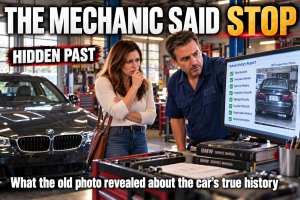
Tony nodded once, then turned and walked back into the garage. He sat at a computer desk in the corner, typed for a few minutes, and pulled up screens of vehicle history. The mileage looked normal. The service records appeared consistent. Then he opened an older inspection photograph and stared at it for a long time.
Something in that photo did not match what we were looking at now.
He zoomed in on the license plate in the image, then looked up at me.
“You need to see who owned this car before the seller,” he said.
My stomach tightened. The deal that had felt almost too good suddenly felt heavier.
I asked what he meant. Tony only shook his head and turned the monitor so I could see the plate more clearly. The numbers and letters did not match the plate currently on the BMW. The older photo showed a different state designation as well.
Derek was still outside under the tree, checking his phone. He had no idea what we were looking at.
I stood there with the smell of oil and warm concrete in the air, trying to decide what to do next. The car sat quietly in the bay, polished and waiting. Tony waited too, patient, not pushing me either way.
I had come here expecting ordinary wear and a fair price. Instead I was staring at a photograph that suggested the car’s recent history was not the simple family story I had been told.
I needed answers before I went any further.
Part 2
Tony printed two pages from the history report and handed them to me without comment. I read while he continued checking fluid levels and suspension points. The report listed a previous owner in another state, someone named Helen Ramirez, who had registered the car four years earlier. The transfer to Derek’s name had happened only six weeks ago. The mileage at that transfer matched almost exactly what the odometer showed now.
That alone was not suspicious. People move. Families sell cars. But the older photograph still bothered me. The plate in that image carried a different state code and a different sequence of numbers. The car in the photo also appeared slightly different in ways I could not immediately name—maybe the wheel design, maybe a small detail of the bumper.
I stepped outside. Derek looked up from his phone and offered a half-smile.
“Everything okay?” he asked.
I kept my voice even. “Tony’s still looking. He found something in the older records. Do you know anything about a previous owner named Helen Ramirez?”
Derek’s expression shifted for half a second, then settled back into polite neutrality. “My aunt’s full name was Helen. Ramirez was her married name years ago. She went back to her maiden name after the divorce, but some of the older paperwork still has Ramirez on it. That’s probably it.”
It sounded plausible. I wanted it to be true. I had already imagined driving this car home, parking it in my own driveway, finally replacing the aging sedan that had been costing me more in repairs each month.
I went back inside. Tony was under the car with a light. When he rolled out he wiped his hands again and spoke quietly so Derek could not hear.
“The plate in that older photo is real. I cross-checked it. That plate was registered to this VIN for almost three years in another state. Then it disappears from the records for a stretch. When the car shows up again here in Florida, it has a new plate and a new title path that looks clean on the surface. But the gap bothers me. And the price he’s asking is low enough that somebody might be motivated to move it quickly.”
I asked if the car itself was safe to drive. Tony said the mechanical inspection was mostly clean. Brakes were good, no major leaks, engine compression solid. The issues were not under the hood. They were in the paper trail and the quiet gaps.
I walked back out to Derek. The afternoon heat was building. A lawn mower hummed somewhere down the street.
“I need more time,” I told him. “I’d like to verify a few things on the title history myself before I decide.”
Derek nodded, though his shoulders had tightened. “Sure. Take the weekend if you need it. I can hold it until Monday.”
He gave me the current title paperwork and a copy of the bill of sale he had prepared. I photographed everything with my phone, including the current license plate and the VIN on the door jamb. Then I drove my own car home, the printed history pages on the passenger seat, the memory of that mismatched plate still clear in my mind.
That evening I sat at my kitchen table with a laptop and a cup of coffee that went cold. I searched the older plate number Tony had shown me. Public records were limited, but I found a few archived insurance references and one old registration note linking the plate to Helen Ramirez in a northern state. The address listed was a modest apartment complex.
I also searched Derek’s name and the Florida address. Nothing dramatic appeared. He had lived there for several years. No obvious red flags. Still, the gap in the car’s history and the sudden low price kept circling in my thoughts.
I called a friend who worked in title work at a dealership. She listened, then said the same thing Tony had implied: clean-looking paperwork can still hide a washed title or a previous salvage that someone worked hard to bury. She advised me to request a more detailed report and, if possible, to speak with the previous owner directly.
I did not sleep well. Every time I closed my eyes I saw the older photograph and the different plate.
On Sunday morning I decided I would try to reach Helen Ramirez.
Part 3
Finding a current number for Helen Ramirez took most of the morning. Public directories were thin. Social media yielded little. Finally an old insurance document I had paid a small fee to access listed a phone number that still worked.
I dialed it from my kitchen, heart beating harder than the situation seemed to warrant. A woman answered on the fourth ring. Her voice was careful, older.
I introduced myself and explained that I was looking at a BMW that had once been registered in her name. There was a long pause.
“That car,” she said finally. “I sold it almost a year ago. Or I thought I did.”
I told her the current seller’s name and the Florida location. Another pause, longer this time.
“I don’t know anyone named Derek,” she said. “And I never lived in Florida. The car was sold through a private listing in my state. A young couple said they were moving south and wanted a reliable car for the trip. They paid cash. I signed the title over to them. That was the last I heard of it.”
My hand tightened around the phone. “Do you remember their names?”
She did, after a moment of thinking. The names she gave me matched neither Derek nor any name on the current Florida title.
I thanked her and hung up. The kitchen felt too quiet. The printed history pages still lay on the table. Somewhere between Helen Ramirez and Derek, the car’s ownership path had changed in ways the surface documents did not fully explain.
I called Tony’s shop. It was closed on Sunday, but I left a message asking if he could look at the more detailed report when he opened on Monday. Then I sat with the information I had and tried to decide how much risk I was willing to accept.
The mechanical side of the car was sound. The price was still attractive. But the story Derek had told me about his aunt no longer matched what Helen Ramirez had just said. Either Derek was mistaken about the family connection, or he was not telling the full truth.
I spent the rest of the afternoon researching title-washing practices and how some cars move across state lines with incomplete histories. None of it made me feel better. By evening I had decided I would confront Derek with what I had learned before I spent another dollar.
Monday morning I drove back to the quiet street. Derek was already outside washing the BMW with a garden hose, as if preparing it for a sale that was still on track. He looked up and offered the same polite smile.
I did not waste time. I told him I had spoken with Helen Ramirez. I repeated what she had said about the young couple and the cash sale in another state.
Derek’s face changed. The polite mask slipped. He turned off the hose and set it down carefully.
“I can explain,” he said.
We stood in the driveway with water dripping from the car’s fenders. A neighbor walked a dog past us and nodded. Neither of us nodded back.
Derek rubbed the back of his neck. “The couple who bought it from Helen ran into money trouble a few months after they got here. They needed to sell fast. I bought it from them. The title work got messy because they had not finished registering it properly in Florida. I cleaned it up through a title service. My aunt story was simpler. People ask fewer questions when they hear it’s a family car.”
He said it as if the explanation should settle everything. It did not.
I asked why the price was so low. He said he needed the money for medical bills related to his mother. The timing of the sale mattered more than maximizing the profit.
I wanted to believe him. The mechanical report was clean. The car drove well. But the gaps, the mismatched plate in the older photo, and the casual rewriting of the car’s recent past all sat uneasily with me.
I told him I needed another day. He agreed, though his expression had hardened.
Back in my car I called Tony again. This time he answered. I recounted everything Helen and Derek had said. Tony listened without interrupting.
When I finished he said, “Come by this afternoon. Bring the paperwork. There’s one more thing I want to check on that older photograph.”
I drove straight to the shop.
Part 4
Tony had the older inspection image open on a larger monitor when I arrived. He had enhanced the area around the license plate and the lower front bumper. In the clearer view a small sticker was visible on the bumper, the kind some states require after certain inspections or repairs. The sticker’s date and code did not match any of the service records Derek had provided.
“That sticker belongs to a shop in the northern state,” Tony said. “I called them this morning. They confirmed the car was in for a structural check after a minor incident three years ago. Nothing major, but it was documented. That documentation never made it into the Florida records.”
I felt the weight of the decision settle more heavily. A minor incident three years earlier did not make the car unsafe now. Tony had already confirmed the structure was sound. But the pattern of incomplete information kept growing.
Tony leaned back in his chair. “I’ve seen this before. Sometimes it’s just messy paperwork and people trying to move a car quickly. Sometimes it’s someone deliberately smoothing over details that might scare a buyer. The low price is the part that still bothers me. Good BMWs in this condition don’t usually sit at that number unless somebody wants them gone fast.”
I asked what he would do in my place.
He thought for a moment. “I’d walk. Or I’d insist on a full title search through a bonded service and a written statement from the current seller explaining every transfer. And I’d get the price even lower to account for the risk. But walking is cleaner.”
I left the shop with the enhanced printout and drove home slowly. The afternoon traffic felt heavier than usual. At a red light I caught myself looking at other used cars on the road, wondering how many of them carried quiet gaps in their histories.
That evening I sat down and listed every fact I knew in a notebook.
Helen Ramirez had sold the car to a young couple in another state.
The couple had brought it to Florida and then sold it to Derek under unclear circumstances.
Derek had used a title service to clean up the paperwork and had invented a simpler family story.
An older inspection photo showed a different plate and a repair sticker that never appeared in the current records.
The mechanical condition was good.
The price was unusually low.
None of the individual pieces proved fraud. Together they formed a pattern of someone who preferred not to answer too many questions.
I called Derek one more time. He answered quickly.
I told him I had additional concerns about the repair sticker and the incomplete records. I asked if he would agree to a formal title search paid for by me, and if he would put in writing the full sequence of ownership from Helen Ramirez forward.
There was a silence long enough that I thought the call had dropped.
“I don’t have time for all that,” he said finally. “If you don’t want the car, just say so. I’ve had other interest.”
The shift in his tone told me more than the words. The polite seller who had been willing to wait was suddenly in a hurry.
I said I would let him know by the next afternoon. He hung up without saying goodbye.
I spent that night weighing the practical against the uneasy feeling in my chest. I could buy the car, accept the gaps, and likely drive it for years without trouble. Or I could walk away from a deal that had never quite felt right from the moment Tony asked that first quiet question.
By morning I knew which choice I would make.
Part 5
I drove to Derek’s house one last time. He was not outside. I knocked. When he opened the door he looked as if he had not slept well either.
I handed him the folder of printed records and the enhanced photograph.
“I’m not buying the car,” I said. “The history has too many unanswered pieces. I wish you luck with the next buyer.”
He stared at the folder for a moment, then took it. “Suit yourself.”
There was no argument, no further explanation. He closed the door.
I sat in my own car for a few minutes before starting the engine. Relief mixed with a strange disappointment. I had wanted the BMW. I had imagined the quieter ride, the better reliability, the simple pleasure of a car that felt solid. Instead I was driving away with nothing but a clearer sense of how easily a clean-looking deal can hide complicated truths.
On the way home I stopped at Tony’s shop to thank him. He was under another car but rolled out when he heard my voice.
“You walked,” he said. It was not a question.
I nodded.
He wiped his hands and stood. “Good. Most people don’t. They talk themselves into ignoring the parts that don’t add up. Then six months later they’re in here asking why the title is giving them trouble at the DMV or why an insurance company is asking questions.”
I asked if he thought Derek had done something illegal.
Tony shrugged. “Maybe not illegal. Maybe just convenient. People rewrite stories all the time when money is involved. The car itself is probably fine. The paper trail is the problem. You made the right call for yourself.”
I paid him for the inspection time and the extra research. He refused the extra money at first, then accepted it when I insisted. As I turned to leave he said one more thing.
“If you decide to keep looking, come back. I’ll check the next one too. Same rate.”
I smiled for the first time in days. “I might take you up on that.”
Over the following week I returned to my search with different eyes. I looked at fewer cars. I asked harder questions. I requested full history reports before I even scheduled test drives. Two promising listings fell apart under the same kind of quiet scrutiny Tony had taught me to apply.
In the meantime I kept thinking about Helen Ramirez and the young couple and Derek’s hurried explanations. I wondered what had really happened in the months between the cash sale in the north and the Florida title. I wondered whether the next buyer would ask the same questions I had asked, or whether they would simply be glad for the low price.
One evening, almost two weeks after I walked away, my phone rang with a number I did not recognize. It was Helen Ramirez.
She had been thinking about our conversation. She had reached out to a friend who worked in motor vehicle records and learned that the young couple who bought her car had run into serious financial trouble within months of arriving in Florida. Their names appeared in a few public notices related to unpaid debts. The car had changed hands again through a third party before reaching Derek. The trail was messy but not criminal on its face.
Helen sounded tired. “I only wanted the car to go to someone who would take care of it,” she said. “I should have asked more questions myself.”
I told her I had decided not to buy it. She was quiet for a moment, then said she thought that was wise.
After the call I sat on my back steps and watched the light change. The decision still felt correct, but the loose ends bothered me. I had walked away from a car. I had not closed the larger question of how often these quiet gaps appear in ordinary private sales.
A few days later I returned to Tony’s shop, not for another inspection, but because I had a question that had been sitting with me.
“How often do you see this?” I asked him while he changed the oil on a different car.
He kept working. “Often enough that I stopped being surprised. People need money. Cars are one of the easiest things to move when the story gets complicated. Most of the time the cars are fine. The stories are what need the inspection.”
I left with that thought still turning.
Part 6
Three weeks after I walked away from the BMW, I found another car. This one was a modest sedan from a different seller, priced fairly, with a complete history I could verify through multiple sources. I took it to Tony. He spent two hours with it and found only ordinary wear. I bought it the next day.
The new car was not a BMW. It did not turn heads. But every time I started it I felt none of the quiet unease that had followed me through Derek’s driveway.
I still thought about the gray BMW sometimes. I wondered who finally bought it, and whether they ever asked about the older photograph or the different license plate. I wondered whether Derek had cleaned up the story further or simply found a buyer who did not look as closely.
One afternoon I drove past the quiet street where the house sat. The BMW was gone from the driveway. A different car was parked there. I did not stop.
Life settled into its usual rhythm. Work, errands, the ordinary repairs that every car eventually needs. I told a few friends the story of the mechanic and the mismatched plate. Some of them said they would have bought the BMW anyway. Others said they would have walked sooner. I understood both reactions.
Then, almost two months later, I received an unexpected message.
It came through a community forum where people discussed local car sales and title issues. Someone had posted a question about a dark gray BMW with a recent Florida title and a price that seemed low. The description matched the car I had almost bought. The poster was asking whether anyone had information about the seller or the history.
I debated for a full day before responding. Finally I wrote a careful reply. I did not use names. I described the older photograph, the different plate, the conversation with the previous owner in another state, and the gaps that had never been fully explained. I suggested the new interested party request a thorough title search and speak directly with any previous owners they could locate.
The original poster thanked me and said they would dig further.
A week later the same person posted an update. They had walked away too. The seller had become defensive when asked for additional documentation. The low price had been the only remaining attraction, and it was no longer enough.
I felt a small, complicated satisfaction. The information had traveled. Someone else had been given the chance to decide with open eyes.
I sent Tony a short message telling him what had happened. He replied with a single sentence: “Good.”
That was all.
The experience changed how I approached every future purchase, not only cars. I began asking more questions about the stories people told when money was on the table. I paid closer attention to the details that did not quite line up. I learned that a clean surface can still hide incomplete history, and that the cost of walking away is often lower than the cost of ignoring the quiet warnings.
I never learned the full truth of what happened between Helen Ramirez, the young couple, and Derek. Some gaps stay closed. But I knew enough to protect myself, and later to offer the same protection to a stranger on a forum.
That felt like the only ending the story needed.
Part 7
Months passed. The modest sedan I had bought served me well. It started every morning, handled the Florida heat without complaint, and required only routine maintenance. I stopped thinking about the BMW every day. It became one of those near-misses that surface only when someone else mentions a too-good-to-be-true deal.
Then, in early autumn, I received another call from Helen Ramirez.
She sounded stronger than before. She had been sorting through old boxes and had found a small envelope of photographs from the years she owned the BMW. One of them showed the car parked in front of her apartment building with the original plate clearly visible. She offered to mail me a copy if I wanted it.
I told her I would like that. A few days later a plain envelope arrived. Inside was a single printed photograph and a short note in careful handwriting.
The photo showed the same dark gray car under northern light, the plate matching the one Tony had enlarged on his screen. In the background a younger Helen stood with a small dog on a leash, smiling at the camera. The note said she had loved that car. It had carried her through a difficult divorce and the first years of living alone. Selling it had felt like closing a chapter. She hoped whoever finally owned it would treat it kindly.
I sat with the photograph for a long time. The car itself had never been the real problem. The problem had been the silence around its recent path and the willingness of one seller to reshape the story for convenience.
I placed the photo in a drawer with the printed history reports I had kept. They were no longer useful for any purchase. They were simply a reminder of the day a mechanic asked a single careful question and changed the direction of a decision.
Tony and I stayed in occasional contact. He inspected two more cars for me over the following year—one for a friend, one for my sister when she needed a reliable used vehicle. Each time he applied the same quiet thoroughness. Each time he found something small that the ordinary checklist would have missed. None of the findings were dramatic. All of them mattered.
I began to understand that the value of a good mechanic is not only in the tools and the knowledge of engines. It is in the willingness to look past the surface and ask the question that does not appear on any standard form.
“Did the seller tell you where this car came from?”
That single sentence had saved me from a purchase I would have regretted in ways I could not have predicted at the time.
I never saw Derek again. The house on the quiet street changed hands a year later. I noticed the for-sale sign one afternoon while driving a different route home. By the next week the sign was gone. I did not inquire further.
Some stories do not need complete closure. They need only the moment when a person chooses caution over convenience and then lives with the ordinary consequences of that choice.
My ordinary consequence was a reliable sedan, a clearer set of questions for future decisions, and a quiet respect for the mechanic who had refused to let the paperwork speak for itself.
Part 8
A year and a half after the original inspection, I received a message that surprised me. It came from the same community forum where I had once posted a careful warning. The original poster from that earlier exchange had started a longer discussion about private-party car sales and the limits of standard history reports. Several people had shared similar experiences—clean mechanical inspections paired with incomplete or reshaped ownership stories.
One commenter described a situation almost identical to mine: a low-priced luxury car, a friendly private seller, a mechanic who noticed a discrepancy in older photographs, and a previous owner who told a different version of events. The commenter had also walked away.
Reading the thread, I felt the private experience open into something larger. The gaps I had encountered were not unique. They were part of a quiet pattern that appeared whenever money, mobility, and incomplete records met.
I contributed a longer post this time. I described the sequence without naming anyone. I explained how the older inspection photograph had revealed the mismatched plate, how the conversation with Helen Ramirez had contradicted the seller’s family story, and how the final decision had rested less on mechanical risk than on the accumulation of unanswered questions. I ended by recommending that buyers treat every private sale as a research project rather than a simple transaction.
The response was larger than I expected. People shared their own near-misses. A few described deals they had completed and later regretted when title problems surfaced at registration or insurance renewal. Others said the discussion had prompted them to return to a current negotiation with harder questions.
Tony saw the thread somehow and sent me a short note: “You’re doing more good than you know.”
I did not feel like I was doing anything remarkable. I had simply refused to ignore what the evidence suggested. Still, the idea that the information continued to travel mattered to me.
Around the same time my sister bought the car Tony had inspected for her. She called me the day she drove it home, laughing with relief. “It feels honest,” she said. “I know that sounds strange for a used car, but it does.”
I understood exactly what she meant.
The gray BMW remained a closed chapter. I never learned who finally purchased it or whether the new owner ever discovered the older photograph and the different plate. I hoped they had asked the right questions. I hoped the car had found a careful home. Beyond that, the story no longer belonged to me.
What remained was the habit of looking closely, of asking the quiet question that does not appear on the checklist, and of accepting that walking away can be its own form of resolution.
Part 9
Two years after the afternoon in Tony’s garage, I was asked to speak at a local consumer workshop about private vehicle purchases. The organizer had seen the forum discussion and thought the story might help other buyers. I almost declined. I am not a public speaker. But the memory of Helen Ramirez’s careful voice and Tony’s steady patience convinced me to say yes.
I prepared a simple outline. I did not dramatize the events. I described the listing, the inspection, the mismatched plate in the older photograph, the conflicting accounts from Helen and Derek, and the decision to walk away. I spoke about the difference between a clean mechanical report and a complete ownership history. I ended with the same question Tony had asked me: Did the seller tell you where this car came from?
Afterward several people waited to talk. One woman said she had been about to buy a car that week and was now going to request additional documentation. A man in his sixties told me he had lost money years earlier on a title that looked clean until the day he tried to register it in a new state. He shook my hand and said he wished someone had asked him that question at the time.
Driving home that evening I felt the story settle into its final shape. It had begun as a personal near-miss. It had become a small piece of shared caution passed from one buyer to another. The car itself had never been the center. The center had been the willingness to stop when the surface did not match the underlying record.
I stopped by Tony’s shop the next week with a thank-you card and a gift certificate to the coffee place he liked. He laughed when he opened it.
“You didn’t have to do that,” he said.
“I know,” I answered. “But the question you asked that day still travels. I wanted you to know.”
He nodded, already turning back toward the car on the lift. “That’s the job. See what’s actually there, not just what people want you to see.”
I left the shop with the familiar smell of oil and concrete following me into the parking lot. The afternoon light was the same soft Florida gold it had been on the day I first brought him the BMW. Everything else had changed.
I no longer needed a different car. The sedan still ran well. More importantly, I no longer needed the lesson. It had already been absorbed into the way I approached decisions that involved trust, paperwork, and the stories people tell when they want a transaction to close quickly.
The gray BMW had taught me something I carried forward without bitterness or regret. Sometimes the most valuable outcome of a potential purchase is the clear decision not to complete it.
Part 10
Years later I still keep the printed photograph Helen Ramirez sent me. It sits in a drawer with the old history reports and the single page Tony had enhanced. I do not look at them often. When I do, I am reminded of the exact moment the deal shifted—the quiet question in the garage, the enlarged license plate on the screen, the careful voice on the phone from another state.
I never learned the complete sequence of ownership between Helen and Derek. The young couple who first brought the car south left only faint traces in public records. Derek himself disappeared from the local listings. The car’s final destination remains unknown to me. That absence no longer troubles me. Not every story requires a full accounting. Some require only enough clarity to choose wisely.
The modest sedan I bought after walking away eventually reached the end of its reliable years. When the time came to replace it, I returned to Tony’s shop with a different candidate. He inspected it with the same thoroughness. The history was complete, the mechanical condition honest. I bought that car without hesitation.
Tony has since trained a younger mechanic who asks the same kinds of questions. I have watched the younger man study older photographs and cross-check plates with the same quiet focus. The habit continues.
Helen Ramirez wrote to me one final time, years after our last conversation. She had moved to a smaller place near her daughter. She said she still thought of the BMW with fondness and was glad it had not carried any further difficulty into my life. I wrote back and told her the truth: the car had given me something more useful than transportation. It had given me a permanent respect for the details that do not match.
I no longer search for bargains that seem too good. I search for records that hold up under ordinary scrutiny and for sellers who can answer simple questions without reshaping the past. That standard has cost me a few attractive deals. It has also spared me the longer complications that follow when the paper trail and the spoken story refuse to agree.
On quiet evenings I sometimes drive past the neighborhood where Derek once lived. The house looks ordinary. The driveway holds different cars now. I do not slow down. The chapter closed the afternoon I handed him the folder and walked away.
What remains is simpler. A mechanic who refused to ignore an older photograph. A previous owner who answered the phone and told the truth as she knew it. A buyer who chose uncertainty over a convenient price. And the lasting knowledge that the most important inspection is often the one that looks beyond the engine and into the spaces where stories are rewritten.
I am grateful for the question that stopped me. I am grateful I listened. The rest of the story belongs to whoever finally drove the gray BMW home, and to the quiet habit of asking where a thing has truly come from before deciding it is yours.
That is the ending I carry.