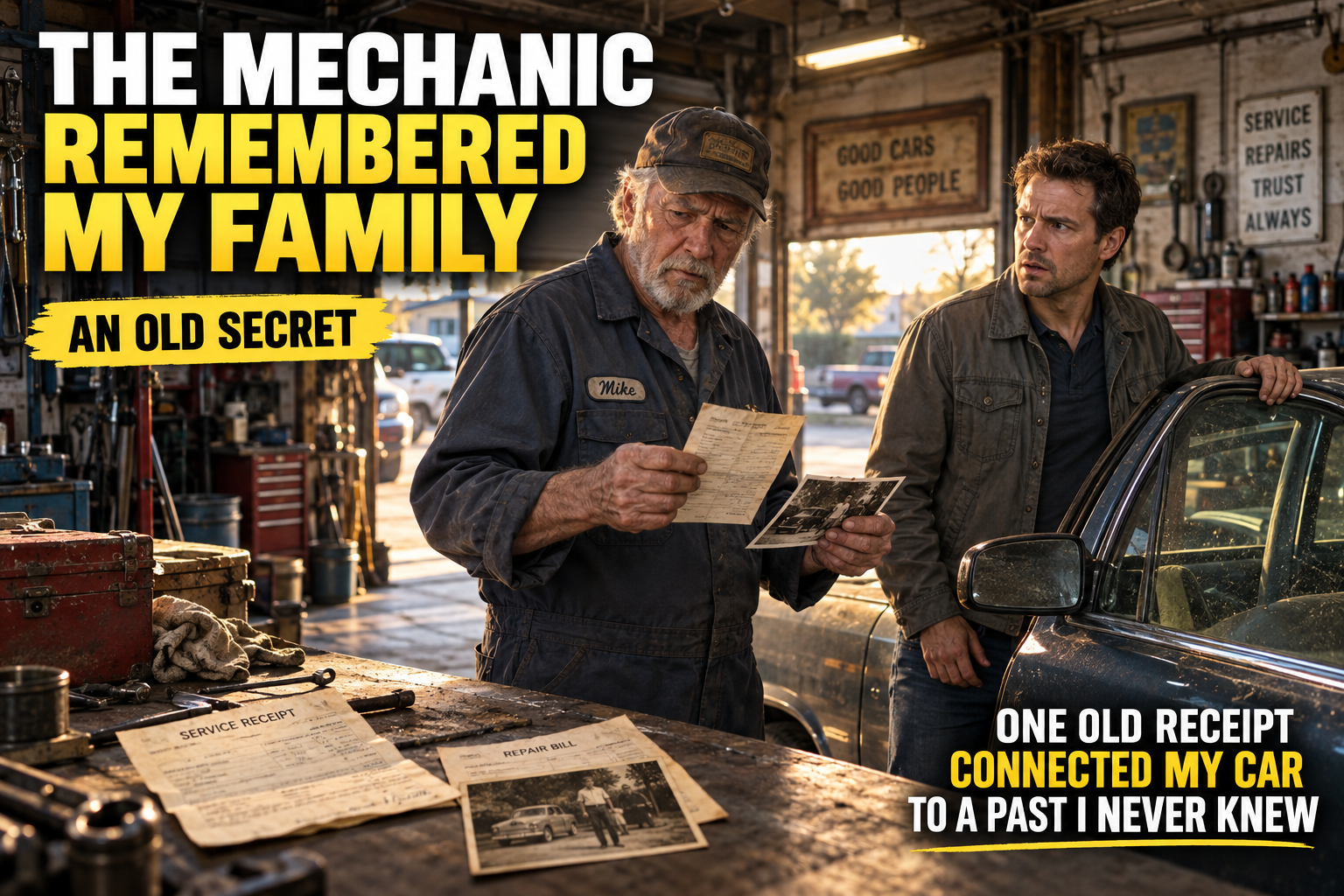
Forty miles from home, a routine car repair turned into a mystery when a mechanic recognized my father’s name—and produced an old receipt proving my mother had once owned the very car I thought my family had sold years earlier.
Part 1
The first thing I noticed was the sound.
Not the engine itself, but the uneven clicking beneath the hood, a stubborn little rhythm that had started somewhere outside a town I barely knew. It came and went whenever I tried to accelerate, and by the time I reached the next exit, the car had begun losing power.
I managed to guide it onto the shoulder.
Forty miles from home.
I sat behind the wheel for a few minutes with both hands resting on it, listening to traffic move past me. I had been driving back from a weekend visit with an old friend, thinking about nothing more complicated than what I would make for dinner.
Now I was staring at the dashboard, trying to decide whether the warning light meant something expensive.
I called roadside assistance.
The estimated wait was nearly two hours.
There was, however, a small garage less than a mile away.
I found it after walking along the side road, following a faded blue sign that read simply:
RIVERSIDE AUTO SERVICE.
The garage looked as though it had been there for decades. Two bays. A small office. An old vending machine beside the entrance. A row of tires stacked against one wall.
An older man was working beneath the hood of another vehicle.
“Excuse me,” I said.
He slid out from beneath the hood and wiped his hands on a rag.
“What happened?”
I explained.
He looked toward the road.
“Your car?”
“Yes.”
“Can you get it here?”
“With some help, maybe.”
He considered that for a moment.
“I’ve got a tow dolly out back. Give me twenty minutes.”
His name was Daniel.
At least, that was what the small metal nameplate on his work shirt said.
He didn’t talk much while we brought the car into the garage. He worked carefully, opening the hood and checking things one by one. I sat on an old chair near the office door, watching him.
There was something familiar about the place.
Not familiar in the sense that I had been there before.
More like the garage belonged to a memory I couldn’t quite reach.
A faded calendar hung beside the office window. A coffee maker sat on a shelf. On the wall were photographs of cars the garage had repaired over the years.
Daniel eventually asked, “You from around here?”
“No. About forty miles away.”
“Thought so.”
“Why?”
“You looked lost when you walked in.”
I smiled.
“Fair enough.”
He returned to the engine.
For several minutes, the only sounds were tools clicking against metal and an old radio playing softly from somewhere behind him.
Then Daniel stopped.
He leaned closer to the engine.
“What’s your last name?”
I told him.
He straightened.
“And your father?”
I frowned.
“What about him?”
“What was his name?”
I hesitated.
“Robert.”
Daniel didn’t answer.
He slowly stepped away from the car.
The expression on his face had changed.
“What?” I asked.
He looked at me.
“Robert was your father?”
“Yes.”
“How long ago did he pass?”
I told him.
Daniel lowered his eyes.
Then he walked toward the office.
I stood.
“Why are you asking about my father?”
He didn’t answer immediately.
Instead, he opened an old metal filing cabinet.
He searched through several folders.
Then he looked back at me.
“Your father ever own this car?”
I laughed nervously.
“No.”
Daniel pulled out a yellowed piece of paper.
“Yes, he did.”
I stared at him.
“That can’t be right.”
He placed the paper on the desk.
It was an old service receipt.
And the vehicle identification number printed on it matched the car sitting in his garage.
But there was something else.
The customer’s name wasn’t Robert.
It was my mother’s.
And suddenly, a memory from childhood came rushing back.
My mother had always told me that our family had never owned this car.
So why did her name appear on an old repair receipt?
Daniel looked at me carefully.
“I think you need to sit down.”
Part 2
I sat.
Daniel remained standing beside the desk.
The receipt was more than a piece of paper. It was a contradiction.
My entire understanding of that car had always been simple.
My father bought it.
My father drove it.
My father sold it in 2006.
That was what I remembered.
At least, I thought it was what I remembered.
I picked up the receipt.
The date was from 2008.
Two years after my father supposedly sold the vehicle.
The handwriting on the service notes was faded, but the customer’s name was clear.
My mother.
I looked at Daniel.
“My mother didn’t own this car.”
“You’re sure?”
“Yes.”
He nodded slowly.
“I thought you might say that.”
“What happened here?”
“I don’t know everything.”
“You clearly know something.”
Daniel leaned against the desk.
“I knew your father.”
I stared at him.
“You knew Robert?”
“Yes.”
“How?”
“He used to come here.”
“When?”
Daniel looked at the receipt again.
“Years ago.”
I waited.
He didn’t continue.
“Why would my father bring this car here in 2008 if he sold it in 2006?”
Daniel rubbed his forehead.
“That is the part I can’t explain for you.”
“Can’t?”
“I wasn’t the only person involved.”
The words made me uncomfortable.
“Who else?”
He looked toward the garage door.
“No.”
I stood.
“Daniel, you have already shown me documents from my family. If there is something you know, I need you to tell me.”
He looked at me for a long moment.
Then he opened another drawer.
He took out a repair bill.
$1,200.
The paper was older than the receipt.
At the bottom was a handwritten sentence.
Do not tell the family.
I read it twice.
My stomach tightened.
“Who wrote that?”
Daniel shook his head.
“I don’t know.”
“You don’t know?”
“I wasn’t the one who wrote it.”
“Then who?”
He didn’t answer.
I turned the paper over.
Nothing.
“Why did you keep this?”
“Because your father asked me to.”
That stopped me.
“My father asked you to keep it?”
Daniel nodded.
“Then why show it to me now?”
He looked at the car through the open garage bay.
“Because I didn’t expect to see it again.”
“What do you mean?”
“That car disappeared from my life a long time ago.”
“But it’s here.”
“I know.”
Daniel picked up the receipt again.
“When you drove in, I recognized the vehicle before I recognized you.”
I stared at him.
“You recognized my car?”
“Not the way most people recognize a car. I remembered the scratches on the passenger-side panel. The shape of the rear light. There was a small dent near the trunk.”
I looked at the car.
Those details were all there.
“How long ago did you see it?”
“2008.”
My mother’s name was still staring at me from the receipt.
I thought about calling her.
Then I remembered she wasn’t alive anymore.
That was the strange thing about old family secrets.
You could spend years believing there was always time to ask questions.
Then one day, there was nobody left to ask.
Daniel reached into another drawer.
“This is the part I never understood.”
He placed a photograph on the desk.
It was faded and slightly bent at one corner.
A woman stood beside the same car.
My mother.
Younger.
Much younger.
I recognized her immediately.
But she wasn’t alone.
A man stood beside her.
His face was partly turned away.
I moved closer.
“Who is that?”
Daniel didn’t answer.
I looked again.
There was something about the man’s posture.
Something about the way he stood beside my mother.
Then Daniel quietly said,
“You’ve seen him before.”
I looked at him.
“No, I haven’t.”
Daniel’s eyes stayed on the photograph.
“You just don’t remember where.”
Part 3
I took the photograph from his hand.
The paper was soft with age.
My mother was standing beside the car, smiling at whoever had taken the picture. She looked younger than I remembered her ever looking, perhaps in her late twenties or early thirties.
The man beside her was taller.
He wore a plain work shirt.
His face was turned slightly away.
I studied every detail.
“I don’t know him.”
Daniel didn’t argue.
“You may not remember him.”
“Who was he?”
“I can’t tell you that.”
I nearly laughed.
“You’ve spent the last hour showing me things you say you can’t explain.”
Daniel accepted that without reacting.
“I know.”
“Then why show me anything?”
“Because you came here.”
“That isn’t an answer.”
“No,” he said. “It isn’t.”
He took the photograph back.
For a moment, neither of us spoke.
Then I noticed something written on the back.
A date.
August 2008.
I felt a chill of recognition.
Not because I remembered the date.
Because I remembered what my mother had told me about that summer.
She had said she was away visiting a cousin.
Three days.
That was all.
I had never questioned it.
I was young.
My father was busy with work.
My mother came home with a small suitcase and acted as though nothing unusual had happened.
I suddenly wondered whether she had actually been visiting anyone.
“Daniel.”
He looked at me.
“Where was this photograph taken?”
“Behind the garage.”
I looked around.
“Here?”
“Yes.”
“Why was my mother here?”
Daniel took a breath.
“She brought the car.”
“My mother?”
“Yes.”
“But why?”
“I don’t know.”
“You repaired it.”
“I did.”
“What was wrong with it?”
He hesitated.
“Nothing unusual.”
“That doesn’t make sense.”
“It was an old vehicle. It needed work.”
“Why the $1,200 bill?”
Daniel looked toward the office.
“That wasn’t ordinary maintenance.”
“What was it?”
He was silent.
I waited.
Finally he said, “Your mother asked us to replace several things and keep the work private.”
“Why?”
“I don’t know.”
“Who is us?”
Daniel gave me a tired smile.
“You’re asking questions I haven’t answered in eighteen years.”
“Maybe you should start.”
He looked at the photograph.
“There were two people here that day.”
“My mother and my father?”
“No.”
That answer hit harder than I expected.
“Then who?”
“Your mother and the man in the photograph.”
I looked down.
“Was my father aware she was here?”
Daniel shook his head.
“I can’t say.”
“You can’t say, or you don’t know?”
“I don’t know.”
I stepped away from the desk.
The garage suddenly felt smaller.
The ordinary sounds of traffic outside seemed very far away.
My mother’s name.
The date.
The car.
The stranger.
The note.
Do not tell the family.
All of it pointed toward a part of my parents’ lives I had never seen.
But there was something else.
Something Daniel hadn’t explained.
“Why did you say I had seen him before?”
He didn’t answer.
“Daniel.”
He finally looked at me.
“When you came through that door, I thought I was looking at Robert.”
I froze.
“What?”
“Not exactly. Your face is different. But the way you stand…”
He stopped.
“The way I stand?”
“Your father used to stand exactly like that when he was worried.”
I didn’t know what to say.
Daniel looked embarrassed by his own observation.
“I’m sorry.”
“No.”
I sat back down.
“Tell me what happened in 2008.”
Daniel looked at the clock.
“I can’t.”
“Why?”
“Because I promised.”
“To my father?”
He didn’t answer.
“To my mother?”
Still nothing.
I felt frustrated.
“Then who?”
Daniel finally said, “To the person who asked me to keep the photograph.”
I stared at him.
“The person in the photograph?”
Daniel nodded.
I looked down at the faded image again.
The man beside my mother.
The stranger who had somehow been connected to my family.
And for the first time, I wondered whether my parents’ marriage had contained a secret that had existed long before I was old enough to notice.
Daniel closed the drawer.
“I think you should go home.”
“Why?”
“Because there are things you need to find before I tell you anything else.”
“What things?”
He looked directly at me.
“Your mother’s old papers.”
Part 4
I drove home with the repair problem temporarily forgotten.
The car was still in Daniel’s garage.
He had said it would be ready the next morning.
I hardly heard him.
All I could think about was my mother.
Her old papers.
The phrase stayed with me throughout the drive.
When I reached home, I went directly to the storage room.
My mother had been gone for years, but I had kept several boxes of her belongings. Most were things I had never had the heart to sort through.
Old photographs.
Receipts.
Letters.
Holiday cards.
Documents.
I had always told myself I would organize them eventually.
That night, eventually arrived.
I pulled the first box from the shelf.
Nothing.
The second contained family photographs.
I searched them one by one.
My parents.
Me as a child.
My grandparents.
Birthday parties.
School events.
Nothing from 2008.
Then I found an envelope.
No name.
No address.
Inside was a folded piece of paper.
The handwriting was my mother’s.
I knew it immediately.
The note was short.
“I don’t want this to become part of the family story. Some things are better left where they belong.”
There was no signature.
No date.
I read it again.
Then again.
My hands were shaking.
I searched the box more carefully.
At the bottom was an old insurance folder.
I opened it.
The first page was from 2006.
The vehicle listed on the policy was the same model as my car.
But the policyholder wasn’t my father.
It was my mother.
I sat on the floor.
Why had I never known?
I searched through the folder.
There were payment records.
A registration document.
A maintenance form.
And one handwritten note.
“Transfer after August.”
August.
The same month as the photograph.
I called Daniel.
He answered on the fourth ring.
“You found something.”
It wasn’t a question.
“How did you know?”
“Your mother kept records.”
“I found an insurance document.”
“Does it have the vehicle number?”
“Yes.”
He was quiet.
“It matches.”
“Daniel, what happened that summer?”
“I told you. I don’t know everything.”
“You knew my mother had the car.”
“Yes.”
“You knew she came to your garage.”
“Yes.”
“You knew there was another man.”
“Yes.”
“And you kept all of this for eighteen years.”
He sighed.
“Yes.”
“Why?”
“Because your father asked me to.”
Again.
My father.
That changed the question.
“Why would my father ask you to keep my mother’s documents?”
“He didn’t ask me to keep your mother’s documents.”
“Then what did he ask you to keep?”
“The photograph.”
I leaned against the wall.
“Why?”
Daniel was silent.
“Daniel?”
“He came here after your mother.”
“When?”
“Two days later.”
My eyes widened.
“What did he say?”
“I can’t remember every word.”
“But you remember the important part.”
“Yes.”
“What was it?”
“He asked whether she had been here.”
“And you told him?”
“I told him the truth.”
“What truth?”
“That she had brought the car.”
“What did he do?”
“He sat in the same chair where you were sitting today.”
I looked toward the doorway.
“What happened then?”
“He asked me to keep the photograph.”
“Why?”
Daniel paused.
“Because he said he needed time.”
“Time for what?”
“To decide whether you should ever know.”
I stared at the phone.
“Know what?”
“I don’t know.”
“You keep saying that.”
“Because it’s true.”
I wanted to believe him.
But another thought came to me.
“If my father knew about the car, why did my mother tell me she never owned it?”
“I don’t know.”
“If my father knew about the photograph, why did nobody ever mention it?”
“I don’t know.”
“And why did he sell the car in 2006 if my mother was still using it in 2008?”
Daniel was quiet.
Then he said something that made me stop breathing for a second.
“Are you certain your father sold it?”
I looked at the old documents on the floor.
The 2006 date.
The insurance records.
My mother’s name.
“I thought so.”
“Thought?”
“That was what I was told.”
Daniel’s voice became softer.
“Then maybe the first thing you need to find is the original sale document.”
I ended the call.
For the next hour, I searched every box I had.
Then I found a folder labeled with my father’s name.
Inside was a vehicle sale agreement dated 2006.
The buyer’s name was blacked out by a faded correction mark.
But underneath it, in my father’s handwriting, were four words:
“Not sold. Transferred temporarily.”
I read the sentence until the words blurred.
My father had never sold the car.
At least, not in the way I had been told.
Part 5
The next morning, I returned to the garage before Daniel opened the doors.
He was already there.
He looked at me through the office window.
“You found it.”
I held up the document.
“You knew.”
“I suspected.”
“You knew enough.”
Daniel unlocked the door.
“Come inside.”
I placed the document on his desk.
“My father wrote that the car was transferred temporarily.”
Daniel read it.
He didn’t seem surprised.
“Where did you find this?”
“At home.”
“Then your mother kept more than I thought.”
“What was happening in 2008?”
Daniel sat down.
For the first time, he looked old.
Not tired.
Old.
As though he had carried the same unanswered question for too many years.
“Your parents were having problems,” he said.
“What kind?”
“Money.”
I waited.
“Your father had made some business decisions that didn’t work out. There were bills. Arguments. Your mother was worried about the house.”
I looked at him.
“That doesn’t explain the car.”
“No.”
“What does?”
Daniel folded his hands.
“Your mother wanted something in her own name.”
“The car?”
“Yes.”
“Why?”
“Security.”
The word sounded ordinary.
Almost disappointing.
But I knew there was more.
“Security from what?”
“From uncertainty.”
He looked at me.
“Your mother had begun putting certain things aside.”
“What things?”
“Documents. Savings. Property information.”
“Why?”
“She wanted to make sure you would be protected if something happened to the family.”
I frowned.
“Why didn’t she tell me?”
“You were young.”
“How young?”
“Old enough to remember things. Too young to understand them.”
That sounded like my mother.
She had always protected me from adult problems.
But the photograph still bothered me.
“What about the man?”
Daniel looked down.
“He was an old friend of your mother’s.”
“Friend?”
“Yes.”
“Just a friend?”
“I don’t know what they were beyond that.”
I studied his face.
“Was he helping her?”
“Yes.”
“With what?”
Daniel reached for another folder.
He opened it carefully.
Inside were copies of several old receipts.
The car had been used as part of a temporary arrangement.
My mother had paid for repairs.
She had also paid for storage.
The man in the photograph had helped her arrange the paperwork.
“Why would she need him?”
“Because your father didn’t know.”
I stared at him.
“Know what?”
“That your mother was trying to protect something.”
“What?”
Daniel pointed toward the folder.
“The house.”
I frowned.
“My mother was protecting our house?”
“Yes.”
“How?”
“She discovered that some financial paperwork had been filed incorrectly.”
I read the documents.
There were references to loans.
Property records.
A bank.
A temporary transfer.
Nothing immediately made sense.
Then I saw my mother’s handwriting.
“Keep the house separate from the business.”
I looked up.
“My father’s business?”
Daniel nodded.
“Your mother was afraid a problem with the business could affect the family home.”
“And the car?”
“Was part of the same plan.”
I sat back.
This was not the secret I had expected.
For years, I had imagined the worst possible explanation for the photograph.
But perhaps the truth was more ordinary.
Still, one question remained.
“Why the note?”
Daniel looked at the words.
“Do not tell the family.”
“Who wrote it?”
“I believe your mother.”
“Why?”
“Because she didn’t want anyone asking questions.”
“About the house?”
“About everything.”
He reached into the drawer again.
“There is one more thing.”
He placed a small envelope on the desk.
My name was written on it.
My name.
I stared.
“When did you get this?”
“2008.”
“From my mother?”
“No.”
“Then who?”
Daniel pushed the envelope toward me.
“It was left here with the photograph.”
I opened it.
Inside was a single page.
The handwriting was not my mother’s.
It was my father’s.
The message was only a few lines.
“I don’t know what the future will look like. If my child ever asks about the car, tell the truth, but only when the time is right.”
I read it twice.
Then I turned the page over.
There was another sentence.
“If I cannot explain it myself, Daniel will understand.”
I looked at the mechanic.
“You knew all along.”
Daniel shook his head.
“No.”
“Then what did you know?”
He looked toward the garage bay.
“Only that your parents were trying to protect you from something they believed would eventually pass.”
“What passed?”
He didn’t answer.
Instead, he asked,
“Do you still have your mother’s old address book?”
“Yes.”
“Bring it tomorrow.”
“Why?”
“Because there is one name you need to find.”
Part 6
I spent the entire evening looking for the address book.
My mother had kept it in the kitchen drawer for years.
I remembered it clearly.
Small.
Brown.
Worn around the edges.
When I finally found it, I sat at the dining table and turned through the pages.
Most entries were ordinary.
Neighbors.
Doctors.
Friends.
Teachers.
Businesses.
There were several names from my father’s company.
Then I found one written in darker ink.
Daniel had been right.
The name belonged to the man in the photograph.
Thomas.
Under his name was a phone number that no longer worked.
Beneath it, my mother had written:
“Only if necessary.”
I stared at the words.
Then I noticed something else.
A second address.
I searched the internet for the street.
The house was gone.
A new building stood there now.
I called Daniel.
“I found the name.”
“Thomas?”
“Yes.”
He was quiet.
“You remember him?”
“No. But my mother wrote his name.”
Daniel sighed.
“Then you should know something.”
“What?”
“Thomas wasn’t your mother’s secret partner.”
I closed my eyes.
“Then what was he?”
“Your mother’s cousin.”
I opened them.
“What?”
“Not by blood.”
I didn’t understand.
“He was the son of your grandmother’s closest friend. They grew up together.”
“That doesn’t explain why nobody mentioned him.”
“Your mother didn’t want his involvement discussed.”
“Why?”
“Because he was helping her with something.”
“The house?”
“Yes.”
Daniel explained slowly.
Years earlier, Thomas had worked in property management.
He knew how to handle complicated transfers.
When my mother became worried about my father’s business debts, she asked Thomas for advice.
He helped her move certain assets into her name.
The car was one of them.
The house was another.
The purpose was simple.
If my father’s business problems became serious, the family home would remain protected.
But there was a problem.
My father discovered what my mother was doing.
“They argued,” Daniel said.
“About money?”
“About trust.”
I looked down.
“That sounds like them.”
“You remember?”
“I remember them being quiet around each other.”
Daniel nodded.
“Sometimes quiet says more than arguing.”
I asked him what happened next.
“My father agreed to the arrangement?”
“Eventually.”
“Then why was everything hidden?”
“Because the paperwork was never completed the way they intended.”
“What happened?”
Daniel hesitated.
“Your father decided to close the business.”
I didn’t know that.
“He never told me.”
“He didn’t tell many people.”
“What about my mother?”
“She knew.”
“And the car?”
“Your father transferred it back to her.”
I stared at him.
“So she owned it.”
“Yes.”
“Then why did she tell me she didn’t?”
“Because she wanted you to think everything was normal.”
The answer was painfully familiar.
My mother had always believed that children should not carry adult worries.
But I was no longer a child.
I wanted the full story.
“What happened to Thomas?”
Daniel looked down.
“He moved away.”
“Why?”
“He had a family of his own.”
“Did my mother stay in contact with him?”
“For a while.”
“How long?”
“Until 2010, maybe.”
Then Daniel opened another drawer.
He removed a postcard.
It was addressed to my mother.
The return address was from another state.
The message was short.
“Everything is settled. You don’t need to worry anymore. Keep the papers safe.”
No signature.
But the handwriting matched the address book.
Thomas.
I sat quietly.
The secret was beginning to take shape.
My mother had not been hiding a second life.
She had been hiding how much she had done to protect the family.
But one thing still didn’t make sense.
Why had the mechanic kept everything?
Why had my father asked him to preserve the photograph?
And why had Daniel recognized me the moment I walked into the garage?
I asked him.
He looked at me.
“Because your father came back here one final time.”
“When?”
“Late 2008.”
“What did he say?”
“He asked me to keep the photograph.”
“Why?”
“He said your mother had made peace with everything.”
“With what?”
“With him.”
I swallowed.
“And the car?”
“Your mother wanted to sell it.”
“To whom?”
Daniel smiled faintly.
“You.”
I stared at him.
“What?”
“Your mother told me that one day, the car would belong to you.”
I looked through the garage window at my vehicle.
The same car.
The same one I had driven for years without knowing any of this.
Daniel continued.
“She said you would eventually need it.”
I felt a strange mixture of sadness and warmth.
My mother had apparently known something about my future that I had never understood.
Then Daniel reached into the drawer one last time.
“This is why I kept the photograph.”
He placed another picture on the desk.
This one was clearer.
My mother stood beside the car.
Thomas stood beside her.
And in the background, partially visible near the garage office, was my father.
He was watching them.
But he wasn’t angry.
He was smiling.
Part 7
I stared at the photograph.
My father was smiling.
That single detail changed everything.
For years, I had imagined the photograph as evidence of something hidden and painful.
Instead, my father looked calm.
Almost relieved.
“Why was he there?” I asked.
Daniel answered quietly.
“Because he wanted to know that your mother was safe.”
I looked at him.
“Safe from what?”
“From losing everything.”
Daniel explained that my father’s business had been struggling badly in 2008.
He had reached a point where one more mistake could have cost the family their home.
My mother had quietly arranged a plan with Thomas.
She separated certain assets from the business.
The car was one.
A portion of their savings was another.
The house was protected through a separate agreement.
None of it was meant to deceive my father permanently.
It was meant to create breathing room.
But my father had misunderstood the plan at first.
“He thought your mother didn’t trust him,” Daniel said.
“Did she?”
“Not exactly.”
“What does that mean?”
“She didn’t trust the situation.”
I looked at the photograph again.
My father wasn’t smiling because everything was perfect.
He was smiling because the crisis had finally been contained.
“What happened after this?”
“They went home.”
“Together?”
“Yes.”
“Did they stay married?”
Daniel looked surprised.
“Of course.”
I almost laughed.
“I’m sorry. I just…”
“You had a different picture in your mind.”
“Yes.”
“So did I, once.”
He sat down.
“Your parents were complicated people.”
“They never seemed complicated.”
“That is because they worked hard to make life look ordinary for you.”
I thought about my childhood.
My mother packing lunches.
My father fixing shelves.
Sunday breakfasts.
School events.
Christmas mornings.
Nothing had seemed wrong.
But perhaps that had been the point.
Daniel handed me the second photograph.
On the back was a date.
September 2008.
Then a sentence in my father’s handwriting:
“We decided together.”
I read it.
“What does this mean?”
“It means the secret belonged to both of them.”
I looked at him.
“Then why didn’t they tell me?”
“Because they didn’t want you to remember that year as a time when the family was struggling.”
I looked down.
That was exactly what my mother would have done.
She had protected the appearance of normal life so carefully that I had grown up believing it had always been normal.
I asked Daniel what happened to the car afterward.
“Your mother kept it.”
“And then?”
“She eventually gave it to your father.”
“But I thought my father sold it.”
“He did.”
“When?”
“Years later.”
“Then how did it come back to me?”
Daniel smiled.
“Your father arranged it.”
I felt confused.
“How?”
“Before he passed, he made sure the car would eventually reach you.”
I stared at him.
“I bought this car from a private seller.”
“Yes.”
“I didn’t know my father had anything to do with it.”
“He didn’t want you to know.”
“Why?”
“He wanted you to choose it yourself.”
I didn’t understand.
Daniel explained that my father had arranged for the car to remain with someone he trusted until the right time.
The seller I had bought it from had no idea about the family’s history.
To me, it had simply been an inexpensive used car that happened to be reliable.
But behind that ordinary purchase was a decision made years earlier.
My father had wanted me to have something that belonged to both of my parents.
Not as a burden.
Not as a reminder of difficult years.
As a gift.
I felt tears in my eyes.
I had spent years thinking my parents had hidden things from me because they didn’t trust me.
Now I wondered whether they had hidden them because they loved me enough to carry the worry themselves.
Daniel stood.
“There is something else.”
I laughed softly.
“Of course there is.”
He smiled.
“Your father left one final instruction.”
“What?”
“He told me that if you ever came back here with the car, I should give you something.”
My chest tightened.
“What?”
Daniel walked to a locked cabinet.
He unlocked it.
Inside was a small box.
He brought it to the desk.
The box had my mother’s handwriting on the top.
My name.
I opened it.
Inside was a key.
A letter.
And a small photograph.
The photograph showed my parents standing together in front of the house where I grew up.
They were holding hands.
On the back my mother had written:
“For the day you finally ask.”
I unfolded the letter.
The first line was enough to make me stop.
“My dear child, if you are reading this, then you are old enough to understand why we kept certain things quiet.”
I looked at Daniel.
He turned away to give me privacy.
I continued reading.
My mother’s letter didn’t contain a shocking confession.
It contained something much harder.
An explanation.
Part 8
My mother wrote that 2008 had been the most uncertain year of her marriage.
My father had nearly lost his business.
She had been frightened.
He had been embarrassed.
And both of them had been too proud to admit how scared they were.
She had gone to Thomas because she needed practical help.
The car was transferred into her name.
The house was protected.
Money was reorganized.
Important papers were moved.
Nothing about it was meant to create a secret life.
It was meant to give the family time.
Then came the sentence I had never expected.
“Your father knew more than you think.”
I stopped reading.
I looked at the photograph again.
My parents.
Together.
Smiling.
The image no longer felt mysterious.
It felt intimate.
My mother continued.
“Your father was angry at first. Not because I had tried to protect the family, but because I had done it without telling him.”
That sounded exactly like him.
He hated being surprised.
She wrote that they spent several weeks barely speaking.
Then one evening, my father came home with a folder.
He placed it on the table.
Inside were the documents my mother had arranged.
He had reviewed everything.
Then he told her something simple.
“If you thought you had to protect us alone, I failed you.”
I read that sentence twice.
My eyes blurred.
My mother wrote that it was the beginning of their reconciliation.
They agreed to handle their problems together.
The car remained in her name for several years.
Eventually, it was sold.
But my father arranged for the buyer to preserve certain records.
He wanted the history of the car documented.
Not because the car was valuable.
Because it represented the year their marriage nearly broke under pressure and the year they decided to rebuild it.
Then my mother wrote about me.
“You were too young to understand why we were worried. We didn’t want you to grow up remembering numbers, bills, and arguments. We wanted you to remember breakfast.”
I put the letter down.
I remembered those breakfasts.
My father making toast.
My mother complaining that he always used too much butter.
Me sitting at the table with my schoolbag beside me.
Those mornings had seemed ordinary.
Maybe they were the greatest gift my parents had given me.
They had taken their fear and kept it away from my childhood.
The letter continued.
“Someday, you may wonder whether we should have told you everything. Perhaps we should have. Parents do not always know where protection ends and silence begins. We made the best decision we could at the time.”
I wiped my eyes.
Then I reached the final page.
There was one more instruction.
“If you ever meet Daniel, ask him about the photograph.”
I looked up.
Daniel was still standing near the garage entrance.
“Why the photograph?”
He turned.
“Because your mother wanted you to see the truth with your own eyes.”
“What truth?”
“That your father knew.”
He came closer.
“The photograph was taken after your parents had finally reached an agreement.”
He pointed to my father’s expression.
“Your father wasn’t there to confront anyone.”
He pointed to my mother.
“He was there because she asked him to come.”
“And Thomas?”
“Thomas was helping them finish the paperwork.”
I looked at the three people in the picture.
My mother.
My father.
Thomas.
For years, I had imagined a triangle of secrets.
It had actually been three people trying to solve a problem.
Then I remembered something.
“The note.”
Daniel nodded.
“Do not tell the family.”
“Why would my mother write that if my father knew?”
“Because the rest of the family didn’t.”
“Why keep it from them?”
“Because your grandparents would have worried. Your father’s brothers would have interfered. Everyone would have had an opinion.”
That sounded believable.
My mother had always been private.
But there was still one unanswered question.
“What happened to Thomas?”
Daniel smiled.
“He’s alive.”
I stared at him.
“You know where he is?”
“Yes.”
“Why didn’t you tell me?”
“Because I promised your mother I wouldn’t unless you came looking.”
I felt my heart beat faster.
“Where is he?”
Daniel wrote an address on a piece of paper.
It was several states away.
Then he added a phone number.
“He knows you’re coming.”
I looked at him.
“How?”
“Because I called him yesterday.”
I stared.
“You called him yesterday?”
Daniel nodded.
“He said he had been waiting eighteen years for the right person to ask the right question.”
I folded the letter carefully.
“What did he say about my father?”
Daniel looked at the photograph.
“He said your father was the one person who understood why the secret had to remain a secret.”
I left the garage that afternoon carrying the photograph, the letter, and a completely different understanding of my parents.
But before I drove home, I called the number Daniel had given me.
An older man’s voice answered.
“Hello?”
I swallowed.
“Are you Thomas?”
There was a long pause.
“Yes.”
“My name is…”
“I know who you are,” he said.
I closed my eyes.
“How?”
He answered softly.
“Your mother told me you would call one day.”
Part 9
Thomas lived in a quiet town several states away.
We spoke for nearly an hour that evening.
He didn’t sound mysterious.
He sounded tired.
Not tired in the way Daniel had looked.
More like someone who had spent years carrying a story that no longer belonged entirely to him.
He remembered my mother clearly.
“She was stubborn,” he said.
I smiled.
“That sounds right.”
“She was also very kind.”
I looked at the photograph on my table.
“Why did you help her?”
“Because she asked.”
“That simple?”
“Sometimes it is.”
I told him what Daniel had shown me.
The receipts.
The photographs.
The letter.
The car.
Thomas was quiet.
Then he said, “Your mother didn’t want you to think your father had failed.”
I frowned.
“Why would I think that?”
“Because children remember tension even when adults think they don’t.”
That sentence stayed with me.
I asked him about the summer of 2008.
He explained that my mother had been afraid the family home might become entangled with my father’s business problems.
She wanted a plan.
My father was overwhelmed.
Thomas helped them understand their options.
The car was moved temporarily.
The house was protected.
Documents were organized.
Nothing dramatic.
Just paperwork, difficult conversations, and months of uncertainty.
But there was one thing Thomas had never told Daniel.
My father had asked him for a favor.
“What favor?”
“He asked me to promise that if anything happened to him, I would make sure you understood that your mother had never betrayed him.”
I sat completely still.
“Why would he ask that?”
“Because he knew how easily people misunderstand silence.”
My father’s words suddenly made sense.
He knew that one day I might find the photograph.
He knew I might see my mother beside another man and assume the worst.
So he left evidence.
Not evidence of betrayal.
Evidence of trust.
I asked Thomas about the handwritten note.
“Do not tell the family.”
He laughed softly.
“Your mother wrote that.”
“Why?”
“Because your relatives were impossible.”
I laughed for the first time that day.
Thomas continued.
“She didn’t want anyone to know about the financial problems.”
“Was my father embarrassed?”
“Yes.”
“Very?”
“Yes.”
I looked down.
That explained so much.
My father had always been the person who fixed things.
Broken appliances.
Bills.
Leaking pipes.
Anything.
He never liked admitting that he couldn’t solve something immediately.
Thomas said my mother understood that.
“She wasn’t trying to take control from him,” he said. “She was trying to give him room to recover his confidence.”
I asked the question I had been avoiding.
“Did my parents really stay together because of that?”
Thomas answered immediately.
“No.”
I looked up.
“They stayed together because they loved each other.”
He paused.
“The paperwork only gave them time to remember that.”
That was the sentence I needed.
For years, I had treated my parents’ marriage as something permanent and uncomplicated.
Now I understood that permanence wasn’t the same as simplicity.
They had struggled.
They had disagreed.
They had hidden things.
They had made mistakes.
And they had chosen each other anyway.
Before ending the call, I asked Thomas one final question.
“Why did my father keep the photograph?”
Thomas was silent.
Then he said, “Because that was the day he realized your mother wasn’t trying to leave him.”
“What was she trying to do?”
“Keep your family together.”
I thanked him.
After the call ended, I sat alone at the kitchen table.
The old photograph was in front of me.
My mother smiling.
My father smiling.
Thomas standing beside them.
The car behind them.
A moment I had spent years interpreting incorrectly without even knowing it existed.
The next morning, I went back to the garage.
Daniel was waiting.
I handed him the photograph.
“You can keep it.”
He shook his head.
“No.”
“Why not?”
“Your mother said it belongs to you.”
I looked at him.
“She was very specific?”
“She was.”
He smiled.
“She said that when you were ready, you would understand.”
I looked around the garage.
The old tools.
The faded photographs.
The same workbench where my parents had once sat.
For the first time, the place didn’t feel like a garage where a secret had been hidden.
It felt like a place where my family had once made a decision.
I asked Daniel one last thing.
“Why did you keep everything for so long?”
He thought about it.
“Because people sometimes forget that documents are more than paper.”
He tapped the photograph.
“They carry memories.”
I nodded.
Then I remembered the car.
“Can you finish the repair?”
Daniel smiled.
“Already did.”
He handed me the keys.
I looked at them.
For years, those keys had simply opened a car.
Now they felt like the last piece of a story my parents had left for me to discover when I was old enough to understand it.
I started the engine.
It ran smoothly.
Before leaving, Daniel called after me.
“One more thing.”
I turned.
“Your father came here once after everything was settled.”
“When?”
“Years later.”
“What did he say?”
Daniel smiled.
“He said he hoped you would someday drive this car without knowing any of the history.”
I laughed through tears.
“That sounds like him.”
Daniel nodded.
“He also said that if you ever found out, you shouldn’t be sad about what they hid.”
“What should I be?”
He looked at me.
“Grateful for what they protected.”
Part 10
I drove home slowly.
The same road.
The same car.
The same forty miles that had begun as an inconvenience had become a journey through my family’s past.
When I reached my house, I parked in the driveway and stayed behind the wheel.
For a few minutes, I didn’t move.
I thought about my mother.
I thought about my father.
I thought about how easily a photograph could tell the wrong story when you didn’t know the people inside it.
I had spent one night believing my mother had hidden something from my father.
Then I learned that my father had known.
Then I thought the secret was about the car.
It wasn’t.
It was about protecting a family during a difficult year.
The car had simply carried the memory forward.
I took the letter from my mother into the house.
I placed it beside an old framed photograph of my parents.
Then I added the picture from Daniel’s garage.
For the first time, I could see the two images together.
In one, they were older.
In the other, they were young and worried and trying to figure things out.
But their hands were always close.
That detail mattered to me.
They had never been perfect.
They had simply kept choosing to stand beside each other.
A few weeks later, I called Thomas again.
We talked for almost two hours.
He told me stories about my mother that I had never heard.
How she used to drink coffee too late at night.
How she hated being told she was wrong.
How she always carried extra cash because she didn’t like being unprepared.
I told him stories about her from my childhood.
Soon we were laughing.
It felt strange.
And wonderful.
A stranger from a photograph had become someone who knew a part of my mother that I had never known.
I eventually asked if he wanted the photograph.
He refused.
“Keep it,” he said.
“Why?”
“Because your father left it for you.”
That answer stayed with me.
Months passed.
The car remained in my driveway.
Sometimes I drove it simply because I could.
Sometimes I took the longer route home.
Sometimes I parked somewhere quiet and listened to the engine.
It had become more than transportation.
It was a reminder that families are rarely as simple as the stories we tell ourselves about them.
We inherit more than names.
We inherit decisions.
Fears.
Promises.
Silences.
And sometimes, we inherit answers that arrive decades late.
One Sunday morning, I opened my mother’s letter again.
There was a final sentence I had overlooked.
It was written on the very bottom of the last page.
“If you ever find the car, don’t look for the secret. Look for the reason we kept it.”
I read it several times.
Then I understood.
The secret had never really been the car.
The secret had been love expressed through paperwork, patience, compromise, and the quiet decisions adults make when they believe their children should be allowed to remain children.
My parents had not given me a perfect childhood.
No one can.
But they had given me ordinary mornings.
Warm breakfasts.
School rides.
Birthday celebrations.
A home that remained ours.
And memories untouched by the worries they were carrying.
That was what my mother had been protecting.
That was what my father had understood.
And that was why the mechanic had kept the photograph.
Not because the past needed to remain hidden forever.
Because sometimes people need time before they can understand the truth without turning it into something it was never meant to be.
I eventually had the car serviced one more time.
Daniel refused to charge me for it.
I argued.
He refused.
Finally, I asked him why.
He shrugged.
“Your father already paid me.”
I laughed.
“When?”
Daniel smiled.
“A long time ago.”
I never found out whether he meant money.
Maybe he did.
Maybe he meant something else.
Either way, I accepted the keys.
Before I left, I looked around the garage one final time.
The same old walls.
The same workbench.
The same place where my mother had once stood beside a car she never wanted me to remember.
Now I understood why.
She hadn’t been ashamed of that year.
She had simply wanted me to remember something else.
That even when life becomes uncertain, people can choose patience.
They can choose honesty after fear.
They can choose each other again.
And sometimes the most important family stories aren’t the ones people tell at dinner.
They’re the ones they quietly carry until the next generation is ready to understand them.
I drove home with the photograph on the passenger seat.
At the next red light, I looked over at it.
My mother was smiling.
My father was smiling.
And for the first time, I wasn’t trying to figure out what they had been hiding.
I finally understood what they had been protecting.
