THE LANDLORD’S FINAL NOTE
My landlord d.ied two weeks before my lease ended.
His daughter came by to collect the keys.
Before leaving, she gave me a small handwritten note.
She said her father had asked her to give it to me only after he d.ied.
The note contained one sentence:
“Don’t let them sell the basement.”
I had no idea what he meant.
The basement belonged to the building, but tenants weren’t allowed down there.
I asked his daughter.
She said she didn’t know anything about it.
That night, I heard someone moving around downstairs.
At first, I assumed it was maintenance.
Then I remembered the note.
The next morning, I asked another tenant whether they’d ever been inside the basement.
He said no.
But then he told me something strange.
The previous tenant had disappeared in 2018.
No one knew why.
I checked old news reports.
There had been a police investigation.
The investigation was closed.
The next evening, I found the basement door unlocked.
Inside was an old desk.
On the desk was a security camera monitor.
One screen showed my apartment.
Another showed the hallway.
The third showed the basement entrance.
And the fourth was pointed directly at my bedroom window.
…Continue Read More…
Website Thumbnail Prompt
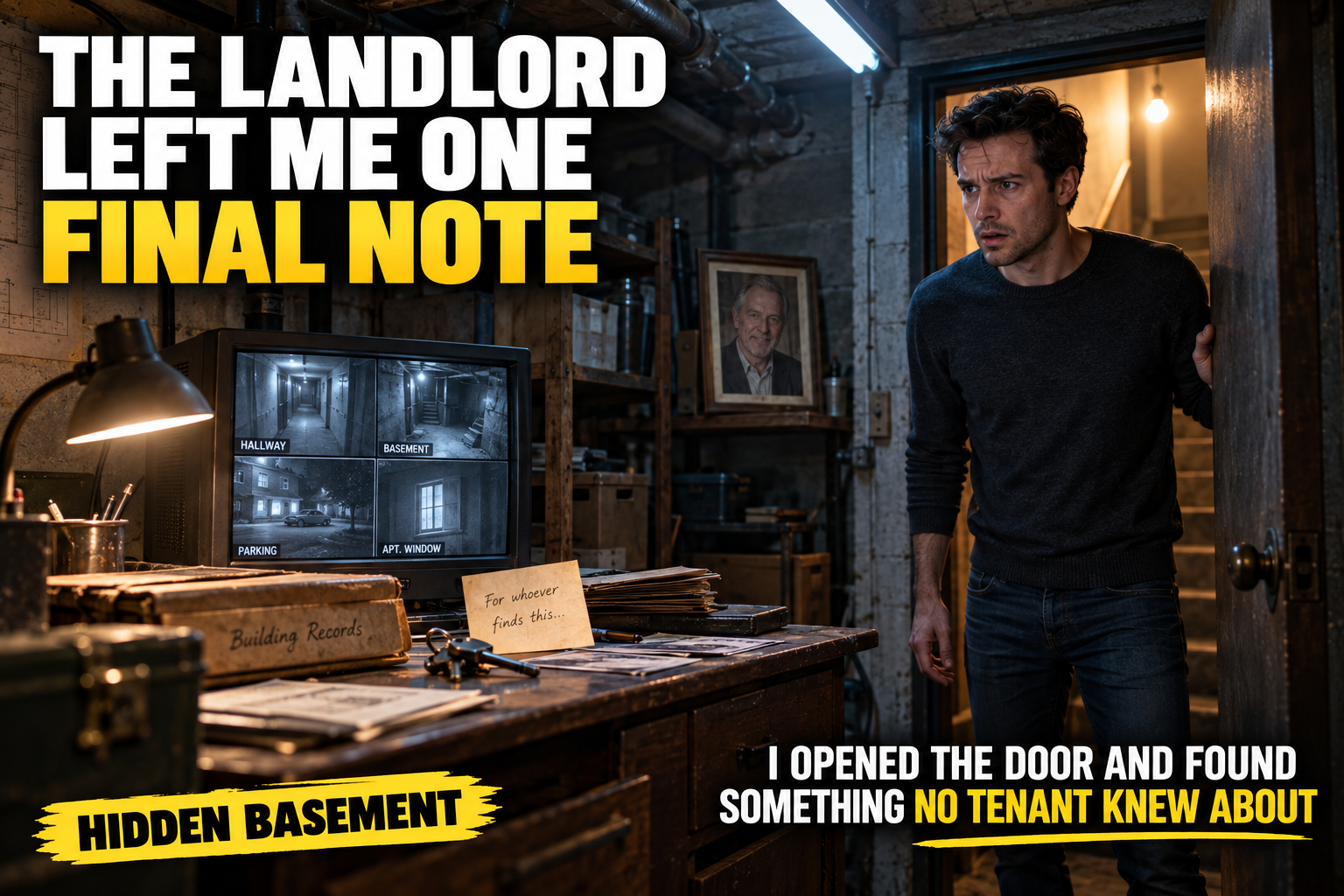
Create a professional 3:2 website thumbnail / cinematic movie-poster photograph inside an aging apartment building basement at night, showing a tenant in his early thirties standing frozen just inside an unexpectedly unlocked basement doorway, wearing a simple dark sweater and jeans, his face tense with confusion and disbelief as he looks toward an old wooden desk covered with dusty papers, keys, folders, and a small handwritten note; on the desk sits an outdated security camera monitor displaying several mysterious building views, including a hallway, basement entrance, apartment exterior, and a bedroom window, while an older male landlord in his late sixties appears only as a framed photograph on a nearby shelf, suggesting an important connection to the hidden room without revealing the final truth; the basement should feel realistic rather than frightening, with concrete walls, exposed pipes, old storage shelves, a single hanging fluorescent light, dusty corners, worn wooden furniture, and subtle signs that someone has recently been using the space; create strong emotional tension through the tenant’s body language, slightly raised shoulders, one hand gripping the basement doorframe, and his cautious gaze toward the monitor; use dramatic nighttime lighting with cool shadows and a narrow warm light spilling from the hallway behind him, shallow depth of field, realistic textures, cinematic composition, strong foreground and background separation, leave clean negative space in the upper-left area and lower-right area for typography; MAIN HEADLINE: “THE LANDLORD LEFT ME ONE FINAL NOTE”; place it large, bold, uppercase in the upper-left negative space, with white primary text and the words “FINAL NOTE” highlighted yellow-gold; HIGHLIGHT BANNER: “HIDDEN BASEMENT”; place it in a compact yellow-gold banner near the lower-left without covering the tenant’s face; SUPPORTING HEADLINE: “I OPENED THE DOOR AND FOUND SOMETHING NO TENANT KNEW ABOUT”; place it along the lower-right in smaller readable white typography with selected important words highlighted yellow-gold; maintain strong contrast, clean typography hierarchy, professional movie-poster composition, readable text, realistic facial expression, no typography over important visual details, no ending spoiler, no unrelated characters, no violent or graphic wording, no watermark. Hyper-realistic, cinematic, emotional, dramatic lighting, expressive faces, ultra-detailed, movie-poster quality, rich color grading, 8K, professional composition, optimized for a 3:2 website thumbnail, readable integrated typography, no watermark.
Strong Hook
Two weeks before my lease ended, my landlord left me a handwritten warning about a basement tenants were forbidden to enter. That night, I heard movement below my apartment, and the next evening I discovered a hidden security system watching places I never knew were being monitored.
Part 1
The note was only one sentence long.
That was what bothered me most.
If my landlord had left me a letter explaining everything, I could have understood it. If he had written several pages, I could have decided whether to believe him. Even a vague warning with some context would have given me something to work with.
Instead, he had written seven words.
Don’t let them sell the basement.
I kept the note on my kitchen table for most of the afternoon, turning it over every few minutes as though another message might somehow appear on the back.
There was nothing.
Just a small rectangle of lined paper, folded once, with my landlord’s handwriting across the front.
I had lived in the building for almost four years.
The building was old but comfortable. Three floors, twelve apartments, narrow hallways, high ceilings, and a basement that everyone knew existed but almost nobody had ever seen.
Tenants weren’t allowed downstairs.
That rule had always seemed ordinary.
The basement belonged to the landlord, and there was a separate entrance for maintenance. Whenever something needed attention, a repair worker would come through the side door, disappear downstairs for a while, and return carrying a tool bag.
Nobody questioned it.
My landlord, Mr. Bennett, was a private man.
He wasn’t unfriendly. He simply didn’t waste words.
If the hallway light stopped working, he’d replace it.
If someone complained about a leaking faucet, he’d send someone over.
If rent was paid on time, he rarely bothered tenants.
We knew almost nothing about his personal life.
I knew he had a daughter.
I knew he had once worked in construction.
I knew he liked old radios because I had seen three of them sitting on shelves in his office.
And I knew he had owned the building for more than twenty years.
That was about it.
Then, two weeks before my lease ended, I learned that he was gone.
His daughter, Laura, came to the building on a rainy Tuesday morning.
She stood outside my apartment holding a ring of keys and a cardboard folder.
“I’m sorry,” she said when I opened the door.
I didn’t know what to say.
She explained that her father had passed away recently and that she was handling the building temporarily.
My lease was almost finished anyway.
She needed the keys.
I handed them over.
She thanked me.
Then, just as she was about to leave, she stopped.
“Oh.”
She reached into the folder.
“My father asked me to give you this.”
She handed me the folded note.
“Why me?”
She looked uncomfortable.
“I don’t know.”
“You don’t know what it means?”
“No.”
“When did he write it?”
“I don’t know that either.”
She looked at the handwriting.
“He specifically told me not to give it to you until after he was gone.”
The words made me uncomfortable.
“Did he say why?”
Laura shook her head.
“He just said you would understand.”
I almost laughed.
“I don’t.”
“Neither do I.”
Then she read the note.
Her eyebrows tightened.
“Don’t let them sell the basement.”
She looked at me.
“What basement?”
I pointed down the hallway.
“The basement.”
She frowned.
“I know there’s a basement.”
“I mean, that’s what he wrote.”
She read it again.
“I’ll ask my attorney.”
“Maybe you should.”
She folded the note and handed it back.
“I’m sorry I can’t explain more.”
Then she left.
I closed the door.
At first, I tried to forget about it.
I had a move to organize.
My new apartment was across town.
I needed to pack dishes, books, clothes, and the ridiculous number of things I’d accumulated over four years.
But every time I walked past the basement door on the ground floor, I thought about the note.
There was a gray metal door beside the laundry room.
A keypad was mounted beside it.
I’d never seen anyone use it.
That evening, I asked Laura about it.
She answered by phone.
“I really don’t know anything about the basement.”
“Your father owned the building.”
“I know.”
“Didn’t you ever go down there?”
“No.”
“Never?”
“No.”
Her voice became quieter.
“Why are you asking?”
“Because your father specifically told me not to let anyone sell it.”
There was a pause.
“I’ll look into it.”
“Please do.”
“I will.”
The call ended.
I stood in the hallway for a moment.
The basement door was directly below my apartment.
For the first time in four years, I wondered what was actually behind it.
That night, at around eleven thirty, I heard a sound.
A dull scrape.
Then another.
I sat up in bed.
Someone was moving something downstairs.
I waited.
There it was again.
Something heavy sliding across the floor.
I told myself it was maintenance.
Maybe Laura had sent someone.
Maybe she was checking the building.
I almost went back to sleep.
Then I heard the basement door close.
Slowly.
Carefully.
And I remembered the note sitting on my kitchen table.
Part 2
I didn’t sleep much.
The sound from downstairs never came again.
That somehow made it worse.
By morning, I had convinced myself that I had imagined half of it.
Old buildings make strange noises.
Pipes shift.
Heating systems click.
Wood expands.
People move around.
There were dozens of harmless explanations.
Still, when I left my apartment, I looked at the basement door.
It was locked.
The keypad light was off.
Everything looked normal.
I went downstairs to the laundry room and found another tenant, Marcus, folding clothes.
Marcus had lived there longer than I had.
He was one of those neighbors who knew everyone’s schedule without seeming nosy.
“Can I ask you something?”
He looked over.
“Sure.”
“You ever been in the basement?”
He laughed.
“No.”
“Never?”
“Why would I?”
“I don’t know.”
I hesitated.
Then I showed him the note.
His expression changed.
“Where did you get that?”
“My landlord left it for me.”
“Mr. Bennett?”
“Yes.”
Marcus read it twice.
“What does he mean by sell the basement?”
“I don’t know.”
Marcus leaned against the washing machine.
“You know the guy who lived in 2B before me?”
“Which guy?”
“Older guy. Quiet. Moved in around 2017.”
“I remember the apartment being empty before you.”
“He wasn’t there long.”
“How long?”
“About a year.”
“What happened?”
Marcus lowered his voice.
“He disappeared.”
I looked at him.
“Disappeared?”
“That was the word people used.”
“What do you mean?”
“One day his apartment was locked. The next week his things were gone.”
“Did he move?”
“Nobody knew.”
“Didn’t anyone contact him?”
“Apparently his family did.”
I stared at him.
“What did the landlord say?”
Marcus shrugged.
“Nothing.”
I thought about the basement.
“Did anyone ever think he went down there?”
Marcus looked at me.
“No.”
“Why?”
“Because tenants aren’t allowed downstairs.”
“That doesn’t mean anything.”
“It did to Mr. Bennett.”
I asked Marcus what he meant.
He said Mr. Bennett was unusually strict about the basement.
If someone left a bicycle near the basement door, he moved it.
If children played near the stairs, he told them to go upstairs.
If a maintenance worker forgot to lock the door, Mr. Bennett would notice immediately.
“He cared about that basement,” Marcus said.
“Did he ever tell you why?”
“No.”
“Did you ever ask?”
Marcus smiled.
“Once.”
“What did he say?”
“He said some things in an old building are better left alone.”
That wasn’t an answer.
But it was enough to make me think about the previous tenant.
That afternoon, I searched online.
I found an old local news article.
It was short.
A tenant from the building had been reported missing in 2018.
There had been an investigation.
Neighbors had been interviewed.
The case had eventually been closed without a public explanation.
There was nothing about the basement.
Nothing about Mr. Bennett.
Nothing about where the tenant had gone.
I searched the man’s name.
There were almost no results.
I found an old photograph.
He looked ordinary.
Late thirties.
Glasses.
Short hair.
A slight smile.
I stared at the picture for a while.
Then I closed the browser.
I told myself not to turn this into something it wasn’t.
The next day, I was supposed to begin moving.
But when I returned from work that evening, I noticed something unusual.
The basement door was slightly open.
Not wide.
Maybe an inch.
I stopped in the hallway.
The light inside was off.
I looked around.
No one was there.
I thought about calling Laura.
Instead, I pushed the door.
It opened silently.
A narrow stairway descended into darkness.
I’d seen those stairs before, but never from this angle.
Dust covered the first few steps.
There were old pipes along the ceiling.
The air smelled faintly of paper and concrete.
I should have closed the door.
Instead, I went down.
At the bottom was a long corridor.
There were storage rooms on both sides.
Most had padlocks.
At the end was a larger room.
The door stood open.
Inside was an old desk.
A chair.
Several filing cabinets.
And a small security monitor.
I stopped.
There were four screens.
The first showed the hallway outside my apartment.
The second showed the basement entrance.
The third showed the building’s side entrance.
The fourth showed the rear of the building.
I stared at the monitor.
Then I noticed something that made me step closer.
One of the camera views showed my apartment window.
Not the inside.
The outside.
But it was clearly my bedroom window.
I looked up toward the ceiling.
A small camera was mounted near the basement exit.
I stepped backward.
The note was suddenly no longer just strange.
It felt like a warning.
And someone had been using this room recently.
Because one of the monitors was still warm.
Part 3
I didn’t touch anything.
That was my first instinct.
Leave.
Go upstairs.
Call Laura.
Call the police if necessary.
But then I noticed the desk.
It wasn’t covered in dust like everything else.
There was a clean rectangular space where something had recently been moved.
A cup sat beside the monitor.
There was still a faint ring of moisture beneath it.
Someone had been there.
Recently.
I took out my phone and photographed the room.
Then I photographed the monitor.
The screen showing my bedroom window made me uncomfortable in a way I couldn’t explain.
It wasn’t aimed directly into the room.
The camera showed only the outside.
Still, someone had deliberately chosen that angle.
Why?
I backed toward the door.
Then I saw the filing cabinet.
One drawer was open.
Inside were folders.
I didn’t want to look.
But the top folder had my apartment number written on it.
I froze.
My apartment number.
I pulled the folder out.
Inside were maintenance records.
The first pages were ordinary.
Dates.
Repairs.
Plumbing.
Electrical work.
Then I found a page with my name.
I read it.
The document listed the date I moved in.
My employment information.
An emergency contact.
The name of my previous landlord.
I had never given that information to Mr. Bennett directly.
At least, I didn’t remember giving it to him.
There were other notes.
“Usually leaves at 7:40.”
“Returns around 6.”
“Works late Thursdays.”
I felt my skin tighten.
Someone had been documenting my routine.
I put the folder back.
Then I heard footsteps above me.
I turned toward the basement entrance.
Someone was walking down the stairs.
I switched off my phone screen and stood beside the desk.
The footsteps stopped.
Silence.
Then a voice.
“Hello?”
Laura.
I stepped out.
“Laura?”
She came down the last few stairs and stared at me.
“What are you doing down here?”
“I could ask you the same thing.”
She looked around.
Her face changed when she saw the monitor.
“What is that?”
“I was hoping you could tell me.”
She walked toward the desk.
“None of this was here when I came yesterday.”
“Your father had this room.”
“I know he had storage.”
“This isn’t storage.”
She looked at the screen showing the hallway.
“Those are security cameras.”
“I know.”
“Why is one pointed at your window?”
“I don’t know.”
Laura stared at the monitor.
Then she noticed the folder.
“What is that?”
“My apartment records.”
She opened it.
Her expression became serious.
“Who made these notes?”
“I don’t know.”
She turned the pages.
“That’s not my father’s handwriting.”
“Are you sure?”
“Yes.”
She sat down.
For a while, neither of us spoke.
Then she asked, “What else did you find?”
I told her about the previous tenant.
She went pale.
“You found out about him?”
“Yes.”
“Where?”
“Old news reports.”
She looked toward the floor.
“Dad never talked about that.”
“Did you know him?”
“No.”
“Did your father?”
“I don’t know.”
She stood.
“I need to call someone.”
“Who?”
“My attorney.”
I laughed without humor.
“That’s what everyone says when they don’t want to answer.”
She looked at me.
“I really don’t know.”
I believed her.
That was the strange part.
She didn’t seem like someone hiding an answer.
She seemed like someone discovering the same mystery at the same time.
Before she left, I pointed toward the filing cabinet.
“There are more folders.”
“Don’t open them.”
“Why?”
“I don’t know what they contain.”
“That hasn’t stopped me so far.”
She gave me a nervous look.
“Please.”
I closed the drawer.
But as she turned toward the stairs, I noticed something on the desk.
A small key.
It had a handwritten label.
“Archive.”
I picked it up.
Laura saw it.
“Put that down.”
“Why?”
“I don’t know.”
“Then why are you telling me?”
She didn’t answer.
The next morning, she called.
“I found something in my father’s office.”
“What?”
“A property map.”
“And?”
“The basement isn’t the only space beneath the building.”
I sat up.
“What do you mean?”
“There are two additional rooms.”
“Where?”
“Under the rear section.”
“Can we access them?”
“I don’t know.”
Then she said something that changed the direction of the entire investigation.
“The property records show those rooms were supposed to have been sealed decades ago.”
I looked toward the basement door.
“Were they?”
She paused.
“I don’t think so.”
Part 4
Laura came back that afternoon with the property map.
We spread it across the old desk.
The building was drawn in faded blue ink.
Three floors.
A narrow courtyard.
A storage area.
And beneath the rear half of the building, two rooms that didn’t appear on the current floor plan.
“They’re not on the tenant plans,” Laura said.
“Why?”
“According to the records, they were sealed in the 1980s.”
“Then how did your father access them?”
“I don’t know.”
I looked at the map.
There was a small corridor leading from the basement storage room toward the rear.
The entrance wasn’t obvious.
But there was a rectangular mark on the wall.
“That’s probably it.”
Laura looked.
“How do we get there?”
“We don’t know yet.”
We searched the basement.
Behind a stack of old shelving, we found a section of wall that looked newer than the surrounding concrete.
There was a narrow metal panel.
No handle.
No lock.
Just a seam.
Laura touched it.
“Dad never mentioned this.”
I looked at the security monitor.
One camera showed the hallway.
Another showed the basement entrance.
But none showed this wall.
Someone had deliberately kept it outside the camera’s view.
I asked Laura why.
She shook her head.
“I don’t know.”
We searched the desk.
There were keys.
Dozens of them.
Most had labels.
Boiler.
Storage.
Office.
Roof.
Electrical.
Then I found one marked simply:
R.
I inserted it into a small lock hidden beneath the desk.
It turned.
A drawer opened.
Inside was a notebook.
The cover was worn.
On the first page was my landlord’s handwriting.
I recognized it immediately.
There were dates.
Names.
Addresses.
Repair notes.
But then I found a section titled:
“People Who Asked Questions.”
My name wasn’t there.
Neither was Laura’s.
The previous tenant’s name was.
So were several others.
I looked at Laura.
“Your father was keeping records of people who asked about the basement.”
She looked uncomfortable.
“Why?”
“I don’t know.”
The previous tenant had asked about it.
A woman who had lived here in the 1990s had asked.
A maintenance worker had asked.
A property inspector had asked.
Beside some names were notes.
“Dropped it.”
“Moved away.”
“Not interested.”
“Handled.”
That last word bothered me.
“What does ‘handled’ mean?”
Laura shook her head.
“I don’t know.”
I turned another page.
There was a date.
Beside it was the previous tenant’s name.
Underneath was one sentence:
“He found the second door.”
I stared at it.
“What second door?”
Laura didn’t answer.
We searched again.
This time, we moved everything.
Behind an old water heater was a narrow wooden door.
It was almost impossible to see.
There was no sign on it.
The lock was old.
The key marked R fit.
The door opened inward.
Beyond it was a narrow passage.
The air was colder.
The walls were unfinished.
We walked slowly.
At the end was another room.
It contained shelves.
Boxes.
Old photographs.
Paper files.
And a second desk.
This room was not abandoned.
There was a lamp.
A chair.
A working extension cord.
Someone had been using it.
Laura whispered, “Dad?”
I shook my head.
“He wasn’t the only person with a key.”
On the desk was a stack of envelopes.
Most were sealed.
One had my name.
I stared at it.
Laura looked at me.
“Open it.”
Inside was a photocopy of my lease.
On the back was a handwritten note.
“Ask why he chose this apartment.”
I read it twice.
“I chose it because it was close to work.”
Laura shook her head.
“No.”
“What?”
“Your father didn’t rent apartments randomly.”
“What do you mean?”
She opened another folder.
Inside were old tenant applications.
Some had handwritten notes.
My application was there.
Beside my name was a sentence.
“Good candidate. Doesn’t know the history.”
I looked at Laura.
“Candidate for what?”
She didn’t know.
But the room contained something else.
A photograph.
It showed the building in 1996.
Several people stood outside.
My landlord was there.
A younger version of the previous tenant was standing near the entrance.
And beside him was a woman I didn’t recognize.
On the back of the photograph was a date.
Underneath it, four words:
“The first agreement.”
Laura turned the photograph over.
“What’s the first agreement?”
I looked around the room.
There were files going back decades.
This wasn’t just a hidden basement.
It was an archive.
And someone had spent years preserving information about the people who lived above it.
Then we heard a door close upstairs.
Laura and I looked at each other.
Someone was inside the building.
And we were no longer sure we were alone.
Part 5
We turned off the lamp.
The room went dark.
For several seconds, neither of us moved.
Footsteps crossed the hallway above us.
Slow.
Measured.
Then silence.
Laura whispered, “Could be maintenance.”
“Did you schedule anyone?”
“No.”
We waited.
Nothing happened.
Eventually, we returned to the main basement.
The building was quiet.
The front door was locked.
There was no one in the hall.
Laura called her attorney.
He arrived less than an hour later.
His name was Martin.
He was careful with his words.
He examined the room, the monitor, the files, and the hidden passage.
“This is beyond a simple property issue,” he said.
“Why?”
“Because these records contain personal information.”
“About tenants?”
“Yes.”
“Can someone legally keep records like this?”
“That depends on what they are and why they were collected.”
Laura looked at him.
“Do you know why my father had this room?”
Martin shook his head.
“I knew he had an archive.”
“You knew?”
“He mentioned old property records.”
“Did he ever mention cameras?”
“No.”
I asked about the previous tenant.
Martin became quiet.
“You know about him?”
“Yes.”
“What happened?”
“I don’t know.”
“Did my landlord?”
“I can’t say.”
“Why?”
“Because I represented your landlord. I didn’t investigate every private matter in his life.”
That answer didn’t satisfy me.
But then Martin found something.
A file marked with the previous tenant’s name.
Inside was a handwritten statement.
The tenant had apparently discovered the hidden room.
He had written:
“I found the archive by accident. Mr. Bennett told me there was a reason it existed. He said the building had been used for something before it became ordinary apartments.”
I read the next page.
“He asked me not to tell anyone until he could explain.”
The following pages were missing.
Martin closed the file.
“That’s enough for today.”
“No.”
He looked at me.
“I want to know what happened.”
“You don’t know that anything happened.”
“The man disappeared.”
“We don’t know why.”
“But we know he found the room.”
Martin sighed.
“I understand your concern.”
Then he said something unexpected.
“Your landlord had been trying to sell the building.”
“I know.”
“No.”
He pointed toward the property map.
“He had received an offer specifically for the rear section.”
“The basement?”
“Yes.”
“Who made the offer?”
“I don’t know.”
Laura looked at him.
“Dad never told me.”
Martin opened his briefcase.
He removed a document.
“This came through two months ago.”
It was a proposal from a development company.
They wanted to purchase the building, renovate the apartments, and convert the basement and rear property into commercial storage.
The offer was substantial.
My landlord had refused.
“Why?”
Martin said, “Your father wrote one sentence.”
He showed us the note.
“Not while I’m responsible for it.”
I looked at Laura.
She looked confused.
“Responsible for what?”
Martin didn’t know.
Then we found the answer in the archive.
A folder labeled:
“FOUNDATION RECORDS.”
Inside were old documents from the building’s earliest years.
The property had once been a boarding house.
In 1958, a local community organization had purchased it.
The basement had been used as a meeting room and document archive.
Residents had stored records there.
Letters.
Agreements.
Receipts.
Names.
Over time, the organization dissolved.
The building became apartments.
The basement remained.
But some records were never transferred.
My landlord had inherited the building decades later.
He discovered the archive.
Instead of destroying it, he preserved it.
Why?
Because the records contained evidence of a promise made by the original owners.
The building was never meant to be sold for redevelopment if doing so would displace the people living there.
It wasn’t a legally simple promise.
But it was an important part of the property’s history.
My landlord had spent years trying to preserve it.
Then the developer arrived.
That explained the note.
But not the cameras.
Not the tenant records.
Not the previous tenant.
Not the strange monitoring system.
We kept searching.
Near midnight, I found a small cassette recorder.
It had a handwritten label:
“2018 — conversation.”
I looked at Laura.
She shook her head.
“Play it.”
I pressed the button.
The recording was old.
My landlord’s voice came through.
Then another man’s voice.
The previous tenant.
Their conversation was calm.
At first.
The tenant said he had discovered the archive.
My landlord admitted it existed.
Then the tenant asked why there were records about residents.
My landlord answered:
“Because someone has been trying to find something in this building.”
The recording stopped.
The rest of the tape had been removed.
On the table beside the recorder was another note.
“Ask what was taken in 2018.”
Part 6
The question stayed with me.
What was taken in 2018?
Laura had no idea.
Martin didn’t either.
We searched the archive for the date.
There were dozens of entries.
Most were routine.
Then I found a handwritten inventory.
Several boxes were marked as missing.
One was labeled “Community Records.”
Another was “Original Agreements.”
A third was simply “Photographs.”
All three had been removed in 2018.
The previous tenant had apparently discovered the missing boxes.
That might have explained why he had asked questions.
But where had the boxes gone?
We searched the building.
Nothing.
Then Marcus came downstairs.
He had heard about the basement.
“I know something,” he said.
We looked at him.
“What?”
“The previous tenant left something with me.”
I stared.
“Why didn’t you tell me?”
“I didn’t know what it meant.”
He pulled a folded envelope from his jacket.
“It was left outside my door in 2018.”
Inside was a photograph of the building.
On the back:
“If anyone asks, I never gave you this.”
Marcus looked nervous.
“I didn’t understand.”
“Why keep it?”
“I forgot about it.”
Until now.
The photograph showed the rear courtyard.
There was an old metal door that no longer existed.
Behind it were several boxes.
The photograph had been taken at night.
Someone had clearly been moving things.
I asked Marcus if he recognized anyone.
He pointed.
“That might be Mr. Bennett.”
The person was too far away to be certain.
But beside him was another figure.
A younger man.
We couldn’t identify him.
