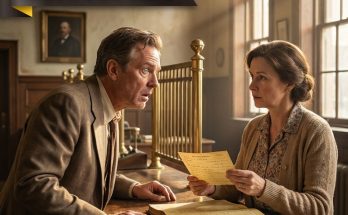
My grandmother always said her father worked three jobs to keep the house during the Depression. I never questioned it—until the day I found the old mortgage papers and saw sixty-two payments from a man no one in our family had ever mentioned. When I showed her the name, she went quiet. Then she told me the truth that rewrote everything I thought I knew about her childhood and the quiet man who never asked for anything in return.
Part 1
The box smelled like attic dust and old paper. I had found it behind a stack of quilts in the back of my grandmother’s closet while helping her clear space for a new walker. The cardboard was soft at the corners, the lid held shut by a length of faded blue ribbon that snapped when I tugged it.
Inside were folders of yellowed documents, some still held together with rusted paper clips. Most of it looked ordinary—old tax forms, a few letters from distant cousins, a property tax receipt from 1948. Then I opened a thinner folder marked only with a date range in careful script: 1931–1936.
Mortgage papers.
I almost put them back. My grandmother, Eleanor, was ninety-two and living alone in the same small house her parents had bought in 1928. She had always spoken of that house with a kind of quiet pride, the way people speak of something they fought hard to keep. The story she told us was simple and repeated often enough that it felt like family scripture: during the worst years of the Depression her father, Thomas Hale, had worked three jobs—day shift at the mill, evenings sweeping floors at the hardware store, nights delivering coal—so the bank would not take the house.
I believed that story the way children believe the things their elders say without needing proof.
But the papers in my hands told a different sequence of numbers.
Between March 1931 and December 1936 there were sixty-two separate payments recorded against the mortgage. Each one was listed with the same careful bank stamp, the same account number, and a name that did not belong to anyone in our family.
Arthur J. Whitmore.
I sat on the edge of the bed and read the name three times. It meant nothing to me. I had grown up hearing every relative’s story—uncles who left for California, a great-aunt who taught school in the next county, cousins who never wrote back. No one had ever mentioned an Arthur Whitmore.
I carried the folder downstairs. Eleanor was in the kitchen, stirring a pot of soup she would never finish. She looked up when I set the papers on the table.
“What have you found now?” she asked, the same gentle tease she used whenever I went through her things.
I turned the top page toward her so she could see the name.
She did not reach for the paper. She simply stared at the letters for several long seconds, her spoon still in the pot, steam rising between us. The kitchen clock ticked. Outside, a neighbor’s dog barked once and went quiet.
Then she set the spoon down carefully, wiped her hands on her apron, and said the words that changed the shape of everything I thought I knew.
“I wondered when someone would find those.”
Part 2
I waited. Eleanor did not rush. She moved to the sink, rinsed her hands, and dried them on a towel that had seen better decades. Only then did she sit across from me and pull the folder closer.
“Your great-grandfather was a proud man,” she said. “He would rather have starved than take charity. That is the part of the story I always told you, because it was true. He worked those three jobs. He came home with coal dust in his hair and blisters on his hands. But the payments—those did not come from him.”
She tapped the name with one thin finger.
“Arthur Whitmore was the man who paid them.”
I asked the obvious questions. Who was he? Why would a stranger pay someone else’s mortgage for five and a half years? Did the family know? Did they ever meet him?
Eleanor’s answers came slowly, the way memory arrives when it has been folded away for a long time.
Arthur Whitmore had been a clerk at the same bank that held the mortgage. Not a high position—just a man who processed loan papers and kept the ledgers neat. In the early months of 1931, when families all over town were falling behind, he had begun making the payments himself. Quietly. Without asking permission and without telling anyone in the Hale family for a long time.
“He never came to the house,” Eleanor said. “Not once. He simply walked the payment over to the teller window every month and put his own money into the account that kept our roof over our heads.”
I looked at the totals. The amounts were not large by modern standards, but in 1931 they would have been everything. Sixty-two payments. Five years and more of someone else’s wages given away without fanfare.
“Why?” I asked.
Eleanor’s eyes moved to the window, to the same oak tree that had stood in the side yard since before she was born.
“Because of my mother,” she said. “And because of something that happened long before I was old enough to understand.”
She would not say more that afternoon. The soup boiled over. She insisted on finishing dinner. But before I left she touched the edge of the folder and said, “Bring those back tomorrow. There are other papers. I kept them separate on purpose.”
That night I lay awake turning the name over in my mind. Arthur J. Whitmore. A bank clerk. A man who paid sixty-two mortgage installments for a family he never visited. And my grandmother, who had carried the knowledge of it for more than eighty years without once letting it slip into the stories she told her children and grandchildren.
The next morning I returned with the folder and a notebook. Eleanor was already at the table with a second, thinner stack of letters tied with the same blue ribbon.
“These,” she said, “are the ones he wrote to my mother.”
Part 3
The letters were few—only eleven in total—and each one was short. Arthur Whitmore wrote in a neat, slightly formal hand, the kind of penmanship taught in commercial schools. He never used the word “love.” He never asked for anything in return. Most of the letters simply confirmed that the monthly payment had been made and that the account remained in good standing.
But the earliest letter, dated April 12, 1931, was different.
Eleanor let me read it aloud.
“Dear Mrs. Hale,” it began. “I am writing to inform you that the March installment on your property has been settled in full from my personal account. Please do not attempt to repay me at this time. Your husband is a hardworking man, and the times are difficult for all of us. I ask only that you keep this arrangement between ourselves for the present. There are reasons I prefer it that way.”
The reasons, Eleanor explained, reached back to 1924.
My great-grandmother, Margaret Hale, had worked for a short time as a cleaning woman at the bank after her own father’s death. She was young, newly married, and determined to help with the household expenses. One evening, after the bank had closed, she found a ledger left open on a desk. The numbers showed that a senior officer had been moving money in ways that did not match the official records. She mentioned it only once, quietly, to the young clerk who sometimes stayed late to finish the books—Arthur Whitmore.
Within a week the irregularity was corrected. The senior officer resigned. No public scandal followed. Margaret never spoke of it again, and Arthur never claimed credit. But something unspoken remained between them: a debt of quiet gratitude that Arthur carried for years.
When the Depression deepened and the Hales fell behind on the mortgage, Arthur simply began to pay.
“He never told my father,” Eleanor said. “He told only my mother, and only because the bank would eventually notice the payments were coming from a different account. She kept the secret because she knew my father would never have accepted it. Pride was the one luxury he refused to give up.”
I sat with the letters spread across the table. The later ones grew shorter still. Sometimes only a single sentence: “Payment recorded this day. Account current.” Once, in the winter of 1933, a slightly longer note: “I hope the cold has not been too hard on the children. The coal delivery should arrive on Thursday.”
He had arranged that, too.
Eleanor watched me read. Her expression was not sad, exactly. It was the look of someone who has carried a private truth for so long that speaking it aloud feels like setting down a heavy object.
“Did he ever marry?” I asked.
“No,” she said. “He lived alone in a boarding house three blocks from the bank until the day he died in 1947. We learned of it only because the bank sent a notice about a small life insurance policy he had left in my mother’s name. Enough to pay the remaining balance on the house and a little more.”
I looked at the final payment date: December 1936. After that the mortgage was current enough that Thomas Hale’s three jobs could keep it going. The house stayed in the family. Eleanor grew up inside it. My mother was born in the front bedroom. I had spent summers running through the same rooms.
All of it made possible, in part, by a man whose name had never been spoken at a single family gathering.
Part 4
The following week I began searching for anything else that might still exist about Arthur Whitmore. The local historical society had microfilm of old city directories. The bank—long since absorbed by a larger institution—had donated some of its early employee records to the county archive. Most of what I found was ordinary.
Arthur J. Whitmore, born 1898 in a nearby farming town. No college. Hired as a junior clerk in 1919. Steady promotions that never reached management. Address listed as a boarding house on Maple Street until his death. No known relatives. No will beyond the small insurance policy.
One photograph survived in an old staff directory from 1935. A thin man in a dark suit, glasses, hair already receding, expression neither stern nor smiling—simply attentive, as if he were listening to something just beyond the camera.
I showed the photograph to Eleanor. She studied it for a long time.
“He looked exactly like that when I saw him once,” she said.
I looked up. “You saw him?”
“Only once. I was nine. It was winter, 1934. My mother had sent me to the bank with a sealed envelope—another of his letters, I realize now. I was told to give it to the man at the third desk and to wait for a reply. He read the note, wrote something brief, and handed it back. Then he looked at me—really looked—and asked if the new baby was sleeping through the night yet. That was my younger brother. He knew things about us he had no reason to know.”
She paused.
“I remember thinking he had kind eyes. That is all. I never saw him again.”
The more I learned, the larger the quiet shape of his life became. He had no children. No wife. No siblings who survived into adulthood. His entire adult existence seemed to have been spent inside the bank during the day and inside a single rented room at night. And for five years he had given a portion of that modest life to a family that never fully knew him.
I asked Eleanor the question that had been growing since the first afternoon.
“Did your mother love him?”
She did not answer immediately. She rose, poured two cups of tea that had gone lukewarm, and set one in front of me.
“I think,” she said at last, “that she felt a deep and complicated gratitude. And I think he felt something that had no simple name. In those years people did not speak of such things the way they do now. He never asked her to leave my father. She never suggested it. The letters stayed formal. The payments continued. When the worst of the Depression passed, the payments stopped. He never contacted us again.”
“And your father?”
“He never knew. My mother made certain of that. She believed it would have broken something in him that could not be repaired. So the secret stayed between her and Arthur Whitmore until the day she died in 1962. She told me only then, and only because she wanted someone to know that the house we lived in had been kept by more than one man’s labor.”
Eleanor looked at the photograph again.
“I have carried that knowledge for sixty-four years,” she said. “I never told your mother. I never told anyone. Until you found the papers.”
Part 5
That evening I sat with my own mother and told her everything. She listened without interrupting, the way she always did when a story mattered. When I finished she was quiet for a long time.
“I always wondered,” she said finally, “why Grandma kept those old bank papers in a separate box. She was careful with everything, but those she treated like something fragile.”
We went together the next day to the county records office and requested a copy of Arthur Whitmore’s death certificate. He had died of pneumonia in the winter of 1947, age forty-nine. The informant listed on the certificate was the landlady of the boarding house. No next of kin.
The small insurance policy had been enough, Eleanor said, to clear the last of the mortgage and leave a modest sum that Margaret had used to repair the roof and replace the coal furnace. After that the house was free and clear. Thomas Hale lived another twelve years, never knowing the full story of how the worst years had been weathered.
I found myself thinking about the shape of quiet debts—the ones that are never announced, never repaid in kind, never entered into the official record of a family’s pride. My great-grandfather’s three jobs were real. The coal dust and the blisters and the long nights were real. But so were the sixty-two payments from a man who chose to remain invisible.
Eleanor asked me one afternoon, while we sorted the remaining papers, whether I planned to write any of this down.
“People should know,” she said. “Not because it makes a better story than the one I used to tell. Because both stories are true at the same time. My father worked himself to exhaustion. And a quiet man at the bank decided that a family he barely knew should not lose their home. One does not cancel the other.”
I promised I would try to tell it carefully.
In the weeks that followed I traced every remaining thread I could find. The boarding house on Maple Street had been torn down in the 1960s. The bank building still stood, though it now housed offices for a law firm. A retired teller in her late eighties, whose father had worked alongside Arthur, remembered only that he was “the quiet one who never took vacation.” No one recalled him speaking of friends or family.
The only personal item that survived was a small brass desk plate, found years later in a box of discarded bank fixtures and donated to the historical society. It read simply: A. J. Whitmore, Clerk.
I held it once, under the fluorescent lights of the archive reading room, and tried to imagine the hands that had set it on a desk every morning for nearly thirty years.
Part 6
Eleanor’s health declined that winter. The conversations grew shorter, but she returned often to the subject of the payments. She wanted the details right. She corrected my notes when I misremembered a date. She insisted that the story must never turn Arthur Whitmore into a saint or her father into a lesser man.
“People are complicated,” she said. “Even the quiet ones. Especially the quiet ones.”
One afternoon she asked me to bring the original mortgage ledger pages to the nursing home where she had finally agreed to stay. We sat by the window while she turned each page with slow care.
“Sixty-two,” she said. “I used to count them when I was a girl, after my mother first told me. I thought if I counted them enough times I would understand why a stranger would do such a thing. I never did understand completely. I only knew that it mattered.”
She looked at me.
“You will have children someday. Or perhaps you already understand this without them. Houses are more than wood and nails. They hold the decisions people make when no one is watching. This house held two sets of decisions. My father’s visible ones. And Arthur’s invisible ones. Both kept us inside it.”
I asked whether she had ever wanted to find a way to thank him while he was still alive.
“I was a child,” she said. “And by the time I was old enough to understand, he had already stopped the payments and stepped back into silence. My mother believed that silence was part of the gift. To thank him publicly would have been to make the gift something else—something that required acknowledgment. He never asked for that.”
She closed the folder.
“So we lived. That was the thanks.”
Outside the window the oak tree still stood in the side yard of the old house, now empty and waiting for decisions about its future. I had begun the process of clearing it, sorting what would be kept and what would be given away. The mortgage papers would stay with me. So would the letters. So would the single photograph of a thin man in a dark suit who had chosen, for reasons only partly known, to keep a roof over a family that would never fully know his name at the dinner table.
Part 7
In the spring I returned to the historical society and requested every remaining document connected to the bank’s employee files from the 1930s. Most were routine. One small ledger, however, contained a notation I had not seen before.
In the margin of a 1932 expense page, in handwriting that matched Arthur’s letters, someone had written a single line that was later crossed out but still legible under strong light:
“Hale property—continue as arranged. No further inquiry necessary.”
The line had been initialed A.J.W.
It was the closest thing to an official record of his decision.
I sat with that page for a long time. A man with no family of his own had looked at a ledger, remembered a young woman who once noticed an irregularity and spoke of it quietly, and decided that the consequence of that small act of honesty should be a home that remained standing through the worst years the country had known.
Gratitude, perhaps. Or something quieter than gratitude—an insistence that certain kinds of integrity should not be punished by the times.
I copied the page and brought it to Eleanor. By then her voice was weaker, but her mind remained clear on the subject.
“He was not a hero in the way people like to invent heroes,” she said. “He was a man who noticed a need and answered it in the only way he knew how—with consistency and silence. That is rarer than it should be.”
She asked me to make sure the story, when I wrote it, did not turn the Depression into a backdrop for easy moral lessons. The years had been hard. People lost homes every week. Some recovered. Many did not. The fact that the Hales kept theirs was not proof of special virtue. It was the result of labor, luck, and one man’s private decision.
“Tell it straight,” she said. “That is enough.”
Part 8
Eleanor died in early summer, three months after her ninety-third birthday. In the final weeks she returned often to the subject of the house and the man who had helped keep it. She wanted the details left clean. She wanted no embellishment.
At the small memorial service I spoke briefly about the two stories that had always lived side by side in our family: the public one of a father who worked three jobs, and the private one of a bank clerk who paid sixty-two installments without ever asking to be remembered. Both were true. Both had shaped the rooms we had grown up inside.
After the service my mother and I went back to the house one last time. The rooms felt larger without Eleanor’s presence. We packed the remaining boxes. In the bottom of a dresser drawer I found one final item she had never shown me: a small envelope addressed in Arthur Whitmore’s hand to Margaret Hale, postmarked three weeks after the final mortgage payment in December 1936.
Inside was a single sheet.
“Mrs. Hale,” it read. “The account is now fully current and will remain so under your husband’s continued efforts. I will make no further payments. Please know that it was an honor to be of quiet assistance during these years. I wish your family every good thing that ordinary life can still provide. Yours sincerely, A. J. Whitmore.”
No request for reply. No suggestion of future contact. Only the formal closing of a private arrangement.
My mother held the letter for a long time.
“She kept this separate from the others,” she said. “Even from Grandma. I think she wanted the ending to stay as quiet as the rest of it.”
We placed the letter with the rest of the papers. The house would be sold. The new owners would never know the full history of its survival. But the documents would remain in the family, and the story—both parts of it—would be told accurately for the first time.
Part 9
In the months after the house sold I finished gathering every remaining fragment. I visited the plot where Arthur Whitmore was buried—an unmarked section of the city cemetery where the boarding-house residents who died without family were laid. There was no stone. Only a number in the cemetery ledger.
I stood there on a cold afternoon and tried to measure the size of a life that had left so little visible trace and yet had altered the course of another family’s generations. My mother was born because that house remained standing. I was born because she was. The ordinary chain of a family continued, in part, because a quiet man decided that certain payments should be made and certain silences kept.
I do not know what he felt when he walked to the teller window each month. I do not know whether he ever regretted the money or the anonymity. The record he left is almost entirely numbers and formal sentences. What remains is the fact of the sixty-two payments and the unbroken roof over a family that would otherwise have joined the long line of those who lost everything.
When I finally sat down to write the full account, I began with the story Eleanor had always told—the three jobs, the coal dust, the stubborn pride of a man who refused to let the bank take his home. Then I set beside it the second story: the clerk, the letters, the payments that arrived without announcement. Neither story cancels the other. Together they form the complete truth of how one ordinary house survived years that destroyed so many others.
Eleanor had been right. People are complicated. Even the quiet ones. Especially the quiet ones.
And sometimes the most important decisions leave almost no mark except the continued existence of the people who never knew they needed saving.
Part 10

Years later I still keep the original mortgage ledger pages in a simple archival box. The paper has grown more fragile. The ink has faded in places. But the name is still clear: Arthur J. Whitmore. Sixty-two payments. 1931 to 1936.
My own children have heard both versions of the story now. They know about their great-great-grandfather’s three jobs and the blisters and the long nights. They also know about the bank clerk who never came to the door, never asked for thanks, and never left more than a handful of formal letters and a single photograph behind.
When they ask why he did it, I give them the only answer that feels honest: we cannot know the whole of another person’s reasons. We can only know what they chose to do when no one was required to notice.
The house is gone. The boarding house is gone. The bank has changed names and owners so many times that the old ledgers live only in the archive. But the fact remains. For five and a half years a man with no family of his own decided that another family’s home should not be lost. He did it quietly. He stopped when the worst had passed. He asked for nothing.
My grandmother carried that knowledge for most of a century and released it only when the papers themselves forced the truth into the open. She did not want a statue or a headline. She wanted the record to be complete.
So this is the complete record.
Thomas Hale worked three jobs and refused to surrender the house.
Arthur Whitmore paid sixty-two installments and never once requested recognition.
Both men kept a family inside the same walls through the hardest years either of them would live to see.
The rest is ordinary life continuing—children growing up, another generation born, the slow turning of years inside rooms that would not have existed without both sets of decisions.
I think of them sometimes when I pass the old neighborhood. The oak tree is still there. The lot has a different house on it now. But the ground remembers, in the way ground sometimes does, that people once chose to protect what mattered to them in the only ways they knew how.
One with visible exhaustion.
One with invisible consistency.
Both, in the end, enough.
That is the story the papers told when I finally opened the box. And that is the story my grandmother, after a lifetime of careful silence, trusted me to set down without exaggeration or apology.
The man who paid the mortgage never met most of the people whose lives he quietly made possible. He never needed to. The payments were enough. The silence was part of the gift. And the house—for as long as it stood—held both truths under the same roof.