In 1984 my father walked into a quiet bank to close an account that should have been empty for decades. Instead the clerk returned with news that left him speechless: money had been deposited every single year since 1926. When she finally looked at the oldest signature, her voice dropped and she told him he might want to sit down.
Part 1
The morning my father drove to the bank was ordinary in every way that mattered. It was a Tuesday in late September 1984, the kind of day when the air already carried the first cool edge of autumn and the maple trees along Maple Street had just begun to turn. He had taken the afternoon off from the hardware store he managed, something he almost never did. The old passbook had turned up while he was clearing out the attic of the house his mother had left him, tucked inside a cardboard box of yellowed insurance papers and a single photograph of a man none of us recognized.
He sat at the kitchen table that morning with the passbook open in front of him. The cover was soft from age, the ink faded but still legible. Account number 4172. Opened March 12, 1926, at First National Bank of Millfield. The last entry anyone in the family remembered was from the early 1950s, a small withdrawal his grandfather had made shortly before he died. After that the book had simply disappeared into the same attic where everything else eventually went to be forgotten.
My mother poured him a second cup of coffee and asked if he was sure it was worth the drive. Millfield was forty minutes away, and the account, as far as anyone knew, held nothing. My father only shrugged and said it felt right to close things properly. He had always been that way—quiet, methodical, the sort of man who believed loose ends should be tied even if no one else noticed them.
He left the house a little after one. I was sixteen that year and home from school with a mild cold, so I watched from the living-room window as the old blue Chevrolet pulled out of the driveway. He had the passbook in the inside pocket of his jacket. I remember thinking it looked almost ceremonial, the way he patted the pocket once before he started the engine.
The bank itself had not changed much since the 1920s. The same limestone façade, the same heavy glass doors that required a firm push, the same long wooden counters polished by decades of elbows and ledgers. A brass clock hung above the teller windows, its hands moving with a soft, deliberate tick. My father took a number and waited on one of the worn benches near the window. There were only two other customers ahead of him. He spent the time studying the passbook again, tracing the early deposits with one finger.
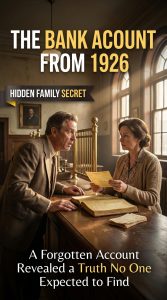
When his number was called he stepped up to the counter and explained, in the careful way he always spoke to strangers, that he wished to close an inactive account that had belonged to his grandfather. He slid the passbook across the polished wood. The clerk—a woman in her late forties with neat brown hair and a pair of reading glasses on a chain—opened it, frowned slightly, and asked him to wait. She disappeared through a door marked STAFF ONLY.
My father stood there with his hands in his pockets, watching the clock. Five minutes passed. Then ten. When the clerk returned she was not alone. An older man in a dark suit walked with her, carrying a thick folder. The clerk’s expression had changed. The polite professional smile was gone. In its place was something quieter, almost cautious.
She placed the passbook back on the counter and said the account had never been closed. There was still money in it. Eight thousand seven hundred dollars.
My father stared at her. He asked her to repeat the number. She did. Then she opened the folder and showed him a computer printout, the kind the bank had only recently begun using. The balance was clear. Interest had been added over the years, modest but steady. The original deposits, however, were the real surprise. Beginning in 1926 and continuing almost without interruption until 1974, someone had walked into that bank once a year and left a small sum—sometimes five dollars, sometimes ten, never more than twenty.
Nobody in our family had known. My father’s grandfather had died in 1953. His grandmother had followed three years later. After that the house had passed to my grandmother, then to my father. No one had ever mentioned an account that kept receiving money long after the people who might have claimed it were gone.
The clerk watched him carefully. She said the deposits had stopped only ten years earlier. My father asked the question that had already formed in his mind: who had been making them?
The clerk glanced at the older man, then back at my father. She opened the folder again and drew out a single yellowed deposit slip, the oldest one they still had on file. She turned it so he could see the signature, then looked up and spoke very quietly.
“You may want to sit down.”
My father did not sit. He kept standing at the counter, one hand resting on the polished wood, waiting for the name she was about to speak.
Part 2
The signature on the oldest slip was careful, almost formal, the kind of handwriting taught in schoolrooms where ink was still mixed by hand. The name written beneath the amount was not my great-grandfather’s. It was not anyone my father recognized at first glance. The clerk waited while he studied it, then said the name aloud, as if the sound itself might settle the matter.
“Eleanor Whitmore.”
My father repeated it once, testing the weight of it. He had never heard the name spoken in our house. The clerk explained that Miss Whitmore had opened the account in 1926 with a single deposit of fifteen dollars. Every year after that, almost without fail, she had returned with another small amount. The last deposit was dated November 1974. After that the account had simply sat, gathering the modest interest the bank still paid on old savings books.
The older man in the dark suit—Mr. Halpern, the branch manager—cleared his throat and said they had tried, years earlier, to locate the account holder. Letters had been returned. The address on file no longer existed. When no one came forward they had followed the law and left the money where it was. Now, with my father standing there holding the original passbook, the situation had changed.
My father asked if they had any other information. Mr. Halpern opened the folder and withdrew a thin sheet of paper, a copy of something older. It listed Eleanor Whitmore’s last known address as a boarding house on the east side of Millfield, the kind of place that had been torn down in the late 1960s to make room for a parking lot. There was no telephone number, no next of kin, nothing that pointed toward a living relative.
The clerk—her name tag read Mrs. Langley—spoke more gently. She said the deposits had always been made in person. The tellers who remembered Miss Whitmore described her as a quiet woman, always neat, always polite, never lingering longer than necessary. She would hand over the money, wait for the slip to be stamped, and leave without conversation. No one recalled her ever asking about the balance or mentioning a reason for the yearly ritual.
My father stood very still. The bank around them continued its ordinary afternoon business—someone laughing softly near the loan desk, the brass clock ticking, the soft shuffle of paper. None of it seemed to reach him. He asked if the signature matched any other accounts. Mrs. Langley shook her head. This was the only one.
He asked permission to keep the oldest deposit slip for a few days. Mr. Halpern hesitated, then agreed, provided my father signed a receipt and returned it. The slip was placed carefully into a clear sleeve. My father folded the passbook, slid both into his jacket pocket, and thanked them. His voice was steady, but the hand that closed the passbook trembled once before he controlled it.
Outside, the afternoon light had shifted. He sat in the Chevrolet for several minutes without starting the engine, staring at the limestone façade of the bank as if it might offer an explanation. Then he drove home the long way, taking the county road that wound past the old mill and the cemetery where his grandparents were buried. He did not stop. He only slowed once, near the iron gates, and looked toward the rows of headstones before continuing on.
When he walked into the kitchen my mother was at the stove. She turned, saw his face, and set the wooden spoon down. He placed the passbook and the sleeved deposit slip on the table between them and told her everything, beginning with the balance and ending with the name.
My mother sat down slowly. She repeated the name the way my father had. Eleanor Whitmore. Neither of them knew it. They spent the evening going through the few boxes of family papers still left in the attic—letters, receipts, a thin stack of photographs. Nothing. No mention of any Whitmore. No unexplained gifts. No stories that might have connected a quiet woman in Millfield to my great-grandfather’s account.
I came downstairs around nine and found them still at the table, the deposit slip under the lamp. My father looked up and, after a moment’s hesitation, told me what had happened. He did not dramatize it. He simply laid out the facts the way he always did, as if the truth itself were enough. I remember the silence that followed, the way the ordinary sounds of the house—the refrigerator humming, the clock in the hall—suddenly felt too loud.
That night I lay awake longer than usual, thinking about a woman who had walked into the same bank every year for nearly fifty years and left money that no one in our family had ever claimed. I wondered what she had looked like, what she had felt each time she handed over the bills, whether she had ever expected someone to ask the question my father had finally asked.
In the morning my father called the bank again and asked if they still had the original signature card from 1926. Mrs. Langley said she would look. Two days later a photocopy arrived in the mail. The handwriting matched the deposit slips. Beneath the signature was a single line of identification: schoolteacher, Millfield.
My father folded the photocopy carefully and placed it with the rest. Then he said, almost to himself, that someone in town must still remember her.
Part 3
The first person my father spoke to was Mrs. Gable, who had lived three doors down from the old boarding house and still kept every issue of the Millfield Gazette stacked in neat piles in her garage. She was eighty-two, sharp-eyed, and not particularly interested in nostalgia, but when he mentioned the name Eleanor Whitmore she set her coffee cup down with a soft click.
“The schoolteacher,” she said. “Yes. I remember her.”
She described a tall woman with dark hair she kept pinned back, always dressed in plain skirts and blouses that looked as if they had been mended more than once. Miss Whitmore had taught third grade at the brick schoolhouse on Oak Street from the mid-1920s until the early 1960s. She never married. She lived alone in a second-floor room at Mrs. Harlan’s boarding house, paid her rent on the first of every month, and walked to school in all weather. Mrs. Gable remembered the way she carried her books—tucked under one arm, the other free to hold the railing when the steps were icy.
My father asked if Miss Whitmore had ever mentioned family. Mrs. Gable thought for a long moment. “Not that I recall. She kept to herself. Polite, but private. The kind of woman who nodded in the street and kept walking.”
She did remember one detail that had stayed with her. Every autumn, around the same week, Miss Whitmore would leave town for a single day. No one knew where she went. She would return the following evening and resume her ordinary routine as if nothing had happened. Mrs. Gable had always assumed it was a family obligation of some kind. Now, hearing about the yearly deposits, she wondered if the two were connected.
My father thanked her and drove next to the historical society, a small brick building that had once been the town library. The volunteer on duty that afternoon was a retired postman named Mr. Ellison who knew every name that had ever appeared in the local paper. He pulled out a box of school photographs and found Miss Whitmore in three of them—1931, 1947, 1959. In each she stood at the edge of the group, hands folded, expression calm and slightly distant. The 1959 photograph was the clearest. My father studied it for a long time, then asked if he could have a copy made.
Mr. Ellison also produced a thin file of teacher contracts. Eleanor Whitmore’s salary had never been large. In the early years it was barely enough to cover room and board. Even in the 1950s it remained modest. The idea that she had set aside money every year for an account that was not hers seemed, to both men, almost impossible. Yet the deposit slips existed.
That evening my father spread everything on the dining-room table: the passbook, the oldest slip, the photocopy of the signature card, the school photograph, and a small notebook in which he had begun writing dates and questions. My mother sat across from him. I hovered in the doorway, not quite invited but not sent away either.
“She taught for almost forty years,” my father said. “Lived in a boarding house. Never married. And somehow she put money into Grandfather’s account every single year until 1974.”
My mother touched the edge of the photograph. “Maybe she owed him something.”
“Or he owed her.”
Neither possibility sat comfortably. My great-grandfather had been a quiet man himself—worked the railroad until an injury forced him into early retirement, raised three children, died of pneumonia at sixty-one. The stories we had about him were ordinary: how he whistled while he worked, how he never raised his voice, how he once walked five miles in a snowstorm to bring medicine for a neighbor’s child. Nothing that pointed toward a secret arrangement with a schoolteacher.
The next day my father took the photograph to the bank and showed it to Mrs. Langley. She studied it carefully, then said it matched the description the older tellers had given. One of them, a woman named Ruth who had retired in 1978, still lived in town. Mrs. Langley offered to call her.
Ruth came to the bank the following morning. She was small, white-haired, and carried a handbag that looked as if it had accompanied her to work for decades. When she saw the photograph her face softened.
“That’s her,” she said. “Miss Whitmore. She came every November, always on a Tuesday. She’d wait until the line was short, hand me the money, and ask for the deposit to be recorded in the same book. She never looked at the balance. Just the stamp. Then she’d thank me and leave.”
My father asked if she had ever spoken of the account’s owner. Ruth shook her head. “Never. And I never asked. In those days you didn’t.”
She did remember one conversation, brief and almost accidental. It had been 1962 or 1963. Miss Whitmore had seemed tired. Ruth had asked if she was well. Miss Whitmore had smiled faintly and said she was only thinking about someone she had known a long time ago. Then she had changed the subject and never raised it again.
Ruth looked at my father for a long moment. “You’re his grandson, aren’t you? The man whose name was on the book.”
He nodded.
“She cared about that account,” Ruth said quietly. “I don’t know why. But she did.”
After Ruth left, my father sat in the Chevrolet again, the photograph on the seat beside him. The questions had only multiplied. He started the engine and drove toward the old schoolhouse on Oak Street, now a community center. The classrooms had been converted, but the hallway still smelled faintly of chalk and floor wax. He stood for a while in the doorway of what had once been the third-grade room, trying to imagine a tall woman with pinned hair standing at the blackboard year after year, and then, once a year, walking to the bank with money that was never hers to keep.
That night he told my mother he was going to find out where Eleanor Whitmore had gone on those autumn days. If the deposits and the disappearances were connected, the answer might still be somewhere in the county records.
Part 4
The county courthouse kept its older records in a basement room that smelled of dust and binder glue. The clerk on duty was young and slightly overwhelmed by the request, but she located the box of death certificates for 1975 through 1980 and left my father alone with a table and a reading lamp. He worked methodically, starting with 1975. Halfway through 1976 he found it.
Eleanor Margaret Whitmore. Died October 3, 1976. Age seventy-one. Cause listed as natural causes. Place of death: County Hospital. The informant was listed as the hospital administrator. No next of kin. Burial at Willow Creek Cemetery, plot 214.
My father copied the information carefully, then asked for the cemetery records. Willow Creek was small, the kind of place where caretakers still kept handwritten ledgers. The entry for plot 214 was brief: purchased 1976, single interment, no headstone ordered at the time of burial. A small concrete marker had been placed later by the county.
He drove out that same afternoon. The cemetery sat on a gentle rise east of town, bordered by a low stone wall and a line of old oaks. Plot 214 was near the back, in a section where the grass grew a little longer. The concrete marker was plain, the name and dates carved in simple block letters. Someone had left a small arrangement of plastic flowers years earlier; the colors had faded to pale pastels.
My father stood there for a long time. The wind moved through the oaks. A crow called once from the far side of the wall and then fell silent. He had brought the school photograph with him. He took it out, looked at the calm face of the woman who had taught third grade for forty years, and then looked at the marker again. The last deposit had been made in November 1974. She had continued the ritual until she no longer could.
On the way home he stopped at the hospital. The records office was more helpful than he expected. A nurse who had worked there in the 1970s remembered Miss Whitmore as a quiet patient who had refused most visitors and asked only that her few belongings be donated to the school library. There had been no will. The hospital had followed standard procedure for unclaimed patients.
That evening the dining-room table held a new set of papers. My mother read the death certificate twice. I sat at the end of the table, listening. The story had begun to feel less like a curiosity and more like something that required an answer.
My father said the only remaining lead was the yearly absence. If Miss Whitmore had left town every autumn for a single day, someone might still remember where she went. He decided to start with the old railroad station. In the 1930s and 1940s a woman traveling alone would most likely have taken the train.
The station had been converted into a small museum, but the volunteer who opened the door remembered the schedules from decades earlier. He pulled out a yellowed timetable and ran his finger down the November columns. One train left Millfield early in the morning and arrived in the larger town of Harrington by mid-afternoon. Another returned the same evening. The timing matched the pattern Mrs. Gable had described.
Harrington was sixty miles away. My father drove there the following Saturday. The public library kept local newspapers on microfilm. He spent four hours scrolling through November issues from the 1930s and 1940s, looking for any mention of a visiting schoolteacher or an unusual gathering. He found nothing. Then, almost by accident, he noticed a recurring advertisement for a small private cemetery on the edge of town—Willow Rest, not to be confused with Willow Creek. The ad appeared every autumn for several years, offering “quiet remembrance services.”
He asked the librarian if the cemetery still existed. It did. She gave him directions.
Willow Rest was older and more overgrown than the cemetery in Millfield. Many of the stones leaned. The grass had not been cut in some time. My father walked the rows slowly, reading names, until he reached a cluster of markers near a stone bench. One of them stopped him.
James Edward Hale. 1898–1925. The stone was simple, the inscription limited to the name and dates. Beside it stood a smaller marker with no name at all, only the words “Beloved” and a single date: 1925.
My father sat on the bench. The air was still. He took out the notebook and wrote the name carefully. James Edward Hale. Born the same year as his grandfather. Died the year before the bank account was opened.
He did not yet know the connection. But the date felt deliberate, the kind of detail a careful person would not choose by accident.
When he returned home that evening he told my mother only that he had found another name. He did not speculate. He simply placed the notebook on the table beside the photograph of Eleanor Whitmore and said he would keep looking.
I remember the quiet that settled over the house after that. It was not the ordinary quiet of a Sunday evening. It was the quiet of people waiting for a truth they were no longer certain they wanted to hear.
Part 5
The connection between James Edward Hale and my great-grandfather took nearly two weeks to surface. My father spent evenings at the historical society and Saturdays at the county archives, following names through tax records, school enrollment lists, and the thin local paper that had recorded every wedding, funeral, and railroad injury for half a century. The breakthrough came from an unexpected place: a 1924 high-school yearbook.
James Hale had graduated the same year as Eleanor Whitmore. In the senior-class photograph they stood only a few places apart. The caption listed him as “Jim,” quiet, good with numbers, already working part-time at the rail yard. Eleanor was described as serious, fond of books, planning to teach. There was no formal couple photograph, nothing that declared a romance, but in the margins of one copy someone had written, in faded pencil, “Jim & Ellie – always.”
My father brought the yearbook home and set it on the table under the lamp. My mother leaned in. I watched from the doorway again. The handwriting in the margin was careful, almost shy. It matched neither of the signatures we already had, but the sentiment was clear enough.
Further records filled in the rest. In the spring of 1925 James Hale had been working the night shift when a coupling accident crushed his left leg. He was taken to the same county hospital where Eleanor would later die. The injury was severe. Infection set in. He lived three months. The newspaper notice was brief: local man, twenty-seven, survived by his mother and a younger sister. No mention of a fiancée or intended.
Yet the bank account had been opened the following March. Fifteen dollars. Then another small sum the next year, and the next, and the next.
My father drove back to Willow Rest on a weekday when the cemetery was empty. He stood at the unmarked stone and tried to imagine a young woman returning every autumn for nearly fifty years, placing something—flowers, a letter, a private word—beside a grave that carried no name of her own. Then driving or taking the train back to Millfield in time to walk into the bank and leave money in an account that belonged to another man entirely.
The question that remained was why my great-grandfather’s name was on the book.
That answer arrived through a different route. An elderly man named Thomas Rourke, who had worked the rail yard in the 1920s, still lived in a small house near the river. My father found his name in an old union ledger and knocked on the door one Saturday morning. Mr. Rourke was ninety-one, hard of hearing, but his memory of the yard remained sharp. When my father mentioned James Hale, the old man’s face changed.
“Jim Hale,” he said. “Good worker. Quiet. Had a girl he was going to marry. Schoolteacher.”
He remembered the accident. He remembered the weeks that followed. And he remembered something else. After Jim died, his mother had been left with almost nothing. The railroad settlement was small. There was talk of the younger sister having to leave school. Then, according to the men at the yard, someone had stepped in. Quietly. No one knew exactly who at first. Later the rumor settled on a man who worked the day shift—my great-grandfather.
Mr. Rourke could not say how much money had changed hands. Only that the sister finished school and the mother kept the house. The help had been given without announcement and without expectation of thanks.
My father sat in the small living room listening to the story, the yearbook open on his knee. When Mr. Rourke finished, the silence between them was long. Finally my father asked if the schoolteacher had known.
“She knew,” Mr. Rourke said. “Everyone who cared about Jim knew. She never spoke of it that I heard. But she knew.”
That evening the pieces settled into a shape that felt almost complete. Eleanor Whitmore had loved a young man who died too soon. My great-grandfather had quietly helped the family left behind. And for nearly fifty years she had repaid a debt that was never formally owed, one small deposit at a time, into an account that carried the name of the man who had shown kindness when it was needed most.
My mother listened without interrupting. When my father finished she reached across the table and covered his hand with hers. I sat with them longer than usual that night. The ordinary objects of the kitchen—the clock, the sugar bowl, the stack of unpaid bills on the counter—seemed suddenly connected to a longer story than any of us had imagined.
There was still one more question. The deposits had continued until 1974. Eleanor Whitmore had died in 1976. In the final two years of her life, after the last deposit, what had she thought about the account that still held every dollar she had ever left?
My father said he did not know. But he intended to find out whether anyone had ever tried to close it, or whether she had simply trusted that the money would wait until the right person came looking.
Part 6
The search for the final years led my father back to the boarding house records and the few people still alive who had known Eleanor Whitmore after she retired. Mrs. Harlan’s daughter, now in her seventies, still lived in Millfield. She remembered Miss Whitmore as a careful tenant who left the room exactly as she found it and paid her rent in cash on the first of every month. After retirement she had taken a part-time job at the town library, shelving books and helping children with their reading. She spoke little of the past.
One detail stood out. In the autumn of 1974 Miss Whitmore had asked for a single day off from the library. She returned the next evening quieter than usual. A week later she made the last deposit. After that she never requested another day away.
The library still had a small staff room with a corkboard where employees once pinned notes. Tucked behind a later notice, yellowed and almost forgotten, was a short handwritten card. My father was shown it by a librarian who had cleaned out the room the previous spring and kept anything that looked personal. The card was undated, written in the same careful hand as the deposit slips.
It read only: “The debt is paid. The rest is theirs.”
No name. No further explanation. But the timing and the handwriting left little doubt.
My father sat with the card for a long time in the library parking lot. The words were simple. They carried the weight of a decision made after nearly fifty years of quiet consistency. Whatever obligation Eleanor Whitmore had felt, she had considered it complete in 1974. The money that remained—every dollar of principal and the modest interest that had grown around it—she had left for the family of the man who had once helped when help was needed.
He brought the card home and placed it with the rest of the papers. That night the three of us sat at the table longer than usual. My mother asked the question none of us had voiced aloud: what should be done with the money now?
My father did not answer immediately. He looked at the passbook, at the photograph, at the small concrete marker he had visited twice. Then he said he wanted to do something that would have made sense to both of them—to the schoolteacher who had taught children for forty years and to the railroad man who had quietly helped a family through a hard season.
The idea formed slowly over the next several days. He spoke with the principal of the elementary school that had replaced the old brick building on Oak Street. He spoke with the historical society. He spoke, finally, with Mr. Halpern at the bank about the practical steps required to claim the account and redirect its contents.
The process was slower than any of us expected. There were forms, affidavits, a waiting period while the bank confirmed that no other claim existed. My father handled each step with the same steady patience he brought to everything else. He did not talk much about the money itself. He talked about the two people whose lives had intersected in a way none of us had known.
In the middle of the waiting period a letter arrived from Ruth, the retired teller. She had heard, through the small-town network that still functioned, that the account was being settled. She wrote that she was glad. She added one memory she had not shared at the bank. On the day of the final deposit Miss Whitmore had paused at the counter longer than usual. She had looked at the passbook for a moment after it was stamped, then closed it gently and said, almost to herself, “That will be enough.” Ruth had never forgotten the quiet finality in her voice.
My father read the letter twice, then folded it and placed it with the card from the library. The picture that had begun with a single confusing afternoon at the bank was nearly complete. What remained was the decision about how to close the circle.
He chose a quiet way. The principal of the elementary school agreed to establish a small annual prize in the name of both Eleanor Whitmore and James Hale—an award for a third-grade student who showed particular kindness or quiet perseverance. The money from the account, once released, would be placed in a simple trust that would fund the prize for many years. The school would keep a brief written account of the story so that future teachers and students would know why the prize existed.
My mother suggested that a copy of the school photograph and the library card be framed and kept in the school’s display case. My father agreed. He asked only that the story itself remain understated. No newspaper feature. No public ceremony beyond the first presentation of the prize. The two people at the center of it had lived private lives. It felt right that the remembrance should match.
I remember the afternoon he finally signed the last of the bank papers. He came home, set the folder on the table, and said it was done. The account that had been opened in 1926 would be closed before the year ended. The money would go where he believed it belonged.
That night he took the original deposit slip, the one Mrs. Langley had first shown him, and placed it carefully into an envelope with the library card and a copy of the yearbook page. He wrote on the outside, in his plain handwriting, “For the school, when the time is right.” Then he put the envelope in the desk drawer where he kept important papers and closed the drawer with a soft click.
The house felt different after that—lighter, somehow, as if a question that had been waiting for sixty years had finally been answered.
Part 7
The first presentation of the prize took place the following spring. The school gymnasium was decorated with paper flowers made by the third-grade classes. Parents sat on folding chairs. Teachers stood along the walls. My father had been invited to say a few words, but he asked the principal to keep the remarks brief. He sat in the back row with my mother and me, watching as a quiet boy named Daniel walked to the front to receive a small wooden plaque and a certificate.
The principal spoke for less than two minutes. She said the prize honored two people who had lived in Millfield many years earlier—a teacher who had given her working life to children, and a railroad worker who had once helped a family through difficulty without seeking notice. She did not recount the full story. She did not need to. The names were enough.
Afterward a few parents asked questions. My father answered simply. He said the money had come from an old account that had been tended with care for a long time, and that it seemed right to put it to use in a place where children still learned the same lessons Miss Whitmore had once taught. Most people nodded and let the matter rest. A few older residents exchanged glances that suggested they remembered more than they said.
In the weeks that followed, the framed photograph and the library card were placed in the school’s display case beside a short typed explanation. Visitors sometimes paused there. Teachers occasionally used the story when they talked about quiet acts of responsibility. The prize itself continued each year, funded by the interest that still grew from the original sum.
My father returned to the hardware store and the ordinary rhythm of his days. He did not speak of the bank account often. When he did, it was usually in private, and only to note that some debts are paid in ways that outlast the people who first incurred them. My mother kept the original passbook in a drawer of the desk, not as a relic but as a reminder that ordinary lives can contain unexpected threads.
I finished high school and left for college. On visits home I sometimes found my father at the dining-room table with the notebook open, adding a date or a small correction to the timeline he had assembled. He never treated the story as finished research. He treated it as something that had been entrusted to him for a short while and then properly returned.
One autumn evening, years after the account was closed, he asked me to drive with him to Willow Rest. The cemetery was quieter than I remembered. The grass around James Hale’s stone had been trimmed. Someone—perhaps a caretaker, perhaps a stranger who had read the school’s short history—had left a small bunch of fresh flowers. My father stood with his hands in his pockets, looking at the two markers.
“She came here every year,” he said. “Then she went to the bank. For almost fifty years.”
I waited.
“I used to wonder why she chose Grandfather’s account. Now I think it was the only way she knew to say thank you without making a noise about it.”
We stayed until the light began to fade. On the drive back he talked about ordinary things—the store, a leak in the garage roof, the way the maples were turning earlier than usual. The larger story had settled into the background of our lives the way certain family photographs do: always present, rarely examined, quietly shaping the way we understood the people who had come before us.
In the years that followed I told the story only a few times, and always carefully. It did not belong to dramatic retellings. It belonged to the kind of quiet that Eleanor Whitmore had practiced for most of her life. The bank clerk’s words that afternoon in 1984—You may want to sit down—had opened a door. What we found on the other side was not scandal or betrayal. It was something rarer: a long, unspoken conversation between two people who had never met, carried on through small, deliberate acts of remembrance and gratitude.
The money itself had never been the point. The point had been the intention behind each deposit, the decision to keep a promise that no one else knew existed, and the final choice to leave the rest for a family that had not even known it was owed.
Part 8
Time moved the way it always does in small towns. The elementary school expanded. The prize continued. New teachers arrived who had never known the old brick building on Oak Street, yet they learned the names Whitmore and Hale and passed the short history along. My father grew older. The blue Chevrolet was replaced by a newer model that still smelled faintly of the hardware store. The passbook stayed in the desk drawer, its pages no longer needed for any practical purpose.
One winter my mother found a letter that had slipped behind a drawer in the attic—a short note written in 1951 from my great-grandmother to a cousin. In it she mentioned, almost in passing, that “Arthur has been a help to the Hale family again this year.” The sentence was unremarkable on its own. Placed beside everything else we had learned, it confirmed what Mr. Rourke had remembered: the assistance had not been a single gesture. It had continued, quietly, for some time.
My father read the letter and then added it to the envelope he had prepared for the school. He said nothing dramatic. He only observed that some people keep their kindness in the same way others keep their grief—privately, consistently, without needing an audience.
I was living in another city by then, married, beginning a family of my own. When I came home for holidays the story would surface in small ways. A question from my own children about the framed photograph at the school. A comment from an older neighbor who still remembered Miss Whitmore walking to the library with her canvas bag of books. Each time the details remained the same. The emotional weight, however, seemed to shift slightly with each telling, as if the story were still settling into its final shape.
In 1998 the bank building underwent renovation. Mrs. Langley, long retired, sent my father a short note. She had kept a copy of the original signature card and thought he might want it. The card arrived in a plain envelope. The handwriting was as careful as it had been in 1926. Beneath the name and the word “schoolteacher” someone had later added, in a different hand, the date of the final deposit and a small check mark.
My father placed the card with the rest of the papers and then, after a long evening of thought, decided the collection belonged at the school permanently. He delivered it himself on a quiet weekday morning. The principal received the envelope, the photograph, the library card, the yearbook page, and the short written account he had prepared. She promised it would be kept with the prize records so that the full story would remain available to anyone who asked.
That afternoon he drove once more to Willow Creek Cemetery and stood at the concrete marker. The plastic flowers were long gone. In their place someone had set a small stone vase. He did not know who. He only nodded once, as if acknowledging a conversation that had finally reached its end, and then returned to the car.
The years after that were quieter still. My father retired from the hardware store. He spent more time in the garden and less time chasing records. When people asked about the old bank account he would smile the half-smile he reserved for things that no longer required explanation and say only that some stories take a long time to finish themselves.
I began to understand, as I grew older, that the real inheritance had never been the eight thousand seven hundred dollars. It had been the example of two people who had chosen, in different ways, to meet obligation with quiet consistency. One had given help without announcement. The other had returned it across nearly five decades without ever asking for recognition. Between them they had created a kind of conversation that required no spoken words—only the steady accumulation of small, deliberate acts.
In the end the bank clerk’s warning had been both necessary and incomplete. Yes, my father had needed to sit down. But what he heard that afternoon was not a shock that damaged anything. It was the beginning of a longer understanding: that the lives we think we know are sometimes connected to other lives by threads so fine they remain invisible until someone, almost by accident, takes hold of the loose end and begins to pull.
Part 9
The last time I visited the elementary school with my father was in the autumn of 2003. He was slower by then, the walk from the parking lot to the front doors requiring more effort than it once had, but he insisted on going inside. The display case still held the photograph and the short explanation. A new plaque listed the names of every student who had received the prize since it began. The list was longer than either of us had expected.
We stood there together for several minutes. A class of third-graders passed in a quiet line, their teacher reminding them to use soft voices in the hallway. One of the children glanced at the case, then at us, then hurried to catch up. My father watched them go.
“She would have liked this,” he said.
I asked if he meant the prize or the ordinary sound of children moving through a school.
“Both,” he answered. “Mostly the ordinary part.”
Outside, the maples along the street were turning the same deep red they had turned the year he first drove to the bank. We sat in the car for a while before starting the engine. He did not speak of the account or the deposits or the long search that had followed. He spoke instead about the way certain responsibilities outlive the people who first accept them, and about the strange comfort of knowing that a quiet promise, kept long enough, can become something larger than the person who made it.
That winter his health declined. In the early spring he asked me to bring the original passbook from the desk drawer. He held it for a time, turning the soft cover in his hands, then set it aside and said he was satisfied. Everything that needed to be done had been done. The money had found its proper use. The story, such as it was, belonged to the school and to anyone who cared enough to ask.
He died in May. At the funeral an older woman I did not recognize approached me afterward. She introduced herself as a former student of Miss Whitmore’s. She had heard, through the small channels that still connected the town, about the prize and the account. She said she had never known the full story while her teacher was alive, but the consistency of those yearly deposits did not surprise her. Miss Whitmore, she said, had always been a person who finished what she started, even when no one was watching.
I thought about that sentence for a long time afterward. It seemed to capture the entire matter more cleanly than any of the documents we had collected. The bank account from 1926 had never been about wealth or secrecy in the ordinary sense. It had been about the decision to keep faith with a gratitude that had no public language. Year after year, in amounts small enough to go unnoticed by almost everyone, Eleanor Whitmore had answered a kindness she had not requested and could never fully repay. When she finally decided the debt was paid, she left the remainder for the family of the man who had first offered help. And when that family eventually arrived, decades later, they chose to turn the quiet conversation outward so that children still learning to read and write might benefit from two lives that had intersected for a short time and then continued, separately, in the same direction.
In the months after my father’s death I returned to Millfield only a few times. On one of those visits I stopped at both cemeteries. At Willow Rest the grass around James Hale’s stone had been recently cut. At Willow Creek the concrete marker looked the same as it always had. I did not leave flowers. It did not feel necessary. The real remembrance was already happening each spring when a third-grade student walked to the front of a school gymnasium and received a small wooden plaque for showing kindness or quiet perseverance.
The story had completed its circle. What remained was the ordinary work of living with the knowledge that some of the most important things people do are never announced, never recorded in newspapers, and never fully understood until long after the people themselves are gone.
Part 10
Years later, when my own children were old enough to ask about the framed photograph in the school display case, I told them the story the way my father had told it to me—steadily, without embellishment, leaving room for the silences that had always belonged to it. They listened the way children do when they sense that something ordinary has turned out to contain more than it first appeared to hold. Afterward one of them asked the question that still surfaces from time to time: why did she choose that particular account?
I gave the only answer that has ever felt true. Because it was the one place where her gratitude could remain private and still be useful. Because some thank-yous are too large for words and too small for monuments, and so they must be expressed in the only currency that lasts—time, repetition, and the quiet decision to keep going long after the original reason has passed out of living memory.
The bank account from 1926 is closed now. The passbook sits in an archive box at the elementary school alongside the signature card, the library note, and the short written history my father prepared. Each spring the prize is given. Each autumn the maples turn. And somewhere in the ordinary movement of a small town, the long conversation that began with a railroad injury and a young teacher’s grief continues in the only form it ever needed: the steady, unremarkable practice of meeting kindness with kindness, year after year, without requiring an audience.
I think sometimes of the afternoon my father stood at the bank counter and heard the clerk say he might want to sit down. He did not sit. He stood there and listened, and then he spent the better part of a year following the thin thread that connected a forgotten account to two people who had never asked to be remembered. What he found did not change the shape of our family in any dramatic way. It simply added a deeper layer to the ground we already stood on.
That, in the end, is what the story leaves behind. Not a revelation that upends everything, but a reminder that the lives we inherit are rarely as simple as they appear, and that the most lasting obligations are often the ones no one else sees. Eleanor Whitmore kept hers for nearly fifty years. My great-grandfather kept his without ever speaking of it. My father kept faith with both of them by making certain the final chapter was written with the same quiet care that had marked every chapter before it.
The money is gone. The deposits have ended. The signatures have faded. What remains is the knowledge that a single act of unspoken generosity can travel farther than anyone involved ever expected—across decades, across strangers, across the ordinary days of people who will never know the full map of the kindness that reached them.
And that, I have come to believe, is enough.