I never expected a free car repair in a small Ohio shop to lead anywhere beyond simple gratitude. When I returned a month later with a thank-you gift, the mechanic’s quiet question about my father’s name stopped me cold and opened a door I hadn’t known existed.
Part 1
The Honda had been complaining for weeks. A soft rattle under the hood, then a hesitation when I pressed the gas, the kind of warning you ignore when the bank account is already stretched thin. I was twenty-eight, living in a rented one-bedroom on the edge of a town that barely made the map, working two part-time jobs and still coming up short most months. The car was older than some of my coworkers, a faded silver Civic that had carried me through college and the first uncertain years after. It was the only thing that still felt like mine.
That afternoon the engine simply gave up. I coasted to the curb outside a small repair shop on a side street lined with maples just starting to turn. The sign above the bay door read “Miller’s Auto” in letters that had once been bright blue and were now the color of faded jeans. A single open bay, a few cars parked along the fence, the smell of oil and metal in the warm September air.
I sat behind the wheel for a minute, hands still on the steering wheel, listening to the quiet. Payday was six days away. Rent was due in nine. I had forty-three dollars in my checking account and a credit card I tried not to look at. Leaving the car here until I could pay felt like the only option, even if it meant walking three miles to work or begging rides.
The mechanic came out wiping his hands on a red rag. He was maybe in his late fifties, solid through the shoulders, hair going gray at the temples, face lined in the way of someone who spent most days under open hoods. He nodded toward the Honda.
“Trouble?”
I got out and explained. The rattle, the hesitation, the sudden silence. I told him I was short on money and would probably have to leave it until I got paid. The words came out flatter than I meant them to. Embarrassment sat heavy in my chest.
He didn’t answer right away. He walked around the car once, then opened the driver’s door and sat behind the wheel. The key was still in the ignition. He turned it, listened, then climbed out and went under the hood. I stood on the sidewalk with my arms crossed, watching him move with the quiet focus of someone who had done this a thousand times.
Nearly an hour passed. Customers came and went. A woman picked up a truck. A teenager dropped off a set of keys. The mechanic stayed with the Honda, occasionally reaching for a tool, occasionally just standing there looking at something I couldn’t see. The sun shifted lower. Shadows stretched across the concrete.
When he finally closed the hood he walked over and said, “You don’t owe me anything.”
I stared at him. “I’m sorry?”
“Simple problem. Fixed it. You’re good to go.”
I thought he was joking. People didn’t just fix cars for free, especially not for strangers who admitted they couldn’t pay. I started to protest, reaching for my wallet even though I knew what was inside it. He shook his head once, polite but firm.
“Someone did the same thing for me years ago,” he said. “Figured it was time I passed it on.”
He shrugged like it was nothing, like the hour of careful work and the refusal of payment were ordinary. I didn’t know what to say. Thank you felt too small. I said it anyway, twice, and then a third time while I started the engine. It turned over smooth and quiet, the way it hadn’t in weeks.
I drove home on streets that suddenly felt wider. The gift of that free repair sat with me the whole way, heavier than the silence the car had made earlier. I kept replaying the shrug, the calm way he had spoken. Someone had done it for him once. Now he had done it for me.
That night I sat at my kitchen table with a blank piece of paper and tried to write a proper thank-you note. The words wouldn’t come. Everything sounded either too formal or too emotional. In the end I just wrote the date and a short line: “Thank you for the kindness. It meant more than you know.” I left it on the table and went to bed still hearing the quiet of that repaired engine.
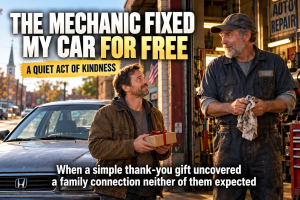
Almost a month later the note still sat there, unanswered by any real gesture. The car ran fine. Work paid what it paid. The forty-three dollars became a little more, then a little less again. One Saturday morning I decided the note wasn’t enough. I went to a small bakery downtown and bought a simple box of cookies, the kind that looked homemade even if they weren’t. I wrapped it in brown paper and tied it with a piece of string. It felt small, but it was something I could afford without pretending.
When I walked back into Miller’s Auto the same mechanic was under the hood of a different car. He straightened when he saw me, wiped his hands, and came over. I held out the package.
“Just a thank-you,” I said. “For last month.”
He took it, turned it over once in his hands, then looked at me for a long moment. Something shifted in his expression, a quiet recognition I couldn’t place.
“Is your father’s name Robert?” he asked.
The question landed soft and strange in the middle of the bay. I felt the concrete floor under my shoes, the smell of oil, the distant sound of a radio playing country music. My father’s name. Robert. The one person I hadn’t spoken to in almost three years.
I nodded, slow, not understanding yet why it mattered.
The mechanic set the gift carefully on the workbench and said, “I think we need to talk.”
Part 2
The bay felt smaller after he asked the question. Afternoon light cut through the open door in a long rectangle across the floor. Dust floated in it. Outside, a car passed on the side street and the sound faded.
I stood with the empty feeling of having handed over a gift and receiving something much heavier in return. The mechanic—his name was Dave, I learned later from the embroidered patch on his shirt—leaned against the workbench and studied my face the way he had studied the Honda a month before.
“Robert Ellis,” he said, not quite a question. “From over near the old paper mill?”
My throat tightened. “Yes.”
Dave nodded once, like a piece had clicked into place. He didn’t smile. He just looked tired in a way that had nothing to do with the day’s work.
“I knew your dad,” he said. “Years ago. Before you were probably tall enough to see over a counter.”
I waited. The radio in the corner switched songs. A customer’s truck idled outside and then pulled away.
Dave told the story without flourish. Twenty-three years earlier he had been younger, newly married, trying to keep a failing garage open on the other side of the county. His own car—an even older Honda than mine—had broken down on a winter night with his wife waiting at home and a baby due in three months. He had no money for a tow, no credit, nothing but pride that was already wearing thin. A man in a dark blue work jacket had stopped, looked under the hood, and fixed a cracked fuel line with parts from his own trunk. When Dave tried to pay, the man had waved it off.
“Someone did it for me once,” the stranger had said. “Pass it on when you can.”
That stranger’s name was Robert Ellis.
I stood there listening, the thank-you cookies still sitting unopened on the bench. My father had never mentioned any of this. In the version of him I carried, kindness was something he reserved for people who could return favors. The idea that he had once stood on a cold roadside and fixed a stranger’s car for free sat sideways against everything I thought I knew.
Dave watched my face change. He didn’t push. He just said, “When you walked in last month with that old Civic and told me you were short, it felt familiar. Same kind of car. Same kind of quiet way of saying you couldn’t pay. I didn’t put the name together until just now, when you brought the gift. You look like him around the eyes.”
I didn’t know what to do with my hands. I put them in my pockets, then took them out again.
“I haven’t talked to him in a long time,” I said. The words came out smaller than I meant.
Dave nodded like he understood more than I had said. “People drift. Happens.”
He offered coffee from a stained pot in the back office. We sat on two mismatched stools and the conversation moved carefully around the edges of the past. He asked how my father was. I said I didn’t know. He asked if I had siblings. One sister, older, living two states away. The quiet between questions filled with the ordinary sounds of the shop—tools clinking, a compressor cycling on, the distant bark of a dog.
When I finally left, the cookies stayed behind. Dave insisted. “You already paid me back by bringing them. That’s enough.”
I drove home with the radio off. The road felt different. Every familiar turn carried the weight of a story I had never been told. My father had once been the kind of man who stopped for strangers. Somewhere between that night and the years I remembered, something had changed him, or changed the way he showed up for the people closest to him.
That evening I sat at the same kitchen table where the unfinished thank-you note still lay. I turned it over and wrote a different sentence: “I met someone who remembers you.” Then I crossed it out. Too dramatic. Too hopeful. I left the paper blank and went to the window instead. The streetlights had come on. Somewhere out there was a man who had once fixed a car for free and then, years later, become the reason another man did the same for me.
I didn’t sleep much. Every time I closed my eyes I saw Dave’s face when he asked the question, the careful way he held the gift, the quiet certainty that the past had just walked back into his shop wearing my face.
The next morning I called my sister. She answered on the third ring, voice still rough from sleep.
“Do you remember Dad ever talking about helping someone with a car?” I asked.
Silence stretched long enough that I thought the call had dropped. Then she said, “He used to. When we were little. Said it was important to help people when you could. Why?”
I told her the short version. The broken Honda. The free repair. The question about Robert. The story Dave had told. She listened without interrupting. When I finished she was quiet again.
“Maybe you should go see him,” she said finally. “Just once. See if the man who fixed that car is still in there somewhere.”
I didn’t answer right away. The idea sat in my chest like something both necessary and dangerous. Seeing my father meant opening doors I had spent years keeping shut. It meant risking the careful distance I had built.
But the alternative—pretending none of it had happened—felt worse.
I hung up and sat with the decision for the rest of the day. By evening I had pulled an old address book from a drawer and found the last number I had for him. It might not work. He might have moved. He might not want to hear from me.
I dialed anyway.
The phone rang four times. Then a voice I hadn’t heard in almost three years said hello, rough and cautious, the way a person answers when they don’t recognize the number.
I closed my eyes and said, “Dad. It’s me.”
Part 3
The silence on the other end lasted long enough that I almost hung up. I could hear the faint sound of a television in the background, something with canned laughter. Then my father’s voice came back, quieter.
“Daniel?”
“Yeah.”
Another pause. I pictured him standing in whatever kitchen or living room he occupied now, maybe still in the same small house on the edge of the old paper-mill town, maybe somewhere else entirely. I hadn’t asked for an address in years. I hadn’t wanted one.
“You okay?” he asked. The question was careful, the way you ask when you’re not sure if the call is about emergency or ordinary life.
“I’m fine. I just… something happened. I met a man who knows you.”
I told him about the Honda, about Dave, about the free repair and the story of a cold night twenty-three years earlier. I kept my voice even. I didn’t accuse. I didn’t soften it into nostalgia either. I just laid the facts down between us like tools on a workbench.
When I finished, my father was quiet again. The television laughter had stopped. I heard a chair scrape.
“Dave Miller,” he said at last. “I remember him. Young guy then. Scared about money. About the baby coming.”
“He remembered you too. Said you fixed his car and wouldn’t take payment.”
A short, almost reluctant sound that might have been a laugh. “Didn’t have much to take. Just some parts and a little time.”
I waited. The old pattern between us was to let silences do the heavy lifting. This time I didn’t let it stretch too far.
“Why didn’t you ever tell us about things like that?” I asked.
He didn’t answer right away. When he did, the words came slower. “Didn’t seem like the kind of thing you talk about. You just do it and move on.”
That was the version of my father I had grown up with—practical, private, more comfortable with actions than explanations. The problem was that the actions had stopped reaching the people inside the house long before I left. Bills got paid. The roof stayed solid. Conversations stayed short. Affection, when it appeared, arrived sideways, through fixed things rather than spoken ones.
“I’m going to stop by the shop again,” I said. “Dave still has the place. Thought you might want to know he’s doing all right.”
My father made a noncommittal sound. Then, almost too quiet to catch, “You still in Ohio?”
“Yeah.”
“Close?”
“Couple hours.”
He didn’t invite me. I didn’t push. We ended the call with the same careful distance we had started it, but something had shifted. A door that had been closed for years was no longer locked. Whether either of us would walk through it remained unknown.
The next Saturday I drove back to Miller’s Auto with no gift this time, just the need to keep the connection alive. Dave was under a different car. When he saw me he wiped his hands and came over like we were already in the middle of a conversation that had only paused.
“Talked to him,” I said.
Dave raised an eyebrow. “How’d that go?”
“About like you’d expect. Short. Careful. But he remembered you.”
Dave nodded, satisfied in a quiet way. He offered coffee again. We sat in the same mismatched stools and talked about ordinary things—the weather, the cost of parts, a customer who kept bringing in the same truck with the same mysterious noise. In the spaces between those topics the larger story sat with us, unspoken but present.
At one point Dave leaned back and said, “Your dad saved more than a car that night. I was ready to close the doors. One more expensive repair and I would’ve been done. The baby came three months later. Shop stayed open. I still think about that sometimes when things get tight.”
I looked at the bay, at the tools hanging in careful rows, at the faded sign outside. This place existed, at least in part, because a man I barely recognized anymore had stopped on a winter road and chosen to help.
“He’d be glad to know that,” I said, though I wasn’t sure it was true. Gladness was hard to picture on my father’s face.
Dave shrugged. “Maybe. Or maybe he’d just nod and change the subject. Some men are like that.”
The afternoon light shifted. A new customer arrived. I stood to leave and Dave walked me to the door.
“Bring him by sometime,” he said. “If he wants. I’d like to shake his hand again.”
I promised nothing. Promises felt dangerous. But the idea lodged itself somewhere behind my ribs and stayed there as I drove home.
That night I sat with the old address book again. The number was still good. The address listed was the same one I remembered from childhood. I stared at the page for a long time before closing the book and setting it aside.
The decision to go see him formed slowly, the way frost forms on a window—quiet, inevitable once the temperature drops far enough. I called my sister again. She listened and then said the thing I needed to hear.
“Go. Even if it’s awkward. Even if it’s short. At least you’ll know.”
I packed a small bag the next morning. Not because I planned to stay overnight, but because the act of packing made the trip feel real. I left a note for the landlord in case anything happened to the Honda again. The irony of that thought almost made me laugh.
The drive took two hours and seventeen minutes. I counted the exits. I watched the landscape change from the flat edges of my town to the low hills near the paper mill. The mill itself was mostly shut down now, a long brick building with most of its windows boarded. The house where I had grown up sat three streets beyond it, smaller than I remembered, the paint on the porch railing peeling in long strips.
I parked across the street and sat for a full minute with the engine off. The same maple tree still stood in the front yard, taller now. The same mailbox leaned slightly to the left. Nothing had changed and everything had.
I got out, crossed the quiet street, and knocked.
Footsteps moved inside. The door opened. My father stood there in a flannel shirt and work pants, older than the last photograph I carried in my head, the lines around his eyes deeper, the hair thinner. He looked at me the way you look at something you both expected and never quite believed would arrive.
“Daniel,” he said.
“Hi, Dad.”
Neither of us moved for a moment. Then he stepped back and held the door open wider.
“Come in.”
Part 4
The living room smelled the same—coffee, old wood, a faint trace of the pipe tobacco he had given up years ago but that still clung to the curtains. The furniture had been rearranged once or twice, but the bones of the place were unchanged. The same clock ticked on the mantel. The same framed photograph of my mother sat on the side table, taken years before the illness that took her when I was fourteen.
My father closed the door and stood with his hands at his sides, uncertain what to do with them.
“You want coffee?” he asked.
“Sure.”
We moved into the kitchen. He poured from a pot that had already been made. The mugs were the same ones from years ago, one with a chip on the rim. We sat at the small table under the window. Outside, the maple leaves drifted down in slow spirals.
I didn’t know how to begin. The careful distance of the phone call felt easier than this. Sitting across from him made every year of silence sit heavier between us.
He spoke first. “You still driving that Honda?”
“Yeah. The one Dave fixed.”
My father nodded, looking down at his mug. “Good car. Reliable if you take care of it.”
The conversation stayed on the surface for a while—work, the weather, whether the paper mill would ever reopen. I answered in short sentences. He did the same. The silences were longer than the words. At one point he got up to refill the coffee even though both mugs were still half full. When he sat back down he kept his eyes on the table.
“I should’ve called,” he said finally. The words came out rough, like they had been practiced and then abandoned and then forced out anyway. “After your mother. After you left. I should’ve called.”
I didn’t rush to answer. Part of me wanted to say it was fine, that people drift, that it didn’t matter. Another part wanted to list every birthday and holiday that had passed without a word. I chose neither.
“I didn’t make it easy,” I said. “I left angry.”
He looked up then. “You had reason.”
The admission sat between us, quiet and large. I had expected defense or explanation. I hadn’t expected the simple acknowledgment.
We talked a little about those years. Not everything. Some wounds were still too raw to touch in a first conversation after so long. But enough. He told me he had sold the old truck the year after I left and bought a smaller one that was easier on gas. I told him about the two jobs and the rented apartment and the way the Honda had become both a necessity and a kind of companion. Ordinary details. The kind that slowly rebuild a map between people who have forgotten how to navigate each other.
When the coffee was gone he asked if I wanted to see the garage. It was the same detached building behind the house where he had spent so many evenings when I was a kid, the light on late, the radio low. We walked out together. The door stuck the way it always had. Inside, the same tool chest stood against the wall, the same workbench under the window. A half-finished project—some kind of wooden shelf—lay under a drop cloth.
“Still fixing things,” I said.
He almost smiled. “Some habits don’t quit.”
We stood there for a while in the cool shade of the garage. I thought about Dave’s shop two hours away, about the chain of free repairs that had started in this man’s hands and somehow circled back to me. The idea still felt strange, like wearing a coat that belonged to someone else.
“Dave asked if you’d come by sometime,” I said. “Said he’d like to shake your hand again.”
My father was quiet. He ran a hand along the edge of the workbench, feeling for something only he could sense.
“Maybe,” he said. “Not sure he’d recognize me now.”
“He would.”
We went back inside. The afternoon light had shifted. I realized I had been there almost three hours and that leaving would feel both necessary and incomplete. I stood, uncertain of the next step.
“I should head back,” I said. “Work tomorrow.”
He nodded. Walked me to the door. On the threshold he paused, one hand on the frame.
“You can come again,” he said. “If you want. Door’s open.”
It wasn’t an apology. It wasn’t a grand reconciliation. It was an offer, simple and careful, the way he had always done the things that mattered most to him.
I said I would. Then I crossed the street to the Honda, started the engine, and drove away with the rearview mirror showing the small house getting smaller until the curve of the road took it out of sight.
That night I called Dave. He answered on the second ring, the shop radio still playing in the background.
“I went to see him,” I said.
Dave’s voice warmed. “How’d it go?”
“Quiet. Awkward. Better than I expected.”
“Good.” A pause. “You tell him about the shop?”
“Yeah. He remembers you.”
I could almost hear Dave smiling on the other end. “Bring him by when he’s ready. No rush.”
After I hung up I sat at the kitchen table again. The blank thank-you note from a month earlier was still there. I turned it over and wrote a new line this time, one that felt closer to true.
“Some debts get paid in ways you never plan.”
I left it there and went to bed. For the first time in a long while the silence of the apartment didn’t feel empty. It felt like a space that might, slowly, begin to hold more than just me.
Part 5
Two weeks passed before I saw either of them again. Work kept me busy. The Honda ran without complaint. The careful peace with my father stayed fragile but intact—one short phone call midweek to check that the number still worked, a text message about the weather that neither of us admitted was an excuse to stay connected.
On a Thursday evening Dave called. His voice sounded different, tighter around the edges.
“Got a minute?”
“Sure.”
“Your dad’s truck is in my bay. He brought it in this afternoon. Said the transmission was slipping. I told him I’d look at it, but it’s more than a simple fix. Parts alone are going to run higher than he expected.”
I sat down hard on the edge of my bed. “Is he still there?”
“Waiting in the office. Didn’t want me to call you, but I thought you should know.”
I was in the car within ten minutes. The drive felt longer than usual. When I pulled into Miller’s Auto the sun was already low. My father’s truck—a dark green pickup I didn’t recognize—sat with the hood up. Dave stood beside it with a clipboard. My father sat on the same stool I had used weeks earlier, hands wrapped around a paper cup of coffee that had gone cold.
He looked up when I walked in. Something like embarrassment crossed his face and then settled into resignation.
“Didn’t need to drag you into this,” he said.
“Dave called. I wanted to come.”
We stood in the bay while Dave explained the problem in plain language. The transmission was worn. It could be rebuilt, but the cost would be significant. A used one might be found, but reliability was a gamble. My father listened without interrupting, the way he always had when mechanical facts were on the table. When Dave finished he looked at the floor for a long moment.
“How much?” he asked.
Dave named a number that made my stomach tighten. My father nodded once, as if he had expected it.
“I’ll figure something out,” he said. “Leave it here for now. I’ll come back when I have a plan.”
I walked him to the door. Outside, the evening air had turned cool. He stood with his hands in his jacket pockets, looking at the quiet street.
“I can help,” I said. “Not with the whole amount, but some of it.”
He shook his head. “Not your problem.”
“It’s not about problems. It’s about—” I stopped, searching for the right words. “You fixed his car once. He fixed mine. Maybe this is just the next turn.”
My father was quiet for a long time. Then he said, “Kindness isn’t a ledger, Daniel. You don’t keep score.”
“I know. I’m not keeping score. I’m just saying I want to help.”
He looked at me then, really looked, the way he had when I was a boy and he was trying to decide whether I was ready for a harder job in the garage. Whatever he saw must have been enough. He gave a short nod.
“We’ll talk about it,” he said. “Not tonight. I’m tired.”
I drove him home. The ride was mostly silent, but the silence felt less like distance and more like two people sharing the same stretch of road. When we reached the house he paused with the truck door open.
“Come by this weekend,” he said. “We’ll figure the numbers.”
I said I would. Then I watched him walk up the steps and disappear inside before I turned the Honda around and headed back toward my own quiet apartment.
That night I sat with a notebook and did the math. My savings were small. The two jobs paid what they paid. Helping with the transmission would mean cutting back on things I had already learned to live without. But the alternative—watching my father struggle alone with something he couldn’t fix himself—felt worse.
I called my sister the next morning. She listened, then said she could contribute a little from her end. “It’s not much,” she warned. “But it’s something.”
Something was enough to start with.
Saturday morning I drove back to the small house near the paper mill. My father had the kitchen table cleared and a pad of paper ready. We sat down like two people negotiating a careful treaty. He listed what he could put toward the repair. I listed what I could add. My sister’s contribution went in the middle. When the numbers were added the gap was smaller but still real.
Dave called while we were still at the table. He had found a used transmission from a salvage yard two counties over. It wasn’t perfect, but it was better than the rebuild cost and came with a short warranty. The final figure dropped into a range the three of us could cover if we stretched.
My father looked at the paper for a long time. Then he folded it once and set it aside.
“All right,” he said. “Let’s do it.”
The decision felt larger than the money. It was the first time in years that the three of us—father, son, distant sister—had moved in the same direction on anything. The transmission became more than a mechanical problem. It became a reason to stay in the same conversation.
Dave scheduled the work for the following week. I took a day off to help ferry parts and keep my father company in the waiting room while the bay stayed busy. We drank bad coffee and talked about nothing important—baseball scores, the price of gas, whether the maple in the front yard needed trimming. The ordinary talk was its own kind of repair.
When the truck was finally ready, my father paid what he could and I covered the rest without making a show of it. Dave refused to take a tip. “We’re even,” he said, and the three of us stood there for a moment in the late afternoon light, the chain of kindness stretching quietly between us across more than two decades.
My father shook Dave’s hand the way he had once shaken it on a cold roadside years earlier. This time there were no words about passing anything on. The gesture itself was enough.
On the drive home my father was quieter than usual. At a red light he said, almost to himself, “Didn’t think I’d see that man again.”
“Glad you did?”
He thought about it. “Yeah. Glad I did.”
The light turned green. We moved forward. Behind us the shop lights stayed on a little longer, the bay door still open, the day’s work not quite finished.
Part 6
The weeks after the transmission repair settled into a new rhythm. I called my father every few days. Sometimes the conversations lasted five minutes. Sometimes they stretched longer. We talked about the truck’s new quietness, about a leak in the kitchen sink he fixed himself, about a book he had found in a box of my mother’s things. Small subjects. Safe subjects. The kind that slowly rebuild trust without demanding it all at once.
Dave became a regular part of the circle. I stopped by the shop when I was in the area, sometimes with coffee, sometimes just to say hello. He always asked after my father. My father always asked after the shop. The two men never exchanged more than a few words when they saw each other, but the recognition between them was steady and unforced.
One Saturday in late October my father called and asked if I wanted to help with a project. The old garage needed a new workbench. The wood was already cut. He just needed another pair of hands. I drove over that afternoon. We worked mostly in silence, the radio low, the smell of sawdust rising around us. When the bench was solid and level he stepped back and nodded once, the same way he used to when a job was done right.
“Your mother always said I spent too much time out here,” he said. “She was probably right.”
I wiped dust from my hands. “She also said you fixed things no one else could.”
He looked at me, surprised. “She said that?”
“Once. After you stayed up all night with the furnace when it quit in January.”
A small smile touched the corner of his mouth and then faded. “I miss her.”
“Me too.”
We stood there with the new bench between us and the years of silence thinner than they had been. Grief, I was learning, could be shared without being solved. Sometimes just standing in the same space with it was enough.
That evening he asked if I wanted to stay for dinner. Nothing fancy—soup from a can, bread from the freezer, coffee afterward. We ate at the same table under the window. Outside, the last of the maple leaves drifted down in the dark. When I left he walked me to the door again and this time put a hand briefly on my shoulder.
“Drive safe,” he said.
The touch lasted less than a second. It stayed with me the whole way home.
November brought colder weather and a new complication. The landlord of my apartment building announced a rent increase starting in January. Not enormous, but enough to stretch my already thin budget. I sat with the numbers for two nights before calling my sister. She listened and then asked the question I had been avoiding.
“Have you thought about moving closer to Dad?”
The idea felt both practical and terrifying. Living nearer would make the careful reconnection easier. It would also mean giving up the independent distance I had built. I told her I would think about it. Then I spent the next week thinking about little else.
I mentioned the rent increase to my father during one of our evening calls. He was quiet for a moment.
“There’s a spare room here,” he said. “Hasn’t been used in years. Needs paint. But it’s there.”
I didn’t answer right away. The offer sat between us, large and unexpected.
“I’m not asking you to decide tonight,” he added. “Just putting it on the table.”
I said I would think about it. After we hung up I walked through my small apartment and looked at the walls that had held my independent life for three years. They suddenly felt temporary in a way they never had before.
The next Saturday I drove to the shop instead of the house. Dave was under a different car. When he saw my face he wiped his hands and came over.
“You look like a man with a decision on his shoulders,” he said.
I told him about the rent, about the spare room, about the careful way my father had made the offer. Dave listened the way he always did—without rushing to advice.
“Kindness isn’t only about fixing cars,” he said eventually. “Sometimes it’s about making space for people when they need it. Your dad’s offering space. Whether you take it is up to you.”
I left the shop with more questions than answers. That night I sat at the kitchen table with a fresh sheet of paper and tried to list the reasons for and against. The list stayed uneven. Logic pointed one way. Fear pointed another. Somewhere in the middle sat the quiet truth that the chain of small kindnesses that had started years ago on a winter road was still moving, still asking something of the people it touched.
I called my father the next morning.
“About the room,” I said. “I’d like to come look at it. No promises. Just look.”
“Anytime,” he answered. “Door’s open.”
Part 7
The spare room smelled of closed air and old cardboard. My father had already started clearing boxes from one corner. A single window looked out toward the maple tree. The walls were a tired shade of beige that had once been white. I stood in the center of the room and tried to picture a bed, a desk, the few things I owned arranged in a new order.
“Needs work,” my father said from the doorway. “But the bones are good.”
We spent the afternoon measuring and talking about paint colors. Nothing was decided. The conversation stayed practical—rollers, drop cloths, whether the old dresser in the garage could be refinished. Practical felt safe. Underneath it the larger question waited.
That evening we ate soup again at the kitchen table. Afterward my father brought out a small wooden box I had never seen. Inside were photographs, some faded, some still sharp. He sorted through them slowly and handed me one. It showed a younger version of him standing beside a dark blue work jacket, tools scattered on the ground, a car with its hood open in the background. Dave, much younger, stood a few feet away with a shy smile.
“Taken the spring after that night,” my father said. “He came by to say thank you. Brought his wife and the baby. We stood around talking longer than either of us planned.”
I held the photograph carefully. The chain of kindness had a face now, a specific moment captured in fading color.
“I kept meaning to stay in touch,” my father continued. “Life got busy. Then it got hard. Then it got quiet.”
I set the photo down. “It’s not quiet anymore.”
He looked at me across the table. “No. It’s not.”
We didn’t decide anything that night. I drove home with the photograph’s image still clear in my mind and the spare room’s empty walls waiting for a choice I wasn’t ready to make.
December arrived with early snow. The rent increase letter sat on my counter like a deadline. I visited the house twice more. Each time the spare room looked a little less empty. My father had painted one wall a soft gray. The dresser from the garage stood against another wall, sanded and waiting for finish. Small progress. Steady.
On a Tuesday evening Dave called with news that had nothing to do with cars.
“Your dad was in today,” he said. “Dropped off a set of socket wrenches he said I could use if I needed them. Wouldn’t take them back when I tried. Said they were just collecting dust at his place.”
I smiled in the dark of my apartment. “Sounds like him.”
“Yeah. Also said you were thinking about the spare room. Told me not to push, just to listen if you needed to talk.”
The fact that my father had mentioned the decision to Dave felt like another quiet step forward. The circle was widening in small, careful ways.
I spent Christmas with my sister. We talked late into the night about the past three years, about the distance, about the slow return. She asked if I had decided about the room. I said not yet. She didn’t push. On the drive home the next day the snow-covered fields looked cleaner than they had any right to, as if the world itself was offering a blank page.
New Year’s Eve I sat alone in the apartment and made a list of everything I would need to move. The list was short. Most of what I owned could fit in the Honda and one trip with a borrowed truck. The realization that my independent life could be packed so easily was both liberating and unsettling.
On January second I called my father.
“If the room’s still available,” I said, “I’d like to take it. At least for a while. See how it goes.”
There was a pause long enough that I wondered if the connection had dropped. Then his voice came back, steadier than I expected.
“It’s available. Come whenever you’re ready.”
I gave notice to the landlord that afternoon. The two weeks that followed were a blur of boxes and goodbyes to a place that had held me through the loneliest stretch of my adult life. Dave helped with the final load. My father met us at the house and directed traffic like a man who had been preparing for this moment longer than he admitted.
That first night in the spare room I lay awake listening to the familiar sounds of the house settling around me. The maple tree moved against the window. Somewhere down the hall my father moved through his own evening routine. The distance between us had shrunk to the length of a hallway. Whether that would feel like closeness or constraint remained to be seen.
In the morning the smell of coffee drifted under the door. I got up, walked to the kitchen, and found my father already at the table with two mugs waiting.
“Sleep all right?” he asked.
“Well enough.”
He nodded and pushed one of the mugs toward me. Outside, the winter light was thin and clear. Inside, the day was just beginning.
Part 8
Living under the same roof again required adjustments neither of us had fully anticipated. My father was an early riser. I was not. He preferred silence in the mornings. I preferred the radio low. The kitchen became a careful negotiation of space and timing. Some days it worked. Some days the old tensions flickered at the edges of ordinary moments.
The spare room slowly became mine. I hung a few photographs. I set up a small desk under the window. The gray walls held the winter light longer than the beige ones had. At night I could hear the house breathe around me—the furnace cycling, the maple branches tapping the glass when the wind rose. It was both familiar and strange, like returning to a language I had once spoken fluently and then forgotten.
Dave stopped by one Saturday with a box of cookies that looked suspiciously like the ones I had brought him months earlier. We sat in the kitchen while my father finished a project in the garage. The conversation wandered from cars to weather to the way small towns held on to their stories longer than people expected.
“Your dad’s different,” Dave said when we were alone for a moment. “Quieter than he used to be, but softer around the edges. I think having you here is good for him.”
“It’s good for me too,” I admitted. “Most days.”
My father came in then, wiping sawdust from his hands. He saw the cookies and raised an eyebrow.
“You two starting a bakery?”
Dave laughed. “Just returning a favor.”
The three of us sat together for a while. The talk stayed light, but the ease of it felt like progress. When Dave left, my father stood at the window watching the truck pull away.
“Good man,” he said.
“He is.”
We didn’t need to say more. The history between them was already understood.
February brought a thaw and a new kind of test. My father’s truck developed a new noise—something in the suspension this time. He diagnosed it himself, ordered the parts, and then, to my surprise, asked if I wanted to help with the repair. We spent a cold Saturday under the truck in the driveway, hands stiff, breath visible in the air. He directed. I handed tools. At one point he asked me to hold a piece steady while he tightened a bolt, and the trust in the request was small and enormous at the same time.
When the job was done he straightened slowly, one hand on the small of his back.
“You’re better at this than you used to be,” he said.
“Had a good teacher once.”
He looked at me for a moment, then nodded and headed inside for coffee. I stayed outside a little longer, watching the late light catch on the wet pavement. The chain of small repairs—cars, rooms, silences—kept lengthening in ways I could no longer predict.
That evening my sister called. She was thinking of visiting in the spring. The idea of the three of us under the same roof again felt both hopeful and complicated. I told her the door was open. She said she would see.
March arrived with mud and the first green tips on the maple. The house felt less like a temporary arrangement and more like a place where decisions could be made without the pressure of deadlines. I still kept my second job, but the financial edge had softened. The rent I paid my father was modest and consistent. The arrangement suited us both.
One evening he brought out the wooden box of photographs again. This time he handed me a different picture—my mother standing in the garden, younger than I ever remembered her, smiling at whoever held the camera. My father’s handwriting on the back named the year and the place.
“I should have shown you these sooner,” he said.
“You’re showing them now.”
He set the box on the table between us. “There’s more. If you want to look.”
We spent the next hour going through them. Some I remembered. Many I didn’t. Each image opened a small window into years I had either forgotten or never fully seen. By the time we put the box away the kitchen was dark except for the light over the stove. Neither of us moved to turn on more.
“I’m glad you came back,” he said quietly.
“I’m glad you left the door open.”
It was the closest either of us had come to naming the larger repair that was still underway. It was enough for that night.
Outside, the wind moved through the bare branches of the maple. Inside, the house held us both without strain. The next morning the coffee was already made when I reached the kitchen. Two mugs waited on the table. The day began the way so many had begun since January—ordinary, careful, and slowly becoming something that felt like home.
Part 9
Spring arrived properly in April. The maple leafed out in a rush of green. My sister’s visit was scheduled for the last weekend of the month. The house prepared itself in small ways—fresh sheets in the second spare room, a grocery list that included the foods she had loved as a girl, a quiet agreement between my father and me that we would let the weekend unfold without forcing anything.
Dave came by the day before she arrived. He brought a small plant in a clay pot and set it on the kitchen table.
“For the windowsill,” he said. “Something living.”
My father eyed the plant with the mild suspicion he reserved for things that required watering. Then he nodded and made space for it beside the sink. Dave stayed for coffee. The three of us talked about the coming weekend, about the way families rearranged themselves after long absences. When he left, the plant remained, a quiet green presence in the room.
My sister arrived midafternoon on Friday. The years showed on her face the way they showed on mine—fine lines, a steadiness that hadn’t been there when we were younger. She hugged my father first, careful and long. Then she hugged me. The three of us stood in the entryway for a moment, unsure what came next.
Dinner that night was simple. Conversation moved carefully around the edges of the past three years. No one pushed. No one retreated too far. Afterward we sat in the living room with the windows open to the spring air. My father brought out the wooden box again. My sister went through the photographs with the same quiet attention I had. Some made her laugh. Some made her go still. When she found the picture of Dave and the younger version of our father she looked up.
“This is the man from the shop?”
“Yes.”
She studied the image for a long time. “I always wondered where that story went. Dad used to tell it when we were little. Then he stopped.”
My father looked down at his hands. “Some stories get harder to tell when the people in them feel far away.”
The honesty in the room felt new. We sat with it until the light faded and the first moths found the porch light outside.
Saturday we drove to Miller’s Auto together. Dave was expecting us. He came out wiping his hands, saw my sister, and smiled the quiet smile of someone who understood he was meeting another link in a chain he had helped forge.
“You’re the one who lives two states away,” he said.
“That’s me.”
They shook hands. My father stood a little apart, watching. Dave gave a short tour of the shop—the same bay, the same tools, the same radio playing low. My sister asked questions. Dave answered. Somewhere in the middle of it all the four of us stood in a loose circle near the open bay door and the afternoon light fell across the concrete in a long rectangle that felt almost ceremonial.
Dave looked at my father. “Still passing it on,” he said.
My father nodded once. “Trying to.”
No one needed to explain what “it” meant. The free repair, the returned gift, the spare room, the careful reconnection—all of it belonged to the same unfinished work.
We left the shop with the smell of oil still on our clothes and the sense that something important had been witnessed. That evening my sister and I sat on the back steps while my father finished something in the garage. The maple moved overhead. The air smelled of cut grass and possibility.
“He’s different,” she said.
“Yeah.”
“You are too.”
I didn’t argue. The months of shared space had changed the way I carried the past. The anger that had once felt permanent had softened into something more complicated and more useful—regret mixed with gratitude, distance mixed with the decision to stay close enough to keep trying.
Sunday morning we ate breakfast together. My sister’s suitcase waited by the door. The visit had been short, but it had done what it needed to do. Before she left she hugged my father again and then me.
“Don’t let the quiet take over again,” she said.
“We won’t,” I answered, and for the first time I believed it might be true.
After her car disappeared down the street my father and I stood on the porch for a while. The plant Dave had brought sat on the kitchen windowsill behind us, already putting out a new leaf.
“Good weekend,” my father said.
“Yeah. Good weekend.”
We went inside. The house settled around us again, smaller without my sister’s presence but no longer empty. The work of repair—mechanical, emotional, ordinary—continued in the quiet way it always had. Only now there were more hands willing to share the load.
That night I sat at the desk under the window in the spare room and wrote a short note I never intended to send. It was addressed to no one in particular, just a record of the strange path that had led from a broken Honda outside a small Ohio shop to this moment of shared air and unfinished stories.
Some kindnesses, I wrote, travel farther than the people who start them ever know.
I folded the paper and put it in the drawer. Outside, the maple moved in the dark. Inside, the house held its newest quiet without complaint.
Part 10
By early summer the spare room no longer felt temporary. The gray walls had collected a few more photographs. The desk held a growing stack of bills paid and letters answered. The plant on the kitchen windowsill had doubled in size and required regular watering that my father now performed without complaint. Life had rearranged itself around the new shape of our days.
The Honda needed new tires in June. I took it to Miller’s Auto out of habit more than necessity. Dave looked it over, named a fair price, and then refused to charge for the labor.
“Consider it interest on an old debt,” he said.
I argued. He shrugged the same way he had the first day. In the end I paid for the tires and left a second box of cookies on the workbench. The circle kept turning.
My father and I developed a Saturday routine that neither of us named but both protected. Morning coffee. A project in the garage or yard if the weather allowed. An evening meal that sometimes included Dave if he was free. The talk stayed mostly ordinary. The ordinary had become the point. Underneath it the larger repairs continued—small admissions, quieter silences, the slow replacement of old distance with something sturdier.
One July evening my father brought out the wooden box one last time. He sorted through the photographs until he found the one of himself and Dave from that spring more than twenty years earlier. He studied it for a long moment, then handed it to me.
“Keep this one,” he said. “Seems like it belongs with you now.”
I took the photograph carefully. The younger faces looked back with the unguarded hope of men who still believed kindness was a simple transaction. They had been right and wrong at the same time. Kindness was simple. The living of it was not.
August brought a letter from my sister. She had found a job closer to home and was thinking of moving back within the year. The news settled over the house like good weather. My father read the letter twice and then set it on the refrigerator under a magnet shaped like a wrench. No grand announcement. Just a quiet adjustment to the possibility of more family under the same roof again.
On a warm evening near the end of the month the three of us—my father, Dave, and I—sat on the back steps after a long day of clearing brush from the fence line. The maple moved overhead. The air smelled of cut grass and cooling earth. Conversation drifted and then settled into a comfortable quiet.
Dave broke it first. “Still think about that night sometimes,” he said. “The cold. The way your dad just showed up and fixed what needed fixing without making a speech about it.”
My father looked out toward the darkening yard. “Didn’t have a speech prepared. Just had some parts and a little time.”
“Was enough,” Dave said.
I sat between them and felt the weight of the years that had brought us to this ordinary moment. A broken car. A free repair. A returned gift. A question about a father’s name. A spare room. A shared table. None of it had been planned. All of it had been necessary.
When Dave stood to leave he shook my father’s hand the way he had the first time, then turned to me.
“You ever need anything,” he said, “you know where the shop is.”
“I do.”
After his truck lights disappeared down the road my father and I stayed on the steps a little longer. The night insects had started their steady chorus. Somewhere in the distance a dog barked once and then went quiet.
“I’m glad you broke down outside his place,” my father said eventually.
I looked at him. “Yeah. Me too.”
We went inside. The plant on the windowsill caught the last of the light. The coffee pot waited for morning. The house held its newest version of us without strain.
Years later I would still drive past Miller’s Auto whenever I was in that part of the county. The sign would be a little more faded. The bay door would still stand open on warm days. Sometimes Dave would be there. Sometimes only the tools and the quiet. Each time I passed I felt the same small recognition—the knowledge that a single act of ordinary kindness had traveled farther than any of us could have mapped, connecting strangers, reopening doors, and slowly, imperfectly, repairing more than engines.
The Honda eventually gave way to a newer car. The spare room became simply my room. My sister moved back and the house adjusted again. My father grew older in the steady way of men who keep working with their hands. Dave kept the shop open longer than anyone expected. And the story of the free repair continued to move, quiet and persistent, through the lives it had touched.
Some debts, it turned out, are never meant to be paid in full. They are meant to be passed on, reshaped, and carried forward until the people who receive them no longer remember where they began—only that the road felt a little less lonely because someone once stopped to help.
That was enough. It had always been enough.