After my father died I found an envelope with my name on it inside his old desk. Inside was a document signed by both of my parents two years before they divorced. When I called my mother she went silent, then whispered that my father had promised they would never tell me. She hung up before I could ask what secret they had kept for decades.
Part 1
The house still smelled like him.
Not the sharp cologne he used for special occasions, but the quieter scent that lived in the wood of the furniture and the pages of the books he never finished. Dust mixed with old paper and the faint trace of the pipe tobacco he had given up years earlier yet somehow never fully left behind. I stood in the doorway of his study for a long time before I stepped inside.
It had been three weeks since the funeral. Three weeks of polite phone calls, casserole dishes left on the porch, and the strange emptiness that settles when the person who once filled a room is suddenly gone. My mother had not come. She sent flowers and a short note in her careful handwriting. That was all. We had not spoken more than a few necessary sentences since the service.
I had come to the house alone to begin the slow work of sorting. The lawyer had already handled the official papers. What remained was the ordinary wreckage of a life: sweaters still hanging in the closet, a half-empty bottle of aspirin in the bathroom cabinet, a calendar on the kitchen wall still turned to the month he died.
The desk was the last place I wanted to open. It was the same heavy oak piece that had stood in every house we lived in when I was a child. The surface was scratched and darkened by years of elbows and coffee cups. One of the lower drawers always stuck. I pulled it free with both hands.
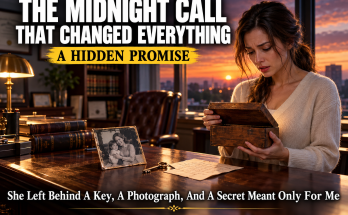
Inside, beneath a stack of old utility bills and a faded photograph of the two of us at a lake when I was ten, lay a plain cream envelope. My full name was written across the front in my father’s familiar slanted script. No address. No stamp. Just my name.
I sat down on the floor with my back against the desk. For a moment I only held the envelope. The paper felt thicker than ordinary stationery, the kind people once used for important letters. I slid my thumb under the flap. It opened easily, as if it had been waiting.
There was no personal letter. No final words of advice or apology or love. Instead I found a single folded sheet of paper, the edges slightly yellowed. Both of my parents’ signatures appeared at the bottom in blue ink. My mother’s careful loops. My father’s sharper strokes. The date written at the top was from two years before their divorce was finalized.
I read the short paragraph once. Then again. The words did not change.
I took out my phone and called my mother.
She answered on the fourth ring, her voice cautious the way it always became when my number appeared on her screen.
“I found something in Dad’s desk,” I said. “An envelope with my name on it. There was a document inside. You both signed it.”
Silence stretched across the line. I could hear the soft click of a television muted in the background of her apartment.
“Mom?”
Her breath caught. When she finally spoke, the words came out low and careful.
“Your father promised we’d never tell you.”
“Tell me what? What did you both promise to keep secret?”
Another pause. Then the line went dead.
I sat on the study floor with the phone still pressed to my ear, listening to the empty tone. The document rested open on my knee. Afternoon light moved slowly across the hardwood. Outside, a lawn mower started somewhere down the street. Ordinary sounds of an ordinary day.
Nothing felt ordinary anymore.
I stayed there until the light began to fade. The house grew quieter. I folded the paper again, slid it back into the envelope, and placed it carefully on the desk. My hands were steady, but something inside my chest had shifted, as if a door I never knew existed had been opened a few inches and refused to close.
I locked the study door when I left. I did not know why. The rest of the house still needed sorting. Clothes still needed boxing. The kitchen still needed emptying. But the envelope had changed the order of things. Everything else could wait.
That night I slept in the guest room of my own apartment with the lights left on. Every time I closed my eyes I saw my mother’s careful signature next to my father’s. I heard the exact moment her voice had gone flat. I replayed the click of the call ending.
By morning I knew I would not be able to leave the question alone.
Part 2
I returned to the house the next afternoon with a cardboard box and a clearer head. The study felt different in daylight. Dust motes drifted in the beam that cut across the desk. I set the envelope in the center of the blotter and opened the document again.
The language was formal but not legal. It read like something written by two people trying to make a private agreement feel permanent. Both of them acknowledged a decision they had made together. Both of them promised never to speak of it to me. The final line simply stated that the matter was closed and would remain closed for the rest of our lives.
No explanation of what the matter was.
I photographed every inch of the page with my phone, then placed the original back in the envelope. I searched the rest of the desk with more care. Receipts. Old insurance forms. A half-finished crossword from a newspaper published the week before he died. Nothing else carried both of their signatures. Nothing else mentioned a secret.
My parents had been divorced since I was eight. I was thirty-four now. The math sat in my mind like a stone. Whatever they had agreed to hide had been hidden longer than most marriages last.
I tried calling my mother again. The call went straight to voicemail. I left a short message. I kept my voice calm.
“I need to understand what I found. Please call me back.”
She did not.
That evening I sat at my kitchen table with a legal pad and began writing everything I could remember about the years before the divorce. The small arguments over dinner. The way my father started staying later at the office. The night my mother packed a suitcase and then, the next morning, unpacked it without explanation. None of those memories pointed to a single hidden document.
I called my aunt Linda, my mother’s younger sister. She lived two states away and had always been the relative who answered questions other people avoided.
“Do you know anything about a paper Mom and Dad both signed before the divorce?” I asked after the usual greetings.
Linda was quiet for a moment. “What kind of paper?”
“Something private. They promised never to tell me about it.”
Another pause. “Claire, some things are better left where they were put.”
“That’s not an answer.”
“It’s the only one I have right now.”
She changed the subject to the weather and her garden. I let her. When we hung up I stared at the notes I had made. The list of ordinary memories looked thinner than before.
I returned to the house the following Saturday determined to go through every drawer and closet. In the back of my father’s bedroom closet, behind a row of winter coats, I found a small locked metal box. The key was taped to the underside of the desk drawer I had already emptied. Inside the box were three things: a faded photograph of my parents on their wedding day, a single silver baby rattle, and a second envelope, this one sealed with old wax and addressed only with the word “Later.”
My hands shook as I broke the seal.
Inside was a short handwritten note in my father’s writing.
Claire,
If you are reading this, then the other document has found its way to you. I am sorry. We thought we were protecting you. We may have been protecting ourselves.
Talk to your mother. Tell her I said it is time.
Dad
I sat on the edge of the bed holding the note. The baby rattle rested in my other hand. It was the kind of object that once meant something specific and now only raised more questions. I had never seen it before. I had no younger siblings. No older ones either. The family story had always been simple: two people, one child, a marriage that did not last.
The story no longer felt simple.
I drove to my mother’s apartment that same afternoon without calling first. She opened the door wearing the same cautious expression she used on the phone. When she saw my face she stepped aside and let me in.
“I found the second envelope,” I said. “Dad left a note. He said it was time.”
My mother closed the door behind me. She walked to the window and stood with her back to me for a long time. When she finally turned, her eyes were dry but tired in a way I had not noticed at the funeral.
“Sit down, Claire,” she said. “This is going to take a while.”
Part 3
We sat across from each other at her small kitchen table. A pot of tea cooled between us, untouched. My mother folded and unfolded a paper napkin until the edges frayed.
“Your father and I made a decision a long time ago,” she began. “We believed it was the only decision that made sense at the time. We were wrong about how long secrets can stay quiet.”
I waited.
She looked at the table rather than at me. “Two years before the divorce was final, we signed that document because we needed to put something in writing. We needed to look at the words and agree that we would never speak them again. It felt safer that way.”
“What words?”
She shook her head once. “Not yet. First you need to understand the year that came before.”
I leaned back in the chair. The apartment was neat in the way of someone who had learned to keep chaos out of the visible spaces. Photographs of me as a child sat on a shelf in careful frames. None of them showed both of my parents together after I turned seven.
“Your father lost his job that spring,” she said. “The company closed the entire department. We had some savings, but not enough. I was working part-time at the library. Rent was due. The car needed repairs. Ordinary pressure that slowly stops feeling ordinary.”
I remembered none of this. At six years old I had been more concerned with the school play and whether my best friend would still sit with me at lunch.
“We started arguing about money every night,” she continued. “Then the arguments moved to other things. Things that had been waiting underneath for years. One night I told him I thought we should consider options we had never talked about before. Hard options. He agreed more quickly than I expected.”
She stopped. The silence in the kitchen felt heavier than the one on the phone.
“What options?” I asked.
“We talked about whether we could keep going the way we were. Whether it was fair to you. Whether there was another path that might give you a more stable life than the one we could see coming.”
My stomach tightened. “You mean sending me to live with someone else.”
She did not deny it. “We looked at temporary arrangements. Family. Friends. Even the possibility of a more permanent placement if things did not improve. We were scared, Claire. Scared of failing you in public ways we could not fix.”
I stared at her. The baby rattle in the metal box suddenly made a different kind of sense. Not a keepsake of a child who never arrived. A reminder of a child they had almost decided to let go.
“We never went through with any of it,” she said quickly. “Your father found new work within a few months. The pressure eased. We put the idea away and promised each other we would never speak of it again. The document was our way of locking the door.”
“But you still divorced.”
“Yes. The money problems were only one crack. There were others. By the time the divorce happened, the earlier conversation felt like something that belonged to different people. We kept the promise anyway. It seemed kinder.”
I stood up and walked to the window. Outside, a neighbor watered plants on a balcony. Ordinary life continued as if nothing in this kitchen had shifted.
“Dad left a baby rattle in the box with the note,” I said. “Why?”
My mother’s face changed. For the first time something like real pain moved across it.
“That rattle belonged to the child we almost gave away,” she said. “It belonged to you. We bought it when you were still a baby, before any of the hard conversations started. After we decided to keep our family together, your father put it away. He said it was proof we had chosen you twice.”
I turned back to her. “You almost gave me away.”
“We almost considered it. There is a difference.”
“It doesn’t feel like a difference right now.”
She nodded slowly. “I know.”
We sat in silence for several minutes. The tea had gone cold. I picked up my bag.
“I need time,” I said.
“I understand.”
At the door she spoke again. “Your father wanted you to know when he was gone. He said living with the secret was harder than telling the truth would have been. I disagreed with him for a long time. I may have been wrong.”
I left without answering. In the car I sat with both hands on the steering wheel and waited for the shaking to stop. It took longer than I expected.
The document no longer felt like a mystery. It felt like a mirror I had never asked to look into.
Part 4
The following days moved in a strange rhythm. I went to work. I answered emails. I cooked simple meals and left most of them unfinished. At night I reread the document and my father’s note until the words blurred.
I called Aunt Linda again.
This time she did not change the subject.
“Your mother told you,” she said. It was not a question.
“She told me part of it.”
Linda sighed. “I was there the night they first talked about it. Your mother called me crying. She said they were drowning and she didn’t know how to keep you above water. I told her to wait. I told her things could change. For a while it looked like they would.”
“Did you know about the document?”
“I knew they wrote something down. I didn’t know they both signed it like a contract. That was pure your father. He needed things in writing even when the writing hurt.”
I walked around my living room while we talked. The ordinary objects in the apartment looked slightly different, as if the light had shifted by a few degrees.
“Was there ever an actual agency involved?” I asked. “Papers beyond what they signed themselves?”
“No. It never reached that stage. They pulled back before any outside doors opened. But the conversation itself left a mark. Your mother carried guilt for years. Your father carried a different kind of weight. He always believed he should have found a better solution faster.”
After we hung up I drove back to the house. The metal box still sat on the bedroom dresser where I had left it. I took the baby rattle out and held it under the light. The silver was tarnished in places. Tiny teeth marks appeared along one edge, marks I must have made myself as a toddler and then forgotten.
I placed it back in the box and closed the lid.
That weekend I invited my mother to the house. She arrived with a small container of soup and an expression that said she expected the visit to be difficult. We sat in the living room instead of the study. I wanted ordinary furniture around us.
“I need the rest of the story,” I said. “Not the version that protects me. The version that actually happened.”
She set the soup on the coffee table. “All right.”
She spoke for nearly an hour. She described the specific nights when the arguments grew loud enough that I must have heard them through the wall even if I no longer remembered. She described the afternoon she visited a counselor alone and came home with pamphlets she later burned in the kitchen sink. She described the exact conversation in which my father said, “If we do this, we can never take it back,” and the long silence that followed before they both agreed to step away from the idea.
“We thought silence was the same as healing,” she said. “It isn’t.”
I asked about the divorce that came later. She did not try to connect the two events into a single neat explanation. Money problems had returned in a different form. Trust had thinned. The earlier near-decision sat between them like a third person in the room, unspoken but always present. When the marriage finally ended, neither of them wanted to reopen the older wound.
“Your father kept the rattle and the signed paper because he believed you deserved the truth someday,” she said. “I kept the promise because I was afraid the truth would make you feel unwanted. Looking at you now, I see that the secrecy did more damage than the honesty ever could have.”
I did not answer right away. Outside, the late afternoon light turned the living room gold and then gray. I thought about all the years I had spent believing the divorce was simply two people who stopped loving each other. The real story was more complicated and somehow more human.
“I don’t hate you,” I said finally. “I need you to know that. I’m angry. I’m confused. But I don’t hate either of you.”
My mother’s shoulders lowered a fraction. “That’s more than I expected today.”
We ate the soup in near silence. When she left she hugged me at the door for longer than usual. The gesture felt awkward and necessary at the same time.
After she drove away I returned to the study and placed the original document back in the envelope. Beside it I set my father’s note and the photograph of their wedding day. Three pieces of paper that had waited decades to be seen together.
I still did not know what to do with them. But for the first time the weight of not knowing had begun to lift.
Part 5
Work became a useful distraction. I managed a small team at a marketing firm, the kind of job that demanded attention to detail and left little room for wandering thoughts during the day. At night the thoughts returned.
I began writing letters I never sent. One to my father. One to the six-year-old version of myself who had slept through conversations that would later shape her entire understanding of family. The letters helped more than I expected. Putting the questions on paper made them less sharp.
Two weeks after the conversation with my mother I received a package in the mail. No return address. Inside was a thin notebook with a blue cover and my father’s handwriting on the first page.
Claire,
I started this the year we almost made the worst decision of our lives. I never showed it to your mother. I never showed it to anyone. If you are reading it, then the other papers have already done their work. Read it when you are ready. Or don’t. The choice is yours now.
Dad
The notebook contained dated entries spanning several months. Some were only a few lines. Others filled entire pages. He wrote about the fear of not being able to provide. He wrote about watching me sleep and wondering whether love was enough when the bills kept arriving. He wrote about the night he and my mother sat at the kitchen table with a blank sheet of paper and tried to put their terror into sentences that could be signed and then locked away.
One entry near the end stopped me cold.
Today we decided not to. We are keeping her. We are keeping us, at least for now. I feel relief and shame in equal measure. Relief that we stepped back. Shame that we ever stepped forward. I will spend the rest of my life trying to be the father who deserved that second chance.
I closed the notebook and sat very still. The shame he described was something I had never seen on his face while he was alive. He had been quiet, steady, sometimes distant, but never openly ashamed. The notebook revealed a man who had carried a private verdict against himself for decades.
I called my mother that evening and read the entry aloud.
She was silent for a long time after I finished.
“He never told me he wrote any of that down,” she said. “I wish he had. I spent years believing I was the only one who still felt the weight of those months.”
“You both carried it,” I said. “You just carried it separately.”
“Yes.”
We talked until nearly midnight. The conversation moved away from the past and into smaller present-day things: the neighbor’s new dog, a book she was reading, the way the light changed in her apartment in autumn. Ordinary subjects felt newly precious.
When we hung up I placed the notebook beside the other documents on the desk in the study. The collection was growing. Each new piece made the original secret feel less like a single sharp event and more like a long, complicated chapter that had simply never been spoken aloud.
I still had questions. I still felt the occasional flash of anger when I imagined the kitchen table conversations I had been too young to understand. But the anger no longer stood alone. It shared space with something quieter and more complicated: a reluctant understanding of two imperfect people who had been terrified of failing the child they loved.
Understanding did not erase the hurt. It simply gave the hurt a more accurate shape.
Part 6
Autumn settled over the neighborhood in slow layers. Leaves collected against the fence of my father’s house. I continued the work of sorting, but the pace had changed. I no longer felt the same urgency to empty every drawer. Some things could stay a little longer.
One Saturday I invited both my mother and Aunt Linda to the house. We sat in the living room with the metal box open on the coffee table. The baby rattle, the photograph, the signed document, the notebook, and my father’s final note formed a small uneven archive of a decision that had almost been made and then unmade.
Linda spoke first. “I remember the exact afternoon your mother called me. She was crying so hard I could barely understand her. I drove over that night. Your father was sitting at the table with his head in his hands. You were asleep upstairs. The whole house felt like it was holding its breath.”
My mother nodded. “We had the pamphlets from the counselor on the table. They looked so official. So final. Looking at them made the idea feel possible in a way that terrified me.”
I listened without interrupting. Hearing the story from two angles at once made it more solid and somehow less personal, as if it had happened to a different family that only resembled mine.
“What stopped you?” I asked.
My mother looked at the rattle. “You woke up and called for water. Ordinary. Ordinary was what saved us. Your father went upstairs, brought you the water, sat with you until you fell asleep again. When he came back down he said, ‘We can’t do this.’ I said the same words at the same time. We burned the pamphlets in the sink and wrote the agreement instead. We thought putting the decision in writing would keep us from ever drifting toward it again.”
Linda reached over and touched my mother’s hand. “They kept that promise for more than twenty years. That counts for something.”
I turned the rattle over in my fingers. The tarnish caught the light. “I keep wondering what my life would have looked like if you hadn’t stopped.”
“Don’t,” my mother said gently. “That path never opened. This is the only life you have. The only one we have.”
We spent the rest of the afternoon packing a few boxes of books and old kitchenware. The work felt almost normal. When Linda left, my mother stayed behind to help finish the living room shelves.
At one point she paused with a stack of photographs in her hands. “There are things I still regret,” she said. “The silence. The way I hung up on you the first time you called. I was afraid. Afraid the truth would make you walk away for good.”
“I’m still here,” I said.
“I see that.”
She set the photographs down and looked at me directly. “Your father was right about one thing. It was time. I’m glad the papers found you. I’m glad we finally said the words out loud.”
After she left I sat alone in the quiet house. The archive on the coffee table no longer felt like evidence of a crime. It felt like the record of a near-miss that two people had spent the rest of their lives trying to outrun.
I took out a fresh sheet of paper and began writing a letter of my own. Not to either of my parents this time. To the version of myself who would someday need to understand why the past had arrived in an envelope long after one of the people who signed it was gone.
The letter was unfinished when I finally turned out the lights. That felt appropriate. Some stories do not end cleanly. They simply continue in a different key.

Part 7
Winter arrived early that year. The first hard frost turned the grass silver overnight. I finished clearing the house in stages, keeping only what felt necessary. The desk stayed. The metal box stayed. The documents stayed inside it.
I began seeing a therapist. Not because I felt broken, but because the weight of the discovery needed a place to land that was not my mother’s kitchen or my own late-night thoughts. The therapist listened without offering easy comfort. She asked questions that made me examine the difference between the child who had been almost given away and the adult who now held the evidence in her hands.
“You were never unwanted,” she said during one session. “You were the center of a very frightened decision that was ultimately reversed. Those two truths can exist at the same time.”
I carried that sentence with me for days.
My relationship with my mother slowly changed shape. We spoke more often. The conversations still contained careful spaces, but the carefulness no longer felt like avoidance. It felt like two people learning a new language after years of speaking only in code.
One evening she came to my apartment with a small cardboard box of her own. Inside were letters my father had written to her during the early years of their marriage, before everything grew complicated. She had kept them in a drawer and never reread them until now.
“I thought you might want to see the man he was before the fear set in,” she said.
I read a few of the letters that night. They were ordinary love notes, full of small observations and future plans that had not survived. Seeing his handwriting in a happier context softened something I had not realized was still rigid.
The following month I drove to the cemetery. The headstone was simple. I brought no flowers. I brought the baby rattle instead, wrapped in a soft cloth. I did not leave it there. I only held it for a while and spoke quietly about the notebook and the document and the long silence that had finally broken.
“I understand more than I did,” I said to the cold air. “I still wish you had told me while you were here. But I understand why you waited.”
On the drive home the sky turned the deep blue of early winter evening. I felt no dramatic revelation, only a steady settling, the way sediment finally rests at the bottom of a glass after being stirred for years.
When I reached the house I placed the rattle back in the metal box and locked it. The key went into a small dish on the kitchen counter where I would see it every day. Not as a reminder of pain. As a reminder that even the hardest decisions can be unmade, and that the people who make them are usually doing the best they can with the fear they have.
I still had the original document. I still had every piece of paper that had waited in the desk. But the urgency to decode them had faded. They were no longer a mystery to solve. They were simply part of the family record, incomplete and human and finally open to the light.
Part 8
Spring returned with its usual indifference to human timelines. The same lawn mower I had heard the day I first found the envelope started up again down the street. I stood in the study and listened to it for a while. The sound no longer carried the same charge.
I had reached a quiet decision over the winter months. The documents would not stay locked in the metal box forever. They belonged in a place where the story could be held without secrecy, even if that place was only a folder in my own closet with a clear label.
I invited my mother over on a Saturday morning. We sat at the kitchen table of the house that still felt half like my father’s and half like a place I was learning to release.
“I’m going to keep these,” I said, gesturing to the small collection of papers and the rattle. “But I’m also going to write my own account of what they mean. Not for anyone else. For me. So that if I ever need to remember the full shape of it, I won’t have to rely only on the versions we spoke out loud.”
My mother nodded. “That seems right.”
“I also want you to know that the anger has mostly burned down. What remains is sadness for the years we lost to silence, and gratitude that the silence finally ended.”
She reached across the table and covered my hand with hers. Her skin was cooler than I remembered from childhood. “I spent so many years afraid you would look at me and see only the woman who almost let you go. I never wanted that to be the first thing you saw.”
“It isn’t,” I said. “I see the woman who stayed. Both things are true.”
We spent the morning packing the last of the books. When the final box was sealed I walked through each room one more time. The study looked ordinary again. The desk was just a desk. The drawer that had once held the envelope now held only a few spare pens and a notepad.
Before we left I took a photograph of the empty study with my phone. Not because I needed proof of anything. Because endings deserve to be marked, even quiet ones.
In the car my mother said, “Your father would be relieved. He always believed the truth would eventually feel lighter than the secret.”
“He was right,” I said. “It does.”
We drove in comfortable silence for several miles. The roads were familiar. The season was turning. Somewhere ahead of us the ordinary future was waiting, no longer shadowed by an unopened envelope.
I did not know yet what I would do with the house. Sell it. Keep it. Decide later. The question no longer felt urgent. The real work had already been done in the conversations and the rereading and the slow acceptance that two people I loved had once been more frightened than I ever realized.
Fear does not make a person unlovable. It only makes them human.
I held that thought as the car moved through the spring light. It felt solid enough to keep.
Part 9
The decision about the house came gradually. By early summer I had accepted an offer from a young couple who wanted the backyard for a garden and the study for a home office. The sale felt clean. No lingering attachment beyond the ordinary sadness of closing a chapter.
On the final day I walked through the empty rooms with the metal box under my arm. The documents and the rattle would go home with me. Everything else had already been donated or discarded or given to relatives who wanted a keepsake.
My mother met me there to say goodbye to the place. We stood in the doorway of the study for a long time without speaking.
“I used to hate this room,” she said eventually. “It was where the hardest conversations happened. Looking at it now, I mostly feel tired. And grateful that the conversations finally finished.”
I set the box on the windowsill and opened it one last time in that space. The papers had grown familiar. The signatures no longer startled me. I closed the lid and locked it.
“Ready?” I asked.
She nodded.
We left the keys on the kitchen counter for the new owners and walked out into the bright afternoon. The lawn needed mowing. Someone else’s problem now.
In the weeks that followed I finished the written account I had promised myself. It was not long. It simply placed the documents in order, recorded the conversations, and ended with a single clear sentence: We almost lost each other to fear, and then we chose not to.
I placed the pages in the same folder as the original papers. The folder went on a high shelf in my closet. I did not need to look at it often. Knowing it existed was enough.
My mother and I began meeting for coffee every other Saturday. Sometimes we talked about the past. More often we talked about ordinary things: a new recipe, a difficult coworker, the book one of us was reading. The ordinary conversations were the ones that slowly rebuilt the ground between us.
One afternoon she brought a small wrapped package. Inside was a silver chain with a simple pendant. On the back, in tiny letters, were the words we chose.
“I had it made,” she said. “Not as an apology. As a reminder. For both of us.”
I put the chain on that same day. The weight of it against my skin felt steady rather than heavy.
That evening I took the baby rattle out one final time and set it on the table beside the pendant. Two objects from two different moments in the same long story. One from the years when fear almost won. One from the years after the truth had finally been spoken.
I photographed them together in the soft light from the window. Then I put the rattle back in its box and the box back on the shelf.
The story was no longer something that needed solving. It had become something I could simply carry.
Part 10
Years later the metal box still sits on the same high shelf. I take it down only occasionally, usually on the anniversary of the day I first found the envelope. The papers have not changed. My understanding of them continues to deepen in small ways.
I am older now than my father was when he signed the document. That fact still surprises me when it surfaces. I look at his signature and see not only the man who once considered an unthinkable option, but also the man who spent the rest of his life trying to be worthy of the second chance he and my mother gave themselves.
My mother and I have reached a place that feels honest. We do not pretend the past was simple. We also do not let it define every conversation. The secret that once sat between us like a locked door is now simply part of the architecture of our family. Visible. Acknowledged. No longer dangerous.
I never had children of my own. The question of what I would have done in their place sometimes visits me in quiet moments. I hope I would have chosen the same final path they did. I also hope I would have found the courage to speak sooner. Both hopes can exist together.
On certain evenings I still take out the notebook and read a few entries. The voice on the page is younger than the father I remember, more frightened, more raw. Reading it no longer hurts the way it once did. It feels like listening to someone I love tell the truth at last.
The house belongs to other people now. I drive past it sometimes when I am in the neighborhood. The garden the new owners planted is thriving. The study window still faces the same direction. I do not stop. I do not need to. The important things left that house with me.
The envelope that started everything is yellowed at the edges. I keep it with the rest of the papers. Every so often I hold it and remember the exact weight of it in my hands on the afternoon I found it, the way the light moved across the floor, the sound of my mother’s voice when she said the words that opened the door.
Your father promised we’d never tell you.
They kept that promise for a long time. Then the promise ended, the way all promises eventually do when the truth becomes more necessary than the silence.
I am glad it ended.
The story I carry now is not the story of almost being given away. It is the story of being kept. Of two people who looked straight at their own fear and stepped back from the edge. Of a child who grew up and finally learned the full shape of the love that had surrounded her, even in its most imperfect form.
That is the ending I choose to keep.
The rest is simply life, continuing, ordinary and precious, the way it always was underneath the secret.
I close the box. I return it to the shelf. I turn out the light.
The quiet that follows is peaceful.