Fifteen years after she left that small apartment, the old landlord called. He refused to mail the letter. When she finally held the unopened envelope, the handwriting on the front stopped her cold. It was her father’s. And he had been gone for more than a decade.
Part 1
The phone rang on a Tuesday afternoon while I was folding laundry in the living room of the house I had lived in for nearly twelve years. I almost let it go to voicemail. The number looked familiar in a distant way, like something I might have saved once and never used again. When I answered, the voice on the other end was older than I remembered, slower, but still steady.
“Is this Claire?” he asked.
I said it was.
“This is Mr. Harlan. From the building on Maple. You rented from me about fifteen years ago.”
I sat down on the edge of the couch. Maple Street. The second-floor unit with the crooked kitchen cabinets and the window that never quite closed in winter. I had lived there for three years right after college, before the move across town, before the marriage, before the divorce, before everything that came after.
“I still have the same number,” I said, though I wasn’t sure why I felt the need to confirm it.
He cleared his throat. “I found something in the apartment. After you moved out. It was tucked behind the radiator in the bedroom. I only noticed it last week when the new tenants asked me to look at the heat.”
I waited.
“It’s a letter,” he said. “Addressed to you.”
The laundry basket sat forgotten on the floor. I stared at the pale blue wall across from me and tried to remember if I had left anything behind. A book, maybe. A sweater. Nothing that would still be there after fifteen years.
“You can mail it,” I said. “I’m not far.”
There was a pause long enough that I thought the call might have dropped.
“I don’t think I should put this in the mail,” he said. “It’s important. You’ll want to see it yourself.”
I asked him what he meant by important. He only repeated that the letter was addressed to me and that the envelope had never been opened. He gave me the address of the management office, the same small building two blocks from the old apartment. I said I would come by the next afternoon.
After I hung up I sat for a long time with the phone still in my hand. Fifteen years. I had not thought about that apartment in a long time. I had not thought about the version of myself who lived there either. The girl who kept a small desk by the window and wrote letters she never sent. The girl who still believed some things could be fixed if you just found the right words.
I called my sister that evening and told her about the conversation. Lena listened without interrupting, which was unusual for her.
“Dad?” she finally asked.
“I don’t know,” I said. “Mr. Harlan only said the handwriting looked familiar. He didn’t open it.”
“You should go,” she said. “Even if it’s nothing.”
I already knew I would go. Curiosity had a way of settling in the chest and refusing to leave. That night I lay awake longer than usual, listening to the house settle, thinking about the radiator in that old bedroom and the way the heat used to clank in the middle of the night. I tried to picture an envelope tucked behind it, waiting through winters and summers and new tenants who never noticed it was there.
The next day I drove across town. The neighborhood had changed. A coffee shop now stood where the corner store used to be. The trees along Maple were taller. But the management office looked the same, a narrow brick building with a glass door that stuck a little when you pulled it.
Mr. Harlan was older, of course. His hair had gone completely white, and he moved carefully, but his eyes were the same. He recognized me the moment I stepped inside.
“Claire,” he said, as if no time had passed. “Come in.”
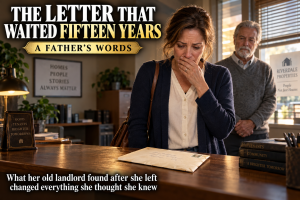
He led me to a small desk in the back. On it sat a single cream-colored envelope. The paper had yellowed slightly at the edges. My name was written across the front in dark blue ink, the letters careful and slightly slanted.
I knew the handwriting before I even touched it.
It belonged to my father.
Part 2
Mr. Harlan did not speak while I stared at the envelope. He simply stepped back and gave me space, the way people sometimes do when they sense something private is about to open.
I picked it up. The paper felt thicker than modern envelopes, the kind that used to come in boxes of matching stationery. The flap was still sealed. No one had tried to open it. My name was written the way my father always wrote it, with a small flourish on the capital C that I used to tease him about when I was a teenager.
“I found it behind the radiator,” Mr. Harlan said quietly. “It must have slipped down there somehow. The new tenants only noticed the heat wasn’t reaching the far side of the room. When I pulled the cover off, there it was.”
I turned the envelope over in my hands. No return address. No postmark. Just my name and the old apartment number, written as if he had planned to leave it for me in person.
“I didn’t open it,” he added. “Didn’t feel right.”
I thanked him. My voice sounded thinner than usual. He nodded and told me to take my time. Then he stepped into the front room and left me alone with the letter.
I sat in the chair across from the desk and held the envelope for a long while before I did anything else. Fifteen years. My father had been gone for twelve of them. A sudden heart attack in the early morning while my mother was still asleep. We had all gathered at the hospital too late. There had been no final conversation, no last advice, no quiet moment to say the things that never quite got said while he was alive.
And now this.
I thought about the last time I had seen him in that apartment. He had come by to help me move a heavy bookshelf. He had complained about the stairs and then stayed for coffee, sitting at my small kitchen table and asking about my job, my friends, whether I was sleeping enough. Ordinary things. The kind of conversation that feels unremarkable until it becomes the last one you remember clearly.
I slid my finger under the flap. The seal gave way with a soft tear. Inside was a single sheet of the same cream paper, folded once. I unfolded it carefully.
The date at the top was from the month before I moved out.
Claire,
I keep meaning to say this in person, but the words never come out the way I want them to. So I’m writing them down instead.
I know things have been hard between us these last couple of years. I know I haven’t always known how to talk to you the way a father should. Your mother says I get quiet when I should speak, and speak when I should listen. She’s probably right.
There’s something I’ve carried for a long time. Something I should have told you when you were younger. I kept thinking there would be a better time. There never is.
I’m leaving this letter here because I don’t trust myself to hand it to you directly. If you find it after you’ve moved, then maybe that’s how it was meant to be. If you never find it, then perhaps some things are better left unsaid. But I hope you find it.
I love you. That part has never been complicated.
Dad
I read it twice. Then a third time. The handwriting was steady. No shaky lines. No sense of urgency. Just the careful script of a man who had taken his time choosing each sentence.
There was no second page. No explanation of the “something” he had carried. The letter ended there, as if he had planned to continue and then decided the rest could wait for another day that never came.
I sat in the quiet office and felt the weight of the paper in my hands. Outside, a car passed on the street. Somewhere in the building a phone rang once and stopped. Mr. Harlan did not come back in. He was giving me privacy, and I was grateful for it.
I folded the letter again and slipped it back into the envelope. Then I stood, walked to the front, and thanked him. He only nodded and said if I ever needed anything to let him know. I left the office with the envelope pressed flat against my bag and the afternoon light feeling suddenly too bright.
In the car I sat for several minutes before starting the engine. The letter rested on the passenger seat. I kept glancing at it as if it might say something different the next time I looked.
That evening I called Lena again. She answered on the second ring.
“It was from Dad,” I said.
She was quiet for a moment. “What did it say?”
I read it to her over the phone. When I finished she didn’t speak right away.
“That’s all?” she asked finally.
“That’s all.”
“He started something and never finished it.”
“Yes.”
Neither of us said the obvious thing. That whatever he had meant to tell me had died with him. That the letter was both a gift and a locked door.
Lena asked if I wanted her to come over. I said not yet. I needed to sit with it first. After we hung up I placed the envelope on the kitchen table and looked at it while the light faded outside the window. The house felt larger than usual. Emptier.
I thought about the years after he died, how my mother had gone through his papers and found nothing unexpected. How we had sorted his clothes and his tools and the small wooden box of photographs he kept in the top drawer of his desk. No unfinished letters. No hidden notes. Nothing that suggested he had been carrying a secret he meant to share.
And yet here it was. Waiting behind a radiator for fifteen years.
I made tea I didn’t drink and sat at the table until the sky turned fully dark. The letter stayed where I had left it. I did not open it again that night. I already knew what it said. What it did not say was the part that kept me awake.
Part 3
The next morning I woke earlier than usual. The envelope was still on the kitchen table, exactly where I had left it. I made coffee and stood at the counter looking at it while the machine finished its cycle. The ordinary sounds of the house—the refrigerator humming, a bird somewhere outside—felt strangely loud against the quiet the letter had brought with it.
I called my mother after breakfast. She answered from the garden; I could hear the faint sound of shears in the background.
“I need to tell you something,” I said.
She set the shears down. I could picture her wiping her hands on the old apron she always wore when she worked outside. I told her about the call from Mr. Harlan, the envelope, the letter. I read it to her the same way I had read it to Lena. When I finished she was silent for a long time.
“He never mentioned writing anything like that,” she said at last. “Not to me.”
“Do you know what he might have meant? The something he carried?”
Another pause. “Your father kept things close. You know that. He wasn’t one for long talks about feelings. But a secret? I don’t know, Claire. I really don’t.”
I asked if she still had any of his old notebooks or papers. She said most of them had been donated or thrown out years ago, but she would look through the few boxes that remained in the attic. She promised to call if she found anything.
After we hung up I sat with the letter again. I noticed small details I had missed the first times. The way the ink had bled slightly on one word. The faint crease near the bottom where the paper had been folded and unfolded, perhaps more than once, before it was sealed. Had he written it and then changed his mind about leaving it? Had he meant to come back for it and never did?
I drove to the old apartment building that afternoon. I didn’t go inside. I just parked across the street and looked up at the second-floor windows. Someone had put up new curtains. A child’s bicycle leaned against the railing of the shared porch. Life had continued there without any knowledge of the letter waiting behind the radiator.
Mr. Harlan saw me from the sidewalk and walked over. He asked if everything was all right. I told him I was fine, that I was just remembering the place. He nodded as if he understood more than I had said.
“Your father used to come by sometimes,” he said after a moment. “When you still lived here. He’d bring tools if something needed fixing. Quiet man. Always polite.”
I hadn’t known that. Or maybe I had and simply forgotten. My father had a way of showing up and helping without making a production of it. He never announced his visits in advance. He just appeared with a toolbox or a bag of groceries and asked what needed doing.
“Did he ever say anything about a letter?” I asked.
Mr. Harlan shook his head. “Not that I recall. He mostly talked about the weather or the building. Once he asked if the radiators still made that noise at night. I told him they did.”
I thanked him again and drove home. The conversation stayed with me. My father had been in that apartment more than I remembered. He had known the radiators. He had known the layout of the rooms. Leaving a letter there would not have been difficult.
That evening Lena came over with takeout and a bottle of wine neither of us really wanted. We sat at the kitchen table with the envelope between us. She read the letter herself this time, slowly, then set it down.
“He was trying,” she said. “That’s something.”
“Trying to say what, though?”
She didn’t have an answer. We talked in circles for a while, the way families do when the past suddenly shifts under their feet. We remembered the arguments he and I used to have when I was in my early twenties—about money, about independence, about the way he worried without ever quite saying he was worried. We remembered the quieter years after that, when the sharp edges had softened but the distance had remained.
“Do you think Mom knows more than she’s saying?” Lena asked.
I considered it. Our mother was not a secretive person. She answered questions directly and expected the same in return. If she had known something important, I believed she would have told us after he died. But people sometimes protect the living from the dead in ways that only make sense later.
“I don’t think so,” I said. “But I’m going to keep asking.”
After Lena left I placed the letter in a drawer in my desk, the same drawer where I kept old photographs and the few cards my father had sent over the years. I did not seal the envelope again. I left it open so I could take the page out whenever I needed to see the words. The unfinished sentence stayed with me through the next several days, a quiet presence in the house that I could not ignore.
I began to notice small things I had not thought about in years. The way my father used to pause before answering certain questions. The times he would change the subject when conversations drifted toward his own childhood or the years before he married my mother. I had always assumed those pauses were simply his nature. Now I wondered if they had been something else.
The letter had not given me answers. It had only given me a new set of questions, and those questions were beginning to rearrange the past I thought I knew.
Part 4
A week after I received the letter, my mother called. She had gone through the attic boxes. Most of what remained were tax records, old appliance manuals, and a few folders of photographs. Nothing that resembled an unfinished confession. She did find one small notebook with a few pages of my father’s handwriting—lists of things to fix around the house, a note about a doctor’s appointment, the name of a hardware store. Ordinary life, recorded in fragments.
“I’m sorry, Claire,” she said. “If there was more, it’s gone.”
I told her it was all right. I did not entirely believe myself.
That same week I contacted the lawyer who had handled my father’s estate. He was retired now, but his son had taken over the practice and still had the old files. I made an appointment and drove to the office on a rainy Thursday. The young man was polite and efficient. He pulled the file and let me look through it in a quiet conference room.
There was nothing unusual. A will that divided everything evenly between my mother, Lena, and me. Bank statements. The deed to the house. A life insurance policy that had been modest but helpful. No sealed envelopes. No letters marked “to be opened later.” The lawyer’s notes from the meetings with my father were brief and practical. My father had been clear about what he wanted. He had not mentioned any personal messages he intended to leave behind.
I left the office feeling both relieved and disappointed. Part of me had hoped for a second letter, something the lawyer had been instructed to deliver after a certain number of years. There was nothing.
On the drive home I took a longer route, the one that passed the cemetery where my father was buried. I had not been there in months. The grass around the headstone was neatly trimmed. Someone—probably my mother—had left a small arrangement of white flowers that were beginning to fade. I stood for a while with my hands in my coat pockets and looked at his name carved in the stone.
“What were you trying to tell me?” I asked aloud.
The wind moved through the trees. No answer came, of course. I stayed until the rain started again, then walked back to the car.
That night I took the letter out of the drawer and read it once more. The words had not changed. The silence at the end of the page felt heavier each time. I began to write down everything I could remember about the months before I moved out of the Maple Street apartment. Conversations. Visits. Arguments. The day he helped me with the bookshelf. The coffee at the kitchen table. I tried to recall if he had seemed different, more distracted, more careful with his words. Nothing stood out. He had been himself—quiet, practical, occasionally wry.
I called an old friend from that time in my life, a woman named Rachel who had lived in the building across the street. We had lost touch years earlier, but I found her number through a mutual acquaintance. She remembered my father vaguely. She remembered that he sometimes fixed things for other tenants if Mr. Harlan was busy. She did not remember any particular conversation or mood.
“He seemed like a good dad,” she said. “Quiet, but present.”
Present. The word stayed with me after we hung up. He had been present in the ways that mattered to him—showing up, helping, making sure the bills were paid and the car had gas. He had been less present in the ways that required him to speak about the things that hurt or confused him. The letter was the closest he had come to crossing that line, and even then he had left the most important part unwritten.
I started keeping a small notebook of my own. Not a diary exactly, more a collection of questions and half-memories. I wrote down the names of people who had known him well—old coworkers, a cousin on his side of the family I had not spoken to in years, the man who used to cut his hair. I did not know yet if I would contact any of them. I only knew that the letter had made the past feel unfinished, and I was not ready to leave it that way.
Lena noticed the change in me before I said anything. One evening she stopped by unannounced with a bag of groceries and the excuse that she had bought too much.
“You’re looking for something,” she said while we put the food away. “I can tell.”
“I’m trying to understand what he left out.”
She leaned against the counter. “Maybe he left it out on purpose. Maybe he decided some things were better not said.”
“Then why write the letter at all?”
She had no answer for that. Neither did I. We ate dinner together and talked about other things—her work, a movie she had seen, the way the seasons were changing. But the letter remained in the room with us, an invisible third presence that neither of us could ignore for long.
Before she left, Lena hugged me longer than usual.
“Just don’t let this take over,” she said. “Dad loved us. That part was never in question.”
I knew she was right. The letter itself had said as much. But love and honesty are not always the same thing, and the gap between them was what kept me awake at night.
Part 5
Two weeks after the letter arrived, I decided to visit my father’s oldest friend. His name was Ray, and he had worked with my father at the same manufacturing plant for nearly thirty years. They had retired within months of each other. Ray lived alone now in a small house on the edge of town, the kind of place where the lawn was always cut and the porch light stayed on after dark.
I called first. He sounded surprised but pleased to hear from me. When I arrived he had coffee ready and a plate of store-bought cookies on the kitchen table. We sat across from each other and talked for a while about ordinary things—the weather, the plant closing years earlier, how the neighborhood had changed. Then I told him about the letter.
Ray listened carefully. When I finished he leaned back in his chair and looked at the ceiling for a moment.
“Your dad was a private man,” he said. “Even with me. We talked about work, about tools, about the games on Sunday. Not much about the inside of things.”
“Did he ever mention anything he was carrying? Something he wished he’d said?”
Ray was quiet longer this time. “There was a stretch, maybe twenty years ago, when he got real quiet for a while. Not depressed exactly. Just… turned inward. I asked him once if everything was all right at home. He said it was. I didn’t push.”
Twenty years ago would have been around the time I was finishing high school, beginning college. I tried to remember if anything significant had happened then. My parents’ marriage had always seemed steady. There had been no obvious crisis.
“Did he ever talk about his own family?” I asked. “His parents, or growing up?”
Ray shook his head. “Not really. I knew his father had passed when he was young. His mother remarried. Beyond that, he kept it close.”
I stayed another hour. Ray showed me a few old photographs from the plant—my father in work clothes, smiling at something off-camera. In every picture he looked like the man I remembered: solid, capable, a little reserved even when he was among friends. I left with no new answers, only the confirmation that the silence in the letter was consistent with the way he had lived.
On the way home I stopped at the public library and asked if they still kept old local newspapers on microfilm. A librarian helped me find the years around my father’s early adulthood. I did not know what I was looking for. Birth announcements. Obituaries. Police reports. Anything that might explain a long-carried weight. I found his wedding announcement, a short paragraph with my mother’s name and the date. I found a brief mention of him in a company newsletter years later when he received a safety award. Nothing else.
The search felt both necessary and slightly foolish. I was chasing a sentence that had never been written. Yet the letter had made the absence of that sentence impossible to ignore.
That weekend my mother invited Lena and me for Sunday dinner, the way she still did every few weeks. The table was set with the same plates we had used growing up. The roast tasted the way it always had. For a while the conversation stayed light—neighbors, a book club my mother had joined, Lena’s latest project at work. Then, over dessert, my mother set her fork down and looked at me.
“I’ve been thinking about that letter,” she said. “About what he might have meant.”
Lena and I both waited.
“There was a time,” she continued, “early in our marriage, when your father went back to his hometown for a few days. His mother was ill. When he came home he was different for a while. Quieter than usual. I asked him about it. He said some things from the past had come up and he needed time to sort them. He never told me what they were. After a few months he seemed more like himself again. I stopped asking.”
I felt something shift in my chest. “Did he ever go back again?”
“Not that I know of. His mother passed not long after that visit. The stepfather had already died. There was no one left there.”
“Do you remember the name of the town?”
She did. A small place two hours north, the kind of town people left and rarely returned to. I wrote it down. After dinner, while Lena helped with the dishes, I stood in the living room and looked at the photographs on the mantel. My father in his thirties, holding me as a baby. My father at a family picnic, slightly apart from the group, watching. My father on the day I graduated, proud and a little awkward in a suit he did not wear often.
The letter had opened a door I had not known was there. Behind it was a version of my father I had never met—the young man who had gone home to care for his mother and returned carrying something he never fully set down.
I did not know yet whether that something still mattered. I only knew I needed to find out.
Part 6
The following Saturday I drove north. The town was smaller than I expected, a main street with a handful of shops, a post office, a diner that looked as if it had not changed its menu in decades. I parked near the library and went inside. The librarian was a woman in her sixties with reading glasses on a chain. When I explained what I was looking for—records related to my father’s family—she nodded as if she had heard similar requests before.
“We keep local obituaries and some old school records,” she said. “Property records are at the county office a few blocks over.”
I spent the morning with microfilm and yellowed binders. My father’s name appeared in a high school yearbook from the late 1950s. He looked young and serious, already wearing the closed expression I recognized. His mother’s obituary was brief. She had been a widow twice over. There was no mention of other children. The stepfather’s name appeared in an earlier notice. Nothing suggested scandal or tragedy beyond the ordinary losses of a small life.
At the county office I requested property records for the address my mother had remembered. The house had been sold decades earlier. The clerk printed what she could find. The chain of ownership was short and unremarkable.
I ate lunch at the diner. The waitress called everyone “hon” and refilled coffee without being asked. I sat in a booth by the window and looked at the papers I had gathered. They told me almost nothing. If my father had carried a secret from this place, it had not left a public trace.
Before leaving I walked the residential streets near the old address. The house was still standing, a modest white place with a porch that sagged slightly on one side. A child’s swing set stood in the side yard. Life had continued here the same way it had continued in the apartment on Maple Street. I did not knock. There was no one left who would remember the boy my father had been.
On the drive home the sky turned the color of old metal. I kept thinking about the letter and the way it ended. He had wanted to tell me something. He had chosen the safest possible way to begin—writing the words down and leaving them where I might or might not find them. Then life had intervened. The move. The years. The sudden heart attack. The letter had waited in the dark behind a radiator while the rest of us went on without knowing it existed.
That night I sat at my desk and wrote a letter of my own. Not to send. Just to put the questions somewhere outside my head.
Dad,
I found what you left. I wish you had finished it. I wish you had handed it to me yourself. I keep trying to guess what you were going to say, and every guess feels both possible and wrong. If you were still here I would ask you directly. Since you’re not, I’m left with the silence at the end of the page.
I love you too. That part was never complicated either.
Claire
I folded the page and placed it in the same drawer as his letter. Two unfinished conversations, side by side.
In the days that followed I returned to ordinary routines. Work. Grocery shopping. Calls with Lena. Dinner with my mother. The letter remained present but no longer consumed every hour. I had gone as far as the available records would take me. Whatever my father had meant to say, he had taken the rest of it with him.
And yet the story did not feel finished. Not completely.
One evening, while looking through a box of old cards I had kept from various birthdays and holidays, I found a short note my father had written me the year before he died. It was ordinary—happy birthday, proud of you, love Dad. But the handwriting matched the letter exactly. Seeing the two side by side made the years between them feel thinner than they were.
I called Lena and told her about the trip north. She listened without judgment.
“Maybe the point isn’t the secret,” she said. “Maybe the point is that he tried to reach you the only way he knew how.”
I wanted to believe that. Part of me did. Another part still felt the pull of the unfinished sentence, the sense that something important had been left on the other side of a door I could not open.
I did not know then that the door was about to open from the other side.
Part 7
The call came on a Wednesday morning from a number I did not recognize. When I answered, a woman’s voice introduced herself as Helen Morrow. She said she had been a neighbor of my father’s family many years ago in the town I had just visited. The librarian had mentioned my inquiry to her, and Helen had asked for my number.
“I don’t know if this will matter,” she said, “but I remember your father. And I remember something that happened the summer before he left for good.”
I sat down.
Helen was in her eighties now, her voice thin but clear. She told me she had lived two houses down from my father’s childhood home. She remembered his mother as a quiet, hardworking woman. She remembered the stepfather as a man who drank more than he should and whose temper was known on the block.
“There was a night,” Helen said, “when things got loud. I don’t know the details. I only know that the next morning your father—he was maybe sixteen—was sitting on the front steps with a suitcase. His face was bruised. He left that day and didn’t come back for a long time.”
I felt the room tilt slightly.
“Did anyone call the police?” I asked.
“In those days people didn’t always. The mother asked us not to. She said it was a family matter. Your father went to live with an aunt in another town for a while. When he came back he was different. Quieter. He finished school and left again as soon as he could.”
Helen did not know what had been said or done that night. She only knew the shape of it—the raised voices, the suitcase, the boy who never quite looked people in the eye afterward.
“I thought you should know,” she said. “In case it helps explain anything.”
After we hung up I sat very still. The letter’s unfinished sentence suddenly had a possible shape. A young man carrying the memory of a violent home, of a mother who asked neighbors to look away, of a decision to leave and never fully return. A man who had built a careful, steady life afterward and still, decades later, felt the need to tell his daughter something about the weight he had carried.
I did not know if that was the secret. It felt possible. It felt like the kind of thing a man like my father would keep close, not out of shame exactly, but out of a desire to protect the life he had made from the life he had escaped.
I called my mother and told her what Helen had said. She was quiet for a long time.
“He never spoke of anything like that,” she said. “Not once. But it would explain the way he was when he came back from that last visit. The way he seemed to be sorting something private.”
Lena came over that evening. We sat with the letter between us again and tried to fit Helen’s story into the silence my father had left. It did not fill the silence completely. It only gave it a possible outline.
“Do you think that’s what he wanted to tell you?” Lena asked.
“I think it might be part of it,” I said. “Or maybe he wanted to tell me that the past doesn’t have to decide who you become. Or maybe he just wanted me to know he had been afraid once, the way everyone is afraid sometimes.”
We would never know the exact words he had intended to write. That was the hard truth of the letter. It had opened a door and then refused to walk through it.
In the weeks that followed I found myself thinking less about the missing sentences and more about the ones that were there. I love you. That part has never been complicated. He had managed to say the most important thing, even if he left the rest unfinished. Perhaps that was the real gift of the letter—not the secret he never told, but the reminder that love can exist alongside silence, alongside unfinished business, alongside the things we never quite find the courage to say out loud.
I returned the envelope to the drawer, but I no longer felt the same urgency to solve it. The questions remained, but they had softened. They had become part of the larger story of who my father had been, rather than a puzzle that demanded a single answer.
Life continued. Work deadlines. Family dinners. The ordinary rhythm of days. The letter stayed where it was, a quiet presence rather than a constant demand. I had gone looking for a revelation. What I found instead was a fuller picture of a man who had tried, in his own imperfect way, to reach across the distance between us.
And then, one ordinary afternoon, something else arrived.
Part 8
The package came in the regular mail, a small padded envelope with no return address. Inside was a second letter, written on the same cream stationery, and a short note from Mr. Harlan.
Claire,
I found this last week when we were clearing out the storage closet in the basement of the building. It was in a box of old tenant files that should have been shredded years ago. Your name was on it. I thought you should have it. I’m sorry it took so long.
—Harlan
My hands were not steady as I opened the second envelope. The paper was the same. The handwriting was the same. The date was three days after the first letter.
Claire,
I wrote you yesterday and left the letter behind the radiator because I lost my nerve. I’ve been sitting with it ever since. If you’re reading this, then somehow both letters found their way to you. I hope that’s true.
The thing I’ve carried is simple and complicated at the same time. When I was sixteen I left home because staying had become dangerous. My stepfather had a temper that got worse when he drank. One night it turned on me. My mother asked me not to make trouble. I left with a suitcase and a bruised face and the knowledge that some homes are not safe to stay in.
I never told your mother the whole of it. I never told anyone. I built a different life and tried to be a different kind of man. Most days I think I managed it. But the boy who sat on those steps with a suitcase never completely left me. I wanted you to know that the quiet in me was not distance from you. It was the habit of a person who learned early to keep certain things inside.
I should have said this years ago. I should have said it in person. I’m saying it now the only way I seem able to. If you find these letters after I’m gone, I hope they help you understand me a little better. If they only confuse you, then I’m sorry for that too.
You have always been stronger than I was at your age. You ask the questions I learned not to ask. Keep doing that.
I love you. Still the simplest true thing I know.
Dad
I read the second letter standing in my kitchen with the afternoon light coming through the window. When I finished I sat down hard on the nearest chair. The silence that had lived inside the first letter was no longer empty. It had a shape now. A history. A reason.
I called Lena first. Then my mother. We gathered that evening at my mother’s house, the three of us around the same table where we had shared so many ordinary meals. I read both letters aloud. No one spoke for a long time after I finished.
My mother wiped her eyes. “He carried that alone,” she said. “All those years.”
Lena reached across the table and took my hand. “He wanted you to know. He just didn’t know how to say it while he was alive.”
We talked late into the night. We talked about the version of our father we had known and the version we were only now meeting. We talked about the courage it must have taken for a sixteen-year-old to leave, and the quieter courage it took to build a life afterward without letting the old fear define it. We talked about the ways silence can be both protection and prison.
I slept at my mother’s house that night in the room that had once been mine. In the morning the three of us walked to the cemetery together. We stood at the headstone and I read the second letter again, softly, as if he could still hear it. Then we left the copies of both letters in a waterproof sleeve at the base of the stone, not because we believed in such gestures in any literal way, but because it felt right to return the words to him somehow.
On the way home I felt something I had not expected. Not closure exactly. Something quieter. A settling. The unfinished sentence had been finished. The door had opened all the way. What lay on the other side was not a dramatic revelation but a human one—a father who had been a frightened boy, who had survived, who had loved his children with the tools he had, and who had finally found a way to tell the truth even if it took fifteen years and two letters and a landlord’s careful hands to deliver it.
Part 9
In the months that followed, the letters became part of the family’s shared language. We did not speak of them constantly, but they were there when we needed them. My mother began to tell small stories she had never told before—about the early years of the marriage, about the ways my father had shown care without words. Lena and I found ourselves remembering him with less frustration and more tenderness. The quiet that had once felt like distance now felt like the residue of an old survival strategy.
I kept both letters in the drawer, but I no longer needed to read them every day. Their presence was enough. Occasionally I would take them out and hold the pages, not to search for new meaning but simply to remember the feeling of finally understanding something that had always been just out of reach.
Mr. Harlan called once more, several weeks after the second letter arrived. He asked how I was. I told him the truth—that the letters had given me a fuller picture of my father and that I was grateful he had kept them safe. He seemed pleased. He said the building was being sold and he was retiring at last. I wished him well. Before we hung up he added, almost as an afterthought, that he had always liked my father. “Quiet man,” he said. “But solid. You could tell he thought carefully about things.”
I thought about that description often. Solid. Careful. A man who had learned early that some truths were dangerous to speak aloud, and who had spent the rest of his life trying to live in a way that made speaking them less necessary. In the end he had spoken them anyway. Not perfectly. Not in person. But completely enough.
That autumn I drove north one more time. I parked near the old house and walked the same streets Helen had described. I did not expect to feel anything dramatic. I only wanted to stand in the place where the boy with the suitcase had once sat and acknowledge that the story had traveled all the way to me. The porch was still sagging. The swing set was gone. A different family lived there now. I stayed only a few minutes, then turned back toward the car.
On the drive home I thought about the long chain of small decisions that had brought the letters to me. My father choosing to write them. Choosing to leave the first one behind the radiator. Choosing to write the second one after all. Mr. Harlan finding the first letter fifteen years later and refusing to mail it because it felt too important. Finding the second letter in a forgotten box and sending it on. Helen hearing about my inquiry and deciding to call. Each of those moments could have gone differently. Any one of them might have kept the truth from reaching me. Instead they had aligned, slowly and imperfectly, until the story was complete.
I did not believe in fate, exactly. But I believed in the stubborn persistence of certain truths. They wait. They find a way.
When I got home that evening I took both letters out and read them one last time in full. Then I placed them back in the drawer beside the note I had written to my father months earlier. Three pieces of paper. Two voices. One conversation that had finally reached its end.
I made dinner. I called Lena to tell her about the drive. I sat by the window as the light faded and felt, for the first time since the original phone call, a quiet that was not restless. The questions had been answered as fully as they ever would be. What remained was the simpler truth my father had managed to write twice: that love, at least, had never been complicated.
I carried that with me into the ordinary days that followed. It did not erase the years of distance or the things left unsaid while he was alive. It did not need to. It only made the distance more understandable, and the love more visible.
The story of the letters had become part of the larger story of our family—a late chapter, unexpected, but no less true for arriving after the man who wrote them was gone.
Part 10
A year after the second letter arrived, I stood in my kitchen on a quiet Sunday morning and realized I had not thought about the envelopes for several weeks. The realization surprised me. For so long they had occupied a central place in my mind. Now they had settled into the background the way true things sometimes do—no longer urgent, but still present, like the sound of a familiar house at night.
I took them out anyway. The paper had softened slightly with handling. The ink was unchanged. I read both letters once more, not searching this time, only listening. When I finished I folded them carefully and returned them to the drawer. Then I did something I had not planned. I took out a fresh sheet of paper and wrote a third letter, this one from me.
Dad,
I found both of your letters. It took a while, and a few people who didn’t have to help but did. I know now what you were trying to say. I wish you had been able to say it while we could still talk about it. But I’m glad you said it at all.
I’ve thought a lot about the boy on the steps with the suitcase. I’ve thought about the man who built a different life afterward. I’ve thought about the father who showed up with tools and stayed for coffee and never quite knew how to cross the last distance between us with words. All of those people were you. Knowing the first one helps me understand the others.
You were right about one thing. Love was never the complicated part. I’m still learning how to live with the rest—the silences, the things we carry, the sentences we leave unfinished. But I carry your letters now the way you carried that old story. Not as a weight. As a reminder that even quiet people leave true things behind if we know how to look for them.
Thank you for trying. Thank you for the second letter especially. I read it when I need to remember that understanding can arrive late and still matter.
I love you.
Claire
I did not leave this letter behind a radiator. I placed it in the drawer with the others and closed it gently. The conversation was complete in the only way it could be.
Later that day I drove to my mother’s house. Lena was already there. We spent the afternoon in the garden, the three of us, talking about nothing urgent. The light was soft. The air smelled of cut grass and the last of the summer flowers. At one point my mother looked at me and said, “He would have been glad you know. Even if it took this long.”
I believed her.
That evening, after Lena and I had gone home to our own lives, I sat by the window of my house and watched the sky darken. The phone did not ring. No new letters arrived. The ordinary world continued, as it always does. But something in me had settled into a different shape—less searching, more accepting. The past had given what it could. The rest belonged to the living.
I thought about Mr. Harlan, now retired, and hoped his days were quiet and kind. I thought about Helen Morrow, who had chosen to speak when she did not have to. I thought about the long chain of small mercies that had carried my father’s words across fifteen years and into my hands. Gratitude, I had learned, could be as complicated and as simple as love.
In the years that followed, the letters remained in the drawer. I did not need to read them often. Their work was done. Occasionally, when someone asked about my father, I would tell the story of the phone call and the two envelopes and the truth that arrived late. People usually listened with a kind of quiet attention. Everyone, it seemed, carried something unfinished. Everyone understood the relief of finally setting it down.
I still live in the same house. The laundry still needs folding. The phone still rings with ordinary calls. But every so often, when the light falls a certain way across the kitchen table, I remember the afternoon I first held the unopened envelope and felt the past shift under my feet. I remember the second letter that completed the first. I remember the long drive north and the porch where a frightened boy once sat with a suitcase. And I remember the simplest true thing my father ever wrote, the sentence that needed no unfinished ending:
I love you. That part has never been complicated.
It still isn’t.