A stranger walked up to me in a coffee shop and knew my wedding date before I ever spoke. She placed an old photograph in my hands and told me to ask my fiancé one quiet question. The answer changed the way I saw the man I was about to marry.
Part 1
The coffee shop smelled like roasted beans and warm sugar the morning everything shifted. I sat by the window with my usual order, a flat white cooling beside an open notebook where I had been crossing off final wedding details. October 14 was only six weeks away. The invitations had already gone out. The florist had confirmed the peonies. My mother kept texting me about the seating chart as if the arrangement of cousins could somehow guarantee a perfect day.
I was not thinking about secrets. I was thinking about whether the string quartet needed a second song for the processional and whether my future mother-in-law would accept that we were serving both chicken and a vegetarian option. Ordinary worries. Comfortable ones.
A woman stopped beside my table. She was older than me, maybe early fifties, with neat gray streaks in dark hair pulled back in a low knot. She wore a simple navy coat and carried a small leather bag that looked well used. She did not smile right away. She simply stood there until I looked up.
“Excuse me,” she said. Her voice was calm, almost careful. “Are you getting married on October 14?”
I blinked. The question felt strangely intimate coming from a stranger. “I’m sorry?”
“October 14,” she repeated. “Is that your wedding date?”
It was. Exactly. I had not posted the date publicly yet beyond the private invitation group. My social media still only showed engagement photos from the spring. A small spike of unease moved through me.
“Yes,” I said slowly. “How did you know that?”
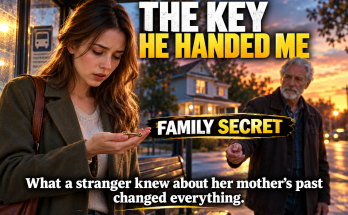
She did not answer at once. Instead she reached into her bag and withdrew a single photograph, slightly faded at the edges, the kind that had once been printed from a lab rather than a phone. She held it out.
I took it without thinking.
The image showed my fiancé, Daniel, standing on the steps of a courthouse. He looked younger, his hair a little longer, wearing a dark jacket I did not recognize. The date stamp in the corner read five years earlier. He was not alone in the frame, though the other figure stood partially turned away, face unclear.
I stared at the photograph for several seconds. The coffee shop noise faded. My pulse felt suddenly loud in my ears.
“I don’t understand,” I said. “Where did you get this?”
“I saw your name on an old document,” the woman replied. “Then I found this.”
“What document?”
She shook her head once. “That’s not important right now.”
I looked up at her. “Why was he there? What is this?”
The woman met my eyes. There was no triumph in her expression, only a kind of quiet gravity. “I can’t tell you that. You need to ask him yourself.”
“Ask him what?”
She hesitated, then spoke the words that lodged themselves under my ribs. “Ask him who was with him that day.”
Before I could form another question she stepped back, gave a small nod, and walked out of the coffee shop. The bell above the door chimed once. I sat frozen, the photograph still in my hands, the date of our wedding suddenly feeling less like a celebration and more like a deadline I no longer fully understood.
I turned the photo over. Nothing was written on the back. No names. No explanation. Only the image of the man I loved standing outside a courthouse five years before we met, and the quiet instruction to ask a question I had never thought to ask.
My phone buzzed on the table. A message from Daniel: Thinking about you. Lunch today if you’re free?
I stared at the screen, then at the photograph, then back at the screen. The ordinary morning had split open. I did not yet know how wide the opening would become.
I slipped the photograph into my notebook and closed the cover. Outside the window people walked past with shopping bags and coffee cups of their own, living lives that still made sense. Mine no longer did.
I stayed at the table a long time after the stranger left. The flat white went cold. The notebook stayed closed. Somewhere in the city Daniel was working, believing the day was ordinary. I had no idea yet what I would say when I saw him. I only knew that the question the woman had given me would not stay quiet.
Part 2
I did not go to lunch with Daniel that day. I sent a short message that a last-minute work call had come up, then sat in my apartment with the photograph lying face up on the kitchen counter. Every time I passed it I felt the same tight pull in my chest.
Daniel and I had met three years earlier at a mutual friend’s birthday dinner. He was steady, thoughtful, the kind of man who remembered how I took my coffee and who always called when he said he would. He had told me about his past in what felt like complete pieces: a serious relationship in his mid-twenties that ended cleanly, a few years of focusing on work, then us. No children. No previous marriages. Nothing that required a courthouse visit five years ago.
Or so I had believed.
I spent the afternoon searching every public record I could find online. Courthouse databases. Old news archives. Anything that might link his name to a legal proceeding around that date. Most of it was behind paywalls or required more information than I had. I found nothing useful. Only the photograph remained, silent and stubborn.
That evening he came over after work the way he often did. He kissed my cheek, asked about my day, and began unpacking the takeout he had brought. I watched him move around my kitchen with the ease of someone who belonged there. The photograph stayed hidden in the notebook on the shelf.
“You seem quiet,” he said after a while. “Everything okay?”
“Just tired,” I answered. The lie tasted thin.
We ate on the couch. He talked about a project at the architecture firm where he worked, about a difficult client, about a possible weekend trip after the wedding. I nodded at the right moments and felt the distance growing between the man in front of me and the man in the photograph.
Later, when he was washing the dishes, I stood in the doorway and studied the back of his head, the way his shoulders moved. Five years earlier he had stood on those courthouse steps. Someone had been with him. The stranger had known my wedding date. None of it fit the life we had built.
I almost asked him then. The words rose and fell back. I told myself I needed more than a photograph and a stranger’s warning. I needed to be sure of what I was asking before I risked the shape of everything.
After he left I took the photograph out again. I held it under the kitchen light and tried to make out the second figure. A shoulder. The edge of a coat. Hair that might have been dark. Nothing clear enough to identify. The more I looked the more the image seemed to withhold itself on purpose.
Sleep came late and uneven. I dreamed of walking into a courthouse I had never seen, of hearing my name called from a room I could not enter. When I woke the photograph was still on the nightstand where I had left it, waiting.
The next morning I called my closest friend, Mara. We met at a different coffee shop, one where the stranger would not find me. I showed her the photograph and told her everything the woman had said.
Mara studied the image for a long time. “This is strange,” she said. “Really strange. Have you asked him?”
“Not yet.”
“Why not?”
“Because once I ask, I can’t take the question back. And I don’t know what the answer will do to us.”
Mara set the photograph down carefully. “You already know you have to ask. The longer you wait the worse it will feel.”
She was right. I knew she was right. Still I drove home with the photograph in my bag and the question unasked. Daniel texted that evening about a dinner reservation he wanted to make for the following week. I replied with a heart emoji and felt dishonest doing it.
Two more days passed in the same careful silence. I went to work. I answered wedding emails. I smiled when people asked how the planning was going. Inside, the photograph had become a third presence in every room I entered. It waited. I waited. Something would have to break.
On the third night Daniel stayed over. We watched a movie neither of us was really watching. When the credits rolled he turned to me and said, “You’ve been somewhere else all week. Talk to me.”
I looked at him. The moment stretched. The stranger’s words echoed. Ask him who was with him that day.
I reached for the notebook on the side table, opened it, and took out the photograph. I placed it in his hand without speaking.
His face changed the instant he saw it. The color left his cheeks. His fingers tightened on the edge of the paper. For several seconds he said nothing at all. Then he looked up at me, and the quiet life we had shared felt suddenly fragile.
“Where did you get this?” he asked.
The question hung between us. I had finally crossed the line. There was no going back to the morning before the stranger appeared.
Part 3
Daniel turned the photograph over, then back again, as if the blank side might offer an explanation the image refused to give. The living room felt smaller. The television screen still glowed with the streaming service menu, forgotten.
“A woman gave it to me,” I said. “At a coffee shop. She knew our wedding date. She said she had seen my name on an old document. Then she handed me this and told me to ask you who was with you that day.”
He closed his eyes for a moment. When he opened them the expression I knew so well—steady, open—had been replaced by something guarded and tired.
“Claire,” he said. My name sounded different in his mouth. “I need you to understand that what happened five years ago doesn’t change how I feel about you.”
“Then tell me what happened.”
He set the photograph on the coffee table between us. “I was at the courthouse because of a family matter. It was complicated. Painful. I didn’t talk about it because it belonged to a part of my life I had already closed.”
“Who was with you?”
He hesitated. The hesitation itself was an answer. Whatever he was about to say had weight.
“My sister,” he said finally. “Elena. She needed me there. It wasn’t something I could refuse.”
I studied his face. Daniel had spoken of his sister before. She lived two states away, called on birthdays, sent thoughtful gifts at Christmas. I had met her twice. She was warm, a little reserved, nothing that suggested a secret courthouse visit.
“Why would your sister need you at a courthouse?” I asked.
“Because our mother had just passed. There were papers. Decisions. Elena was the one handling most of it, but she asked me to come. I went. That’s the photograph.”
The explanation landed softly, almost reasonably. Yet the stranger’s manner, the way she had spoken, the fact that she knew my wedding date, did not fit a simple story about estate papers.
“Why would a stranger care about that?” I asked. “Why would she track me down and hand me this?”
Daniel rubbed the back of his neck. “I don’t know. Maybe she was connected to the lawyer’s office. Maybe she recognized me from somewhere. Claire, I swear to you, it was nothing that should touch our life now.”
I wanted to believe him. The part of me that loved the ordinary mornings and the shared jokes and the future we had planned reached for the simplest version. A family matter. Papers. A sister who needed support. Clean. Contained.
But the stranger had not said, Ask him about the papers. She had said, Ask him who was with him that day. The phrasing felt deliberate.
“Was anyone else there?” I asked.
“Just Elena and me. And the clerk.”
“The photograph shows someone else.”
He glanced at the image again. “That’s Elena. Her face is turned. The angle is bad.”
I looked. The figure’s height, the shape of the shoulders, the coat—none of it matched the Elena I had met. Elena was taller, thinner, usually in bright colors. The person in the photograph seemed smaller, the coat darker, the posture different.
“It doesn’t look like her,” I said quietly.
Daniel’s jaw tightened. “Photographs can be misleading. Lighting. Angle. It’s her.”
We sat in silence for a long stretch. Outside, a car passed with music playing too loud. Inside, the air felt thin.
“I need time to think,” I told him.
He nodded. He did not argue. He only said, “I’m not hiding anything that should scare you. I love you. That part is true.”
After he left I remained on the couch with the photograph. I compared it in my mind to every memory I had of Elena. The mismatch refused to resolve. Either Daniel was mistaken about the identity of the person beside him, or he was choosing not to tell me the full truth.
I did not sleep much that night. In the morning I did something I had never done before. I searched for public records using Daniel’s full name and the approximate year of the photograph. Most results were ordinary—professional listings, an old college alumni note. Then, behind a paywall I decided to open, I found a single entry that made my hands go still.
A civil filing. The names were partially redacted in the free preview, but the date aligned. The courthouse matched the one in the photograph. And one of the parties listed carried a last name I had never heard Daniel mention.
I paid the fee. The document loaded. My throat tightened as I read.
Daniel had not gone to the courthouse that day only for his sister and estate papers. He had been named in a legal proceeding involving another woman. The filing was five years old. The matter had been resolved. The other woman’s name was listed clearly.
I sat back in my chair. The stranger’s words returned with new force. Ask him who was with him that day.
I now had a name. I still did not have the full story. But the simple explanation Daniel had offered no longer held.
I closed the laptop and stared at the wall. The wedding was still weeks away. The invitations were already in people’s homes. And the man I planned to marry had stood outside a courthouse with someone whose presence he had just denied.
I picked up my phone, then set it down again. Calling him immediately felt too sharp. I needed to understand more before the next conversation. I needed to know who the woman in the filing really was, and why a stranger had decided I should find out now.
The quiet life I had trusted was unraveling one careful thread at a time.
Part 4
The name on the document was Rebecca Lang. I repeated it under my breath until it stopped sounding foreign. Rebecca Lang. Five years earlier she and Daniel had been connected by a legal filing at the same courthouse that appeared in the photograph.
I spent the next two days piecing together what I could from public sources. Rebecca had lived in the same city at the time. She worked in nonprofit administration. There were a few professional photographs online, enough to give me a sense of her face. Dark hair. Steady eyes. Nothing dramatic. Nothing that prepared me for the possibility that she might be the blurred figure standing beside Daniel on those steps.
I did not contact her. Not yet. First I needed to hear the truth from Daniel himself, without the filter of whatever story he had already chosen to tell.
We met at a park near his apartment on a weekday evening. The light was soft, the kind that usually made ordinary conversations feel gentle. This one would not be gentle.
I handed him a printed copy of the filing summary. He looked at it for a long time without speaking.
“You found this,” he said.
“Yes.”
He exhaled slowly. “I should have told you the whole thing from the beginning.”
“Then tell me now.”
He sat on the bench and rested his forearms on his knees. “Rebecca and I were together for almost two years. It ended badly. Not in a dramatic public way. Just… quietly painful. We had talked about marriage. Then she decided she didn’t want that life. Or maybe she decided she didn’t want it with me. Either way, it ended. A few months later there were some legal loose ends—shared lease, a small joint account, things that needed formal separation. The courthouse visit was for that. Elena came with me because I was in a rough place and she didn’t want me to go alone.”
I listened carefully. The explanation was fuller than the first one, but it still felt incomplete.
“The stranger said to ask who was with you that day,” I said. “Not what papers you signed.”
Daniel’s shoulders tensed. “Elena was with me. That’s the truth.”
“The person in the photograph doesn’t look like Elena.”
“I know what it looks like. The angle is bad. It’s her.”
I studied his face. He believed what he was saying, or he needed me to believe it. The difference mattered.
“Why did a stranger know my wedding date?” I asked. “Why did she care enough to find me?”
“I don’t know,” he said. “Maybe Rebecca hired someone. Maybe there’s a connection I never saw. Claire, it was five years ago. It has nothing to do with us.”
I wanted the distance of five years to be enough. I wanted the past to stay neatly closed. But the stranger had chosen the weeks before our wedding for a reason. The timing itself felt like a message.
That night I lay awake replaying every conversation Daniel and I had ever had about previous relationships. He had always been brief. Respectful of the other person’s privacy, he said. I had accepted that. Now the brevity looked different.
Two days later I received an email from an address I did not recognize. The subject line was only my first name. The body contained three short sentences.
I am the woman who gave you the photograph. You deserve the complete truth before you marry him. If you want to talk, I will meet you.
No signature. No further explanation. Only the offer.
I stared at the screen for a long time. Part of me wanted to delete it and pretend the last week had not happened. The larger part knew that ignoring the message would not return me to the version of my life that existed before the coffee shop.
I replied with a single line: When and where.
The answer came within an hour. A public library reading room the following afternoon. Neutral ground. Quiet.
I told no one. Not Mara. Not Daniel. I needed to hear whatever this woman had to say without anyone else’s interpretation layered over it.
The reading room smelled of old paper and polished wood. She was already seated when I arrived, the same navy coat folded over the back of her chair. She looked tired in a way that suggested long consideration rather than lack of sleep.
“Thank you for coming,” she said.
“Who are you?” I asked.
“My name is Helen. I used to work in the records office at the courthouse. I retired two years ago. I keep an eye on certain files because some of them never felt finished.”
“Why my wedding?”
Helen folded her hands on the table. “Because the document that carried your name was a recent addition to an older file. Someone had requested a copy of the original filing. Your name appeared on the request form as the intended recipient of certain information. When I saw the wedding date listed in a note attached to the request, I decided you should not walk into that day without knowing what the photograph shows.”
My pulse quickened. “What does it show?”
Helen reached into her bag and withdrew a second photograph, clearer than the first. In this one the second figure’s face was visible. It was not Elena. It was Rebecca Lang. She stood close to Daniel, one hand resting lightly on his arm, her expression unreadable.
“They were not there only for paperwork,” Helen said. “There was more. And the more is still relevant.”
I looked at the clearer image and felt the floor of my understanding shift again. The story Daniel had told was no longer enough. Whatever had happened on those steps five years earlier still carried weight into the present. And someone, somewhere, had decided I needed to carry it too.
Helen watched me carefully. “I will not force the rest on you. But if you want the full record, I can tell you where to look. Or you can ask him one more time, with this photograph in front of him.”
I took the second photograph. The paper felt heavier than it should have. Outside the library windows the afternoon light continued, indifferent to the quiet crisis unfolding inside the reading room.
I left without deciding which path I would take next. Both felt necessary. Neither felt safe.
Part 5
I did not confront Daniel immediately. Instead I spent the next day following the path Helen had outlined. The full civil record was available through a formal request process. I submitted the forms. While I waited for the documents to arrive I sat with the two photographs side by side and tried to reconcile the man I loved with the man standing beside Rebecca Lang on those courthouse steps.
Daniel called twice. I let both calls go to voicemail. The second message was quiet and careful. “I know you’re upset. I want to talk when you’re ready. I’m not going anywhere.”
The words should have comforted me. They only reminded me how much of our foundation now felt provisional.
Mara came over that evening. I showed her both photographs and told her what Helen had said. Mara listened without interrupting, then asked the question I had been circling.
“Do you still want to marry him?”
I did not answer right away. The truth was more complicated than a simple yes or no. I still loved the version of Daniel I had known for three years. I no longer trusted that the version was complete.
“I need the rest of the story first,” I said.
The documents arrived two days later. I opened the envelope at my kitchen table with the morning light falling across the pages. The filing concerned the formal dissolution of a shared domestic partnership and the division of certain assets. Nothing criminal. Nothing scandalous in the dramatic sense. Yet buried in the supporting statements was a detail that stopped me cold.
Rebecca Lang had been pregnant at the time of the filing. The pregnancy was noted in a medical addendum related to insurance coverage during the separation period. There was no further information about the outcome. No birth record attached. No mention of a child in the final decree.
I sat very still. The possibility opened like a door I had not known existed. Daniel had never spoken of a child. In every conversation about the future he had talked about “when we have kids” as if the idea were still entirely ahead of us.
I thought of the stranger’s instruction again. Ask him who was with him that day. Rebecca had been with him. And if the pregnancy had continued, someone else might have entered the world who still belonged, in some quiet legal or emotional way, to that day.
I called Daniel and asked him to come over. My voice stayed even. He arrived within the hour, face drawn, hands in his pockets.
I laid the documents on the table between us. “Rebecca was pregnant,” I said. “Did you know?”
His expression shifted through several emotions too quickly to name. Finally he nodded once. “Yes. I knew.”
“Is there a child?”
The silence that followed was longer than any that had come before. When he spoke his voice was lower than usual.
“There is a little girl. Her name is Sophie. She is four and a half now.”
The room seemed to tilt. I gripped the edge of the table.
“You have a daughter.”
“Yes.”
“And you never told me.”
“I didn’t know how. Rebecca and I agreed that I would not be part of Sophie’s daily life. It was her decision, and at the time I believed it was the right one. I send support. I receive photographs twice a year. I have never met her in person since she was a baby. Claire, I was going to tell you. I kept waiting for the right moment and the moments kept feeling wrong.”
I stood and walked to the window. Outside, ordinary people moved through an ordinary afternoon. Inside, the man I was six weeks from marrying had just rewritten the shape of our future.
“You were going to marry me without telling me you have a child.”
“I was afraid of losing you.”
“You might lose me anyway.”
He did not argue. He only sat at the table with the documents and the photographs and the weight of five years of silence.
I turned back to him. “Does Sophie know about you?”
“Rebecca has told her that her father lives far away and cares about her. That is all.”
“And the stranger? Helen?”
“I don’t know who she is. I never authorized anyone to contact you. If someone is trying to force this into the open now, it isn’t me.”
I believed that part. The rest of the truth was still settling into my body like cold water.
“I need you to leave,” I said. “I need time.”
He stood, hesitated, then nodded. At the door he paused. “I love you. That has never been a lie.”
After he was gone I sat on the floor with my back against the cabinet and cried without sound. The tears were not only for the secret. They were for the version of our life that had just ended, the one in which the past stayed politely in the past and the future belonged only to the two of us.
Sophie existed. Somewhere a little girl carried Daniel’s features and did not know the woman who had planned to become her stepmother. The wedding date that had once felt like a beginning now felt like a crossroads with no clear map.
I stayed on the floor until the light changed. Then I picked up my phone and wrote a single message to Helen.
I know about Sophie. Tell me the rest.

Part 6
Helen replied the next morning with an address and a time. We met in a quiet corner of a botanical garden where the late-season roses still held color. She looked unsurprised that I had learned the truth about Sophie.
“I hoped you would find it yourself,” she said. “It is better that way.”
“Why are you involved in this at all?”
Helen watched a pair of sparrows hop along the path. “Because twenty years ago I made a promise to a young woman who came through the records office terrified and alone. She asked me to watch certain files if anything ever changed. Rebecca is not that woman. But the principle stayed with me. When your name appeared attached to a request for the old filing, I decided the promise still applied. You deserved to walk into your marriage with open eyes.”
“Who requested the documents?”
“I am not at liberty to say. The request was legal. The note about the wedding date was attached by the requester. I chose to act on it.”
I accepted that I would not get every answer from Helen. Some doors she intended to leave closed.
“What else should I know?” I asked.
“Only that Sophie is well. She is loved. Rebecca has been careful and consistent. Daniel has kept his financial promises. The silence was a mutual agreement that both of them now seem to regret in different ways.”
“Does Rebecca know about the wedding?”
“I believe she does. Whether she is the one who set this in motion, I cannot confirm.”
I left the garden with more pieces but no clear picture of what I was supposed to do with them. The wedding was still approaching. Guests had bought plane tickets. My mother had ordered the cake. Every ordinary plan now carried an invisible asterisk.
That evening I called Rebecca Lang. I found her number through professional channels and left a brief, careful message. I did not expect a reply. She called back within the hour.
Her voice was steady, neither warm nor cold. “I wondered if you would reach out.”
“I need to understand what you want,” I said.
“I want my daughter’s life to remain stable. That is all. I did not send the stranger. I did not request any documents. If someone is trying to force a confrontation before your wedding, it is not me.”
“Daniel says he has never been part of Sophie’s daily life.”
“That is true. It was my choice at the time. I was angry and frightened and certain that a clean break was kinder. I no longer believe that. But changing an agreement this old is complicated. Sophie knows she has a father. She does not know the details. I have not decided how or when to change that.”
We spoke for twenty minutes. She answered every question I asked without drama. By the end of the call I understood that Rebecca was not an enemy. She was a woman who had made difficult choices and was still living inside their consequences.
After we hung up I sat with the new knowledge. Daniel had a daughter. The mother of that daughter was reasonable and protective. The stranger had forced the truth into the open for reasons that still felt unfinished. And I was the person standing in the middle, six weeks from a wedding that no longer looked the same.
I met Daniel the following afternoon at the same park bench where he had first admitted Sophie’s existence. The air was cooler. Leaves had begun to turn.
“I spoke with Rebecca,” I said.
He looked startled, then resigned. “What did she say?”
“That she didn’t send the stranger. That Sophie is well. That the silence was her request and she is no longer sure it was the right one.”
Daniel nodded slowly. “I’ve wanted to be more present for years. Every time I raised it she asked for more time. I stopped asking.”
“You still should have told me.”
“I know.”
We sat without speaking for a while. The future we had imagined—quiet evenings, shared decisions, children who would be entirely ours—had been replaced by a more complicated landscape. There was a little girl who already existed. There were years of absence that could not be erased. There was the question of whether I could stand beside him while he tried to build something new with the child he had never really known.
“I need to meet her,” I said eventually. “Not as a stepmother. Just as the person who is trying to decide whether this life is still possible.”
Daniel’s eyes filled. He did not look away. “Rebecca may not agree.”
“Then we ask. Together.”
He reached for my hand. I let him take it. The contact felt different than it had a week earlier—more fragile, more deliberate. We were no longer the couple who had planned a simple October wedding. We were two people standing at the edge of a larger story, trying to decide whether we could walk into it side by side.
That night I dreamed of a courthouse I had never entered. In the dream the stranger handed me the photograph again, only this time the image showed Sophie’s face instead of Rebecca’s. I woke with the sense that the past was no longer content to stay behind us. It had stepped into the present and was waiting to see what we would do.
Part 7
Rebecca agreed to a meeting with conditions. It would take place at a public playground near her home. Sophie would be present but would not be told who we were beyond “friends of Mommy.” Daniel and I would not attempt any private conversation with the child. If at any point Rebecca felt the visit was too much, it would end immediately.
I understood the boundaries. They were protective and fair.
We drove the two hours on a Saturday morning under a sky the color of pale steel. Daniel was quiet behind the wheel. I watched the familiar landscape give way to unfamiliar streets and tried to prepare myself for the moment I would see the little girl who carried his features.
Sophie was on the swings when we arrived. She had Daniel’s dark hair and a serious concentration as she pumped her legs higher. Rebecca stood nearby, hands in her jacket pockets, watching us approach with careful neutrality.
Introductions were brief. Sophie glanced at us, offered a polite hello, and returned to the swing. She was four and a half, articulate in the way of children who spend a lot of time with adults, and clearly secure in her mother’s presence.
Daniel and I sat on a bench a short distance away. We did not stare. We simply existed in the same space for the first time.
After twenty minutes Sophie came over to show Rebecca a small stone she had found. Her eyes flicked to Daniel’s face and lingered for a second longer than a stranger’s might. Something in the resemblance registered, even if she could not name it. Then she ran back to the sandbox.
Rebecca joined us on the bench. “She’s noticed,” she said quietly. “She doesn’t know what she’s noticing yet.”
“Thank you for allowing this,” Daniel said.
Rebecca nodded once. “I’m not ready for more. But I’m also not willing to keep the door completely closed anymore. We can talk about next steps later. Separately.”
The visit lasted less than an hour. When we left, Sophie waved without looking up from the castle she was building. The ordinary gesture undid something in my chest. She was real. She was whole. She was not a secret any longer, at least not to me.
In the car Daniel drove in silence for several miles before speaking. “I don’t expect you to decide anything today.”
“I know.”
“But I need you to know that I want to be her father in a real way. If that changes what you want for your life, I will understand.”
The honesty was painful and necessary. I watched the road and felt the weight of two futures pressing against each other. One was the life we had planned. The other included a child who already existed and a mother who was carefully, protectively, opening a door that had been sealed for years.
That evening I called my own mother. I did not tell her everything. I only said that something complicated had come up and the wedding might need to be postponed while we worked through it. She was quiet for a long time, then said the most useful thing she could have said.
“Whatever you decide, make sure it is a decision you can live with in ten years, not just six weeks.”
I hung up and sat with that counsel. Ten years. The phrase stretched the present into a longer arc. In ten years Sophie would be a teenager. In ten years the choices we made now would have hardened into the shape of her childhood.
I did not sleep easily. When I did, I dreamed of the coffee shop again. The stranger sat across from me and said nothing. She only waited, as if the rest of the story now belonged entirely to the people still living it.
The next morning I wrote Daniel a short message. I need a few days. Then we talk about what comes next for us.
He replied with a single word: Okay.
The space between us felt both necessary and precarious. I used the days to walk, to think, to write pages in a notebook that no one else would read. I listed what I knew to be true. Daniel had lied by omission. He had also spent years respecting a boundary that was not entirely his to break. Sophie was not a problem to be solved. She was a person. Rebecca was not an obstacle. She was a mother doing her best inside an imperfect history.
The question that remained was whether I could still see a life with Daniel that included all of these truths without resentment calcifying at the center of it.
On the fourth day I drove to the coffee shop where the stranger had first approached me. I sat at the same table. The same window. I ordered a flat white and waited for the feeling of that morning to return. It did not. The place was only a coffee shop again. The photograph was no longer in my bag. The secret was no longer secret.
I realized then that the stranger’s work was finished. She had placed the question in my hands. What I did with the answer was mine alone.
I left a generous tip and walked out into the afternoon light. Somewhere in the city Daniel was waiting for my decision. Somewhere else a little girl was probably asking for a snack or a story. And I was the person standing between the life I had expected and the life that was actually possible.
I took out my phone and typed a message to Daniel.
I’m ready to talk. Not about the past. About what we do now.
Send.
The reply came almost immediately. Tell me where.
I chose the park bench one more time. It felt right that the next conversation should happen in the same place where the truth had first been spoken aloud between us.
Part 8
Daniel arrived first. I saw him from across the grass, sitting with his elbows on his knees the way he had the day he told me about Sophie. When he looked up his face carried both hope and the readiness to accept whatever I had decided.
I sat beside him. For a moment neither of us spoke. The playground in the distance held the ordinary noise of children. It felt appropriate somehow.
“I’ve thought about everything,” I began. “The silence. The photographs. The stranger. Sophie. Rebecca. All of it.”
He waited.
“I was angry. I still am, in places. You should have told me before we got engaged. Before the invitations. Before I started imagining a future that didn’t include a child who already existed.”
“I know,” he said.
“But anger isn’t the whole of what I feel. I also see that you were trying to honor an agreement that wasn’t only yours. And I see that Sophie is not a secret to be kept or a problem to be managed. She is a person. If I stay, I stay knowing that.”
Daniel’s hands tightened together. “Are you staying?”
I looked at the trees, at the path, at the man beside me who had become more complicated and somehow more real in the span of two weeks.
“I want to try,” I said. “But the wedding in six weeks cannot happen as planned. We need time. We need to build something honest with Rebecca and with Sophie before we stand up in front of everyone we know and make promises. I will not marry you while this is still half-hidden.”
He nodded. The relief and the sorrow moved across his face together. “I understand. I’ll call the venue. The guests. Everything.”
“We’ll do it together. And we tell my parents the truth. No more careful versions.”
“Agreed.”
We sat for a while longer. The decision did not feel like a victory. It felt like the first honest step onto ground that had shifted under us and might continue to shift. That was all right. Shifting ground was still ground.
Over the following days the practical work began. Daniel spoke with Rebecca about a gradual path toward more contact. She was cautious but not closed. They agreed on short, supervised visits. No overnight stays yet. No sudden introductions of me as a permanent figure. Sophie would set the pace as much as the adults would allow.
I postponed the wedding with a carefully worded message that spoke of needing more time for personal reasons. Some guests were disappointed. Some were curious. My mother cried on the phone and then said she was proud of me for choosing honesty over a date on a calendar.
Helen sent one final email. I saw the update to the file. I hope the truth serves you well. That was all. I did not reply. Her part in the story had ended the day she placed the first photograph in my hands.
Two weeks after the park conversation Daniel and I sat at my kitchen table with a blank calendar. We were no longer planning a wedding. We were planning the slower, quieter work of becoming a family that could hold more than two people.
“I don’t know how to be a father yet,” he said. “Not really.”
“Then learn,” I answered. “And let me learn beside you, if that’s still what you want.”
He reached across the table and took my hand. The gesture carried none of the automatic ease it once had. It carried intention instead. That felt like the right kind of beginning.
Outside, the season continued its turn toward autumn. October 14 would arrive and pass without vows. The date that had once felt like a finish line had become something else: a marker of the day we chose a more difficult, more truthful path.
I did not regret the choice. I only hoped we would prove strong enough for what came next.
Part 9
The first official visit with Sophie took place on a Sunday afternoon in early October. Rebecca had chosen a small children’s museum with interactive exhibits and plenty of space. Daniel and I arrived separately from Rebecca and Sophie, as agreed. The goal was simple proximity, nothing more.
Sophie remembered us from the playground. She showed Daniel how a certain gear wall worked and accepted my help tying a stubborn apron in the pretend kitchen. She did not ask who we were. Children often accept new adults the way they accept new weather—interesting, temporary, not yet significant.
After an hour Rebecca gave a quiet signal. The visit ended with polite goodbyes. In the parking lot Daniel stood for a long moment looking at the door Sophie had disappeared through.
“She’s so much like my mother,” he said. “The way she concentrates.”
I had no reply that would not sound like consolation. Instead I simply stood with him until he was ready to leave.
In the weeks that followed the visits became slightly longer. Rebecca began to stay for parts of them, then gradually stepped back for short intervals. Sophie started asking small questions. Why does Daniel know how to draw buildings? Why does Claire carry a notebook everywhere? The questions were ordinary. The answers were careful and true.
One afternoon Sophie looked at Daniel with sudden seriousness and said, “Mommy says you’re my dad.”
The air in the room changed. Rebecca, who had been nearby, set down the book she was holding. Daniel crouched so he was at Sophie’s eye level.
“Yes,” he said. “I am.”
Sophie considered this. “Okay.” Then she returned to the puzzle she had been working on, as if the information had been filed in a place she could return to later.
That night Daniel cried in my apartment for the first time since the photographs. They were quiet tears, the kind that come from relief and grief arriving together. I held him and felt the shape of our life expanding to make room for a child who had just claimed her father with a single practical word.
My own parents met Sophie a month later. The introduction was brief and gentle. My mother brought a small sketchbook because she had heard Sophie liked to draw. Sophie accepted it with solemn thanks and later filled three pages with careful houses and trees. When they left, my mother hugged me harder than usual.
“She’s lovely,” she said. “And you’re doing the hard thing the right way.”
The original wedding date came and went. Daniel and I spent the evening of October 14 walking along the river path near my apartment. We did not speak much. We did not need to. The day that had once been meant for vows had become a quiet anniversary of the choice to wait until the vows could be honest.
In November Rebecca invited us to Sophie’s preschool Thanksgiving celebration. We sat in small chairs and watched Sophie sing with her class. Afterward she ran to Daniel and showed him a paper turkey she had made. Then she ran to me and asked if I would help her tape the feathers that had come loose. The small request felt enormous. I taped the feathers. Sophie smiled and returned to her friends.
That night I wrote in my notebook a single sentence I had been turning over for weeks: I am not losing a simple life. I am gaining a real one.
The stranger’s photograph still lived in a drawer. I no longer needed to look at it. The past it had revealed was no longer a threat. It had become the ground we were learning to stand on together.
Winter approached. The visits continued. Sophie began to call Daniel “Dad” in private and then, one ordinary Tuesday, in front of her teacher. The teacher smiled and made a note. The world adjusted itself around the new fact with surprising ease.
Daniel and I began to talk again, carefully, about a future wedding. Not the large celebration we had once planned. Something smaller. Something that could include Sophie if and when she was ready. The conversation no longer felt like a return to an old plan. It felt like the start of a new one, built on everything the old one had been missing.
One evening in early December I stood at my kitchen window and watched the first real snow begin to fall. Daniel was on the phone with Rebecca, coordinating a weekend visit. Sophie’s laughter came faintly through the speaker. I listened to the sound and felt something settle in my chest that had been restless since the morning in the coffee shop.
The woman who knew my wedding date had given me a photograph and a question. The question had led me here—to a life that was messier, truer, and more alive than the one I had been preparing to enter. I no longer wished the stranger had never approached my table. I only wished I had been brave enough to ask the question sooner.
Outside, the snow continued. Inside, the ordinary evening held more than enough.
Part 10
Spring arrived earlier than expected the following year. The peonies I had once ordered for an October wedding were blooming in the park near my apartment when Daniel and I finally set a new date. It was a quiet Saturday in May. The guest list was small—immediate family, Mara, a few close friends, and Sophie, who had chosen her own dress and insisted on carrying a small basket of petals she had helped pick.
Rebecca came. She sat near the back and smiled when Sophie ran down the short aisle ahead of me, scattering petals with serious concentration. There was no tension in her presence. Only the calm of a woman who had watched a careful process unfold and found it safe enough to trust.
We said our vows under a simple arch of greenery. Daniel’s voice shook when he promised to keep no more silence between us. Mine was steady when I promised to meet the full truth of his life with an open heart. Sophie stood between us for the final words, holding both our hands as if the three of us were already a single unit.
The reception was a long lunch at a family friend’s garden. Sophie fell asleep on a blanket under a tree with her paper crown still on her head. Daniel sat beside her, one hand resting lightly on her back. I watched them and felt the last of the old fear dissolve. The life we were building would never be the simple one I had first imagined. It would be better. It already was.
In the years that followed, Sophie grew into a thoughtful, funny child who loved drawing buildings because her father did and who asked endless questions about the world. She called me Claire for a long time, then one ordinary morning at breakfast tried out the word “Mom” as if testing its fit. It fit. We both cried a little, then laughed, then finished our toast.
Rebecca remained a constant, respectful presence. The three adults learned a rhythm of shared holidays and school events that required patience and frequent conversation. It was not always easy. It was always honest.
Sometimes, late at night, I still thought of the stranger in the coffee shop. Helen had never reappeared. I never learned who had requested the old documents or why the wedding date had been attached to the request. The mystery of her intervention remained unsolved. I no longer needed it solved. The photograph had done its work. The question had been asked. The answer had reshaped everything that came after.
On our fifth anniversary Daniel and I took Sophie back to the children’s museum where she had first spent time with both of us. She was older now, less interested in the pretend kitchen, more interested in the architecture exhibit her father had helped design. As we walked through the galleries I felt the quiet certainty that we had chosen well on the day we postponed the original wedding. We had chosen the longer road. The road had led us here—to a family that had room for every truth that belonged to it.
That evening, after Sophie was asleep, Daniel found the old photograph in the drawer where I still kept it. He looked at the image of himself and Rebecca on the courthouse steps, then set it down gently.
“I used to hate that day,” he said. “Now I think it was the beginning of everything that mattered.”
I took his hand. Outside the window the city lights shone the way they always had. Inside, the life we shared felt complete in the way only hard-won things can feel complete.
The woman who knew my wedding date had given me a single photograph and a single instruction. I had followed both. What I found on the other side was not the ending of the story I had expected. It was the beginning of a truer one—one that held room for a little girl who loved paper crowns, a mother who had protected her fiercely, a father who had learned to show up, and a woman who had once sat in a coffee shop believing her future was simple.
It had never been simple. It had always been worth it.
The photograph stayed in the drawer. We no longer needed to look at it. We were too busy living the life it had made possible.