A stranger at a bus stop handed me a small key and spoke my mother’s name like it belonged to him. The address he gave matched the house I grew up in. The number on the key matched a box I had seen only once in her garage. I still do not know why she trusted him with either.
Part 1
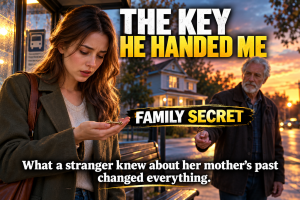
The bus was late again. I stood under the thin metal shelter with my bag over one shoulder, checking the time on my phone even though I already knew it would not help. The late afternoon light had that soft, washed-out quality it gets in early autumn, when the air still holds a little warmth but the shadows lengthen early. Across the street a few cars waited at the light. No one else was at the stop.
I heard footsteps before I saw him. An older man, maybe in his late sixties, walked up with the careful pace of someone who had learned not to hurry. His coat was plain, dark, well-kept. He stopped a few feet away and looked at the bus schedule as if he needed to confirm something, though the printed times had not changed in years.
After a moment he turned slightly toward me.
“Excuse me,” he said. His voice was steady, not loud. “Do you know a woman named Linda?”
I felt the small, automatic pause that happens when a stranger uses a name that belongs to someone close. Linda was my mother. She lived twenty minutes from here, in the same house she had lived in since I was a child. I still went there every Sunday for dinner.
“Yes,” I said. “She’s my mother.”
He nodded once, as if that settled something for him. Then he reached into the inside pocket of his coat and took out a folded piece of paper. He held it out.
“This address,” he said. “Does it mean anything to you?”
I took the paper. The handwriting was neat, slightly old-fashioned. The street name and number were the ones I had written on envelopes and school forms for as long as I could remember. My childhood home.
I looked up. “How do you know this?”
“She gave it to me,” he said. “Many years ago.”
The words sat between us. I waited for more, but he only watched my face with a quiet attention that did not feel invasive, only deliberate.
Then he reached into his pocket again. This time he brought out a small key. Brass, or something that looked like it, with a short shaft and a simple head. He placed it in my hand.
“I believe this belongs with you now,” he said.
I turned the key over. The number engraved along the side was clear even in the fading light. 47. I had seen that number before. Not on any key I owned, but on the side of an old metal storage box that sat on a high shelf in my mother’s garage. I had noticed it once when I was helping her move boxes for a yard sale that never happened. She had said it was nothing, just old papers, and we had left it where it was.
The bus appeared at the far end of the block. The man glanced at it, then back at me.
“I won’t keep you,” he said. “But if you open that box, you may understand why she trusted me with both.”
He stepped back. The bus doors opened. I got on without another word, the key still closed in my fist, the paper folded in my other hand. Through the window I watched him walk away in the opposite direction, not waiting for any bus of his own.
I rode the whole way home with the key pressed against my palm, the metal warming slowly to my skin. My mother had never mentioned any older man who might have reason to know our address or hold a key to something that had sat, untouched, in her garage for years. She was careful with details. She remembered birthdays and preferred certain brands of tea and always locked the side door even when she was only going to the garden. Secrets were not something she advertised.
Yet the address was correct. The number on the key matched. And the man had spoken her name as if it still carried weight for him.
When I got home I set the key on the kitchen counter and stared at it for a long time. Then I called her.
She answered on the second ring, the way she always did.
“Mom,” I said. “Something strange happened today.”
There was a short silence on the other end, the kind that happens when someone is already listening harder than usual.
“What is it?” she asked.
I told her about the bus stop, the man, the address, the key. I did not raise my voice. I simply recited the facts as they had occurred.
When I finished, the silence lasted longer.
“What did he look like?” she asked finally.
I described him the best I could—the silver hair, the careful walk, the plain coat. She did not speak for several seconds.
“Mom?”
“I need you to come over,” she said. Her voice had changed. Not panicked, but stripped of its usual ease. “Tonight. Bring the key.”
I said I would. After we hung up I stood in my kitchen looking at the small piece of brass on the counter. Outside, the last light was leaving the sky. Somewhere across town my mother was waiting, and for the first time in years I felt the quiet certainty that whatever waited in that storage box was not going to be ordinary.
I put the key in my pocket and left the house.
Part 2
The drive to my mother’s house took the same route I had taken hundreds of times. Past the grocery store where she still preferred to shop, past the park where she used to take me after school, past the corner where the maple tree had dropped its leaves in the same pattern every October. Everything looked ordinary. That was the strange part. The ordinary parts of a life can sit right next to something that does not belong, and most days you never notice the seam.
Her porch light was already on when I pulled into the driveway. She opened the door before I reached it.
She looked the same as always—graying hair pulled back, cardigan over a simple blouse, the small gold studs she had worn for years. But her eyes moved quickly over my face, then to my hands, as if she expected to see the key already visible.
“Come in,” she said.
We sat at the kitchen table. The same table where I had done homework and argued about curfews and listened to her talk about work. She poured tea without asking if I wanted any. The cups were the ones with the small blue flowers along the rim.
I set the key on the table between us.
She looked at it for a long time. Her fingers rested against the side of her cup, not quite steady.
“Where is the box?” I asked.
“Garage,” she said. “Same place it’s always been.”
“You’ve known about this key.”
It was not a question, but she answered it anyway.
“I knew someone might bring it one day. I didn’t know it would be him.”
“Who is he?”
She lifted her eyes to mine. For a moment I thought she might deflect, the way she sometimes did when a topic moved too close to something she preferred to leave alone. Instead she took a breath and spoke carefully.
“His name is Raymond. I knew him a long time ago. Before you were born. Before I met your father.”
The name meant nothing to me. My father had died when I was twelve. I had never heard my mother speak of any man from before that marriage.
“Why did he have our address?”
“Because I gave it to him,” she said. “I told him that if anything ever happened—if I needed him to return something—he should come find me there. Or find whoever lived there after me.”
“What something?”
She looked at the key again.
“There are papers in that box. Letters. A few other things. Things I didn’t want to keep in the house, and didn’t want to destroy either. I asked him to hold the key. I thought it would be safer that way.”
“Safer from what?”
She did not answer immediately. Outside, a car passed on the street. The sound of its engine faded.
“From myself, mostly,” she said at last. “From the temptation to open it on a hard day and start rearranging the past. And from anyone who might have used those papers to make trouble.”
I waited. She had always been precise with language. Trouble was a word she used when she meant something larger than inconvenience.
“What kind of trouble?”
She stood and carried her cup to the sink, though it was still half full. When she turned back, her expression had settled into something quieter and more resolved.
“If we’re going to talk about this properly, we should open the box. I’ll show you what’s inside. Then you can decide what you want to know and what you don’t.”
I followed her through the side door into the garage. The air was cooler there, smelling of dust and old cardboard and the faint metallic scent of tools that had not been used in years. She pulled the chain on the overhead light. The fluorescent bulb flickered, then held.
The storage box sat on the highest shelf, exactly where I remembered. Metal, rectangular, the kind that might once have held tools or important documents. The number 47 was stamped into the side in the same style as the engraving on the key.
My mother reached up, but her arms were not quite long enough. I took it down. It was heavier than I expected. We carried it back into the kitchen and set it on the table.
She held out her hand for the key. I gave it to her. She inserted it into the lock. It turned with a soft, reluctant click.
For a moment neither of us moved. Then she lifted the lid.
Inside were several manila envelopes, a small notebook with a cracked leather cover, and a single folded letter on top. The paper of the letter had yellowed at the edges.
My mother did not touch anything at first. She simply looked down into the box the way a person looks at a place they have not visited in a very long time.
“This is where it starts,” she said. “If you want to know the rest, we’ll go through it together. But once we do, you won’t be able to put the knowledge back.”
I reached for the letter on top. My fingers brushed the paper. It felt dry, almost fragile.
“I’m ready,” I said.
She nodded once. Then she sat down across from me, and we began.
Part 3
The letter on top was addressed to no one. The handwriting was my mother’s, but younger—firmer, less careful. The date at the top was from a year before I was born.
I read it slowly.
It was not a love letter, exactly. It was more like a record of a decision. She had written that she was choosing a quieter life, one with fewer complications. She mentioned a man named Raymond who had helped her through a difficult period, and she wrote that she trusted him to keep certain things safe if she ever needed distance from them. There was no drama in the language. Only a clear, almost practical tone, as if she were leaving instructions for a future version of herself.
When I finished, I looked up. My mother was watching me with an expression I could not quite name.
“What difficult period?” I asked.
She folded her hands on the table.
“I was younger than you are now. I had taken a job in another city for a while. The work was fine. The people around it were not always fine. There was pressure to look the other way on certain things—money that moved in ways it shouldn’t have, favors that came with expectations. I got out before it became something I couldn’t leave. Raymond helped me leave cleanly. He was older, steadier. He had connections I didn’t. When I came back here, I asked him to hold onto a few documents in case anyone ever tried to pull me back into that world. The key was a way to keep those documents out of my daily life.”
“What documents?”
She reached into the box and took out the first manila envelope. Inside were photocopies of bank statements, a few contracts with names blacked out in places, and a short typed statement signed by someone whose name I did not recognize. The dates lined up with the period she had described.
“These showed that certain payments had been made to keep people quiet,” she said. “I never wanted them. I never used them. But I also didn’t want them destroyed, in case the people involved decided I was a loose end. Raymond kept the key so I wouldn’t have to see this every time I opened a drawer.”
I set the papers down. The kitchen felt smaller than it had a few minutes earlier.
“Why didn’t you ever tell Dad?”
“Your father and I built a life that didn’t need this in it. He knew I had left a complicated job. He didn’t need the details. After he died, there seemed even less reason to open the box. The people who might have cared were long gone or no longer in a position to cause trouble. I thought the whole thing had simply aged into irrelevance.”
“Until today.”
“Until today,” she agreed.
I opened the second envelope. This one held letters—handwritten, some from Raymond, some from other people whose names meant nothing to me. The tone of Raymond’s letters was careful, almost formal. He wrote about ordinary things: the weather, a book he had read, a question about whether she was still painting. In one of them he mentioned that he still had the key and that he would return it if she ever asked, or if he ever felt the time had come.
The last letter from him was dated only a few months earlier.
My mother saw me reading it.
“He wrote that he was not well,” she said quietly. “He said he wanted to make sure the key found its way back before it was too late. I never answered. I didn’t know what to say after so many years.”
“So he came looking for you.”
“He came looking for the address I gave him. He found you instead.”
I set the letter down. The idea of an older man tracking down an address from decades ago and waiting at a bus stop felt both strange and oddly consistent with the careful, deliberate way she had described him.
“Is there more?” I asked.
She nodded toward the notebook.
I lifted it out. The leather cover was cracked along the spine. Inside, the pages were filled with my mother’s handwriting again—lists of names, short notes about conversations, a few sketches of what looked like floor plans or office layouts. Near the back were several pages that seemed more personal. She had written about the decision to leave the city, about the relief of returning home, about the quiet fear that someone might still be watching.
One entry stopped me.
It mentioned a name I recognized from the photocopied contracts. And next to it, in the margin, she had written a single sentence: If they ever come looking, the box is the only proof I have that I walked away clean.
I looked at my mother.
“Did anyone ever come looking?”
“No,” she said. “Not once. That was the strange mercy of it. The years passed. The people involved moved on or left the country or simply stopped caring. I kept the box because throwing it away felt like erasing the fact that I had protected myself. And I left the key with Raymond because I trusted him more than I trusted my own impulse to dig through the past on a lonely night.”
The garage light was still on. I could see it through the open side door, a pale rectangle against the dark.
“What do we do with all of this now?” I asked.
She closed the notebook gently.
“That depends on you,” she said. “You’re the one who received the key. You’re the one who has to decide whether these papers stay locked away or whether they become part of the story you carry.”
I looked at the open box, at the envelopes and the notebook and the letter that had started everything. Somewhere in the house a clock ticked. Outside, the neighborhood was settling into evening.
I was not ready to decide yet. But I knew the quiet version of my mother’s life—the version I had grown up inside—had just acquired a new layer, and I could not pretend I had not seen it.
Part 4
We spent the next hour going through the rest of the contents more carefully. There was a small photograph I had never seen—my mother standing outside a brick building in a city I did not recognize, younger, her hair longer, smiling at someone just outside the frame. On the back, in pencil, was the name of the street and a year.
There was also a short legal document, unsigned, that appeared to be a draft of some kind of affidavit. My mother explained that Raymond had helped her prepare it in case she ever needed formal protection, but she had never filed it. The people involved had never pushed hard enough to force the issue.
By the time we closed the box again, the tea had gone cold.
“I need time to think,” I said.
She nodded. “Take the key if you want. Or leave it here. Either way, the box stays where it is until you decide otherwise.”
I left the key on the table. Driving home, I kept replaying the moment at the bus stop—the way the man had spoken my mother’s name, the way he had placed the key in my hand as if completing a task he had carried for a long time.
That night I could not sleep easily. I kept thinking about the version of my mother who had written those careful notes, who had chosen to leave a complicated situation and then chosen, again and again, not to reopen it. The mother I knew had always been steady, private, more interested in the present than the past. Now I understood that some of that steadiness had been deliberate construction.
The next morning I called in late to work and drove back to her house. She was in the garden, cutting back the last of the summer plants. When she saw me she wiped her hands on her jeans and came inside without asking why I had returned so soon.
We sat at the table again. The box was still there, lid closed, key resting on top.
“I want to know more about Raymond,” I said.
She told me what she could. They had met through a mutual acquaintance at a time when she needed practical help more than friendship. He had been older by nearly twenty years, already established in a quiet professional life that gave him access to information and people she did not have. He had never asked for anything in return beyond the promise that she would stay out of the situation once she left it. Over the years the letters had continued, sparse and formal, a kind of long-distance check-in that never quite became a friendship and never quite disappeared.
“Did you love him?” I asked.
The question surprised her. She considered it for a moment.
“No,” she said. “Not in the way you’re thinking. I respected him. I trusted him. In a different life maybe it could have been something else. But I was already moving toward the life I wanted—your father, this house, a quieter set of problems. Raymond understood that. He never tried to change it.”
“And now he’s dying.”
“Or already gone,” she said. “I don’t know. The last letter was months ago. He may have waited as long as he could before finding a way to return the key.”
I picked up the key again. The number 47 felt more significant than it had the day before. It was not just a label on a box. It was a marker of a decision my mother had made when she was roughly my age, a decision that had shaped the rest of her life in ways I had never seen.
“I want to try to find him,” I said. “If he’s still alive, he should know the key reached the right person. If he’s not, then at least we’ll know the story ends cleanly.”
My mother was quiet for a long time.
“I don’t have an address for him,” she said. “Only the letters, and those stopped using return addresses years ago. He was always careful that way.”
“There must be something. A full name. A city. Something.”
She opened the notebook again and turned to a page near the middle. There, in her younger handwriting, was a name: Raymond H. Ellison. And beneath it, a city several hours north of where we lived.
“That’s all I have,” she said. “It may not be enough.”
I wrote the name and the city down. Then I looked at her across the table.
“Are you okay with me looking?”
“I gave him the key for a reason,” she said. “If the reason has finished its work, then yes. I’m okay with you finishing it.”
I left with the name and the city and a copy of the most recent letter. The rest of the papers stayed in the box. My mother locked it again and put it back on the high shelf in the garage.
On the drive home I kept thinking about the bus stop, about the way the man had simply handed me the key and walked away. He had not asked for anything. He had not explained himself beyond the necessary facts. He had completed a task that had been waiting for decades, and then he had disappeared into the ordinary evening traffic.
I did not know yet whether I would find him. But the search itself already felt like part of the story my mother had started long before I was born.
Part 5
Finding someone with only a name and a city is slower work than it looks in stories. I started with public records, old phone directories, newspaper archives. Raymond H. Ellison had lived in that northern city for many years. He had worked in a mid-level administrative role for a regional company that no longer existed. There were a few mentions of him in local papers—nothing dramatic, just the ordinary footprints of a quiet life: a letter to the editor about a park renovation, a brief notice about a community board he had served on.
The most recent trace I could find was a change-of-address notice from two years earlier. He had moved to a smaller town an hour farther north, closer to the lake. No phone number. No email. Only a street address that might or might not still be current.
I told my mother what I had found. She listened without interrupting, then said, “If you go, I want to come with you.”
We drove up on a Saturday morning. The sky was clear, the trees along the highway already turning. My mother sat in the passenger seat with a thermos of tea and the notebook open on her lap, though she did not read it. She seemed to be gathering herself for something she had postponed for a long time.
The town was small enough that the main street still had parallel parking and a single traffic light. The address led us to a modest one-story house with a neat lawn and a wooden porch. A single car sat in the driveway.
We sat in our own car for a minute after we parked.
“What if it’s not him?” I asked.
“Then we apologize for the interruption and leave,” she said. “But I think it is.”
We walked up the short path together. My mother rang the bell.
The man who opened the door was thinner than the man I remembered from the bus stop, and he used a cane, but the face was the same. The silver hair, the careful eyes, the quiet attention.
He looked at my mother first. Something shifted in his expression—recognition, and then a kind of relief that seemed to cost him effort.
“Linda,” he said.
“Raymond.”
They stood looking at each other for a moment that stretched longer than politeness usually allows. Then he stepped back and opened the door wider.
“Come in. Please.”
The living room was spare and orderly. Books on the shelves, a single armchair near the window, a small table with a glass of water and a folded newspaper. He gestured for us to sit on the couch. He took the armchair, lowering himself carefully.
“You found the key,” he said to me.
“Yes.”
“And the box?”
“We opened it,” my mother said. “She knows most of it now.”
Raymond nodded. He did not seem surprised. He only looked tired in a way that went beyond the physical.
“I waited longer than I should have,” he said. “I kept thinking there would be a better moment. Then the better moments stopped arriving.”
“How long have you been sick?” my mother asked.
“Long enough to know the shape of it,” he said. “Not long enough to finish every conversation I meant to have. The key was one of the last unfinished things. I went to the address you gave me. When I saw her at the bus stop, something about the way she stood reminded me of you at that age. I took the chance.”
I felt my mother’s hand rest briefly on my arm.
“Why didn’t you just mail it?” I asked.
“Because a key like that should be handed over, not dropped in a box,” he said. “And because I wanted to see, once, that it had reached the right person.”
He looked at my mother again.
“I never used any of the information you left with me. I never needed to. The people who might have caused trouble moved on or lost interest. I kept the key because you asked me to, and because it was a small way of keeping a promise.”
“I never thanked you properly,” my mother said.
“You didn’t need to. You left cleanly. That was the important part.”
They talked for a while longer about the years in between—ordinary updates, the kind of conversation people have when the large subjects have already been acknowledged and there is room for smaller ones. He asked about my father. She told him, briefly, about the years after. He listened without offering empty comfort.
At one point he turned to me.
“The papers in that box are yours now, in a way. Or they can be destroyed. Either choice is legitimate. They no longer have the power they once did. The only power left is the one you give them by deciding what they mean.”
I did not answer immediately. I was still turning over the fact that this quiet man had carried a small brass key across decades because my mother had once asked him to.
When we stood to leave, he walked us to the door. The cane tapped softly against the floor.
“If you ever need anything from those papers—context, a name, a date—you can write to me here,” he said. “While I’m still able to answer.”
My mother reached out and took his hand for a moment.
“Thank you, Raymond.”
He nodded. “It was a long time to keep a small thing. I’m glad it’s finished.”
We drove home mostly in silence. The landscape moved past the windows in the ordinary way landscapes do. Somewhere behind us, an older man was sitting in his armchair with one less unfinished task in his life. And somewhere ahead of us, a metal box with the number 47 waited on a high shelf, its lock no longer a secret.
Part 6
In the weeks that followed, the box stayed closed. My mother and I did not talk about it every day. Life returned to its usual patterns—work, Sunday dinners, the small repairs a house always needs. But the knowledge sat underneath everything, quiet and persistent.
One evening I asked her if she regretted keeping the papers all those years.
She thought about it while she dried a plate.
“No,” she said. “I regret that I let the fear of them shape certain choices more than it needed to. I was careful in ways that sometimes made me smaller. But I don’t regret having the proof that I walked away on my own terms. Even if I never used it.”
I understood that. There is a difference between carrying something because it still has power and carrying it because it once did, and you are not yet ready to decide which is true.
I started going through the notebook more carefully on my own. The sketches of floor plans turned out to be rough diagrams of the offices where she had worked. The lists of names were people she had observed taking or giving the kind of favors that never appeared on official records. None of it was dramatic in the way a movie would require. It was simply the quiet machinery of a place that rewarded looking the other way.
One name appeared more often than the others. I asked my mother about it.
“He was the one who made the offers,” she said. “Nothing illegal on paper. Just opportunities that came with unspoken expectations. When I left, he was the one I was most careful about. Raymond helped me make sure there was a clear record that I had refused everything and taken nothing.”
“Is he still around?”
“I checked years ago. He left the country. I never heard from him again.”
The information settled into place like a final piece of a puzzle I had not realized I was solving. The danger my mother had prepared for had never arrived. The box had remained a precaution that time itself had slowly disarmed.
Still, the key and the papers existed. And existence creates its own questions.
I began to think about what it would mean to destroy them. Burning the letters and the photocopies would be simple. The notebook could go with them. The key could be returned to the box or thrown away. The story would end with a clean absence.
But destruction felt like erasing the fact that my mother had once needed protection, and that a near-stranger had provided it without asking for anything in return. Keeping the papers felt like preserving a version of the past that no longer had teeth.
I did not decide quickly. Decisions that matter rarely arrive all at once. They accumulate in small moments—while driving, while washing dishes, while lying awake at two in the morning listening to the house settle.
One afternoon I drove back to the northern town alone. I did not tell my mother I was going. I parked near Raymond’s house and sat for a while, watching the ordinary movement of the street. Then I walked up and rang the bell again.
He opened the door more slowly this time. He looked frailer, but his eyes were clear.
“I wondered if you’d come back,” he said.
We sat in the same places. I told him I was still trying to decide what to do with the contents of the box.
He listened without offering advice. When I finished, he said, “The papers were never meant to be a burden. They were a tool you hoped you wouldn’t need. Tools can be put away when the job is done.”
“And if putting them away feels like forgetting?”
“Then keep a single page,” he said. “Or keep the key. Memory doesn’t require a full archive. Sometimes the knowledge that something existed is enough.”
I stayed for nearly an hour. We talked about ordinary things—books, the lake, the way small towns change without seeming to. When I left, he walked me to the door again.
“Your mother chose well,” he said. “Both times. When she left that life, and when she built the one that came after.”
I drove home with his words in my head. That night I sat at my own kitchen table with the key in front of me and tried to imagine what my mother had felt at my age—standing at the edge of a complicated situation and choosing the quieter path, then spending decades making sure the choice stayed intact.
The next Sunday, at dinner, I told her I wanted to keep the box closed but not destroy it. I wanted the papers to remain where they were, locked, available if some future version of us ever needed the record, but otherwise left alone.
She considered it while she passed the bread.
“That’s a fair middle,” she said. “Not erasure. Not obsession. Just a closed door we both know how to open if we ever have to.”
We finished the meal talking about other things. The box stayed on its shelf. The key stayed with me.
For the first time since the bus stop, the weight of the story felt manageable.
Part 7
Autumn deepened. The trees along my mother’s street turned and then began to drop their leaves. I kept the key on a small dish on my dresser, where I would see it every morning. It no longer felt like an emergency. It felt like a marker of something that had been resolved as far as resolution was possible.
Raymond’s health declined more quickly than any of us expected. In early November my mother received a short letter from a neighbor. Raymond had been moved to a care facility near the lake. He was still clear-minded, the neighbor wrote, but the days were shorter now.
We drove up the following weekend. The facility was quiet and well-kept, with large windows that looked out toward the water. A nurse showed us to his room.
He was sitting up in a chair near the window, a blanket over his legs. When he saw us he smiled, the same careful smile I remembered.
“You didn’t have to come,” he said.
“We wanted to,” my mother answered.
We stayed for most of the afternoon. Conversation moved slowly, with long comfortable pauses. He asked about the box. I told him we had decided to leave it locked and in place.
He nodded. “Good. Some things are better as closed possibilities than as open wounds.”
Near the end of the visit he asked my mother if she would sit closer. She pulled a chair beside him. He took her hand with a formality that somehow did not feel formal.
“I kept the key because you asked,” he said. “But I also kept it because it was a way of staying connected to a version of myself I liked—the version that could help someone leave a bad situation cleanly. Thank you for giving me that.”
My mother did not speak for a moment. Then she said, “You made it possible. I only walked through the door you held open.”
He looked at me.
“Take care of her,” he said. “And take care of the story, whatever form it ends up in.”
We left as the light was beginning to fade over the water. In the car my mother was quiet for a long stretch of highway. When she finally spoke, her voice was steady.
“I’m glad you met him,” she said. “I’m glad the key came back through you.”
I reached over and squeezed her hand. We did not need to say more.
Two weeks later the same neighbor wrote again. Raymond had died peacefully in the early morning. There would be a small service by the lake. My mother and I went. Only a handful of people attended—neighbors, a former colleague, a distant cousin. The service was brief and without pretense. Afterward we stood near the water for a while, watching the late autumn light move across the surface.
On the drive home my mother said, “He never asked for anything. Not once. That may be the rarest thing about the whole story.”
I agreed. In a life full of complicated exchanges, a simple kept promise stood out.
When we reached her house I went with her into the garage. We took the box down one more time. She unlocked it. We looked at the contents without removing anything. Then she locked it again and I helped her place it back on the high shelf.
“It stays,” she said. “For as long as this house is mine. After that, you decide.”
I kept the key.
Winter arrived. The ordinary months resumed their ordinary shape. But every so often, when I passed the dish on my dresser, I would pick up the small brass key and feel the number under my thumb. 47. A marker of a decision made long before I existed, carried by a man who asked for nothing, returned to the daughter of the woman who had trusted him with it.
The story no longer felt unfinished. It felt complete in the way some stories are complete only after the last quiet piece has been set in place.
Part 8
In the spring my mother asked me to help her sort through the attic. It was a project she had postponed for years. We spent three weekends opening boxes of old clothes, school papers, photographs, and the accumulated evidence of a life lived in one place for a long time.
On the second weekend we found a small envelope tucked inside a box of winter scarves. Inside the envelope was a single photograph I had never seen—my mother and Raymond standing outside the brick building from the earlier picture, both of them younger, both of them looking at the camera with the careful half-smiles of people who know a photograph is being taken for a reason.
On the back, in Raymond’s handwriting, was a short note: For the record. You left clean. —R.
My mother held the photograph for a long time.
“I forgot he gave me this,” she said. “I must have put it away and then forgotten where.”
We set it aside with the other things we were keeping. Later that evening, after she had gone to bed, I sat at the kitchen table with the photograph and the key. Two small objects that together formed a kind of evidence—not of wrongdoing, but of a choice made and kept.
I thought about the version of my mother who had stood in that other city and decided the complicated life was not the one she wanted. I thought about the version of Raymond who had agreed to hold a key and then held it for decades without complaint. And I thought about the version of myself who had stood at a bus stop and received both the key and the beginning of an explanation.
The next morning I told my mother I wanted to write the story down—not the papers in the box, but the larger shape of what had happened. The bus stop. The key. The quiet man who had kept a promise. The mother who had chosen a different life and then protected that choice.
She was quiet for a moment.
“Will you use our real names?”
“Only if you want me to.”
“I don’t mind,” she said. “The people who might have cared are gone. And the truth of it is simple enough. A woman left a difficult situation. A man helped her. Years later the help completed itself.”
I began writing in the evenings. The words came more easily than I expected. I did not try to make the story larger than it was. I simply set down what I knew: the late bus, the older man, the address that matched, the key with the familiar number, the box on the high shelf, the drive north, the conversations that filled in the years between.
When I finished a first draft I showed it to my mother. She read it at the kitchen table with a cup of tea growing cold beside her. When she reached the end she looked up.
“You got the important parts right,” she said. “The carefulness. The lack of drama. The way ordinary life continued around it.”
“Is there anything you want changed?”
“Only one thing. In the part where Raymond gives you the key, you wrote that he looked sad. He didn’t. He looked finished. There’s a difference.”
I changed the sentence.
Summer came. The story sat in a folder on my computer, complete enough for now. I did not try to publish it. It was not that kind of story. It was a private record of a private debt that had been paid in full.
One evening in late July I drove past the bus stop where everything had started. The shelter was the same. The schedule was the same. A few people waited for the next bus. None of them looked like they were carrying anything heavier than a bag or a phone.
I parked and walked over. The bench was empty. I sat for a few minutes, feeling the warm evening air, watching the ordinary traffic move past. Then I took the key out of my pocket and turned it over in my hand.
The number 47 was still clear. The metal was slightly worn where it had rested against other keys or against the fabric of a pocket for years.
I thought about putting it back in the box and locking it away for good. I thought about keeping it as a small reminder. In the end I did neither of those things immediately. I simply held it and let the evening continue around me.
When the next bus came I did not get on. I walked back to my car and drove home. The key stayed in my pocket. The story stayed in its folder. And the quiet knowledge that some promises are kept across decades without fanfare stayed with me the way certain true things do—not heavy, not dramatic, just present.
Part 9
In early autumn, almost a year after the bus stop, my mother called and asked me to come over. Her voice sounded ordinary, but there was a note underneath it that I had learned to recognize.
When I arrived she was sitting at the kitchen table with the metal box in front of her. The lid was open. The key was in the lock.
“I’ve been thinking,” she said. “About what happens to this after I’m gone.”
I sat down across from her.
“I want you to have clear instructions,” she continued. “If you want to keep the papers, keep them. If you want to destroy them, destroy them. If you want to leave them locked and pass the key to someone else someday, that’s fine too. The only thing I ask is that you don’t let them become a weight. They were never meant to be one.”
“I understand.”
She reached into the box and took out the notebook. She opened it to the last written page and added a short note in her current handwriting. Then she closed it and placed it back inside.
“What did you write?” I asked.
“Just that the key came home. And that the story is finished in the way it needed to be.”
She locked the box and handed me the key.
“This stays with you now. For good.”
I put it in my pocket. The weight of it felt familiar.
We spent the rest of the afternoon doing ordinary things—walking through the garden, talking about a leak in the back gutter, deciding whether the porch needed new paint. The large subject had been addressed. The smaller subjects were free to take up space again.
That night, at home, I took the key out and looked at it under the kitchen light. Then I opened the folder on my computer and added a final paragraph to the story I had written. I described the moment at the table, the open box, the note my mother had added, the quiet transfer of the key from her hand to mine.
When I finished I saved the file and closed the laptop.
Outside, the neighborhood was settling into evening the way it always did. Somewhere a dog barked. A car door closed. The ordinary sounds of a life that had room for both secrets and their resolutions.
I thought about Raymond, about the long years he had carried a small brass object because someone he respected had asked him to. I thought about my mother at my age, standing in a different city and choosing the path that led to this house, this table, this quiet evening. And I thought about myself at the bus stop, receiving a key and an address and the beginning of an explanation I had not known I needed.
The story did not feel dramatic. It felt true. And truth, I was learning, does not always arrive with raised voices or sudden revelations. Sometimes it arrives in the form of an older man at a bus stop, a small key with a familiar number, and a box that has waited patiently on a high shelf for the right moment to be opened and then closed again.
I put the key back in the dish on my dresser. In the morning I would see it there, the way I had for months. It would no longer ask a question. It would simply be what it was—a finished piece of a longer story that had finally found its last quiet page.
Part 10
Years later the house still stood on the same street. The maple tree still dropped its leaves in the same pattern every October. My mother grew older in the way people do when they have lived carefully and been mostly lucky. The metal box remained on the high shelf in the garage, locked, its contents undisturbed.
I kept the key.
Sometimes, when I visited, I would go into the garage for a tool or a ladder and glance up at the shelf. The number 47 was still visible on the side of the box. I never felt the urge to open it again. The knowledge of what was inside was enough. The story had completed its arc.
Raymond’s name came up only rarely in conversation, and always with a kind of quiet respect. My mother would mention him the way she mentioned other people who had mattered in the long middle of a life—briefly, accurately, without embroidery. I understood that the chapter they had shared belonged to a time before I existed, and that its resolution had been a gift they both accepted without needing to revisit it endlessly.
One autumn afternoon, when the light was the same soft, washed-out quality it had been on the day of the bus stop, I stood at that same stop again. I was older. The shelter was still the same. A few leaves skittered along the sidewalk in the light wind.
I took the key out of my pocket and held it in my open palm the way I had the first time. The metal was smoother now, worn by years of occasional handling. The number was still clear.
I thought about the man who had handed it to me. I thought about the woman who had once given it to him. I thought about the long chain of ordinary days that had stretched between those two moments and the quiet afternoon when the chain had finally closed.
A bus appeared at the far end of the block. I did not get on. I stayed on the bench until the bus doors closed and it pulled away. Then I walked back to my car and drove the familiar route to my mother’s house.
She was in the garden, cutting back the last of the season’s plants. When she saw me she smiled the way she always did—practical, warm, unsurprised.
“You’re early,” she said.
“I was in the neighborhood.”
We went inside. She made tea. We sat at the kitchen table with the same blue-flowered cups. Outside, the light continued its slow fade.
I did not take the key out. I did not need to. It was enough to know it was in my pocket, enough to know the box was still on its shelf, enough to know that some stories end not with a flourish but with the simple, durable fact that a promise was kept and a choice was honored and a life continued, quieter and more whole because of both.
Later, after the tea was finished and the light had gone, I helped her bring the garden tools into the garage. The box sat where it always had. I looked at it once, briefly, and then closed the garage door.
In the years that followed, the key remained with me. When my mother eventually left the house for the last time, I took the box down and placed it in my own storage, still locked. I never opened it again. I never felt the need. The important part had never been the papers. The important part had been the fact that they existed as proof of a clean departure, and that a quiet man had carried the means of opening them across decades without once making the burden visible.
On certain evenings, when the light is the same as it was that first afternoon, I still think of the bus stop. I still see the older man stepping forward, speaking my mother’s name, placing a small key in my hand. I still feel the weight of it, not as a mystery to be solved, but as a completed gesture—an ending that arrived without spectacle, and therefore felt true.
The story is finished now. It finished the day the key came home, and it finished again every ordinary day afterward when no one needed to open the box. Some truths do not require constant examination. They only require the willingness to receive them when they finally arrive, and then the grace to let them rest.
That is what I learned from a stranger at a bus stop, from a mother who chose a quieter life, and from a man who kept a small promise for longer than most people keep anything. The key is still in a drawer in my house. The box is still locked. And the life that grew around both of them continues, ordinary and intact, which is the only ending that ever really mattered.