When I was ten my father bought me a blue bicycle for fifteen dollars at a garage sale. Thirty years later that same bicycle appeared in a 1959 photograph inside his toolbox, long before I was born. The receipt bore his name as the seller. Then I saw the little girl standing behind it, wearing a dress I already knew from another family picture.
Part 1
I was ten the summer the blue bicycle came into my life. It leaned against a folding table at a garage sale three streets over from our house, the paint still bright under a thin layer of dust. My father counted out fifteen dollars in worn bills while the woman running the sale watched him with a strange, almost relieved expression. He wheeled it home himself, one hand on the handlebars, the other resting lightly on my shoulder.
I rode that bicycle until the soles of my sneakers wore through. I rode it to the corner store, to the creek behind the elementary school, to the empty lot where the older kids played ball. When I finally outgrew it, my father stored it in the garage under a tarp. I never asked what happened to it after that. Childhood objects disappear the way seasons do—quietly, without ceremony.
Thirty years later I was standing in that same garage, now empty of almost everything except an old wooden toolbox that had belonged to my father. He had been gone six months. The house was being prepared for sale, and I had been assigned the task of sorting the last of his things. The toolbox sat on the workbench where he had left it, the lid slightly open as if he had meant to return.
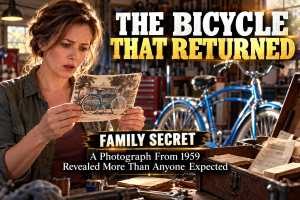
Inside, beneath a layer of screwdrivers and measuring tapes, I found a photograph. It was black and white, the edges soft with age. A blue bicycle stood in the center of the frame, the same shape, the same curved handlebars I remembered. The date written in careful pencil on the back read 1959.
I was not born until 1974.
I carried the photograph into the kitchen and sat at the table for a long time. The light from the window fell across the image the same way it had once fallen across the bicycle in our driveway. I could still feel the vibration of the chain under my feet, the way the front wheel wobbled slightly when I took a corner too fast.
That evening I called my older sister. She listened without interrupting while I described the photograph. When I finished she was quiet for several seconds.
“Dad never talked about much from before we were born,” she said finally. “Maybe it belonged to someone he knew.”
I wanted to believe that. I wanted the simple explanation. But the longer I looked at the photograph, the less simple it felt. The bicycle was not merely similar. It was identical—down to the small chip of paint missing from the front fender, a detail I had once traced with my finger as a child.
The next morning I returned to the toolbox. I emptied every compartment. Beneath a folded cloth I found a receipt, yellowed and soft at the creases. It was from the same garage sale where my father had purchased the bicycle for me. The seller’s name was printed at the bottom in the same careful handwriting that had labeled the photograph.
It was my father’s name.
I sat on the concrete floor of the garage with the receipt in one hand and the photograph in the other. The numbers on the receipt matched the amount he had paid. The date matched the summer I turned ten. Yet the name at the bottom was his.
I thought it must be a mistake. People reused names. Perhaps someone else with the same name had sold the bicycle years earlier and the papers had become mixed. I told myself that until the afternoon I found the newspaper advertisement.
It was folded inside an old envelope at the bottom of a drawer in his desk. The paper was brittle. The advertisement was small, placed among the classifieds of a local paper dated June 1959. It described a blue bicycle, exact make and model, lost from a residential street. A reward was offered. The contact name listed at the end was again my father’s.
He had owned the bicycle once before.
According to the advertisement it had disappeared for fifteen years.
I stood in the quiet of his study holding the yellowed paper and felt the first real shift in the ground beneath my feet. The man who had taught me to ride, who had run beside me with one hand on the seat until I found my balance, had once reported that same bicycle missing. Then, decades later, he had bought it back from a stranger’s garage sale and given it to me as if it were ordinary.
I returned to the photograph. This time I looked more carefully. Behind the bicycle, partially obscured by the front wheel, stood a little girl. She wore a light-colored dress with a small bow at the collar. The dress was familiar. I had seen it before in another family photograph, one that sat on the mantel in my parents’ living room for as long as I could remember.
The girl in that older picture was my father’s younger sister. She had died when she was seven.
The room suddenly felt smaller. The air seemed thinner. I set the photograph down and pressed my palms against the edge of the desk until the wood bit into my skin. Outside, a car passed on the street. A dog barked once and then fell silent. Ordinary sounds continued while something far less ordinary settled into place inside me.
I did not know yet what any of it meant. I only knew that the blue bicycle had carried more than a child. It had carried a secret my father had kept for most of his life, and now that secret was beginning to surface in the quiet rooms he had left behind.
Part 2
I spent the next three days moving through the house like a person searching for a single missing key. Every drawer, every box, every envelope felt like it might contain another piece of the same puzzle. My sister came over on the second afternoon. We sat at the kitchen table with the photograph, the receipt, and the newspaper clipping spread between us.
She studied the image of the little girl for a long time.
“That’s Aunt Claire,” she said quietly. “Mom always said Dad never got over losing her.”
I nodded. We had grown up with the story in fragments. A sudden illness. A short hospital stay. A funeral neither of our parents ever described in detail. The photograph on the mantel showed Claire smiling in that same dress, standing beside a younger version of our father who looked barely older than a teenager himself.
“Why would he keep a picture of the bicycle with her in it and never say anything?” my sister asked.
I had no answer. The silence that followed felt heavy, the kind that settles when two people realize the person they loved most had lived an entire private life they never knew.
That evening I called the local historical society. A volunteer named Ruth answered. When I described the newspaper advertisement she asked me to bring it in. The next morning I sat across from her at a long wooden table while she examined the clipping under a magnifying lamp.
“1959 was a busy year for lost items,” she said. “People still reported things in the paper then. But a bicycle listed with a reward—that was less common.”
She pulled a bound volume of old newspapers from a shelf and turned pages until she found the same advertisement. Then she flipped further and stopped.
“Here’s something else.” She pointed to a short article two weeks later. A blue bicycle matching the description had been recovered from a drainage ditch near the edge of town. The owner had claimed it. No further details were given.
I copied the article by hand. The date of recovery was fifteen years before the garage sale where my father had bought the bicycle for me. The timeline matched the gap the advertisement had mentioned, yet nothing explained why he had later sold the bicycle under his own name and then purchased it back as if it belonged to a stranger.
Ruth watched me write. “Family history can be complicated,” she said. “Sometimes people keep quiet because the truth is painful. Sometimes they keep quiet because they never found the right words.”
I thanked her and left with the copied article folded in my pocket. Outside, the afternoon light was bright and ordinary. I sat in my car for several minutes before starting the engine, staring at the steering wheel as if it might offer an explanation.
That night I dreamed of the bicycle. In the dream I was ten again, riding down the long hill near our old house. My father ran beside me, one hand steady on the seat. When I looked back he was gone, and the little girl in the dress stood at the top of the hill watching me. I woke with the taste of metal in my mouth and the sound of the chain still turning in my ears.
The following day I drove to the address listed on the original 1959 advertisement. The house was still there, a small white bungalow with a porch that sagged slightly on one side. An elderly woman answered the door. When I explained who I was and why I had come, she studied my face for a long moment.
“You’re Robert’s daughter,” she said. It was not a question.
I nodded.
She invited me in. The living room smelled of lemon polish and old books. She brought tea and sat across from me in a chair that creaked when she settled.
“I lived next door back then,” she said. “Your father was a quiet boy after his sister passed. The bicycle was hers first, you know. Their parents bought it for her the spring before she got sick. After she was gone he rode it everywhere. Then one day it disappeared. He was inconsolable. When it turned up again weeks later he acted as if nothing had happened, but something in him had changed.”
I listened without interrupting. The tea cooled between my hands.
“He kept that bicycle for years,” she continued. “Then, sometime in the early seventies, I heard he had sold it. I always wondered why. When I saw him at the grocery store years later he never mentioned it again.”
I asked if she remembered anything about the day it was recovered. She shook her head.
“Only that he claimed it quickly and never spoke of the loss afterward. Some people put their grief in a box and close the lid. Your father was one of those people.”
I thanked her and left. On the drive home the sky had begun to darken. Rain collected on the windshield in slow, deliberate drops. I thought of the receipt with my father’s name at the bottom, of the photograph hidden in the toolbox, of the little girl in the dress who had stood behind the bicycle in 1959 and somehow still stood behind every quiet decision my father had made afterward.
Something was still missing. The pieces fit too neatly in some places and not at all in others. Why sell the bicycle under his own name only to buy it back years later and give it to me? Why keep the photograph but never speak of it? Why leave the receipt where I would eventually find it?
I returned to the house and sat once more at the kitchen table with the photograph in front of me. This time I noticed a detail I had overlooked. In the lower right corner of the image, almost lost in the grain, a second shadow stretched across the ground beside the little girl. It belonged to someone standing just outside the frame.
Someone my father had chosen not to include.
Part 3
I spent the better part of a week trying to identify the second shadow. I enlarged the photograph on my computer, adjusted the contrast, even took it to a local photography shop where a technician named Marcus examined it under specialized lighting. He confirmed what I already suspected: another person had been present when the picture was taken. The angle of the shadow suggested someone roughly the height of a teenager or young adult, standing slightly behind and to the right of the little girl.
“Could be a parent,” Marcus said. “Could be a sibling. Hard to say from a shadow alone.”
I already knew my father’s parents had been alive in 1959. My grandmother had kept detailed scrapbooks. I drove to my sister’s house that evening and we spread the old albums across her dining table. Page after page of black-and-white images showed family gatherings, birthday parties, ordinary afternoons in the backyard. Claire appeared in many of them, always in dresses with small collars, always smiling. My father appeared less often after 1959. When he did, he stood slightly apart from the others.
In one photograph taken the summer after Claire’s death, he held the blue bicycle by the handlebars as if it were the only solid thing left in the world. The same chip of paint was missing from the front fender.
My sister closed the album slowly. “He never talked about her,” she said. “Not once that I can remember. Mom said it was too hard for him.”
I told her about the neighbor’s recollection, about the bicycle disappearing and returning, about the second shadow. She listened with the same careful attention she had given the original photograph.
“Maybe the person outside the frame was the one who found it,” she suggested. “Or the one who took it.”
The idea settled between us like a third presence at the table. Neither of us spoke for a while. Outside, the wind moved through the trees with a soft, continuous sound.
The next morning I returned to the historical society. Ruth was there again. I showed her the enlarged image and asked if any police reports from the summer of 1959 mentioned a recovered bicycle. She disappeared into a back room and returned twenty minutes later with a thin folder.
“Most of the records from that period were never digitized,” she said. “But we have a few incident summaries. Here.”
The report was brief. A blue bicycle matching the description had been found in a drainage ditch on the west side of town. The finder was listed as a sixteen-year-old boy named Thomas Hale. The owner, listed as Robert Ellis—my father—had claimed the bicycle the same afternoon. No further action was taken.
Thomas Hale.
I wrote the name down. Ruth offered to check local directories for any additional mention. An hour later she returned with a single newspaper clipping from 1962. Thomas Hale had enlisted in the military. A short article noted his departure. There was a photograph of a thin young man standing beside a bus, one hand raised in a half-wave.
I stared at the image. Something about the set of his shoulders felt familiar, though I could not place why.
That evening I searched online for any living relatives of Thomas Hale. The name was common enough to produce dozens of results. I narrowed the search to the same county and found an obituary from 2018. Thomas Hale had died at the age of seventy-four. He was survived by a daughter, Margaret Hale, who still lived two towns over.
I sat with the information for a long time before deciding to contact her. The following afternoon I drove to the address listed in the public records. The house was modest, the yard carefully kept. A woman in her fifties answered the door. When I explained who I was and why I had come, she studied me with a mixture of caution and curiosity.
“My father never talked much about his teenage years,” she said. “But he kept a box of old things in the attic. You’re welcome to look if you think it might help.”
We climbed the narrow stairs together. The box was cardboard, the corners soft with age. Inside were report cards, a few letters, a faded baseball glove, and a small notebook. Margaret handed me the notebook. The pages were filled with careful handwriting. Most of the entries were ordinary—school assignments, lists of chores, the occasional complaint about weather. Then, near the middle, I found a single page dated June 1959.
The entry was short.
Found a blue bicycle in the ditch behind the old mill road. Looked expensive. Took it home. Cleaned it up. Owner came for it the next day. Kid about my age. Looked like he’d been crying for a week. Didn’t say much. Just took the bike and left. Felt bad for him.
I read the entry twice. The handwriting was steady, the tone almost detached. Yet the final sentence carried a weight that the rest of the page did not.
Margaret watched my face. “Does that mean something to you?”
I told her what I knew—the photograph, the receipt, the advertisement, the little girl in the dress. She listened without interrupting. When I finished she was quiet for a moment.
“My father never mentioned any of that,” she said. “But he kept that notebook all these years. Maybe it mattered more than he let on.”
I asked if I could photograph the page. She nodded. As I left she stood on the porch and watched me walk to the car. The sky had begun to cloud over again. I drove home with the image of the notebook page saved on my phone and the sense that the story was still only half visible.
That night I sat once more with the original photograph. The second shadow no longer felt anonymous. It belonged, almost certainly, to the boy who had found the bicycle and returned it. Yet something still did not fit. Why had my father later sold the bicycle under his own name? Why buy it back years later and give it to me as if the history did not exist?
I turned the photograph over. On the back, beneath the date, a single word had been written in pencil so faint I had almost missed it the first time.
Claire.
Not a label. A dedication.
The bicycle had belonged to her first. Everything that followed—the loss, the recovery, the silence, the eventual return—had begun with that simple fact.
Part 4
I began to understand that the bicycle was never only a bicycle. It was a container for everything my father had been unable to say aloud.
The following week I visited the cemetery where Claire was buried. The headstone was simple, the grass around it carefully trimmed. I stood there for a long time with the photograph in my coat pocket, trying to imagine the boy my father had been at fifteen or sixteen, standing in this same place with the knowledge that the sister who had ridden the blue bicycle would never ride it again.
When I returned home I found an envelope that had been slipped under the front door. No return address. Inside was a single sheet of paper and a photocopy of an old photograph I had never seen. The note was brief.
I knew your father. He asked me once to keep this safe. I think it belongs with you now.
The photograph showed my father as a young man standing beside the blue bicycle. Claire stood on the other side, one hand resting on the seat. Both of them were smiling. The image was clearer than the one from the toolbox. The second shadow I had noticed earlier was gone; the photographer had framed them cleanly this time.
I turned the photocopy over. On the back someone had written a name and a phone number. The name was Eleanor Voss. I dialed the number that evening. A woman’s voice answered, older, careful.
When I identified myself she was silent for several seconds.
“I wondered if you would call,” she said. “Your father and I were friends when we were young. After Claire died he changed. He kept the bicycle like it was the last piece of her. Then one summer it vanished. He was frantic. When it came back he never spoke of the loss again. Years later he told me he had sold it because looking at it every day had become too difficult. He asked me to hold onto a few photographs in case he ever wanted them. He never asked for them back.”
I asked about the receipt, about the garage sale where he had bought the bicycle a second time.
Eleanor’s voice softened. “He told me once that he had seen it listed in a local paper. He recognized it immediately. He said he couldn’t let it go to someone who didn’t know what it meant. So he bought it again and gave it to you. He said it felt like giving Claire a second chance to be part of the family, even if no one else understood.”
The explanation settled over me slowly, the way rain settles into dry ground. It did not answer every question, but it answered enough.
“He never told you any of this?” Eleanor asked.
“No,” I said. “He never told anyone.”
She was quiet for a moment. “Some people carry their grief so carefully that it becomes invisible. Your father was one of them. He loved you. He just never found a way to explain the shape of that love.”
After the call ended I sat in the darkening kitchen with the new photograph on the table. Claire’s face was clearer here. She looked like a child who expected the world to remain kind. My father looked like a boy who had not yet learned otherwise.
I thought of the summer I had learned to ride. The way he had run beside me without ever letting go until I asked him to. The way he had watched me disappear down the street and then stood in the driveway long after I was gone. I had always assumed he was simply being careful. Now I wondered if he had been remembering another child on the same bicycle, another set of small hands on the same handlebars.
The next day my sister and I met again. I showed her the new photograph and told her everything Eleanor had said. She cried quietly for a long time. When she finally spoke her voice was steady.
“He gave you the one thing that still connected him to her,” she said. “And he never took credit for it. That feels exactly like him.”
We sat together until the light faded. Outside, the neighborhood continued its ordinary evening routines—cars returning home, porch lights switching on, the distant sound of a television through an open window. Inside the house the blue bicycle’s long, complicated history finally began to feel less like a mystery and more like a story that had been waiting, patiently, for someone to finish reading it.
Yet one detail still troubled me. The receipt from the garage sale listed my father as the seller. If he had bought the bicycle from someone else, why did the paperwork carry his name?
I returned to the original receipt that night and examined it under a stronger light. The handwriting was his. The signature was his. But the date of the sale was three days before the day he had brought the bicycle home to me. The discrepancy was small, yet it opened a new question.
Had he arranged the sale himself? Had he somehow placed the bicycle in that garage sale under his own name so that he could purchase it back in a way that felt legitimate, ordinary, free of the weight it actually carried?
The possibility felt both elaborate and entirely consistent with the careful, private man I had known.
I needed to find the woman who had run the garage sale.
Part 5
Finding her took longer than I expected. The address on the original receipt led to a house that had changed hands twice since the summer I turned ten. The current owners knew nothing of previous garage sales. I spent two afternoons at the county records office tracing property histories until I located the name of the woman who had lived there in the early 1980s. Her name was Diane Mercer. She had moved to a retirement community on the other side of the county.
I arrived on a Thursday morning. The receptionist called her room and a few minutes later a woman with carefully styled white hair appeared in the lobby. When I explained who I was and why I had come, her expression shifted from polite curiosity to recognition.
“You’re Robert’s girl,” she said. “I remember the bicycle.”
We sat in a quiet corner of the common room. She folded her hands in her lap and looked at me with the steady attention of someone who had been waiting years to tell a particular story.
“Your father came to me a week before the sale,” she said. “He asked if he could include a blue bicycle among the items. He said it had belonged to someone he loved and that he wanted it to find a new home, but he also wanted the chance to buy it back himself if no one else claimed it first. He offered to handle the paperwork under his own name so there would be no confusion. I thought it was odd, but he seemed so earnest I agreed.”
I listened without speaking.
“The morning of the sale he arrived early,” she continued. “He priced the bicycle at fifteen dollars and stood across the street watching. When you and he walked up later he pretended to discover it for the first time. He paid me the fifteen dollars in cash and wheeled it away. Afterward he thanked me and asked me never to mention the arrangement to anyone. I never did. Until now.”
The room felt very still. Somewhere down the hallway a television played at low volume. Diane watched my face carefully.
“He loved you very much,” she said. “Whatever complicated reasons he had, that much was clear.”
I thanked her and left. In the parking lot I sat in the car with the engine off and the windows down. The air smelled of cut grass and distant rain. I thought of the elaborate care my father had taken to return the bicycle to our family without ever explaining its history. He had staged an ordinary garage-sale purchase so that the moment would feel light, unburdened, free of the grief that had shaped so much of his private life.
He had given me Claire’s bicycle without ever speaking her name.
The drive home was quiet. When I arrived I found my sister waiting on the front steps. I told her everything Diane had said. She listened with her arms wrapped around her knees, the same way she had sat as a child when the world felt too large.
“He protected us from his sadness,” she said finally. “Even when it meant protecting us from the truth.”
We went inside together. The photograph from the toolbox still lay on the kitchen table. I placed the new information beside it in my mind and felt the last major pieces settle into place. The bicycle had belonged to Claire. It had disappeared after her death and been returned by a boy named Thomas Hale. My father had kept it for years until the daily sight of it became unbearable. He had sold it under carefully controlled conditions so that he could one day buy it back and give it to me. He had left the photograph and the receipt where I would eventually find them, perhaps trusting that when the time came I would be ready to understand.
Yet even with the facts assembled, something remained unfinished. The story still needed a final act of acknowledgment—something that belonged not to the past but to the present.
I decided to restore the bicycle.
It took three weekends. I found the original frame in a storage unit my father had rented and never emptied. The paint was faded, the tires cracked, the chain rusted into a single stiff line. I took it to a small repair shop on the edge of town. The owner, a man named Luis, listened to the abbreviated version of the story I was willing to tell and then nodded once.
“We’ll bring it back carefully,” he said. “No need to make it look new. Just make it honest.”
We worked together. I sanded the frame by hand. Luis replaced the tires and adjusted the brakes. We left the small chip of paint on the front fender untouched. When the work was finished the bicycle stood in the center of the shop looking exactly as it had in the 1959 photograph—bright, slightly imperfect, unmistakably itself.
I wheeled it home in the early evening. The sky was the soft color of old photographs. My sister met me in the driveway. Neither of us spoke for a long time. Finally she reached out and rested one hand on the handlebars the same way Claire had once done.
“She would have liked that you found her,” she said.
I nodded. The bicycle stood between us like a quiet third presence, no longer a mystery, no longer a secret, simply a blue bicycle that had traveled farther than most objects ever do and somehow found its way home again.
Part 6
The following month I received a letter from Margaret Hale. She had been going through more of her father’s belongings and had found a second notebook. Inside was a longer entry dated several years after the summer of 1959. She included a photocopy.
I still think about that kid and the blue bicycle. He never said thank you. Just took it and walked away. But the look on his face stayed with me. Like he had gotten something back that mattered more than the bike itself. I hope he was okay.
The words were simple. They carried no drama, no revelation beyond the quiet observation of a teenager who had once done a small kindness and never forgotten the expression on another boy’s face. I wrote Margaret a long reply thanking her. I told her that the boy had grown into a man who had carried both the bicycle and the memory of his sister with a kind of private loyalty that shaped everything that came after. I told her that the bicycle was home again.
A week later she replied with a single sentence.
I’m glad it found its way back to the right family.
The exchange felt like the closing of a circle that had remained open for more than sixty years.
I began to write the full story down—not for publication, not for anyone else’s eyes, but for myself and for my sister. I wanted a record that held every piece: the garage sale, the photograph, the receipt, the newspaper advertisement, the second shadow, the neighbor’s recollection, Eleanor’s photographs, Diane’s confession, Thomas Hale’s notebook, the careful restoration. I wanted the story to exist in one place so that it could not scatter again.
While I wrote, ordinary life continued. The house sold. My sister and I divided the last of the furniture. I kept the toolbox and the restored bicycle. She kept the mantel photograph of Claire. We agreed that the bicycle would stay with me for now, and that someday it might travel again to the next generation if either of us had children who wanted it.
One afternoon in late autumn I took the bicycle out to the long hill near our old neighborhood. The street was quieter than it had been when I was ten. I stood at the top with both hands on the handlebars and looked down the gentle slope. The air was cool. A few leaves drifted across the pavement.
I did not ride. I simply stood there and let the memory of my father’s hand on the seat settle beside the newer knowledge of everything he had carried in silence. The two versions of him—the careful father who had taught me balance and the grieving brother who had never stopped missing his sister—finally felt like the same person.
When I returned home I found a message from Eleanor Voss. She had located one last photograph. It arrived in the mail three days later. The image showed my father as an older man standing beside the blue bicycle in our driveway the summer he bought it for me. I was visible in the background, a small figure already climbing onto the seat. My father’s face was turned slightly away from the camera, but the set of his shoulders was the same as it had been in every earlier picture: steady, private, quietly determined.
On the back of the photograph Eleanor had written a short note.
He asked me to take this the day he brought the bicycle home. He said he wanted one picture that showed both of you together with it. He never asked for a copy. I think he only needed to know it existed.
I placed the new photograph beside the others on the kitchen table. The collection had grown into a small archive of a single object’s long life. Looking at them together I felt something I had not expected: gratitude. Not only for the truth that had finally surfaced, but for the careful way my father had protected the people he loved from the full weight of his own sorrow until he believed they were ready to carry it.
The blue bicycle had returned twice. Once after Claire’s death, and once again when my father decided the time had come to let it belong to the living. Both returns had required quiet acts of courage. Both had been offered without explanation.
I understood now that the absence of explanation had been part of the gift.
Part 7
Winter arrived early that year. Snow settled on the restored bicycle where it leaned against the wall of my garage. I covered it with the same kind of tarp my father had once used. Each time I passed it I felt a small, steady acknowledgment of everything it represented.
My sister and I began the slow work of deciding what to do with the remaining family papers. In a box of old correspondence we found a letter my father had written but never mailed. It was addressed to Claire. The date was the summer I turned ten—the same summer he bought the bicycle back.
The letter was short.
I found your bicycle again. I’m giving it to my daughter. She doesn’t know the history and I don’t think I’ll tell her. Some things are better carried quietly. I hope you understand. I miss you every day. I always will.
I read the letter twice and then handed it to my sister. She held it for a long time without speaking. When she finally looked up her eyes were wet but her voice was clear.
“He wrote to her the whole time,” she said. “Even when the rest of us thought he had stopped talking about her.”
We made copies of the letter and placed the original with the other documents. It felt right that Claire should have the last word in the collection, even if the word had been written decades after she was gone.
In the spring I contacted the local historical society again. Ruth was still there. I donated copies of the photographs, the newspaper clippings, and a carefully written summary of the bicycle’s history. I asked that the materials be filed under both my father’s name and Claire’s. Ruth agreed.
“Stories like this deserve to be kept,” she said. “They remind people that ordinary objects sometimes carry extraordinary weight.”
I left the building with a lighter sense of completion than I had expected. The public record now contained a small, accurate account of what the blue bicycle had meant. It would not be lost again.
That evening my sister and I sat on the back steps of the house that was no longer ours. The new owners had not yet moved in. The yard still looked the way it had when we were children. We talked about ordinary things for a while—work, weather, a mutual friend who had recently moved away. Then the conversation turned, as it often did, back to our father.
“Do you think he hoped we would find all of this?” she asked.
I considered the question carefully. The photograph left in the toolbox. The receipt placed where it would be discovered. The letter written but never sent. The careful staging of the garage sale. None of it felt accidental.
“I think he left a path,” I said. “He just never forced us to walk it.”
She nodded. The sky above the trees had begun to take on the soft color of late afternoon. Somewhere down the street a child laughed. The sound carried clearly in the still air.
We stayed on the steps until the light faded. When we finally stood to leave, my sister rested one hand on my shoulder the same way our father once had.
“I’m glad we know,” she said.
“So am I.”
The knowing had not erased the sadness of Claire’s early death or the years of silence that followed. It had simply given the sadness a clearer shape. And in that clarity there was a kind of peace neither of us had expected to find.
Part 8
A year after I first found the photograph, I received an unexpected invitation. Margaret Hale was organizing a small gathering to mark the anniversary of her father’s passing. She asked if I would come and bring the restored bicycle if I felt comfortable doing so. I hesitated only briefly before accepting.
The gathering was held in a community hall on a Saturday afternoon. A dozen people attended—family, a few old friends, neighbors who had known Thomas Hale in his later years. Margaret introduced me simply as the daughter of the boy whose bicycle her father had once found. I told the shortened version of the story, leaving out the most private details but keeping the essential truth: that a single act of returning a lost object had mattered more than anyone involved could have known at the time.
When I finished, an older man in the back of the room raised his hand.
“I knew Tom in high school,” he said. “He mentioned that bicycle once. Said it was the only time he ever saw a kid look both broken and repaired in the same moment. He never forgot it.”
The room was quiet for a few seconds. Then Margaret stood and walked over to the bicycle, which I had placed near the entrance. She rested one hand lightly on the seat.
“My father would have liked knowing it was still being cared for,” she said.
After the gathering ended I stayed behind to help stack chairs. Margaret and I talked for a while about ordinary things—work, the weather, the way old stories sometimes surface when least expected. Before I left she handed me a small envelope.
“I found this in the same box as the notebooks,” she said. “I think it belongs with the rest of the history.”
Inside was a single photograph. It showed a teenage Thomas Hale standing beside the blue bicycle in what appeared to be a backyard. The image was slightly blurred, as if the camera had moved. On the back someone had written in pencil: Returned to owner, June 1959.
I thanked her. The photograph joined the others in the growing archive. Each new image made the story feel less like a collection of separate facts and more like a continuous thread that had simply waited for the right moment to become visible.
Driving home that evening I thought about the long chain of quiet decisions that had kept the bicycle’s history intact. Thomas Hale had returned it. My father had kept it, then released it, then reclaimed it. Eleanor had safeguarded photographs. Diane had honored a strange request. Margaret had opened a box of old notebooks. My sister and I had chosen to keep looking even when the answers were incomplete.
None of those decisions had been dramatic. Each had been small, careful, and offered without expectation of recognition. Together they had preserved something that might otherwise have disappeared completely.
I parked in the driveway and sat for a moment with the engine off. The restored bicycle leaned against the garage wall where I had left it. In the fading light it looked almost ordinary again—just a blue bicycle waiting for the next person who might need it.
I realized then that the story was no longer only about loss. It had become a story about return. About the ways people find to give back what was taken, even when the giving takes decades and travels through many hands.
That night I added the new photograph to the collection and wrote a final page in the record I had been keeping. I did not try to summarize the meaning. I simply listed the names of everyone who had touched the bicycle’s history and noted the year each person had played their part. The list felt complete.
Claire. Robert. Thomas. Eleanor. Diane. Margaret. My sister. Myself.
A small constellation of ordinary people who had, without ever planning it, kept a single blue bicycle from disappearing into forgetting.
Part 9
Two years after the initial discovery I received a call from the historical society. Ruth had retired, but her successor, a younger archivist named Priya, had been reviewing the donated materials and wanted to know if I would be willing to record an oral history. She explained that the bicycle’s story had already drawn quiet interest from local researchers studying mid-century family life and the ways ordinary objects carry private meaning.
I agreed. The recording took place on a weekday morning in a small room lined with boxes of documents. Priya asked careful questions. I answered as honestly as I could, leaving space for the silences that still belonged to my father. When the session ended she thanked me and said the recording would be preserved alongside the photographs and papers.
“People need stories like this,” she said. “They remind us that the past is never as finished as it seems.”
I left the building with a sense of quiet finality. The public record now held as much of the truth as I was willing to share. The rest—the private weight of the letter to Claire, the particular quality of my father’s silence, the way the bicycle had felt under my hands when I was ten—remained where it belonged: inside the family that had lived it.
That autumn my sister and I took the restored bicycle to the cemetery. We leaned it carefully against Claire’s headstone and stood for a long time without speaking. The afternoon was clear. A light wind moved through the trees. After a while my sister reached into her bag and brought out a small bouquet of flowers she had cut from her garden. She placed them at the base of the stone.
“I think she would have liked knowing the bicycle was still being ridden,” she said.
I nodded. We stayed until the light began to change. When we finally wheeled the bicycle back to the car, neither of us felt the need to fill the silence. Some moments do not require explanation.
In the years that followed the bicycle remained in my garage. I rode it occasionally on quiet mornings when the streets were empty. Each time I felt the familiar wobble of the front wheel and the steady rhythm of the chain I thought of the long path it had traveled. From Claire’s childhood to my father’s grief, from a drainage ditch to a staged garage sale, from a hidden photograph to a restored frame leaning against a headstone—the bicycle had carried more history than most people ever do.
I never told the full story to casual acquaintances. When neighbors asked about the old blue bicycle I simply said it had been in the family a long time. That was true enough. The deeper truth belonged to the people who had lived it, and to the quiet rooms where the photographs still rested.
One evening in early spring I sat at the kitchen table with the entire collection spread in front of me. The original photograph from the toolbox. The receipt. The newspaper advertisement. Thomas Hale’s notebook page. Eleanor’s photographs. Diane’s recollection written in my own hand. Margaret’s final image. My father’s unsent letter. The list of names.
Looking at them together I understood something I had only partially grasped before. The mystery had never been about solving a puzzle. It had been about learning to see the shape of a love that had expressed itself through silence, through careful returns, through objects kept and released and kept again.
My father had not been hiding the truth from us out of shame. He had been protecting the most fragile part of himself until he believed we were strong enough to hold it with him. And when the time came, he had left the path clearly marked.
I gathered the papers into a single folder and placed it in the toolbox beside the original photograph. Then I closed the lid.
The story was complete enough.
What remained was simply to live with the knowledge, the way my father had lived with it for so many years—quietly, steadily, and with a kind of private loyalty that needed no audience.
Part 10
Five years after I first opened the toolbox, the restored blue bicycle found a new rider.
My sister’s daughter turned eight that spring. She had grown up hearing fragments of the story—enough to know the bicycle was special, not enough to feel burdened by its full history. On her birthday we brought it out of the garage and adjusted the seat to her height. She climbed on without hesitation. Her feet found the pedals. She wobbled once, then found her balance the way children do when the ground suddenly feels negotiable.
My sister and I stood in the driveway and watched her ride in slow circles. The afternoon light caught the blue paint the same way it had in every photograph. For a moment the years collapsed. I could see Claire’s small hands on the handlebars. I could see my father’s steadying grip on the seat. I could see myself at ten, flying down the long hill with the wind in my face and no knowledge yet of the complicated love that had placed the bicycle beneath me.
The child rode to the end of the driveway, turned carefully, and came back. Her face was bright with the simple pleasure of movement. She did not ask about the missing paint on the fender or the age of the frame. She simply rode.
When she finally stopped she looked up at us and said, “Can I keep it?”
My sister and I answered at the same time.
“Yes.”
That evening, after the birthday cake and the ordinary celebrations, I sat alone in the quiet kitchen with the folder of papers open in front of me. I added one final note to the record.
The bicycle has a new rider. Her name is Claire.
I had not planned the name. My sister had chosen it years earlier, long before either of us understood the full weight it would carry. The coincidence felt less like chance and more like the last quiet return in a long series of returns.
I closed the folder and placed it once more in the toolbox. Then I walked out to the garage where the bicycle now leaned against the wall with a child’s helmet hanging from the handlebars. The space smelled of oil and dust and the faint sweetness of cut grass from the open door.
I stood there for a long time. The story that had begun with a fifteen-dollar garage-sale purchase and a hidden photograph had ended, not with a dramatic revelation, but with a small girl riding in circles in a driveway while two sisters watched and remembered.
There was nothing left to solve. The questions that had once kept me awake had been answered as completely as they ever would be. What remained was the ordinary, ongoing work of living with the knowledge that love sometimes expresses itself in silence, in objects carefully returned, in histories kept safe until the right hands are ready to receive them.
I switched off the garage light and went back inside. Through the kitchen window I could see the first stars appearing above the rooftops. Somewhere down the street a dog barked once and then fell quiet. The house settled around me with the familiar sounds of evening.
The blue bicycle rested in the dark, waiting for morning, waiting for the next pair of small hands, waiting to be ridden again under a sky that had seen every version of its long journey and still had room for more.
I thought of my father standing in this same doorway years earlier, watching me disappear down the street on the bicycle that had once belonged to the sister he never stopped missing. I hoped he had known, even then, that the gift would outlast him. I hoped he had understood that the silence he kept was not a failure of love but one of its most careful forms.
The story was finished. The living continued.
And the blue bicycle, having traveled farther than most objects ever do, had finally come to rest in the only place it had ever truly belonged—among the people who remembered why it mattered.