When I found the letter tucked inside my grandmother’s old sewing machine, I thought it was just another forgotten keepsake. The date was 1944. The name on the envelope belonged to a stranger. Then I saw the birth date of a child she mentioned, and everything I believed about my own family began to shift in ways I could never have prepared for.
Part 1
The farmhouse always smelled like lemon oil and old wood, even in the weeks after she was gone. My grandmother, Eleanor Margaret Hale, had lived in that white clapboard house outside Lancaster for sixty-three years. She raised my mother there. She kept the same black iron bed, the same lace curtains, the same sewing machine that had belonged to her own mother. When the funeral was over and the casseroles stopped arriving, my mother and I began the slow work of sorting through a lifetime.
I was thirty-four that October, newly divorced and living in a small apartment in Philadelphia. Coming back to the farmhouse felt like stepping into a slower clock. The floorboards still creaked in the same places. The kitchen still had the blue enamel coffee pot on the back burner. My mother moved through the rooms with quiet purpose, folding tablecloths, labeling boxes, deciding what to keep and what to let go.
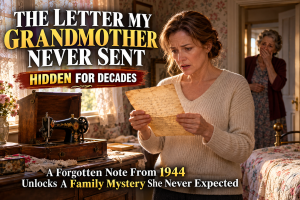
On the third day we reached the bedroom. The sewing machine sat against the far wall beneath the window, its dark wood gleaming from years of careful dusting. Eleanor had used it until her hands grew too stiff. I remembered sitting on the floor as a child watching the needle rise and fall while she hummed old hymns under her breath. The lid was closed now. I lifted it out of habit more than curiosity.
Inside, nestled beneath a folded piece of blue cotton, was a thin envelope, yellowed and soft at the edges. No stamp. No return address. Just a name written in careful black ink: Thomas R. Whitaker.
I almost put it back. Letters belonged to the person who wrote them, even after they were gone. But the date caught my eye—October 12, 1944. My grandmother would have been twenty-three. The war was still on. My mother had not yet been born.
I sat on the edge of the bed and unfolded the pages. There were four of them, written front and back in the same neat hand. She wrote about summer evenings on the porch, about a shared radio and the way the cornfields looked at dusk. She wrote about fear, and about waiting. And then she wrote about a child.
“I still see his small hands when I close my eyes,” the letter said. “They told me he would be taken somewhere safe. I have tried to believe that was true. I have tried every day.”
I stopped reading. The child’s birth date was listed clearly: March 3, 1944.
My mother had been born on July 8, 1944.
Four months later.
I sat very still. The room felt suddenly smaller. Outside the window the late afternoon light turned the fields gold. I could hear my mother moving around downstairs, the soft clink of dishes being stacked. I folded the letter carefully and slipped it back into the envelope. Then I carried it down the stairs.
She was in the kitchen, drying a plate with a faded dish towel. When she saw my face she set the plate down.
“What is it?”
I held out the envelope. “I found this in the sewing machine. It’s from 1944. There’s a name on it I don’t recognize. And there’s something about a child.”
She took it without speaking. Her eyes moved across the first page. After a moment she folded the paper once, then again, and pressed the crease with her thumb. Her voice, when it came, was quiet and steady.
“Where did you find this?”
That was the moment the ordinary work of clearing a house became something else entirely. The letter was no longer just paper. It was a door that had been closed for decades, and I had just put my hand on the handle.
My mother did not laugh. She did not dismiss it as a mistake or a story about someone else. She looked at the folded pages as if they carried a weight she had long expected but never wanted to lift. Outside, a tractor moved slowly across a distant field. Inside the kitchen, the air between us felt charged with everything that had not yet been said.
I waited. She did not open the letter again. She only asked, once more, where I had found it, and when I told her, she nodded as though the sewing machine itself had been keeping a secret she already half understood.
We stood there for a long time without speaking. The letter rested on the counter between us like an unanswered question. Somewhere in the house a floorboard settled. The past, it seemed, had decided it was time to be heard.
Part 2
My mother set the letter on the kitchen table and poured two cups of coffee that neither of us drank. She sat across from me, hands wrapped around the mug as if it could steady her. The late light slanted through the window and caught the silver in her hair. She looked older than she had that morning.
“I always wondered if she kept something,” she said finally. “She never talked about the war years the way other people did. She would change the subject. Or go quiet. I thought it was just her way.”
I asked about the name on the envelope. Thomas R. Whitaker. She shook her head. “I never heard it. Not once. Your grandfather’s name was James. They married in forty-six. Everything before that was… closed.”
She reached for the letter again but did not unfold it. Her fingers traced the edge of the paper. “March third,” she murmured. “Four months before me.”
The implication sat between us like a third person at the table. A child born in early spring of 1944. A letter written that October speaking of a child taken somewhere safe. My mother born in July of the same year. The math was simple and impossible at the same time.
“She could have been writing about someone else’s baby,” I offered, though the words felt thin even as I said them.
My mother looked at me the way she used to when I was small and trying to explain away a broken dish. “Eleanor didn’t invent stories. And she didn’t hide letters in sewing machines for no reason.”
We sat in the quiet kitchen while the sky outside deepened from gold to soft violet. I thought of my grandmother’s hands—strong, practical, always busy with something useful. I thought of the way she had hummed while she sewed, the same few hymns over and over. I had never wondered what those songs were covering.
Later that evening my mother called my uncle Robert, her younger brother. He lived in Ohio now, a retired high-school principal with a careful way of speaking. She put him on speaker. I listened as she described the letter without reading it aloud. There was a long pause on the other end.
“I remember her crying once,” Robert said. “I was maybe eight. She was in the bedroom with the door closed. When I asked what was wrong she said she was only remembering. She never said what.”
He did not know the name Thomas Whitaker either. He asked if we had looked for any other papers. My mother said we had only just begun.
After the call ended we went back upstairs. The sewing machine still stood open. I ran my hand along the wooden case and found a small compartment I had missed earlier, tucked behind the bobbin drawer. Inside were two more folded pages, thinner than the letter, written in the same hand but less steady. They were not addressed to anyone. They read more like notes to herself.
One line stopped me cold: “If I ever speak of this, it will undo the life I built. Silence is the only kindness left.”
My mother read it over my shoulder. Her breath caught. She turned away and looked out the window at the darkening fields. I could see the set of her shoulders, the way she held herself carefully, as if any sudden movement might break something fragile inside her.
We did not sleep much that night. The farmhouse felt different after dark—larger, fuller of the people who had lived in it and the things they had chosen not to say. I lay in the guest room that had once been my mother’s childhood bedroom and listened to the old house settle around me. Somewhere downstairs a clock ticked. Outside, an owl called once and then fell silent.
In the morning my mother was already at the table with a notepad. She had written the name Thomas R. Whitaker in careful block letters. Beneath it she had written the birth date of the child and the date of the letter. She looked up when I came in.
“We need to know who he was,” she said. “And we need to know what happened to that child.”
Her voice was steady, but her eyes were not. I understood then that this was no longer only about a letter. It was about the story of her own beginning, and whether the beginning she had always known was complete.
We finished our coffee in silence. Outside, the morning light returned to the fields. Inside, the past had begun to speak, and neither of us was certain we were ready to hear everything it had to say.
Part 3
The next days settled into a careful rhythm of searching and waiting. My mother and I went through every drawer, every box, every photo album in the farmhouse. We found ration books from the early forties, a few faded postcards from friends, a marriage certificate dated June 1946. Nothing that mentioned Thomas Whitaker. Nothing that explained a child born in March of 1944.
I drove into Lancaster one afternoon and spent hours at the historical society. The volunteer there, a woman named Ruth with silver glasses and endless patience, helped me search old city directories and newspaper microfilm. There was a Thomas Whitaker listed in a 1943 directory—an address on the east side of the city, occupation listed as machinist. In 1945 the listing disappeared. No death notice. No forwarding address. The trail simply ended.
Ruth suggested military records. Many young men from the area had enlisted or been drafted. She showed me how to begin a request through the National Archives. I filled out the forms that evening at the kitchen table while my mother made a simple supper of soup and bread. Neither of us ate much.
That night I read the letter again, more slowly. My grandmother’s voice on the page was younger than the woman I had known. There was longing in it, and a careful restraint. She wrote of evenings spent listening to the radio together, of the way he had fixed the porch step the summer before he left. She wrote of a promise they had made and the fear that the promise might not survive the war. And always, circling back, the child.
“They said the home was clean and kind,” one paragraph read. “They said he would have a better chance there. I signed the papers because I believed them. I still do not know if I was right.”
I closed my eyes. A home. Papers signed. A child taken somewhere safe. The language of wartime decisions made under pressure, when options were few and the future uncertain.
My mother found me still sitting at the table long after midnight. She poured two glasses of water and sat down. “You’re thinking the same thing I am,” she said.
I nodded. “That the child might have been hers. That she gave him up. And that four months later she had you.”
The words hung in the air between us. Saying them aloud made them more real and more painful. My mother stared at the letter for a long time.
“If that’s true,” she said quietly, “then I had a brother. Or at least a half-brother. Someone who grew up somewhere else, never knowing.”
She rubbed her forehead with the heel of her hand. “I keep trying to picture her at twenty-three. Pregnant. Alone, or nearly alone. Making that kind of choice. And then carrying me so soon after. How does a person live with that and never speak of it?”
I had no answer. The grandmother I had known was steady, practical, given to small kindnesses and long silences. I had never seen her cry. I had never heard her raise her voice. Now I wondered what those silences had been holding.
The following morning a thin envelope arrived from the archives request I had submitted online. It contained only a brief note saying that more time would be needed and that some records from that period remained incomplete. Progress, if it could be called that, was slow.
We kept searching. In a box of old correspondence we found a single Christmas card from 1945, unsigned, with a short message in a different hand: “I hope the quiet has been kind to you. Some things are better left where they are.” No name. No return address. My mother held it up to the light as if the paper itself might reveal more.
That evening we sat on the back porch as the sky turned the soft purple of late autumn. The fields stretched out dark and quiet. My mother spoke without looking at me.
“I always felt there was something she carried,” she said. “Not unhappiness exactly. Just a weight. I used to think it was the ordinary weight of a long life. Now I think it was this.”
I reached over and took her hand. Her fingers were cool. We stayed like that until the last light left the sky and the first stars appeared above the barn. Somewhere in the distance a dog barked once and then fell silent. The letter, still folded on the kitchen table, seemed to wait for us to decide what to do next.
We did not yet know how far the search would take us, or what it would ask of us once the answers began to arrive. We only knew that the quiet my grandmother had chosen was no longer possible. The past had been found, and it was beginning to speak.
Part 4
A week after the letter was found, my mother decided we should try to locate any living relatives of Thomas Whitaker. The directory listing from 1943 gave us a starting address. The house was still there, a modest brick row home on a quiet street. The current owner, an elderly man named Mr. Ellison, invited us in when we explained why we had come. He had bought the place in the late sixties. He remembered nothing of the previous tenants, but he allowed us to look through a box of old papers left in the attic by the former owners.
Most of it was utility bills and church bulletins. Near the bottom, though, was a small black-and-white photograph of a young man in work clothes standing beside a bicycle. On the back, in pencil: Tom, summer 1943. The face was open, a little shy, with a slight smile. My mother stared at it for a long time.
“He looks kind,” she said.
We asked around the neighborhood. An older woman two doors down remembered a family named Whitaker who had lived there briefly. The young man had gone into the service, she thought. Or maybe he had moved west after the war. She could not be certain. Memory, she said, grew soft at the edges after so many years.
I took the photograph to a local genealogist recommended by the historical society. She was a careful woman named Patricia who worked from a cluttered office filled with binders and old maps. She listened to the story without interruption, then began making notes. Within a few days she called with a possible lead.
Thomas Raymond Whitaker, born 1921 in Lancaster County. Drafted in early 1944. Assigned to a unit that trained in the South before shipping overseas later that year. No record of marriage in Pennsylvania. A possible discharge record from 1946 listing an address in Ohio. After that, the trail thinned again.
Ohio. My uncle Robert lived in Ohio. The coincidence felt thin, but my mother called him anyway. He listened, then said he would ask around among the older members of his church and the local historical group. A few days later he called back. There had been a Thomas Whitaker who worked for a time at a tool-and-die shop near Dayton in the late forties. He had kept to himself. People remembered him as quiet and reliable. He had left the area sometime in the early fifties. No one knew where he had gone.
We were gathering pieces, but they did not yet form a picture. The child remained the largest missing piece. If Eleanor had given a baby to a home in the spring of 1944, there might still be records. Adoption files from that era were often sealed, but sometimes fragments survived in church or agency archives.
My mother and I drove to the county seat and spent an afternoon in the basement of the old courthouse going through birth registers. March 1944 produced several entries for male infants with no father’s name listed. One entry, dated March 5, listed the mother’s name as E. M. Hale. The child’s name was left blank. A notation in the margin read simply: “Released to care.”
My mother sat very still when she saw it. The air in the records room felt suddenly thin. She touched the page with one finger, as if confirming it was real.
“Released to care,” she repeated. “That’s all it says.”
The clerk, a kind woman who had helped us for hours, explained that further details would be in closed files if they still existed at all. Many wartime placements had been informal or handled through private agencies. Tracking them could take months, or longer, or never succeed.
We left the courthouse in silence. In the car my mother rested her head against the window and closed her eyes. “She was twenty-three,” she said. “Alone with a baby she couldn’t keep. And then, four months later, pregnant again. With me.”
I drove us home along the back roads. The fields were turning brown. Harvest was nearly finished. I thought of my grandmother at that age—young, frightened, making a choice that would shape the rest of her life and the lives of people who had not yet been born. I thought of the letter she had written months later, still trying to believe the child was safe.
That night my mother opened the letter again and read every page aloud. Her voice did not break, but it grew quieter as she reached the final lines.
“I will not write again,” Eleanor had finished. “Some doors must stay closed if the life that follows is to stand. I hope you understand. I hope the child is well. I hope, someday, that silence will feel like peace instead of absence.”
When she finished, the kitchen was very quiet. Outside, the wind moved through the bare trees. Inside, we sat with the knowledge that the silence my grandmother had chosen had lasted more than seventy years—and that we were the ones who had finally broken it.
Part 5
Winter came early that year. By mid-November the fields around the farmhouse were dusted with frost each morning. My mother and I stayed on longer than we had planned. Clearing the house had become secondary to the quieter, harder work of understanding the letter and what it asked of us.
I spent evenings online, following every thin thread. Military records slowly trickled in. Thomas Whitaker had served in the European theater. He had been wounded lightly in the spring of 1945 and returned to the States the following year. A discharge paper listed a forwarding address in a small town in western Pennsylvania, not far from where we were. I drove there on a gray Saturday.
The address belonged to a boarding house that had long since become private apartments. The current residents knew nothing of the 1940s. At the town library I found a single mention in a 1947 local paper: Thomas Whitaker had spoken briefly at a veterans’ meeting about the need for quiet after the noise of war. No further details. No photograph. The trail, once again, grew cold.
Meanwhile my mother had begun writing letters of her own—to the state archives, to adoption advocacy groups that specialized in mid-century records, to a few private investigators who handled family-history cases. Most replies were polite and unhelpful. One, from a woman who had spent decades helping people navigate sealed files, offered a careful note of encouragement. Sometimes, she wrote, the truth surfaced in unexpected places. Sometimes it never did. The work required patience and a willingness to accept incomplete answers.
We talked often in the evenings, sitting in the living room with the old radio playing softly in the background the way my grandmother had liked. My mother spoke of her childhood in the farmhouse—of the long summers, the careful routines, the sense that certain subjects were simply not raised. She had never questioned it. Children rarely do. Now every quiet moment from those years seemed to carry a different weight.
“I used to ask about her parents,” my mother said one night. “She would tell me small things—how her father grew tomatoes, how her mother could stitch a hem so fine you could barely see it. But if I asked about the years just before she married my father, she would smile and change the subject. I thought she was only private. I didn’t understand she was protecting something.”
I asked whether she was angry. She considered the question for a long time.
“I don’t know yet,” she said. “I feel sad more than anything. Sad for her. Sad for the child, whoever he became. Sad that she carried it alone for so many years. Anger might come later. Or it might not. Right now I just want to know what happened.”
In early December a thin package arrived from the genealogist. Inside was a photocopy of a 1944 agency ledger page, partially redacted. The entry for March 5 listed a male infant, mother E. Hale, released to a private placement arranged through a church-affiliated home in central Pennsylvania. The receiving family’s name had been blacked out. A single notation remained visible in the margin: “Healthy. Quiet placement preferred.”
My mother held the page under the lamp and studied the blacked-out lines as if sheer concentration might reveal what lay beneath. “Quiet placement,” she said. “They wanted it quiet. And she agreed.”
We sat with that knowledge for several days. The idea of a child growing up somewhere not far away, perhaps still living, perhaps with children and grandchildren of his own, was both hopeful and painful. If he was still alive he would be in his early eighties. He might have spent a lifetime wondering about his origins, or he might have never wondered at all.
I contacted the church organization listed in the ledger. A kind archivist named Sister Margaret replied after two weeks. The records from that period, she explained, were incomplete. Many placements had been handled with minimal documentation to protect all parties. She could confirm that a child matching the description had been placed in March 1944, but she could not release identifying information without a court order or the consent of living parties. She offered, carefully, to forward a letter if we wished to write one that could be held in case a matching inquiry ever arrived from the other side.
My mother and I spent an evening drafting that letter together. We kept it simple. We explained who we were. We described the letter found in the sewing machine. We said we sought only understanding and, if possible, the chance to know whether the child had lived a good life. We did not ask for names or addresses. We asked only that the letter be kept, and that if the time ever came when the other side wished to know more, the path would be open.
Sister Margaret wrote back to say the letter had been filed. Whether it would ever be read by anyone connected to the child was impossible to know.
That night, after my mother had gone to bed, I sat alone in the kitchen with the original letter. I imagined my grandmother at the same table, younger, writing those careful pages by lamplight. I imagined the weight of the decision she had already made and the life she was trying to build afterward. Silence, she had written, was the only kindness left. I wondered whether, after all these years, kindness might look different.
Outside, the first real snow of the season began to fall. Soft flakes drifted past the window and settled on the dark fields. Inside, the house held its quiet. The letter rested on the table, no longer hidden, but still only partially understood. We had come further than we expected. The rest of the distance remained unknown.
Part 6
January brought a different kind of cold. The farmhouse settled into its winter silence. My mother and I continued the slow work of sorting the last of my grandmother’s belongings, but the letter and the questions it raised stayed close to the surface of every day.
One afternoon while clearing a high shelf in the hallway closet I found a small tin box I had never seen. Inside were a few pieces of jewelry, a dried corsage, and a single photograph wrapped in tissue. The photo showed a young woman who was unmistakably Eleanor, standing on a porch with a man whose face matched the picture we had found of Thomas Whitaker. They were not touching, but the space between them felt intimate. On the back, in pencil, a single word: Summer.
My mother held the photograph for a long time. “She kept this,” she said. “All those years. She kept his face.”
We added it to the small collection of documents we had gathered—the letter, the ledger page, the discharge record, the notes from the genealogist. Together they formed a fragile outline of a story that still had large empty spaces.
In late January my uncle Robert called with unexpected news. While going through some of his own old papers he had found a letter his mother had written to him in the 1970s, shortly after he moved to Ohio. In it she mentioned, almost in passing, that she had once known a man who settled near Dayton after the war. She did not name him. She only said that some connections were better left in the past, and that she hoped Robert would understand if she never spoke of certain things. Robert had forgotten the letter until now. Reading it again in light of what we had found, the reference felt deliberate.
“She was warning me,” he said on the phone. “Or protecting me. Or both.”
The coincidence of Dayton—where Thomas Whitaker had briefly worked—felt stronger now. Robert offered to dig deeper among local records and older residents. We accepted the help gratefully.
Meanwhile my mother began to speak more openly about her own early memories. She remembered a time when she was perhaps five or six when a man had come to the farmhouse door. Her mother had spoken with him on the porch for a long time. When she came back inside her eyes were red, but she said only that it had been someone asking for directions. My mother had never questioned it. Now she wondered.
“I don’t know if it was him,” she said. “I don’t even know if I remember the face. But the feeling stayed—something important had happened, and we were not going to talk about it.”
I asked whether she wanted to know the full truth even if it proved difficult. She did not answer immediately. When she did, her voice was quiet but clear.
“I want to know what she lived with. I want to understand the choice she made. And if the child is still alive, I want him to know—if he wishes to know—that he was not forgotten. That someone kept a letter. That someone still wondered.”
The words settled between us with a kind of gentle finality. The search was no longer only about solving a puzzle. It had become an act of recognition—for Eleanor, for the child she had released, and for the family that had grown in the space that silence left behind.
In February a letter arrived from Sister Margaret. She wrote that an inquiry had been received some years earlier from a man seeking information about a possible placement in 1944. The details were incomplete, and at the time no matching record had been confirmed. She had, however, retained the contact information. With our permission, she was willing to reach out and ask whether the man still wished to be connected.
My mother and I sat at the kitchen table and read the letter twice. The possibility felt both sudden and long-awaited. We gave our permission that same afternoon.
Waiting for a reply tested us in new ways. Days passed. Then a week. Then another. We tried to keep the ordinary work of the house moving forward—packing the last boxes, deciding which pieces of furniture would go to family and which would be sold. But the waiting colored everything.
One evening my mother found me standing at the sewing machine, running my hand along the wooden lid. “She hid it here for a reason,” she said. “Maybe she hoped someone would find it when the time was right. Or maybe she hoped no one ever would. I don’t think we’ll ever know which.”
I closed the lid gently. The machine had kept its secret for decades. Now the secret was out in the open, and we were learning how to live with the questions it left behind.
On a cold morning in early March—almost exactly eighty-one years after the child’s birth—an email arrived from Sister Margaret. The man who had inquired years earlier was still living. He was open to contact. His name was Daniel. He had been raised by a kind couple in central Pennsylvania. He had always known he was adopted. He had never known the names of his birth parents.
My mother read the email aloud. When she finished, the kitchen was very still. Outside, the first hints of thaw were beginning to soften the edges of the fields. Inside, something that had been closed for a lifetime was beginning, carefully, to open.
We sat with the news for a long time before either of us spoke. When my mother finally did, her voice carried both wonder and caution.
“We have to be careful,” she said. “For him. For us. This is not a story that can be rushed.”
I nodded. The next step would require patience, honesty, and a willingness to accept whatever shape the truth finally took. The letter had brought us this far. The rest of the journey would be made together, one careful conversation at a time.
Part 7
The first exchange of letters with Daniel was handled through Sister Margaret. We wrote simply, introducing ourselves and explaining how the original letter had been found. We included a photocopy of Eleanor’s handwriting and the photograph of her with Thomas Whitaker. We asked nothing beyond the chance to share what we knew and to listen to whatever he wished to share in return.
His reply arrived two weeks later. The handwriting was steady, the tone measured and kind. He wrote that he had grown up on a small farm not far from the one where Eleanor had lived. His adoptive parents had been open about his origins from the beginning. They had told him only that his birth mother had been young and that she had wanted him to have a stable home. He had never pressed for more. In his sixties he had begun to wonder, quietly, and had made the inquiry that Sister Margaret still held. Life had intervened—work, family, the ordinary demands of years—and he had not followed up. Receiving our letter, he said, felt like the closing of a circle he had not expected to see completed.
He asked whether we would be willing to meet.
My mother and I discussed it for several days. The idea carried both hope and a kind of reverent caution. This was not a reunion of the sort people saw in films. It was the careful meeting of people whose lives had been shaped by a decision made in wartime, under pressures we could only partially understand. We agreed to meet in a neutral place—a quiet café in a town halfway between us.
The day of the meeting was clear and cold. My mother wore a simple blue sweater she had loved for years. I drove. Neither of us spoke much on the way. When we arrived, Daniel was already there—a tall man in his early eighties with white hair and the same quiet set of the shoulders I had seen in the old photograph of Thomas Whitaker. He stood when we entered and offered his hand.
“Thank you for coming,” he said.
We sat for nearly three hours. Conversation moved carefully at first—where we lived, what work we had done, the ordinary details that let strangers begin to feel less strange. Gradually the talk turned toward the past. Daniel spoke of his adoptive parents with clear affection. They had given him a good life, steady and kind. He had married, raised two children, worked as a teacher. He had been happy. Still, he said, there had always been a quiet space in him that wondered about the beginning.
My mother told him about Eleanor—the farmhouse, the sewing machine, the long silence, the letter written in 1944. She showed him the original pages. He held them gently, reading the lines about the child taken somewhere safe. When he finished, he looked up with eyes that were bright but composed.
“She hoped I was safe,” he said. “I was. I want her to know that, if there’s any way left to say it.”
He asked about Thomas Whitaker. We shared what little we had learned. Daniel listened without interrupting. At one point he said, almost to himself, “I always wondered if there was a father who knew. Or if he never did.”
We had no certain answer. The records remained incomplete. What we knew was only a partial map. Still, the act of sitting together, of placing the pieces side by side, felt like a kind of completion neither of us had expected to reach.
Near the end of the meeting Daniel took a small envelope from his coat pocket. Inside was a photograph of himself as a boy of about five, standing in a field with a dog. “My parents took this the year they told me I was adopted,” he said. “I thought you might like to see the child she wrote about.”
My mother accepted the photograph with both hands. For a moment she could not speak. When she did, her voice was low and steady.
“She would have been glad,” she said. “I believe that.”
We parted with an agreement to stay in contact, carefully and without pressure. No one promised more than they could give. The meeting had not erased the years of silence or the difficult choices that had shaped them. It had simply allowed the silence to become something shared rather than solitary.
On the drive home my mother was quiet for a long time. When she finally spoke, she looked out at the winter fields and said, “I keep thinking about her writing that letter and then putting it away. She must have believed the story was finished. And now here we are, still living inside it.”
I reached over and touched her arm. The road stretched ahead, familiar and changed at the same time. Behind us, a man who had once been a child taken somewhere safe was driving back to his own life. Ahead of us, the farmhouse waited with its remaining boxes and its long memory. The letter that had started everything rested in my mother’s bag, no longer a secret, but a bridge.
We did not know yet how the story would settle in the months to come. We only knew that the first careful steps had been taken, and that the past, once opened, could not be closed again in the same way.
Part 8
In the weeks after the meeting, letters and brief phone calls continued between us and Daniel. The exchanges remained gentle and measured. He sent photographs of his children and grandchildren. My mother sent a few images of Eleanor in later years—smiling in the garden, standing beside the sewing machine, holding me as a baby. Each small sharing felt like the careful placement of stones across a stream that had once seemed too wide to cross.
My mother began to speak more freely about what the discovery meant for her own sense of self. One evening as we packed the last of the books from the living-room shelves, she paused with a volume of poetry in her hands.
“I used to think my beginning was simple,” she said. “Two people who loved each other, a wedding, a baby. Now I know there was another beginning before mine—a different kind of love, a different kind of choice. It doesn’t erase what came after. But it changes the light I see it in.”
I asked whether she felt the letter had given her something or taken something away. She considered the question while sliding the book into a box.
“Both,” she said. “It took the clean story I thought I had. It gave me a more honest one. And it gave me a brother I never expected. That feels like a gift, even if it arrives late.”
Daniel, for his part, seemed to move through the new knowledge with a quiet steadiness. In one letter he wrote that he had always felt a certain restlessness in early spring—an unnamed longing that arrived with the first thaw. He had never connected it to anything specific. Now he wondered whether some part of him had always carried the memory of a decision made in another March long ago. He did not claim certainty. He only noted the feeling and let it stand.
In April we invited him to the farmhouse. He came on a bright Saturday when the fields were beginning to green. My mother had set the table with the good dishes. We walked him through the rooms, showing him the places Eleanor had lived and worked. He stood for a long time in front of the sewing machine. When he touched the wooden lid, his hand was steady.
“This is where she kept the letter,” he said. It was not a question.
Later we sat on the porch. The conversation moved easily between past and present. Daniel spoke of his adoptive father’s habit of whistling while he worked, of the way his mother had taught him to read by the stove in winter. My mother spoke of Eleanor’s quiet routines, her love of order, the way she had planted the same flowers every spring. I listened more than I spoke, aware that I was witnessing something rare—the careful weaving together of two lives that had once been separated by necessity and silence.
Before he left, Daniel asked if he could see the original letter once more. My mother brought it out. He read it slowly, then looked up.
“She wrote that silence was the only kindness left,” he said. “I think she was right for the time she lived in. But I’m glad the silence didn’t last forever.”
After he drove away, my mother and I remained on the porch as the afternoon light softened. The house behind us felt different—less a place of unanswered questions and more a place where questions had been allowed to breathe. We still did not know everything. The full story of Thomas Whitaker remained incomplete. The exact circumstances of the placement might never be recovered. Yet what we did know felt sufficient in a way that surprised us both.
That evening my mother took out a pen and a sheet of paper. She began to write a letter of her own—not to Daniel, not to any living person, but to Eleanor. She wrote for nearly an hour. When she finished she folded the pages and placed them inside the sewing machine, in the same small space where the original letter had waited for so many years.
“I wanted her to know we found it,” she said. “And that the child was safe. And that we understand, as much as anyone can.”
I did not ask to read what she had written. Some words are meant for the person who writes them and the person they are written to, even across time. I simply helped her close the lid of the sewing machine. The soft click of the latch sounded final and gentle at the same time.
Outside, the evening star appeared above the barn. Inside, the house held its new quiet—not the silence of secrets kept, but the quieter peace of secrets shared and honored. The story was not finished. Stories of this kind rarely are. But it had found a place to rest, at least for a while, and that felt like enough.
Part 9
As spring deepened into early summer, the practical work of closing the farmhouse came to its natural end. The last boxes were labeled. The furniture that would stay in the family had been claimed. The sewing machine, by quiet agreement, would remain where it had always stood. My mother said she could not imagine the room without it.
Daniel continued to write. In one letter he described a conversation he had with his own children after the meeting. They had listened with interest and without judgment. One of his granddaughters, a girl of twelve, had asked whether the woman who wrote the letter would have liked to meet him. Daniel had answered that he believed she would have, if the world she lived in had made such a meeting possible. The granddaughter had nodded solemnly and said that sometimes people have to wait a very long time for the right kind of quiet to arrive.
My mother smiled when she read that part aloud. “Out of the mouths of children,” she said.
We began to plan a small gathering—nothing formal, just a day when Daniel and his family might come to the farmhouse and walk the land Eleanor had loved. The invitation was extended carefully, with the understanding that no one was obligated. When the reply came accepting, my mother spent an afternoon in the garden planting the same flowers her mother had always planted—zinnias, cosmos, a few rows of beans along the fence.
On the day of the gathering the weather was kind. Soft clouds moved across a blue sky. Daniel arrived with his daughter and two grandchildren. My uncle Robert drove in from Ohio. For a few hours the farmhouse held more voices than it had in years. We ate simple food on the porch. The children explored the barn and the edge of the fields. The adults talked in the unhurried way of people who have decided that the past does not need to be solved completely in order to be respected.
At one point Daniel’s granddaughter asked to see the sewing machine. My mother led her upstairs. I followed at a distance. The girl stood in front of the open machine and looked at the place where the letter had been hidden. She did not touch anything. After a moment she said, “It’s like she left a message for later.”
My mother rested a hand on the girl’s shoulder. “I think that’s exactly what she did.”
Later, as the afternoon began to cool, we walked together to the small rise behind the house where Eleanor had liked to watch the sunset. No one spoke for a while. The light turned the fields gold the way it had on the day the letter was found. Daniel stood with his hands in his pockets, looking out at the land.
“She chose safety for me,” he said quietly. “And then she chose a life here. Both choices took courage. I don’t think I understood that until now.”
My mother nodded. “I used to think courage always looked like speaking. Sometimes it looks like protecting what can still be protected.”
The words settled over us like the soft evening air. We did not need to agree on every interpretation of the past. It was enough that we had stood in the same place, looking at the same fields, and allowed the story to be larger than any one of us.
When the gathering ended and the cars pulled away down the lane, my mother and I remained on the porch as the first stars appeared. The house behind us was nearly empty of its long accumulation of objects, yet it felt fuller than it had in months. The letter had done its work. It had connected people across time. It had allowed a silence to become a conversation. It had given a name and a face to a child who had once been only a line in a hidden page.
That night I found my mother sitting at the kitchen table with the original letter open in front of her. She was not reading it. She was simply keeping it company, the way one might sit with an old friend after a long separation.
“I’m going to leave it here,” she said when she noticed me. “In the sewing machine, with the letter I wrote. If someone finds them years from now, they’ll know the story continued. And that it was allowed to continue with kindness.”
I sat down across from her. The kitchen light was soft. Outside, the night held the quiet of early summer. Inside, two women who had inherited a secret sat with the evidence of it and felt, for the first time, that the secret no longer needed to be heavy.
The past had been given its due. The present had been allowed to breathe. What remained was the ordinary, precious work of living forward—carrying the knowledge without letting it close the heart.
We turned off the light and went upstairs. The sewing machine stood in its place, lid closed, holding its new and old pages together in the dark. Somewhere beyond the fields, a life that had begun in uncertainty had found its way to this moment of recognition. The letter my grandmother never sent had, in the end, been received.
Part 10
By the time the farmhouse was ready to close, the season had turned fully to summer. The fields were green. The garden my mother had planted was beginning to bloom. We stood together in the empty kitchen on the last morning and looked around at the clean surfaces, the swept floors, the windows open to the warm air.
“She would have liked this,” my mother said. “Not the empty rooms. The fact that we finished the work carefully.”
I nodded. The letter remained in the sewing machine upstairs, joined now by the pages my mother had written and a brief note from Daniel that he had asked us to keep with the rest. The collection felt complete in a way that no longer required further searching.
In the months that followed, life resumed its ordinary rhythms. My mother returned to her own house. I returned to the city. We spoke often. Sometimes the conversation turned to Eleanor and the letter; more often it turned to the present—work, weather, the small news of daily life. The past had been honored. It did not need to dominate every hour.
Daniel and his family stayed in gentle contact. Cards arrived at Christmas. A photograph of a new great-grandchild was shared in the spring. Once, on the anniversary of the day the letter was found, my mother received a short note from him. He wrote that he had walked in his own fields that morning and thought of the woman who had chosen safety for him. He hoped she had found peace in the life she built afterward. He believed she had.
My mother kept the note with the others.
Two years after the discovery, we returned to the farmhouse for a brief visit. The new owners had kept the sewing machine in its place by the window. They were kind people who understood that some objects carry more than wood and metal. My mother asked if she might open the lid for a moment. They stepped back politely.
She lifted the lid and rested her hand on the smooth wood. She did not remove the letters. She only stood there, quiet, while the afternoon light moved across the floor the way it always had. When she closed the lid again, her face was calm.
“It’s enough,” she said.
On the drive home we spoke of ordinary things—the traffic, a book she was reading, the way the light looked on the river as we crossed. The large questions had been asked and answered as fully as they could be. What remained was the quieter knowledge that a difficult choice made long ago had led, in time, to connection rather than only to loss.
I think often of the young woman who sat at that table in 1944 and wrote pages she never sent. I think of the courage it took to release a child into uncertainty, and the further courage it took to build a life afterward without speaking of the cost. I think of the man who grew up safe, and the daughter who grew up loved, and the granddaughter who found a letter in a sewing machine and refused to look away.
The story did not end with a single revelation or a perfect resolution. It ended the way most true stories end—with people choosing, again and again, to meet the past with honesty and the present with care. The letter my grandmother never sent became, in the end, a letter that reached further than she could have imagined. It reached across decades. It reached across silence. It reached into the lives of people who needed to know that love, even when it must make hard choices, still leaves a trace.
On quiet evenings I sometimes picture the farmhouse as it stands now—lights in the windows, the sewing machine in its place, the fields stretching out under the same sky. Somewhere in that picture the past and the present sit together without strain. The child who was taken somewhere safe grew into a man who was found. The woman who kept the secret was, at last, understood. And the family that inherited the silence learned how to turn it into something that could be shared.
That is the ending the letter made possible. Not a perfect circle, but a circle that closed with kindness. Not every question answered, but enough answered to allow the heart to rest. And in that rest, a kind of peace that feels earned, quiet, and true.
The sewing machine keeps its pages still. The fields keep their seasons. And the people who found the letter continue forward, carrying the knowledge the way one carries a valuable thing—carefully, gratefully, and without the need to hide it any longer.