Three months after the night my car left the driveway without me, the dashcam quietly saved the proof. I had been out of town. No one in my family had the keys. Yet someone was driving. When the dealership technician looked closer, he revealed the dashcam was not the only system that had recorded every mile of that unexplained trip.
Part 1
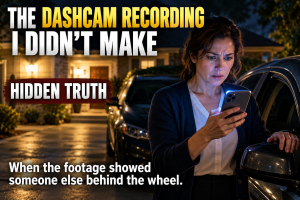
The notification appeared on my phone on a quiet Tuesday morning while I was still in my robe, coffee growing cold on the kitchen counter. My dashcam app had automatically uploaded a new file. I almost deleted it without looking. The date stamp stopped me. Three months earlier. A night I could not place.
I opened the video. The screen filled with the familiar view from the windshield of my silver sedan. Streetlights slid past in soft yellow arcs. The timestamp in the corner read 1:12 a.m. My driveway. The gate I always locked. And then the car began to move.
I watched the entire clip twice. The vehicle pulled out of the driveway, turned left onto the residential street, and continued for several blocks before the recording cut off. The driver’s hands were visible on the wheel for brief moments, but the face stayed just outside the camera’s reach. Someone was driving my car.
I set the phone down and stared at the dark kitchen window. Three months earlier I had been in Portland for a long weekend visiting my sister. Flight records, hotel confirmation, and a dozen photos of us laughing over seafood confirmed it. I had not been home. I had not driven anywhere that night.
The first explanation that came to mind was practical. Someone must have borrowed the car. My brother lived twenty minutes away. My college-age nephew sometimes needed a vehicle when his own was in the shop. My mother still had a spare set of keys from when she stayed with me after her knee surgery two years ago. Any of them could have taken it.
I sent a group text. Casual. No accusation. Just a question about whether anyone had used the car around that date. Replies came quickly. My brother: “Not me. Haven’t touched it in months.” My nephew: “No way, Aunt Claire. I was at work.” My mother: “The keys are still in the drawer, honey. I never took them out.”
I walked to the key drawer in the kitchen and opened it. The spare set sat exactly where it always did, tagged with a small blue label that read “Mom.” My own primary keys hung on the hook by the door. No one had taken them. No one in my family had driven the car.
The video played again on my phone, the headlights cutting through the dark street. I felt a slow, cold pressure settle under my ribs. Someone had been inside my house, taken the car, and returned it without leaving any obvious sign. Or they had never needed keys at all.
That afternoon I drove to the dealership where I had bought the car two years earlier. The service department was quiet. A young technician named Marcus took the USB drive I had copied the file onto and plugged it into his diagnostic screen. He watched the footage once, then checked the vehicle’s internal logs.
He looked up at me with an expression that was carefully neutral. “The dashcam wasn’t the only system that recorded this trip,” he said. “Your car has a connected services package. Location history, ignition events, door sensors. All of it is still in the system.”
I asked him to show me. He turned the screen so I could see the data. Ignition on at 1:09 a.m. Doors unlocked at 1:07 a.m. The car left the driveway, drove for forty-seven minutes, and returned at 1:56 a.m. The doors locked again at 1:58 a.m. No key fob signal was registered. The system showed the car had been started with a digital key.
I did not own a digital key. I had never set one up. Marcus checked the connected account. One additional device had been authorized three months and four days earlier. The authorization had been deleted two days after the night in question.
Someone had given themselves access to my car, driven it, and then erased the trail. The only remaining proof sat on the dashcam file that had quietly waited in the cloud for three months before uploading.
I left the dealership with a printed report and a growing certainty that the person who drove my car that night had known exactly how to disappear afterward. The question that followed me home was simpler and heavier: who had been sitting in the driver’s seat while I slept in a hotel four hundred miles away?
Part 2
That evening I sat at the kitchen table with the printed report spread in front of me. The digital key authorization had been created using an email address I did not recognize. A string of letters and numbers that looked randomly generated. No name. No recovery phone number. Just a temporary account that had been closed almost immediately after the drive.
I called the customer support line for the connected services package. After twenty minutes of transfers and hold music, a supervisor named Denise confirmed what Marcus had already told me. The authorization had been made from a mobile device using a one-time verification code sent to a phone number that was no longer active. The number itself had been a prepaid line purchased with cash at a convenience store two towns over.
Denise offered to lock the account and remove any remaining permissions. I asked her to do it while I waited on the line. When she finished, she asked if I wanted to file a formal incident report with their security team. I said yes. She gave me a case number and told me someone would call within forty-eight hours.
After the call I walked through the house with a new kind of attention. The back door lock looked the same. The windows were latched. Nothing appeared disturbed. Yet someone had entered, or at least had gained the ability to start my car without a physical key. The thought made the familiar rooms feel less solid.
I checked the security camera footage from the porch. The system only kept thirty days of video. The night in question was long gone. I scrolled through the remaining files anyway, looking for anything unusual in the weeks before or after. Nothing stood out. Delivery drivers. A neighbor’s dog. My own arrivals and departures.
Sleep came late and shallow. At 3:17 a.m. I woke with the image of those hands on the steering wheel still clear in my mind. The next morning I drove to the convenience store where the prepaid phone had been purchased. The clerk, a tired man in his fifties, remembered nothing about a customer from three months earlier. He suggested I speak with the manager, who would not be in until the afternoon.
I left my number and returned home. The case number from the connected services company sat on a sticky note on the refrigerator. I stared at it while I made toast I did not eat. The more I examined the timeline, the clearer one fact became. Whoever had done this had planned carefully. They had known I would be out of town. They had known how to create temporary access. And they had known how to erase most of the evidence.
That afternoon the manager of the convenience store called. He had pulled the transaction records. The prepaid phone had been bought with cash at 9:42 p.m. on a Thursday. The customer had paid for the phone and a bottle of water. The security camera above the register had captured a person in a dark hoodie and a baseball cap pulled low. The face was never fully visible. The person left the store and walked out of frame toward the parking lot.
I asked if he could send me a still image. He said company policy required a formal request through their corporate office. I thanked him and hung up. The image would probably show nothing useful, but the detail stayed with me. A hoodie. A baseball cap. Cash. Someone who did not want to be remembered.
Later that day I received a call from the security team at the connected services company. A woman named Priya introduced herself and confirmed the case number. She had already reviewed the logs. She told me the digital key had been used only once. The night of the unexplained drive. After that, the authorization was removed and the temporary account closed. No other activity. No other vehicles. Just that single forty-seven-minute trip.
Priya asked if I had any idea who might have done it. I said no. She asked if I lived alone. I said yes. She was quiet for a moment, then suggested I consider changing the locks on the house and adding a camera system that retained footage longer than thirty days. She also recommended I notify the local police and file a report, even if it felt thin on evidence.
I sat in the quiet living room after the call and tried to decide what I was more afraid of: the idea that a stranger had been inside my life for one night, or the possibility that it was not a stranger at all.
Part 3
The police report took forty minutes. The officer who took my statement was polite and thorough. He copied the dashcam file, the printed logs from the dealership, and the case number from the connected services company. He asked the same questions Priya had asked. Did I have any idea who it might be. Did I have any recent disputes. Had anyone shown unusual interest in the car or the house.
I answered honestly. No. Nothing I could point to. He wrote everything down and gave me a report number. He said they would look into it, but without a clear suspect or more physical evidence, progress might be slow. He suggested I keep an eye on my accounts and report any further unusual activity.
I left the station with the report number in my purse and a strange sense of having done something and nothing at the same time. The drive home felt longer than usual. Every time I stopped at a light I found myself checking the rearview mirror, half expecting to see a familiar face or a dark hoodie.
That evening my sister called from Portland. I had not told her about the recording yet. When she asked how I was, the whole story came out in a rush. She listened without interrupting. When I finished she was quiet for several seconds.
“Claire,” she said finally, “is there anyone who might have a reason to want access to your car? Even someone you trust?”
The question hung between us. I thought of the people closest to me. My brother. My nephew. My mother. A few close friends. None of them made sense. None of them needed to hide.
“I don’t know,” I said. “That’s the part that keeps me awake.”
She offered to fly out if I needed her. I told her I would call if things changed. After we hung up I sat on the couch with the television on mute and the printed logs open again. Forty-seven minutes. Where had the car gone?
I opened a mapping app and tried to reverse-engineer the route from the location pings in the report. The data was not continuous. It showed the car leaving the driveway, then a gap, then a cluster of points near a commercial area on the edge of town, then another gap, then the return. The commercial area contained a mix of storage units, a late-night diner, and a small industrial park that closed early.
The next morning I drove there. The storage facility had a gate that required a code. The diner was open for breakfast. I sat at the counter and ordered coffee I did not drink. The waitress was friendly. When I asked if she remembered anything unusual three months earlier, she laughed and said the place saw a lot of late-night regulars and she would not remember a specific car.
I left and walked the perimeter of the industrial park. Empty loading docks. A few parked trucks. Nothing that explained why someone would take my car there at 1:12 in the morning. On the way back to my vehicle I noticed a small camera mounted under the eave of a neighboring building. It looked like a private security system. I took a photo of the address and made a note to check later.
Back home I contacted the connected services company again and asked whether the location data could be expanded. Priya returned my call within an hour. She said the system only stored the pings that had already been provided. No additional detail. She did, however, have one new piece of information. The digital key authorization had been created using a device that had also connected briefly to a public Wi-Fi network at a coffee shop two days before the drive. The coffee shop was on the other side of town from my house.
I drove there that afternoon. The place was busy with students and freelancers. I ordered a tea and sat near the window, watching people come and go. The idea that someone had sat in this same room planning access to my car felt both distant and strangely intimate. I left without speaking to anyone. There was nothing to say.
That night I changed every password connected to the car and the house. I ordered a new set of deadbolts online. I set a reminder to call a locksmith in the morning. The practical steps helped a little. The larger question remained. Someone had wanted my car for less than an hour in the middle of the night, and they had gone to considerable trouble to make sure I would not know until months later.
I lay in bed listening to the quiet house and wondered what else they might have done that I had not yet discovered.
Part 4
The locksmith came the next morning. While he worked on the doors I sat at the kitchen table and made a list of every person who had been inside the house in the six months before the incident. Friends who had stayed for dinner. The plumber who fixed the kitchen sink. The woman who cleaned every other Thursday. My nephew when he dropped off a package for my mother. The list was longer than I expected and still felt incomplete.
When the locksmith finished he handed me the new keys and a short lecture about not hiding spares under mats or flower pots. I nodded and paid him. After he left I walked through each room again, looking for anything that felt out of place. Nothing did. The house looked exactly as it always had. That, somehow, made the intrusion feel worse.
In the afternoon I received an email from the connected services security team. They had completed their internal review. The temporary account had been created using a virtual private network, which made the original IP address untraceable. The prepaid phone number had been deactivated within forty-eight hours of purchase. They had no further leads and would close the case on their end unless new information appeared. They apologized for the inconvenience and offered a complimentary year of their premium monitoring service.
I stared at the email for a long time. Inconvenience. The word sat badly. Someone had driven my car while I was four hundred miles away, and the official response was an apology and a free upgrade.
That evening my brother stopped by unannounced. He had heard the short version from our mother and wanted the full story. I showed him the dashcam footage and the printed logs. He watched in silence, then asked the same questions everyone else had asked. When I finished he sat back and rubbed his face.
“You know this means someone was either inside the house or close enough to get a digital key working,” he said. “That’s not nothing, Claire.”
I nodded. “I know.”
He offered to stay for a few nights. I told him I would be fine. He looked unconvinced but did not push. Before he left he checked the new locks himself and made me promise to call if anything else unusual happened.
After he was gone I opened the mapping app again and stared at the cluster of location points near the commercial area. On a whim I searched for any news or police reports from that night in the surrounding blocks. Nothing. No accidents. No break-ins. No mentions of a silver sedan.
I was about to close the laptop when a thought surfaced. The dashcam had recorded the departure and part of the drive, but it had cut off before the return. The connected services log showed the full timeline. If the car had stopped somewhere long enough, there might be another camera that had caught more than the dashcam did.
The next day I returned to the industrial park and the neighboring building with the private camera. The business was a small auto-parts warehouse. The woman at the front desk was cautious but not unfriendly. When I explained the situation she asked me to wait while she spoke with the owner.
The owner, a man in his sixties named Ray, listened to the story without interrupting. When I finished he said he would check the archived footage for that night, but only if I brought the police report number and identification. He was not interested in getting involved in anything that looked like trouble. I agreed and left with his card.
At the police station I requested a copy of the report. The officer at the desk recognized my name from the earlier visit and printed it quickly. I drove back to the warehouse and handed Ray the papers. He studied them, then nodded and led me into a small office where a computer monitor showed a grid of camera feeds.
He scrolled through the archive until he found the correct date. The camera covered the side of the building and a portion of the access road. At 1:31 a.m. a silver sedan matching mine appeared at the edge of the frame. It slowed, then pulled into a shadowed area just out of clear view. The headlights went off. Three minutes later the headlights came back on and the car left the way it had come.
Ray paused the video and zoomed. The image was grainy. The driver’s side window was down a few inches. A figure sat behind the wheel, but the quality was too poor to make out features. What was clear was the timing. The car had stopped for only a few minutes in a place with almost no cameras and almost no traffic.
Ray burned a copy of the clip to a USB drive and handed it to me. “I don’t know what this is,” he said, “but I hope you find out.”
I thanked him and drove home with the new file sitting on the passenger seat like another unanswered question.
Part 5
I spent the evening comparing the new footage with the original dashcam recording. The timelines matched. The car had left my driveway, driven to the industrial area, stopped briefly in the shadow of the warehouse, and returned. Whatever had happened in those three minutes had been deliberate and quick.
I uploaded both videos to a private folder and sent links to Priya at the connected services company and to the detective assigned to my police report. The detective, a woman named Alvarez, called the next morning. She had reviewed the new clip. She agreed it was consistent with the earlier data but still did not give them a clear direction. She asked if I had noticed anything missing from the house or the car after the incident. I said no. She asked again whether anyone in my life might have a reason to do this. I said the same thing I had said before. I could not think of anyone.
After the call I sat with the question longer than I wanted to. Reasons. Motives. The word felt heavy. People did not go to this much trouble for no reason at all. Someone had needed the car for less than an hour in the middle of the night and had chosen a location that offered almost no witnesses.
I thought about the storage units near the industrial park. The gate required a code. If the car had stopped there, the stop would have shown in the location data. It had not. The stop had been on the public access road in the shadow of the warehouse. Something had been transferred in or out of the car in those three minutes. Or someone had been dropped off or picked up. Or something else entirely.
That afternoon I received a message from the convenience store manager. Corporate had approved the release of the still image from the night the prepaid phone was purchased. He attached the photo. A person in a dark hoodie and baseball cap stood at the counter, head tilted down, face almost entirely hidden. The height and build were average. The hands were visible on the counter for a moment as cash was counted. Nothing distinctive. No rings. No visible tattoos. Just a person who did not want to be known.
I forwarded the image to Detective Alvarez. She replied that they would add it to the file. Progress, she said, was still limited.
The days that followed settled into a strange rhythm. I went to work. I came home. I checked the new cameras I had installed at the front and back doors. I slept poorly. Every unexpected sound in the house pulled me awake. The knowledge that someone had moved through my life without leaving clear tracks changed the way the rooms felt after dark.
My mother called one evening and asked if I was eating. I lied and said yes. She asked if I wanted her to come stay for a while. I told her I was fine. The word tasted thin.
On the weekend I cleaned the car thoroughly. I emptied the glove compartment, the center console, the trunk. Nothing was missing. Nothing had been added that I could see. I ran my hands under the seats and along the edges of the carpets. Still nothing. The car looked exactly as it had the day I left for Portland.
I sat in the driver’s seat with the doors closed and the engine off and tried to imagine the person who had sat there three months earlier. Had they adjusted the mirrors. Had they changed the radio station. Had they felt anything at all about using someone else’s vehicle in the dark.
The silence of the garage answered nothing.
Later that night I opened the connected services app and scrolled through the history one more time. The single unauthorized trip remained the only anomaly. Everything before and after looked ordinary. My own drives to work. Grocery runs. A weekend trip to the lake. Normal life surrounding one inexplicable gap.
I closed the app and set the phone on the nightstand. Sleep still came slowly. When it finally arrived it carried the same image I had been carrying for days. Hands on a steering wheel. A dark street. A car that should have been empty and was not.
Part 6
Two weeks after the initial discovery, Detective Alvarez called with a small update. They had run the still image from the convenience store through available databases. No matches. The prepaid phone records, what little existed, led nowhere useful. She asked if I had remembered anything else in the meantime. I said no. She told me they would keep the case open but that I should not expect rapid movement.
The honesty was almost a relief. At least no one was pretending the answers were close.
That same week I received a letter from the connected services company confirming the closure of their internal investigation and reiterating the offer of free monitoring. I filed it with the other papers in a folder I had started labeling “Car.” The folder was thicker than I liked.
I began to notice small changes in my own habits. I locked the car even in the garage. I checked the back seat before getting in. I varied my routes home from work for no logical reason. The caution felt both necessary and slightly irrational. Whoever had driven the car had done so once and then vanished. There was no evidence they intended to return. Still, the knowledge that they had been capable of it once made the ordinary feel provisional.
My nephew stopped by one afternoon with a bag of groceries my mother had insisted he deliver. He was quiet in a way that was unusual for him. After he put the bags on the counter he hesitated, then asked if I was okay. I told him I was handling it. He nodded, then said something that stayed with me.
“If someone did this on purpose,” he said, “they probably thought you’d never notice. The dashcam uploading late is the only reason you know.”
He was right. If the file had never uploaded, the entire event would have remained invisible. The car would have been driven and returned and the digital trail erased, and I would have gone on with my life none the wiser. The late upload was the only fracture in an otherwise careful plan.
After he left I sat with that idea. Careful. Planned. The person had known my schedule well enough to choose a weekend I was away. They had known how to create temporary digital access. They had chosen a stop location with minimal cameras. They had erased what they could. The only mistake had been the dashcam’s delayed upload, something they could not have controlled.
The more I turned the details over, the more the event felt less like a random intrusion and more like a single calculated action with a specific purpose. The purpose remained the missing piece.
I returned to the industrial park one more time. This time I walked the access road slowly, looking at the ground, the fences, the places where a person might step out of sight quickly. Near the shadowed area where the car had stopped I found nothing. No discarded items. No marks. Just gravel and weeds and the ordinary debris of an industrial edge.
On the way back to my car I noticed a small self-storage facility I had overlooked before. It sat farther down the road, partially hidden by a row of trees. The gate was closed. A sign listed office hours and a phone number. I wrote the number down and called from the parking lot.
A woman answered. I explained that I was trying to determine whether a vehicle matching mine had been near the facility on a specific night three months earlier. She was polite but firm. Without a warrant or police request she could not share gate logs or camera footage. I thanked her and hung up. Another closed door.
That evening I sat on the back porch with a glass of water and watched the light fade. The new cameras covered the yard. The new locks were solid. The car sat quietly in the garage. Everything looked secure. Yet the sense of something unfinished remained.
I thought about the three minutes the car had been stopped. Whatever had happened in that short window had been important enough to justify the risk and the planning. Important enough that the person had been willing to enter my life without permission and then disappear.
I did not yet know what that importance was. But I was beginning to understand that I would not be able to let the question rest until I found out.
Part 7
The breakthrough, when it came, arrived from an unexpected direction. I had been reviewing the location data one more time when I noticed a small detail I had previously overlooked. Between the cluster of points near the industrial area and the return home, there was a single additional ping. It was brief and sat slightly off the main route, near a residential street I did not recognize.
I mapped the address. A quiet cul-de-sac of older homes. I drove there the next morning. The street was tree-lined and still. Most of the houses had tidy lawns and closed curtains. Nothing about the place suggested a reason for a late-night stop.
I parked at the end of the cul-de-sac and walked the length of it once. A woman watering plants near the sidewalk looked up and asked if I was lost. I said I was looking for an address related to a car that had been in the area a few months earlier. She shook her head and said she did not know anything about that. I thanked her and continued walking.
Near the middle of the street a house stood slightly apart from the others. The porch light was on even though it was mid-morning. A single car sat in the driveway. As I passed, the front door opened and a man in his late thirties stepped out. He looked at me for a moment longer than a casual glance required, then turned and went back inside.
I noted the house number and returned to my car. Something about the exchange felt unfinished, but I had no reason to knock. I drove home with the address written in my notebook and the sense that I was circling something without yet seeing its shape.
That afternoon Detective Alvarez called. She had received the additional location ping from the connected services company after I flagged it. They were looking into the address. She asked me not to approach any of the residences myself. I told her I had already driven past. She was quiet for a second, then said she understood the impulse but preferred that I leave further contact to them.
Two days later she called again. The house belonged to a man named Daniel Kessler. He had no criminal record. He worked as a freelance software consultant. The night of the unexplained drive, his personal vehicle had been in the shop for repairs. The timing was interesting, she said, but not conclusive. They were arranging a conversation with him.
I spent the intervening days trying not to invent stories about a man I had never met. The effort was only partially successful. The image of the hands on the steering wheel had a face now, whether accurate or not.
When Alvarez finally called with an update, her voice carried a note of caution. Kessler had agreed to speak with them. He claimed he had never driven my car and had no knowledge of the digital key. He could not explain why the location data showed a brief presence near his street. He suggested it might be a system error. Alvarez said the conversation had been polite and unrevealing. They had no grounds to push further without additional evidence.
I sat with the news and felt the familiar frustration return. Another closed door. Another explanation that explained nothing.
That evening I opened the dashcam file again and watched it from beginning to end. The hands on the wheel. The dark street. The moment the car turned onto the road that would eventually lead past Kessler’s house. I paused the video at every clear frame of the driver’s hands. Average. No rings. No scars that showed. Nothing useful.
I closed the laptop and walked through the quiet house. The new locks. The cameras. The folder of papers on the kitchen table. All of it evidence of a problem that refused to resolve itself into a clear story.
I was beginning to understand that some questions did not answer themselves simply because they had been asked. Some required a different kind of persistence.
Part 8
I decided to try a different approach. Instead of waiting for official channels to produce answers, I began reconstructing the days leading up to the incident with as much detail as I could gather. I pulled my own calendar. I reviewed emails from that week. I checked the security camera logs that still existed. I made a timeline of every person who had been near the house or the car in the month before I left for Portland.
The exercise was tedious and revealing in equal measure. Most of the entries were ordinary. A friend who had borrowed a book. The cleaning service. A delivery of a package that had required a signature. One entry stood out only because it was slightly less ordinary. Two weeks before the trip, a technician from the dealership had come to the house to update the car’s software under a free recall notice. I had been home. The visit had lasted less than an hour. The technician had been polite, efficient, and forgettable.
I called the dealership and asked for the name of the technician who had handled the recall update. After a short search they gave me a name: Marcus. The same Marcus who had later reviewed the dashcam file with me. The coincidence felt sharp.
I asked whether Marcus was still employed there. The service manager said yes. I asked if I could speak with him. The manager said he would pass along the request.
Marcus called me that evening. His voice was careful. I told him I was reconstructing the timeline and had noticed his visit two weeks before the unauthorized drive. I asked if anything unusual had happened during the software update. He was quiet for a moment, then said he did not remember anything out of the ordinary. The update had completed normally. He had tested the systems and left.
I thanked him and hung up. The conversation left me with more questions than answers. Marcus had been inside the car with the systems open. He would have known how the digital key system worked. He would have known how temporary authorizations were created. And he had been the first person to tell me that the dashcam was not the only system that had recorded the trip.
The possibility sat uncomfortably. I did not want to believe that the person who had helped me at the dealership was involved. Yet the access and the knowledge lined up too neatly to ignore.
I contacted Detective Alvarez and shared the connection. She listened carefully and said they would look into it. She also cautioned me against drawing conclusions too quickly. Technicians handled many vehicles. Access alone was not proof of intent.
Still, the idea would not leave me. That night I reviewed the dashcam footage once more, this time watching for any sign of familiarity in the way the car was driven. The turns. The speed. The brief pause near Kessler’s street. Nothing definitive emerged. The driver simply drove.
The following day Alvarez called with another update. They had spoken with Marcus. He had been cooperative. His own vehicle and phone records placed him at home on the night of the drive. The prepaid phone purchase did not match his description. The still image from the convenience store did not resemble him. For the moment, she said, he did not appear to be a strong lead.
I felt a complicated mix of relief and disappointment. Relief that the person who had helped me was probably not the person who had used the car. Disappointment that the clearest connection had dissolved.
I was left again with the original set of facts and no clear path through them. Someone had gained temporary digital access. Someone had driven the car for forty-seven minutes. Someone had stopped briefly near an industrial area and then near a quiet residential street. Someone had erased most of the trail. And I still did not know why.
That evening I sat on the porch and watched the light change. The cameras recorded the ordinary movements of the neighborhood. A dog walker. A delivery van. The usual patterns of a street that had never given me reason to feel unsafe until now.
I realized then that the real damage was not only the unanswered question. It was the way the question had altered the texture of ordinary days. The house no longer felt entirely mine. The car no longer felt entirely private. Trust, once broken in even a small way, required deliberate effort to rebuild.
I did not yet know how to rebuild it. But I knew I could not stop looking for the missing piece.
Part 9
The missing piece arrived three days later in the form of a short email from Detective Alvarez. Subject line: Update on your case. The message was brief. They had identified a possible connection between the residential address and a storage unit rented under a different name at the facility near the industrial park. They were following up. She would contact me when they had something more concrete.
I read the email twice. Storage. The word fitted the three-minute stop in a way nothing else had. Something transferred. Something left. Something retrieved.
I forced myself not to drive back to the industrial park. Alvarez had been clear about leaving further steps to them. Instead I spent the afternoon organizing the folder of papers one more time, as if order on the table might produce order in the larger situation.
That night sleep came in fragments. I dreamed of the car moving through dark streets without me, the hands on the wheel belonging to someone whose face I could never quite see. I woke before dawn and sat in the kitchen with the lights off, listening to the quiet house and waiting for morning.
Alvarez called just after nine. Her voice carried a note of controlled energy. They had obtained records from the storage facility. A unit had been rented two days before the unauthorized drive and closed the day after. The renter had used a name that did not match any local records. Payment had been made in cash. The unit had been empty when staff opened it after the rental expired. No cameras inside the facility covered the specific unit. The gate logs, however, showed a vehicle matching the description of my car entering and exiting the facility during the window of the three-minute stop.
I absorbed the information slowly. The car had gone to the storage facility. Something had been placed in the unit or removed from it. Then the car had continued to the residential street and eventually returned home. The purpose of the trip was still unclear, but the shape of the action was sharper now.
Alvarez said they were continuing to dig into the rental records and any associated contacts. She asked me again whether the storage facility or the residential address meant anything to me. I said no. She thanked me and said she would be in touch.
After the call I sat for a long time without moving. The story had expanded. A temporary digital key. A night drive. A storage unit. A brief stop near a house. A careful erasure of the digital trail. Each new detail made the original intrusion feel less random and more deliberate. Someone had needed the car as a tool for a specific task and had chosen a night when I would not be present to notice.
I thought about the people in my life who might have known my travel plans. The list was short. Family. A few close friends. Colleagues who had seen the out-of-office message. None of them made sense as the person behind the wheel. Yet someone had known enough to act.
That afternoon I received a second call from Alvarez. This one was shorter. They had a name connected to the storage rental through a secondary record. The name was not familiar to me when she said it. She asked if I was certain. I said yes. She told me they would continue the investigation and update me as appropriate.
I hung up and wrote the name in my notebook. It meant nothing. A stranger. Or a name that belonged to a stranger. The distance between the name and the hands on the steering wheel still felt vast.
Evening came. I locked the doors. I checked the cameras. I sat with the knowledge that the investigation was moving and that I remained largely outside its progress. The role of the person whose car had been used was mostly to wait and to answer questions when asked.
I did not like the role. But for the moment it was the only one available.
Before bed I opened the original dashcam file one last time. The familiar sequence played out. Driveway. Street. Dark road. Hands on the wheel. I watched until the recording ended, then closed the laptop and turned off the light.
Somewhere the investigation continued. Somewhere the person who had driven my car that night still existed in the world. And somewhere the reason for the forty-seven-minute trip waited to be fully understood.
I did not know how long it would take. I only knew that I was no longer willing to let the question remain unanswered simply because the answers were slow in arriving.
Part 10
The final pieces came together two weeks later. Detective Alvarez asked me to come to the station. When I arrived she led me to a small interview room and placed a thin folder on the table between us.
The storage unit, she explained, had been used to hold a set of documents and a small external hard drive. The documents related to a civil dispute involving a company that had once employed Daniel Kessler as a contractor. The hard drive contained copies of internal files that Kessler claimed had been improperly withheld from him during a contract dispute. He had needed a vehicle that would not be traced to him for a single late-night transfer of the materials from one location to another. My car, temporarily accessible through a digital key created with the help of someone who had brief access to the vehicle systems, had provided that cover.
The someone, Alvarez said carefully, had been a former acquaintance of Kessler’s who worked in a related technical field and had known enough about connected vehicle systems to create the temporary authorization. The acquaintance had since left the area. The prepaid phone and the convenience-store purchase traced back to that person. The still image matched available photos closely enough to support the connection.
Kessler himself had admitted the core of the plan when presented with the combined evidence of the location data, the storage records, and the digital key trail. He maintained that he had never entered my house and had never intended harm. He had needed an untraceable vehicle for less than an hour and had chosen a night when the owner was known to be away. The delayed dashcam upload was the one element he had not anticipated.
Alvarez watched me as she finished the summary. “He will face charges related to the unauthorized use of the vehicle and the digital access,” she said. “The larger civil matter is separate. From your perspective, the immediate intrusion ends here.”
I sat with the information for a long moment. The hands on the steering wheel belonged to a man I had never met, acting for reasons that had nothing to do with me personally. My car had been a convenient tool in someone else’s dispute. The careful planning, the temporary key, the storage unit, the brief stop near his street—all of it had been about moving materials without leaving a clear trail back to him.
The knowledge did not erase the weeks of disrupted sleep or the altered sense of the house after dark. It did, however, replace the formless anxiety with something more concrete. A specific person. A specific purpose. A specific set of actions that had now been interrupted.
I asked Alvarez what happened next. She outlined the process. Charges. Possible restitution. The option to provide a victim impact statement if I chose. She also confirmed that the digital key systems on my vehicle had been fully secured and that no further unauthorized access remained.
I left the station with the folder’s contents still settling in my mind. The drive home felt different. The streets looked the same. The house looked the same. Yet the unanswered question that had occupied so much space for weeks had finally taken a clear shape.
That evening I sat at the kitchen table and wrote a short statement for the case file. I described the discovery of the dashcam recording, the process of piecing together the timeline, and the effect the uncertainty had had on ordinary days. I did not exaggerate. I did not minimize. When I finished I sealed the envelope and set it aside to deliver the next day.
In the weeks that followed, the legal process moved at its own pace. Kessler entered a plea. The charges related to the vehicle were resolved without a lengthy trial. I received a formal letter confirming the outcome and a modest restitution amount that felt less important than the closure itself.
I kept the new locks. I kept the cameras. I did not, however, continue to check the back seat of the car every time I entered it. The habit faded as the concrete facts replaced the open-ended fear.
One afternoon several months later I opened the original dashcam file one final time. The familiar sequence played. Driveway. Street. Dark road. Hands on the wheel. This time I watched it with the knowledge of who those hands belonged to and why the car had been moving. The footage no longer felt like a mystery. It felt like a closed chapter.
I deleted the local copies and archived the official records in a box on a high shelf. The house settled back into its ordinary rhythms. Friends came for dinner. My mother visited and left her spare keys in the drawer again, this time with my full awareness. My nephew stopped by with groceries and stayed to talk about ordinary things.
The night the car left the driveway without me remained part of the story of the house. It no longer defined it. The dashcam recording I had not made had led, eventually, to a complete accounting. The accounting had not been simple or quick. It had been enough.
I locked the doors that evening out of habit rather than urgency, turned off the lights, and went to bed in a house that felt, once again, like it belonged entirely to the people who lived in it.