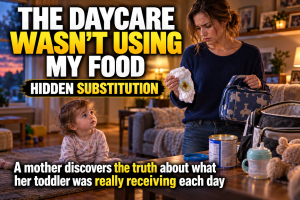
She packed the same lunch and the same expensive formula every morning. Three days later the bag came home untouched and the bottles were filled with plain water. When she started marking the diapers and the tape disappeared, the quiet suspicion turned into something she could no longer ignore.
Part 1
The kitchen smelled like warm oatmeal and the faint sweetness of mashed banana. Claire stood at the counter in her soft gray robe, the same one she had worn every morning for the past six months, and packed the small insulated lunch bag with practiced care. Apple slices cut thin so her daughter could manage them. A container of plain yogurt. Two soft cheese crackers. Everything labeled with the date and her name in black marker.
Maya was twenty months old. She still slept with her fist curled under her chin and woke up reaching for the same blue blanket. Claire had stopped working full-time three months after Maya was born. The daycare two miles from their apartment had seemed like the careful compromise. Licensed. Recommended by two other mothers in the building. The monthly fee was high, but Claire told herself it was temporary. Just until Maya turned two and the waitlist at the better center opened up.
She checked the formula can on the counter. The powder was expensive. Forty-one dollars a can. She measured it carefully into the bottles the way the pediatrician had shown her, snapped the lids tight, and slid them into the side pocket of the bag. Then she took a fresh pack of Pampers from the closet. Forty-five dollars a box. She had stopped buying the cheaper brands after Maya developed a rash that lasted two weeks. She wrote Maya’s name on the waistband of three diapers with a fine black marker and placed them in the bag.
At the door she kissed the soft spot behind Maya’s ear and handed her to the caregiver who answered. The woman smiled the same automatic smile she always used. Claire watched them walk down the short hallway before the door closed.
That evening the lunch bag came home untouched. The apple slices had turned brown. The yogurt container was still sealed. The bottles were empty, but when Claire rinsed them the water ran clear and thin. No residual formula smell. The diapers Maya wore home were plain white generics. No name written on them.
Claire stood in the small kitchen for a long time after she put Maya to bed. She told herself it was a mistake. Someone had mixed up the bags. Someone had run out of the right size. She washed the lunch containers, refilled the bottles, and packed everything again for the next day.
The second day the same thing happened. Untouched lunch. Brown apple slices. Generic diaper. Bottles that smelled only of water.
On the third morning she took a Sharpie and put a small dark blue dot on the inside of each diaper she sent. She tore a strip of blue painter’s tape and wrapped it around the neck of each bottle, just under the lid. Then she drove to the daycare with the same careful smile she used every morning and handed over the bag.
When she picked Maya up that afternoon the diapers had no dots. The tape was gone. The bottles were filled with water again.
Claire sat in the car with Maya strapped into the back seat and stared at the empty parking lot. Her hands were steady on the steering wheel. She did not cry. She simply opened her phone and began looking up the state licensing office.
Part 2
The complaint form was longer than she expected. Claire filled it out at the kitchen table after Maya was asleep, the only light coming from the under-cabinet strip above the sink. She wrote the dates carefully. She described the marked diapers and the missing tape. She listed the brand of formula and the cost. She mentioned the untouched lunch bags three days in a row.
She hit submit at 11:47 p.m.
Two days later an inspector arrived at the daycare without calling ahead. Claire received a short email that afternoon confirming the visit had taken place. The next morning the inspector called her.
The woman on the phone spoke in the flat, careful tone of someone who had seen too many of these cases. Eighteen children present in a space licensed for nine. One caregiver on the floor. The meal logs for the previous week listed organic chicken and steamed broccoli for every child. When the inspector opened the kitchen she found a single large pot on the stove and a stack of cans of ravioli on the counter. The food budget recorded for the month was three hundred sixty dollars. The center’s monthly revenue, according to the paperwork on file, was thirty-one thousand.
Claire listened without interrupting. When the inspector paused she asked about the owner.
The owner drove a late-model Mercedes. Her license application listed three personal references. None of them could be located. Four years earlier the same woman had operated a different daycare under a slightly different name. That center had been shut down for the same overcrowding violation and for serving commercial canned food while charging parents for organic meals.
There was a co-owner listed on the old license. The inspector said the name was still under review.
Claire hung up and sat very still at the table. Maya was on the living-room floor pushing a wooden train along the rug, making soft engine sounds with her mouth. The ordinary sound of it made the kitchen feel suddenly too quiet.
She called her sister first. Then she called the two mothers in the building who had recommended the place. Both of them went silent when she repeated what the inspector had said. One of them started crying. The other said she was pulling her son out that same day.
Claire packed Maya’s things that evening. She did not return the extra diapers or the half-used formula can. She simply left them in a paper bag by the door and never went back.
The inspector’s full report arrived by email three days later. Claire printed it and read every page twice. In the margin of the last page someone had written in small blue ink: Co-owner still active. Same address listed on both applications.
She stared at the address for a long time. It was only twelve minutes from her apartment.
Part 3
The address belonged to a modest two-story house on a quiet street lined with maples. Claire drove past it twice before she parked half a block away and sat with the engine off. A silver Mercedes was in the driveway. The same model the inspector had described.
She did not get out of the car. She simply watched the front door for twenty minutes. A woman in her mid-forties came out carrying a large canvas tote and a stack of folders. She locked the door, placed the tote in the trunk, and drove away.
Claire wrote down the license plate and the house number. Then she went home and opened her laptop.
The old daycare that had been shut down four years earlier still had a Facebook page that no one had bothered to delete. Claire scrolled through the photos. Smiling children. Colorful walls. Meal posts that listed organic chicken and steamed broccoli. The same language the current center used.
In the comments under one of the older posts a parent had written: They never sent the bottles back with formula. Always water. The comment was from three years ago. No one had replied.
Claire saved the screenshot. She kept scrolling. Another parent had posted a photo of a generic diaper with the caption: Paid for Pampers. Got these. The post was from the same period.
She closed the laptop and walked into Maya’s room. The toddler was asleep on her stomach, one arm thrown over the blue blanket. Claire stood in the doorway and listened to the soft breathing. The anger that had been sitting quietly in her chest for days shifted into something colder and more precise.
The next morning she called the inspector again. She asked for the name of the co-owner listed on the old license. The inspector hesitated, then said the name was still under active investigation and could not be released yet. Claire thanked her and hung up.
She spent the afternoon calling every parent she could find who had used the old center. Most of the numbers were disconnected. Two women answered. Both remembered the same pattern. Untouched lunches. Generic diapers. Bottles refilled with water. One of them said her son had lost weight during the six months he attended. The pediatrician had asked questions. She had pulled him out and never reported it because she was embarrassed she had not noticed sooner.
Claire wrote everything down in a notebook she kept in the kitchen drawer. Dates. Names. Exact phrases. She did not know yet what she was going to do with the information. She only knew she could not stop collecting it.
That evening her sister came over with takeout and a bottle of wine. They sat on the couch after Maya was in bed and Claire told her everything. Her sister listened without interrupting, then said quietly, “You need a lawyer.”
Claire nodded. She had already looked up three names.
Part 4
The first lawyer she met was polite and expensive. He listened to the timeline, reviewed the inspector’s report, and told her the case against the current center was strong on the licensing violations. The food and diaper issues were harder. Parents signed contracts that gave the center discretion over daily care. Proving intentional substitution would require more than marked diapers and missing tape.
Claire left the office feeling smaller than when she went in.
The second lawyer was younger and less polished. She worked out of a shared office downtown and charged half the rate. She read the report twice, then looked up and said, “The co-owner is the part that interests me. If the same people are running the same operation under a new name, that changes the picture.”
Claire handed over the notebook. The lawyer spent twenty minutes reading every page. When she finished she closed it carefully and said, “I can file a formal request for the old license records. It will take time. In the meantime, document everything. Keep every receipt. Keep every photo of the diapers and the bottles. If other parents come forward, get their statements in writing.”
Claire drove home with the notebook on the passenger seat. That night she created a shared folder online and began uploading every photo she had taken of the lunch bags, the generic diapers, the bottles with the tape removed. She wrote a short message and sent it to the two mothers from her building and the two women from the old center who had answered her calls.
By the end of the week seven parents had added their own photos and statements to the folder.
The inspector called again on a Thursday afternoon. The current center had been issued a formal notice of violation. The owner had thirty days to reduce the number of children or face closure. The meal logs were under review. The inspector could not discuss the co-owner further, but she confirmed that the investigation into the previous center’s records was still open.
Claire thanked her and hung up. She stood in the kitchen looking at the stack of formula cans she no longer needed. Maya was at a temporary home-care arrangement two blocks away. The cost was higher, but the woman who ran it had only four children and cooked every meal herself.
Claire opened the notebook and wrote the date at the top of a new page. Then she wrote three words: Keep going.
Part 5
Two weeks after the formal notice, the current daycare closed its doors. The owner posted a short statement online claiming “personal family reasons.” The Mercedes disappeared from the driveway of the house Claire had watched. The phone number listed on the old Facebook page was disconnected.
Claire expected to feel relief. Instead she felt the same tight focus she had carried since the first unmarked diaper. The co-owner’s name was still missing from every public document she could find.
The younger lawyer called on a Monday morning. The records request had produced a partial result. The co-owner listed on the old license application was a woman named Denise Harlan. The address on the application matched the house with the maple trees. The same address appeared on the current center’s utility bills for the first six months of operation.
Denise Harlan had not been charged in the earlier shutdown. The paperwork showed she had claimed she was only an investor and had no daily involvement. The state had accepted the explanation at the time.
Claire wrote the name in the notebook in capital letters. Then she searched every public database she could access. Denise Harlan owned a second property across town. A small commercial building that had once housed a children’s clothing consignment shop. The shop had closed two years earlier. The building was still in her name.
Claire drove past it on a rainy afternoon. The windows were papered over from the inside. A faded “For Lease” sign hung in the front window. She parked across the street and sat for a long time watching the empty doorway.
That evening she added the address to the shared folder and sent a short update to the other parents. One of them replied within an hour. Her sister-in-law had worked at the consignment shop. She remembered Denise Harlan coming in once a week to collect the cash receipts. She also remembered the woman talking about “the next daycare project” and laughing about how easy it was to keep the food costs under four hundred a month if you knew what you were doing.
Claire saved the message. Then she opened a new document and began drafting a formal complaint to the state licensing board that named both the previous and current centers and requested a full review of Denise Harlan’s involvement.
She worked on it until past midnight. Maya slept through the entire process. When Claire finally closed the laptop the apartment was quiet except for the soft hum of the refrigerator. She sat in the dark living room for a while and let the silence settle around her.
For the first time since the marked diapers, she felt something that was not only anger. It was the beginning of a kind of steady resolve.
Part 6
The formal complaint was filed on a Tuesday. The lawyer handled the submission and told Claire to expect a long wait. State investigations moved slowly. In the meantime the shared folder kept growing. Two more parents from the old center found the group through a mutual acquaintance and added their own accounts. One of them had kept a detailed log of every day her daughter came home in a different brand of diaper. Another had photographed the meal logs that listed organic chicken while the kitchen held only canned pasta.
Claire read every new entry. She no longer felt the sharp spike of surprise. The pattern was too consistent.
Her sister came over again on a Saturday and brought Maya a new set of wooden blocks. While the toddler stacked them on the living-room rug, the two women sat at the kitchen table with coffee. Claire’s sister asked the question that had been circling for weeks.
“What happens if nothing comes of this? What if the state just files it and moves on?”
Claire looked at the notebook open beside her mug. The pages were filled with dates and names and small careful handwriting. She said, “Then I keep the record. Someone else will need it later.”
Her sister was quiet for a moment. Then she reached across the table and closed the notebook gently. “You don’t have to carry all of it alone.”
Claire did not answer right away. She watched Maya place a blue block carefully on top of a red one. The tower wobbled and held. Maya clapped once, soft and pleased with herself.
“I’m not carrying it alone,” Claire said finally. “There are nine of us in that folder now. That has to count for something.”
Two days later the lawyer called with an update. The licensing board had opened a formal inquiry into Denise Harlan’s role in both centers. They had requested bank records and tax filings. The process would take months, but it was no longer buried.
Claire hung up and stood in the middle of the kitchen. The afternoon light came through the window in a clean white bar across the floor. She walked into Maya’s room and sat on the edge of the small bed. The blue blanket was folded at the foot. She picked it up and held it for a moment, the soft worn fabric familiar under her fingers.
She did not cry. She simply sat there until the light shifted and the room grew dimmer. Then she put the blanket back, stood up, and went to start dinner.
Part 7
The inquiry moved in slow, bureaucratic steps. Claire received occasional updates from the lawyer. Bank records showed regular transfers from the current center’s operating account to an account in Denise Harlan’s name during the months the center was open. The amounts were not large, but they were consistent. The food budget line remained under four hundred dollars every month while the enrollment fees totaled more than thirty thousand.
The licensing board scheduled a hearing for the following spring. Claire was invited to submit a written statement. She spent three evenings drafting it, then revised it twice more with the lawyer’s notes. The final version was calm and precise. It listed the dates of the marked diapers and the missing tape. It described the untouched lunches and the bottles refilled with water. It included the statements from the other parents without naming them. It ended with a single clear request: that Denise Harlan be barred from any future involvement in licensed childcare.
She submitted the statement and then forced herself to stop checking her email every hour.
Life settled into a new rhythm. Maya adjusted quickly to the home-care arrangement. She came home each afternoon with clean clothes and a full stomach. Claire returned to part-time work at the marketing firm she had left when Maya was born. The hours were flexible. The pay was enough to cover the higher care costs.
Some evenings, after Maya was asleep, Claire still opened the shared folder and scrolled through the photos. The generic diapers. The brown apple slices. The empty formula bottles. She no longer felt the same sharp anger. The images had become evidence rather than open wounds.
One night in late autumn her phone buzzed with a message from one of the parents in the group. The woman’s sister worked in the county records office. A new business license application had been filed three weeks earlier under a different name. The applicant was Denise Harlan. The proposed location was the empty commercial building that had once been the consignment shop. The stated purpose was “early childhood education center.”
Claire read the message twice. Then she forwarded it to the lawyer with a single line: She is trying again.
The lawyer replied within an hour. The application would be flagged. The pending inquiry would be attached to the new file. It would not be easy for Denise Harlan to open another center while the investigation was active.
Claire set the phone down and looked around the quiet kitchen. The notebook still sat on the counter. She picked it up, turned to a fresh page, and wrote the date. Underneath she wrote: New application. Same person. Same building.
Then she closed the notebook and went to bed.
Part 8
Winter arrived with the kind of cold that made the apartment windows frost at the corners. Maya turned two in January. Claire threw a small party with the other parents from the shared folder. They brought cake and juice boxes and sat on the living-room floor while the children played with the wooden blocks. No one talked about the daycare for the first hour. Then one of the mothers mentioned the upcoming hearing and the room grew quieter.
Claire told them what the lawyer had said. The licensing board had compiled a full file. The bank transfers. The old violation. The new application that had been flagged. The hearing was set for March. Several of the parents planned to attend.
After everyone left, Claire cleaned the kitchen slowly. Maya was already asleep, exhausted from the sugar and the company. Claire stood at the sink with her hands in warm water and thought about the first morning she had put the blue dots on the diapers. It felt both recent and very far away.
In February the lawyer called with a new development. Denise Harlan had submitted a written response to the inquiry. She claimed she had been only a silent investor in both centers and had no knowledge of the daily operations or the food and supply practices. She attached statements from two former employees who said the same thing.
Claire read the response the lawyer forwarded and felt the old tightness return to her chest. She spent the evening going back through every photo and statement in the shared folder. The pattern was still there. The same language in the meal logs. The same generic diapers. The same bottles filled with water. The consistency itself was the strongest evidence.
She wrote a short addendum to her original statement and sent it to the lawyer. Then she forced herself to close the laptop and sit with Maya on the couch while the toddler pointed at pictures in a board book and named the animals in her careful, serious voice.
The hearing date approached. Claire arranged for her sister to watch Maya that day. She laid out her clothes the night before: a simple dark sweater and the only pair of trousers that still fit well. She slept poorly.
On the morning of the hearing she drove to the state office building with the notebook on the passenger seat. She did not know if she would be asked to speak. She only knew she needed to be there.
Part 9
The hearing room was smaller than Claire expected. Fluorescent lights. A long table at the front. Folding chairs arranged in two short rows. She sat in the second row with three of the other parents. The lawyer sat beside her with a thin folder.
Denise Harlan arrived ten minutes late. She wore a tailored coat and carried a leather portfolio. She did not look at the parents when she took her seat at the side table.
The proceedings were formal and slow. The licensing board presented the records: the overcrowding violation, the meal logs that did not match the kitchen inventory, the bank transfers, the previous shutdown, the new application that had been filed while the inquiry was open. The lawyer for the board spoke in a calm, measured voice. She did not raise it once.
When it was Denise Harlan’s turn, she repeated the same claim she had made in writing. Silent investor. No daily involvement. She had trusted the operators. She had been shocked by the findings.
One of the board members asked about the regular transfers from the center’s account into her personal account. Denise Harlan said they were repayments of a personal loan she had made to help the center stay afloat. She produced a document that appeared to support the claim. The board member examined it without comment and set it aside.
Claire’s lawyer was given a brief opportunity to submit additional materials. She handed over the compiled statements from the parents and the photographs of the marked diapers and the bottles. The board accepted them into the record.
No one asked Claire to speak. She sat with her hands folded in her lap and watched Denise Harlan’s face. The other woman never once looked in their direction.
The hearing ended after ninety minutes. The board said a written decision would be issued within sixty days. Everyone stood. Denise Harlan left first, her coat already buttoned, the portfolio under her arm.
Outside on the sidewalk the parents stood together for a few minutes in the cold. No one said much. Claire drove home with the notebook still unopened on the seat beside her. Maya was playing on the living-room floor when she walked in. Her sister looked up from the couch and raised an eyebrow.
Claire shook her head once. “We wait.”
That night she put Maya to bed and then sat at the kitchen table with a cup of tea that went cold. She did not open the notebook. She simply sat with the quiet and the knowledge that the next part was no longer in her hands.
Part 10
The written decision arrived on a Thursday in early May. Claire’s lawyer called first thing in the morning. The licensing board had permanently barred Denise Harlan from any ownership, investment, or operational role in licensed childcare facilities in the state. The previous center’s violations were formally linked to her financial involvement. The new application for the commercial building was denied. The board’s order noted the pattern of substitution of supplies and the consistent under-reporting of food costs as evidence of intentional mismanagement that endangered the children in care.
Claire listened to the full summary, thanked the lawyer, and hung up. She stood in the kitchen for a long moment with the phone still in her hand. Then she walked into the living room where Maya was stacking the wooden blocks into a careful tower.
“Hey, bug,” she said softly.
Maya looked up and grinned, showing the small gap where a front tooth was coming in. Claire sat down on the rug beside her and helped place the next block. The tower held. Maya clapped.
That afternoon Claire sent a short message to the shared folder. She included the key points of the decision and a single line at the end: It’s done.
Replies came in steadily through the evening. Some were short. Some were longer. One of the mothers from the old center wrote that she had kept her own private folder of photos for four years and had finally deleted it that afternoon. Another simply wrote thank you.
Claire closed the folder for the last time and left it archived.
In the weeks that followed the ordinary days returned with a different weight. Maya started at a new licensed center in the fall, one with a long waitlist and a kitchen that smelled like real food every afternoon. Claire went back to full-time work. The notebook stayed in the kitchen drawer. She did not open it again.
Sometimes, late at night when the apartment was quiet, she still thought about the first unmarked diaper and the brown apple slices. The memory no longer carried the same sharp edge. It had become part of the longer story of the years when Maya was small and Claire had learned how carefully she needed to watch the places that claimed to care for her child.
On Maya’s third birthday they had a small party in the park. Claire’s sister came. A few of the parents from the shared folder came too, their own children running across the grass. No one mentioned the old daycare. They ate cupcakes and watched the children climb the low wooden structure and slide down the other side, laughing.
When the sun started to drop and the air cooled, Claire packed the leftover cake and the juice boxes into the same insulated bag she had once filled with apple slices and formula bottles. She buckled Maya into the car seat, smoothed the soft hair back from her forehead, and drove home through the early evening light.
The kitchen smelled like the cupcakes they had brought back. Claire set the bag on the counter, poured herself a glass of water, and stood for a moment looking out the window at the quiet street. Maya’s laughter still seemed to linger in the room even though the child was already in the bath with her sister supervising.
Claire washed the glass, dried her hands, and went to join them. The day settled around her in the ordinary way good days do. Nothing dramatic. Nothing unfinished. Just the steady knowledge that she had done what needed to be done, and that her daughter was safe, and that the record of what had happened was no longer hers alone to carry.