When my daughter needed her birth certificate for college, I saw two names where only one should have been. The clerk’s careful voice told me the document had been changed when she was three months old. I still had the original sealed envelope. Opening it meant facing a truth I never knew existed.
Part 1
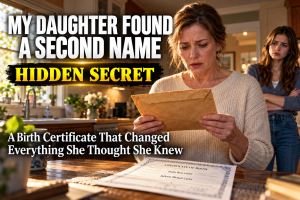
The afternoon light in our kitchen had that soft golden quality that made everything look warmer than it really was. I was rinsing the last of the breakfast dishes when Emma walked in holding a folded piece of paper like it might burn her fingers.
“Mom, can you look at this?” she asked.
I dried my hands on the dish towel and took the paper. It was a certified copy of her birth certificate, the one she needed for the financial aid office at the university. She had ordered it online the week before, and the county office had mailed it straight to her. I expected the usual information: her full name, the date, the hospital, my name, and her father’s name listed in the appropriate boxes.
Instead, my eyes stopped halfway down the page.
There were two names listed in the space for the child’s name. The first was the one I had chosen the day she was born. The second sat right beside it, connected by a thin slash, as if it had always belonged there.
I stared at the paper longer than I meant to.
Emma leaned against the counter. “Why are there two names?”
I looked up at her. She was twenty years old, the same age I had been when I first held her. Her hair was pulled into a messy knot, and she still had that slight crease between her eyebrows that appeared whenever something didn’t make sense.
“It must be an administrative error,” I said. The words came out automatically. “These offices make mistakes all the time. Someone probably typed the wrong thing years ago and it just stayed in the system.”
She didn’t look convinced. “It’s on the official copy. They charged me thirty-five dollars for this.”
I folded the paper carefully and set it on the table. “I’ll call them tomorrow. It’s probably nothing.”
But that night I couldn’t sleep. I kept seeing the second name every time I closed my eyes. It wasn’t a name I recognized. It wasn’t a family name. It simply sat there on the page as if it had always been part of her identity.
The next morning I waited until Emma left for her shift at the bookstore before I dialed the county records office. The hold music was cheerful and slightly out of tune. When a clerk finally answered, I explained the situation as calmly as I could.
There was a pause on the other end of the line.
“Could you hold for a moment, please?” the woman asked. Her voice had changed. It was more careful now, slower.
I waited.
When she returned, she spoke as if she were choosing each word from a short list. “The record shows that the document was amended when the child was three months old.”
I felt the kitchen grow quieter around me.
“Amended?” I repeated. “I was never told about any amendment.”
Another pause. “Ma’am, do you still have the original certificate that was issued at the time of birth?”
I glanced toward the hallway closet where a box of old papers lived on the top shelf. “Yes,” I said. “I think I do.”
“You may want to review that,” she said. “I’m not authorized to discuss further details over the phone.”
The call ended. I stood in the middle of the kitchen holding the phone against my chest. The second name on the new certificate suddenly felt heavier. I walked to the closet, pulled down the box, and found the old manila envelope still sealed with the hospital’s return address faded but readable.
I carried it to the table and set it beside the new certificate.
For a long time I simply looked at both of them. The sealed envelope felt thicker than I remembered. My fingers rested on the flap, but I didn’t open it.
Emma would be home in a few hours. She would ask what the clerk had said. She would want to know why there was a second name.
I wasn’t sure I wanted the answer yet.
The light in the kitchen had shifted by then. The golden quality was gone, replaced by the flatter gray of late afternoon. I left both documents on the table and went outside to sit on the porch steps. The neighborhood was quiet. A dog barked somewhere down the street. A car passed and then the street was empty again.
I thought about the day Emma was born. The hospital room had been cold. The nurse had handed me the first certificate while I was still trying to learn how to hold a newborn properly. I had signed the forms without reading every line. I had been tired and overwhelmed and grateful that the baby was healthy.
I had never imagined that something important might have been changed later without my knowledge.
When I finally went back inside, the envelope was still waiting. I picked it up once more, felt the weight of the paper inside, and set it down again.
I told myself I would open it after dinner. Or tomorrow morning. Or when Emma was asleep and the house was quiet enough for whatever was inside.
The truth was simpler. I was afraid of what the original certificate might say.
And for the first time in twenty years, I was no longer certain that the story I had always believed about my daughter’s beginning was the complete one.
Part 2
Emma came home just after six with a paper bag of leftover pastries from the bookstore café. She set them on the counter and noticed the two documents still lying side by side on the table.
“Did you call?” she asked.
I nodded. “They said the record was amended when you were three months old.”
She pulled out a chair and sat down slowly. “Amended how?”
“They wouldn’t say over the phone. The clerk asked if I still had the original.”
Emma looked at the sealed envelope. “Is that it?”
“Yes.”
She reached toward it, then stopped. “Have you opened it?”
“Not yet.”
The silence between us stretched. I could hear the refrigerator humming and the faint sound of a television from the apartment next door. Emma broke a piece of pastry into smaller pieces without eating any of them.
“Maybe it’s nothing,” she said. “Maybe they just corrected a spelling error.”
“Maybe.”
But neither of us believed that. The second name was too deliberate. It sat on the new certificate with the same weight as the first, as if both belonged.
I told her I wanted to wait until morning. She didn’t argue. She simply nodded and went upstairs to her room. I heard her door close, then the soft sound of music starting.
I stayed at the table for a long time. The envelope looked ordinary. The hospital logo was still visible in the corner, though the ink had faded to a pale blue. I remembered signing for it in the maternity ward. I remembered the nurse smiling and saying congratulations. I remembered thinking that the hard part was over.
I had been wrong.
Around nine o’clock I finally stood up and carried both documents to my bedroom. I placed them in the top drawer of the nightstand and closed it. Then I lay down without changing out of my clothes and stared at the ceiling.
Sleep came in pieces. I dreamed of hospital corridors that never ended and of a baby whose face kept changing. When I woke at three in the morning, the house was completely still. I got up, walked to the kitchen for a glass of water, and found myself standing in front of the nightstand again.
I opened the drawer.
The envelope was still sealed. The glue had yellowed slightly along the edge. I ran my thumb under the flap and felt it give a little. One more pull and it would open.
I stopped.
Something about the careful way the clerk had spoken stayed with me. People didn’t choose their words that carefully unless the information behind them mattered.
I closed the drawer and went back to bed.
In the morning Emma was already at the table with a cup of coffee. She looked like she hadn’t slept much either.
“I think we should open it together,” she said.
I sat down across from her. “Are you sure?”
She nodded. “If there’s something about me on that paper, I want to know.”
We carried the envelope to the living room where the light was better. I sat on the couch. Emma sat on the floor in front of me, knees pulled up. I slid my finger under the flap and pulled. The paper tore with a soft, dry sound.
Inside was a single folded sheet and a small white card that had once been clipped to it. The certificate itself was thinner than the new one, printed on older paper. The ink was slightly faded, but the information was still clear.
I unfolded it carefully.
Emma’s full name appeared at the top exactly as I remembered choosing it. The date of birth was correct. The hospital was correct. My name was listed as the mother.
Then I looked at the space for the father’s name.
It was blank.
I stared at the empty line. On the new certificate, her father’s name was clearly printed. On this original, the box was empty.
Emma leaned closer. “That’s not right. Dad’s name is on every other document.”
I turned the paper over. There was a small handwritten note in the margin, dated three months after the birth. The handwriting was unfamiliar. It simply said: “Name amendment requested. Secondary given name added per family request. Father’s information updated upon submission of supporting documentation.”
I read the note twice.
Emma took the paper from my hands and studied the note herself. “Family request? Whose family?”
I didn’t answer. I was still looking at the blank space where a father’s name should have been.
When Emma was born, her father and I had already been married for two years. He had been in the delivery room. He had held her first. He had signed every form I remembered seeing. There was no reason for his name to be missing from the original certificate.
Unless the original certificate had never included him.
I set the paper down on the coffee table. My hands felt unsteady.
Emma looked up at me. “Mom. What does this mean?”
I opened my mouth, then closed it again. The careful voice of the clerk returned to my mind. The way she had asked whether I still had the original. The way she had refused to say more over the phone.
Something had been changed when Emma was three months old. A second name had been added. A father’s name had been entered. And I had never been told.
I reached for the small white card that had come with the original certificate. It was a hospital identification card with Emma’s footprints in faded blue ink. On the back, someone had written a short note in the same unfamiliar handwriting.
“Contact records department if further clarification is needed regarding parental information.”
I read the words out loud. Emma’s face had gone very still.
“Mom,” she said quietly. “I think we need to go to the records office in person.”
I nodded. The sealed envelope had been opened. The questions it contained were no longer theoretical.
They were sitting between us on the coffee table, waiting for answers neither of us was ready to hear.
Part 3
The county records office was a low brick building with fluorescent lights that hummed constantly and a waiting area filled with plastic chairs. We arrived just after it opened. Emma carried the original certificate in a folder. I carried the new one.
The woman at the front desk looked at both documents, then at us, then asked us to wait. Fifteen minutes later a different clerk called our names and led us into a small office with a single window that looked out onto the parking lot.
She introduced herself as Mrs. Delgado. She was in her fifties, with short gray hair and glasses that sat low on her nose. She examined both certificates carefully, comparing the information line by line.
“I can confirm that an amendment was filed,” she said at last. “The request was submitted three months after the birth. A secondary given name was added, and the father’s information was entered at that time.”
Emma leaned forward. “Who submitted the request?”
Mrs. Delgado checked her screen. “The file lists the requestor as the mother of record.”
I felt the air leave my lungs. “That’s not possible. I never filed anything.”
She turned the monitor slightly so we could see. My name appeared in the requestor field, along with a date and a signature line that had been scanned into the system.
The signature looked like mine. The loops of the letters were familiar. But I had no memory of signing that form.
Emma stared at the screen. “Could someone have forged it?”
Mrs. Delgado’s expression remained neutral. “I can’t speak to that. What I can tell you is that the supporting documentation included a marriage certificate and a statement of paternity that was accepted by the office at the time.”
I asked to see the paternity statement. She printed a copy and handed it across the desk. The form was short. It listed Emma’s father by name and stated that he acknowledged paternity. The signature at the bottom was his.
I recognized it immediately. He had always signed his name with a sharp upward stroke on the last letter.
Emma read the form twice. “So Dad signed this. And someone signed Mom’s name. And then the certificate was changed.”
Mrs. Delgado folded her hands. “That appears to be the sequence of events. The secondary given name was requested at the same time. The form indicates it was chosen to honor a family member.”
“Which family member?” I asked.
She checked the notes again. “The file doesn’t specify. It simply says ‘per family request.’”
We left the office with printed copies of everything they were allowed to release. In the parking lot Emma sat in the passenger seat without putting on her seatbelt.
“Do you think Dad knows about this?” she asked.
I started the car but didn’t put it in gear. “I don’t know. We never talked about the birth certificate after the hospital. I thought everything was finished.”
She turned the original certificate over in her hands. “There’s a second name on here that I’ve never used. It’s not on my driver’s license. It’s not on my social security card. It’s just… sitting there.”
The name was simple. It didn’t sound like anything from either side of our families. I had repeated it in my mind so many times since first seeing it that it had begun to feel almost familiar, which only made it more unsettling.
We drove home in silence. When we walked into the house, the first thing I noticed was the empty space on the coffee table where the documents had been the night before. I had put them away, but the absence still felt loud.
Emma went upstairs. I heard her door close. A few minutes later I heard her voice, low and steady, talking to someone on the phone. I didn’t listen long enough to know who it was.
I sat at the kitchen table and spread the papers out again. The original certificate with the blank father’s name. The amended version with two names and a completed paternity section. The statement of paternity signed by Emma’s father. The amendment request that carried a signature that looked like mine but that I could not remember making.
Something about the timeline bothered me. Emma had been three months old when the changes were filed. That would have been early autumn. I remembered that season clearly because it was the first time I had returned to work after maternity leave. Her father had taken two weeks off to stay home with her. I had been exhausted and grateful for the help.
I tried to recall any conversation about paperwork. Any mention of the birth certificate needing correction. Any reason a second name would have been added.
Nothing came.
Around noon Emma came downstairs with her phone in her hand. Her eyes were red.
“I called Dad,” she said.
I waited.
“He said he doesn’t remember any amendment either. He said the only forms he signed were at the hospital. He sounded… careful. Like the clerk.”
I felt a cold weight settle in my chest. “What else did he say?”
“He asked if we still had the original. Then he said he needed to check something and he’d call back.”
She sat down across from me. The pastry bag from the night before was still on the counter, forgotten.
“Mom,” she said, “what if the second name isn’t just a name? What if it’s connected to something else?”
I didn’t answer right away. The papers on the table seemed to watch us. The blank line on the original certificate felt louder than any of the filled ones.
I reached for my own phone and opened the contacts list. Emma’s father lived two hours away now. We had been divorced for six years. Our conversations were polite and limited mostly to logistics about Emma.
I typed a short message asking him to call me when he had a moment. Then I set the phone down and waited.
The house felt too quiet. Outside, a lawnmower started somewhere down the block. The ordinary sound of a weekday afternoon continued as if nothing had changed.
But everything had.
The original certificate had opened a door I hadn’t known existed. Behind it were signatures I didn’t remember, a name I had never chosen, and a careful silence from the people who should have known the answers.
Emma rested her chin on her folded arms. “I’m scared we’re going to find out something we can’t put back.”
I reached across the table and covered her hand with mine. “I know.”
We sat like that for a long time, the documents between us, the afternoon light moving slowly across the floor, both of us waiting for a phone to ring with answers that might be worse than the questions.
Part 4
Emma’s father called just after three. His voice on speakerphone sounded the way it always did when he was trying not to sound worried—measured, a little too even.
“I looked through the old files I still have,” he said. “There’s nothing about an amendment. The only birth certificate I remember is the one from the hospital.”
Emma sat on the edge of the couch, knees drawn up. “Did you sign a paternity statement three months later?”
There was a pause. “I don’t think so. I signed everything at the hospital. After that I don’t remember any more forms.”
I asked him about the signature on the statement we had received from the records office. He asked me to send a photo. A few minutes later his reply came by text: the signature looked like his, but he had no memory of the document.
“People forget things,” he said when we called him back. “It was a long time ago. We were tired. Maybe I signed something and just don’t remember.”
Emma’s voice was quiet. “There’s a second name on the amended certificate. Did you ever talk about adding one?”
Another pause, longer this time. “No. We only ever discussed the one name. The one we both liked.”
After the call ended, the living room felt smaller. Emma stood up and walked to the window. Outside, the neighbor’s kids were riding bikes in slow circles. The ordinary world continued without us.
I gathered the papers and put them back into the folder. “I’m going to call the hospital,” I said. “Maybe they still have records from that time.”
The hospital’s medical records department was polite and thorough. After verifying my identity, the clerk told me that birth records from that year had been transferred to microfilm and later digitized. She could request a search, but it might take several days.
I gave her the dates and the file numbers from the certificates. She promised to call back.
While we waited, life tried to resume its normal shape. Emma went to her shift at the bookstore. I answered emails for the small accounting work I did from home. I made dinner. We ate mostly in silence.
That night I found myself standing in front of the hallway closet again, looking at the box where the original envelope had been stored for twenty years. I pulled it down and emptied everything onto the bed. Old tax returns. Emma’s elementary school drawings. A packet of photographs from her first birthday. A folded hospital discharge summary I had forgotten existed.
I read the discharge summary carefully. It listed Emma’s name—only the one I had chosen. It listed me as the mother. It listed her father as the father. The dates matched. Nothing in the summary mentioned an amendment or a secondary name.
I set it aside and kept looking. Near the bottom of the box I found a small manila envelope I didn’t recognize. It was thinner than the others and had no label. Inside was a single folded sheet of paper and a faded receipt from a notary public dated three months after Emma’s birth.
The sheet was a copy of the amendment request. My signature was there again. Beneath it was a short handwritten note in different handwriting: “Secondary name added at request of maternal grandmother. Supporting statement attached.”
I stared at the words.
My mother had died when Emma was four. She had lived in another state. We had spoken on the phone every week, but she had never mentioned anything about the birth certificate. She had never suggested adding a name.
I carried the paper downstairs. Emma was on the couch with her laptop open, half-heartedly working on a paper for class. When she saw my face she closed the computer.
“What is it?”
I handed her the note. She read it twice.
“Maternal grandmother,” she said. “Grandma?”
“Apparently.”
Emma set the paper down carefully. “Why would she request a second name? And why wouldn’t she tell you?”
I sat beside her. The only answer I could think of felt incomplete. “Maybe she thought it was important. Maybe she believed she was protecting something.”
“Protecting what?”
I didn’t know. My mother had been private about certain parts of her life. She had grown up in a small town and rarely spoke about her own childhood. When I was younger I had assumed it was simply her nature. Now the silence felt different.
Emma picked up her phone. “I’m going to call Aunt Claire.”
Claire was my mother’s younger sister, the only remaining relative from that side of the family who still kept in touch. She lived several states away and sent birthday cards with short notes in careful handwriting.
The call went to voicemail. Emma left a message asking Claire to call back when she had time, mentioning only that we had a question about old family paperwork.
After she hung up, the house settled into evening quiet. I made tea neither of us drank. The folder of documents sat on the coffee table like a third person in the room.
Around ten o’clock my phone rang. It was the hospital records clerk. She apologized for calling so late, but she had found something in the digitized files.
“There’s a notation in the administrative section,” she said. “It references a request for amendment that originated outside the hospital. The hospital itself only issued the original certificate. Any changes after discharge were handled by the county.”
I already knew that much. I asked if there was any mention of a secondary name or a family request.
“Only a brief note,” she said. “It says the family requested the addition of a traditional name for cultural reasons. That’s all.”
Cultural reasons. The phrase felt strangely formal.
After the call I sat with the information for a long time. My mother’s family had never spoken of any particular cultural tradition involving names. We were ordinary people with ordinary histories, or so I had always believed.
Emma came downstairs in her pajamas. “Anything?”
I told her what the hospital had said. She listened without interrupting.
“Traditional name,” she repeated. “That sounds like something Grandma would care about. She was always talking about doing things the right way.”
I nodded. My mother had valued order. She had kept detailed scrapbooks and labeled every photograph. The idea that she might have arranged a quiet change to a legal document without telling me was difficult to accept, but not impossible.
Still, the blank father’s name on the original certificate remained unexplained. And the signature that looked like mine but that I could not remember writing continued to sit in the file like an unanswered question.
We went to bed without resolving anything. In the dark I listened to the familiar sounds of the house settling and tried to remember the months after Emma was born with more clarity than I ever had before.
I remembered the exhaustion. I remembered the small victories of learning to soothe a crying infant. I remembered my mother visiting for a week when Emma was about two months old, bringing home-cooked food and offering to watch the baby so I could sleep.
I did not remember any conversation about names or certificates or paperwork that needed correcting.
Yet the documents insisted that something had happened during that time. Something deliberate. Something carefully recorded and then quietly stored away.
In the morning the folder was still on the table. The questions inside it had not lessened overnight. If anything, they had grown sharper.
Emma made coffee. I opened my laptop and began searching for any public record that might explain a secondary name added for cultural reasons. The results were scattered and inconclusive. Some families added traditional names for heritage. Some did it for religious reasons. None of the explanations felt like they belonged to us.
By midday Aunt Claire still had not returned the call. The silence from that direction began to feel intentional.
I looked at the second name on the amended certificate once more. It was a simple name, neither unusual nor elaborate. It could have belonged to anyone.
Or it could have belonged to someone specific—someone my mother had wanted to honor without ever explaining why.
The thought stayed with me for the rest of the day, quiet and persistent, waiting for the moment when the rest of the story would finally surface.
Part 5
Aunt Claire called on the third day. Her voice was thinner than I remembered, the way people’s voices become when age and distance have both done their work.
Emma put the phone on speaker and set it on the table between us.
“I got your message,” Claire said. “You’re asking about the birth certificate.”
I explained what we had found—the second name, the amendment, the note that mentioned the maternal grandmother.
There was a long silence on the line. I could hear a clock ticking somewhere in Claire’s house.
“I always wondered if this would come up,” she said at last.
Emma’s hands tightened around her coffee mug. “What do you mean?”
Claire exhaled slowly. “Your grandmother made that request. She asked me to help with the paperwork because she didn’t want to worry you at the time. You were a new mother. You were tired. She thought it was better to handle it quietly.”
“Handle what?” I asked.
Another pause. “There was a name in the family that she felt should be carried forward. An older name. She believed it mattered.”
“What older name?” Emma asked.
Claire’s voice softened. “It belonged to her own mother. Your great-grandmother. She died before you were born, and your grandmother always regretted that the name hadn’t continued. When Emma arrived, she saw a chance to fix that.”
I stared at the second name on the certificate. It matched. I had never known my great-grandmother’s first name. My mother had rarely spoken of her.
“Why didn’t she just tell me?” I asked.
“She was afraid you would say no,” Claire said. “You and your husband had already chosen a name. She didn’t want to create conflict. So she arranged the amendment through the county and asked me to notarize the supporting statement. She bring it from old letters. She told the clerk it was authorized. I helped because she asked me to. I didn’t realize it would stay hidden this long.”
Emma’s voice was steady but thin. “So the second name is Great-Grandma’s.”
“Yes,” Claire said. “Her name was the one added. Your grandmother believed names carried memory. She thought leaving it behind would be a kind of forgetting.”
I pressed my fingers against my temples. “And the father’s information? Why was it blank on the original?”
Claire was quiet for several seconds. “That part I only learned later. The hospital had an administrative delay with the paternity acknowledgment. Your husband signed the hospital forms, but the county copy somehow went out without the father’s section completed. When your grandmother filed the name amendment, she submitted the paternity statement at the same time so everything would be corrected together. She thought she was cleaning up a mistake while adding the name she cared about.”
Emma looked at me. “Dad really doesn’t remember signing anything later?”
“He may not,” Claire said. “It was one more form in a pile of new-parent paperwork. People forget. Your grandmother kept the copies. She never meant harm. She only meant to keep a name alive.”
After the call ended we sat in the quiet kitchen. The second name on the certificate no longer felt random. It belonged to a woman I had never met, a woman my mother had loved enough to risk a quiet deception.
Emma traced the letters with one finger. “I have a great-grandmother’s name on my birth certificate and I never knew.”
“Neither did I,” I said.
She closed the folder gently. “I think I want to know more about her.”
That night I pulled out the old photo albums my mother had left me. Most of the pictures were labeled in her careful handwriting. Near the back of one album I found a single photograph of a woman standing in a garden, hand shading her eyes from the sun. On the back, in the same handwriting that had appeared on the amendment note, was written: “Mother, 1952.”
The face was unfamiliar, yet something in the set of the mouth felt known. Emma sat beside me and studied the picture for a long time.
“She looks like she could keep a secret,” she said softly.
I nodded. The house felt different with that photograph on the table. The second name was no longer an administrative mystery. It was a thread leading backward into a life I had never been told about.
We still had questions. Why my mother had chosen secrecy over conversation. Why the blank line on the original certificate had been allowed to stand for three months. Why no one had ever spoken the name aloud in my hearing.
But for the first time since Emma had handed me the new certificate, the fear had a shape. It was no longer formless. It was a grandmother’s quiet decision, a name carried forward, and a family that had chosen silence over explanation.
Emma rested her head against my shoulder. “Tomorrow we should call Dad again. Tell him what Claire said.”
“Yes,” I answered. “Tomorrow.”
Outside, the evening settled over the neighborhood. Inside, the photograph of a woman named in the margin of a birth certificate watched us from the table, waiting for the rest of her story to be remembered.
Part 6
The next morning I called Emma’s father before she woke. I told him everything Claire had said—the secondary name belonging to my great-grandmother, the quiet arrangement my mother had made, the way the paternity statement had been submitted alongside the amendment.
He was silent for a long time.
“I remember the hospital forms,” he said finally. “I don’t remember anything after that. But if the signature is mine, then I signed it. I was exhausted. We both were. I probably thought it was just more paperwork.”
“Do you remember my mother saying anything about a name?”
“No. She was helpful when she visited. She cooked. She held Emma so we could sleep. She never mentioned certificates.”
After we hung up I sat with the knowledge that two people I had trusted—my mother and, in a smaller way, Emma’s father—had participated in a change I never knew about. One had chosen secrecy. The other had simply forgotten.
Emma came downstairs rubbing her eyes. I told her what her father had said. She listened, then poured coffee without speaking.
“I keep thinking about the blank line,” she said at last. “On the original. Even if it was a clerical delay, someone must have noticed. Someone let it sit unfinished for three months.”
I had been thinking the same thing. The county office had accepted the original with a blank father’s section. That should have raised a flag. Yet the file had remained incomplete until my mother supplied the missing information along with the name she wanted added.
I called the records office again and asked to speak with Mrs. Delgado. When she came on the line I explained what we had learned from Claire and asked whether the original blank section had been flagged at the time.
She checked the notes. “The system in those years was less automated. Incomplete fields were sometimes overlooked if the rest of the document appeared in order. Once the amendment and supporting paternity statement arrived, the file was updated and closed. There is no further notation.”
I thanked her and ended the call. The practical answers were settling into place, but the emotional ones remained unsettled.
That afternoon Emma and I drove to the small cemetery where my mother was buried. We had not been there in nearly a year. The headstone was simple. Beside it, a few feet away, stood an older stone with my great-grandmother’s name—the same name that now appeared on Emma’s birth certificate.
Emma crouched and brushed fallen leaves from the base of the older stone. “She existed,” she said quietly. “She had a whole life and I never heard a single story about her.”
I sat on the grass beside her. “My mother rarely talked about her own childhood. I used to think it was just her way. Now I wonder if there were reasons she kept certain doors closed.”
We stayed until the light began to fade. On the drive home Emma was thoughtful.
“I want to use the name,” she said suddenly. “Not every day. Not legally. Just… sometimes. When I think about her. So she isn’t only letters on a paper.”
I reached across the seat and took her hand. “I think she would have liked that.”
At home we found a short letter my mother had written years earlier and never sent. It was tucked inside a cookbook. In it she mentioned “the name we added” in passing, as if the recipient already knew. The letter was addressed to Claire. It had never been mailed.
The final paragraph read: “I hope I did the right thing. The child will carry both names. One for the life ahead of her, one for the life that came before. I could not let the older name disappear.”
Emma read the paragraph twice. Then she folded the letter carefully and placed it with the birth certificates.
The mystery of how the amendment happened was largely solved. What remained was the quieter question of why silence had felt safer to my mother than honesty, and how a name could travel twenty years without anyone speaking it aloud until a college requirement forced it into the light.
That night I dreamed of the hospital room again, but this time my mother was there, standing near the window, holding a form I could not read. When I reached for it, she simply shook her head and smiled the way she used to when she believed she was protecting me from something too heavy.
I woke with the sense that protection and secrecy had looked the same to her, and that the difference between them had only become visible long after she was gone.
Part 7
In the days that followed, Emma began asking different questions. Not only about the certificate, but about the woman whose name she now carried in official ink.
We visited Claire by video call. She had pulled out an old box of letters and photographs. One by one she held them up to the camera. A young woman in a cotton dress standing beside a vegetable garden. The same woman holding a baby—my mother as an infant. A later picture of her seated on a porch, hands folded, expression calm and unreadable.
“She was quiet,” Claire said. “She kept her own counsel. When she decided something mattered, she simply did it. Your grandmother inherited that.”
Emma asked whether there had been any particular reason the name needed protecting.
Claire hesitated. “There were hard years. Money was scarce. Your great-grandmother worked in a factory for a time. She lost two children before your grandmother was born. I think the name became a way of saying that the ones who remained still counted. Your grandmother never said it outright, but I believe she feared the name would vanish the way those earlier children had.”
The information settled over us like a second layer of understanding. The amendment was not only about heritage. It was about refusal—refusal to let absence win.
I found myself replaying ordinary memories of my mother with new attention. The way she labeled every photograph. The way she kept receipts and letters in labeled envelopes. The way she had arrived the week Emma was two months old with containers of frozen soup and a determination to be useful. She had been building continuity in the only ways she knew how.
Emma started a small notebook. She wrote down every detail Claire could remember. The factory. The garden. The two children who did not live. The quiet decision to place the name on a legal document so it could not be erased by time or forgetfulness.
One evening she looked up from the notebook and said, “I used to think birth certificates were just facts. Name, date, place. Now it feels like they can hold whole arguments about what should be remembered.”
I understood what she meant. The second name had begun as a bureaucratic surprise. It had become a conversation with the dead.
We still had one practical task left. Emma needed the certificate for college. The amended version was the official one now. She would use it. But she also wanted a copy of the original for herself—the version that showed the blank line and the single name, the version that proved something had been incomplete before it was made whole.
Mrs. Delgado helped us obtain both. When the copies arrived, Emma placed them side by side on the table the way I had done the first night.
“One is the story they told at the beginning,” she said. “The other is the story they decided to tell three months later. Both are true in different ways.”
I touched the edge of the original. “The blank line still bothers me. Even if it was only a delay, it feels like an absence that was allowed to stand until someone chose to fill it.”
Emma was quiet for a moment. “Maybe that’s what Grandma understood. Absences don’t correct themselves. Someone has to decide they matter enough to fix.”
The words stayed with me. My mother had seen an incomplete record and an incomplete family memory, and she had acted. She had done it without asking permission. She had accepted the risk that the choice might one day be discovered and questioned. She had chosen the name over the comfort of transparency.
Whether that choice was right or simply human remained an open question. But it was no longer a mystery.
That weekend Emma’s father drove down. We sat at the kitchen table with the documents and the photograph of the woman in the garden. He read Claire’s explanations and the unsent letter. He looked older than the last time I had seen him, the way people do when the past arrives without warning.
“I wish she had told us,” he said. “We would have agreed. The name is beautiful. We would have given it to her.”
Emma smiled a little. “Maybe that was the point. She didn’t want it to be a discussion. She wanted it to be a fact.”
He nodded slowly. “She was good at making things into facts.”
We spent the afternoon talking about ordinary memories—the first apartment, the night Emma learned to walk, the way my mother had hummed while folding laundry. The conversation was not dramatic. It was simply the sound of three people allowing an old silence to become speech.
When he left, Emma walked him to the car. I watched from the doorway. They spoke for a few minutes, heads close together. When she came back inside her eyes were clear.
“He said he’s glad the name is there,” she told me. “He said it feels like the family is larger than he knew.”
I felt something ease in my chest that had been tight since the first afternoon she handed me the certificate. The fear of opening the envelope had been replaced by the slower work of understanding what had been inside it all along.
The second name was no longer a secret. It was a decision made by a woman who believed memory required action. And now it belonged to Emma in a way it never had before—chosen, examined, and finally spoken aloud.
Part 8
As the weeks passed, the intensity of the discovery softened into something more ordinary and more lasting. Emma began using the second name in small ways. She signed a sketchbook with both names. She told a close friend the story over coffee. She wrote a short essay for a class about how official documents can carry private histories.
I watched her integrate the knowledge without drama. She did not feel betrayed. She felt expanded.
I struggled more than she did. The forgery of my signature—however well-intentioned—still sat uneasily with me. One evening I said so out loud while we washed dishes.
Emma handed me a plate to dry. “She was wrong to sign your name. But she was right that the name mattered. Both things can be true.”
I considered that. “I keep wishing she had trusted me enough to ask.”
“Maybe she didn’t trust the moment,” Emma said. “You were exhausted. Dad was exhausted. She saw a window and took it. People do that when they’re afraid something important will slip away.”
The fairness of the observation surprised me. My daughter had become the more measured of the two of us.
We decided to visit Claire in person. The drive took most of a day. Claire lived in a small house with a garden that looked remarkably like the one in the old photograph. She greeted us at the door with the same careful warmth I remembered from childhood visits.
Over tea she told us more. My great-grandmother had been the first in her family to read fluently. She had kept a journal that was later lost in a move. She had insisted that every child learn the full names of the generations before them. When two of her children died in infancy, she had written their names in the front of the family Bible and refused to let the pages be removed.
“Your grandmother grew up with that,” Claire said. “The idea that a name written down is a name that cannot be taken. When Emma was born she saw the chance to write one more name where it would be permanent.”
Emma asked if there were any living people who still remembered her great-grandmother well.
Claire shook her head. “Only stories now. And the name on your certificate.”
That night we stayed in Claire’s guest room. Emma sat on the edge of the bed looking at the copy of the amended certificate she had brought with her.
“I used to think the second name was a problem I needed to solve,” she said. “Now it feels like an invitation. To know them. To carry them forward in whatever way I can.”
I sat beside her. “You don’t have to carry anything you don’t want.”
“I know. But I think I do want to. Not as a burden. Just as a fact. The way Grandma wanted it to be a fact.”
We left the next morning with a small box Claire had packed for us—photographs, a recipe card in my great-grandmother’s handwriting, and a single silver spoon that had belonged to her. Ordinary objects. The kind that survive when stories are only half-told.
On the long drive home Emma slept for a while with the box on her lap. I watched the road and thought about the sealed envelope I had been afraid to open. The fear had been reasonable. Discoveries of this kind can fracture things. But this one had not fractured us. It had asked us to make room.
When we reached our kitchen again, the late light was the same soft gold it had been on the afternoon Emma first showed me the certificate. I set the box on the table. Emma opened it and placed the photograph of the woman in the garden beside the two birth certificates.
Three documents. Three versions of belonging.
She looked at me and smiled the small, private smile she had used since childhood when something difficult had finally settled into place.
“I’m glad we opened it,” she said.
“So am I,” I answered, and realized I meant it without reservation.
The second name had done what my mother hoped it would do. It had refused to disappear. And in refusing, it had given us a larger story than the one we started with.
Part 9
Autumn arrived while we were still learning how to live with the new knowledge. Emma started her college term with both certificates filed carefully in a folder labeled simply “Records.” She used the official amended version for every form that required it. The original stayed at home with the photographs and the silver spoon.
I found myself telling the story in pieces to a few trusted friends. Each time I told it, the edges softened further. What had begun as shock became a family anecdote with weight—an illustration of how love and control can wear the same face, how a person can be both wrong in method and right in longing.
One afternoon I received a letter from the county records office. Mrs. Delgado had taken the unusual step of writing to say that their internal review of older incomplete files had been prompted, in part, by our questions. Procedures had tightened over the years, but our case had reminded the office how easily a blank field could travel forward until someone chose to complete it. She thanked us for our patience.
I showed the letter to Emma. She read it and laughed once, softly. “So the blank line did some good after all.”
We began a quiet ritual. On the anniversary of my great-grandmother’s birth—Claire had given us the date—we cooked the recipe from the old card. It was a simple cake with too much cinnamon. We ate it at the kitchen table with the photograph nearby. We did not make speeches. We simply said the name aloud once, the way one might greet someone who has been away a long time.
Emma’s father joined us for the second of those small observances. He brought flowers for both headstones the next time he was in town. The gesture was understated and exactly right.
As the months passed I noticed a change in myself. The urge to judge my mother’s secrecy lessened. In its place grew a more complicated gratitude. She had seen a thread about to break and had tied a knot. The knot was imperfect. It involved a signature that was not freely given. But the thread had held. The name had reached Emma. And Emma, in turn, had chosen to receive it with curiosity rather than resentment.
Late one evening I found her at the table with her notebook open and the two certificates side by side again.
“What are you thinking?” I asked.
She tapped the original with her pen. “That the blank space was never really blank. It was just waiting. Grandma filled it with a name and a father and a decision. Now I’m filling it with understanding. Maybe that’s the real amendment—the one that happens after the paperwork is finished.”
I sat down across from her. The kitchen was quiet except for the hum of the refrigerator and the distant sound of rain beginning on the roof.
“Do you ever wish we had never seen the second name?” I asked.
She considered the question seriously. “No. I would have gone through life with only half the story. I would have thought the certificate was just a form. Now I know it can be a conversation between generations. I’m glad I get to be part of it.”
Her certainty steadied me. The fear that had kept the envelope sealed for so long had been the fear of rupture. Instead we had received continuity—messy, imperfect, human continuity.
I reached for the photograph of the woman in the garden. Her face, once unfamiliar, had become known through the stories Claire told and the quiet ways Emma had begun to carry her.
“Thank you,” I said to the picture, feeling only a little foolish. “For the name. And for the stubbornness that kept it alive.”
Emma smiled. “She can hear you. Names are good at that.”
We turned off the lights and went upstairs. Behind us the documents remained on the table, no longer sources of dread. They had become what my mother always intended them to be: proof that someone had refused to let a life disappear without a trace.
The rain continued through the night. By morning the air smelled clean. Emma left early for class. I stood at the sink rinsing the cinnamon-scented plates from the night before and felt, for the first time since the discovery, a simple and unguarded peace.
The second name had done its work. The rest belonged to the living.
Part 10
Two years after the afternoon Emma first handed me the birth certificate, she graduated. On the program her full legal name appeared exactly as the amended document recorded it—both names side by side. When she walked across the stage she carried the silver spoon in the pocket of her gown, a small private weight only she and I knew about.
After the ceremony we stood under the trees with her father and Claire, who had made the trip despite the distance. Claire held Emma’s face in both hands for a moment and said, “She would have been proud of the way you wear it.”
Emma did not need to ask who “she” was.
That evening the five of us—Emma, her father, Claire, me, and the quiet presence of the women whose names we now spoke freely—shared a meal at a long table outdoors. No one made a formal toast. Conversation moved the way family conversation does when the hardest truths have already been told and what remains is ordinary affection.
Later, when the others had gone inside, Emma and I walked the edge of the lawn. The sky was still light.
“I’ve been thinking about the envelope,” she said. “The one you almost didn’t open.”
“I remember.”
“I’m glad you were afraid. It meant you understood it might matter. And then you opened it anyway. That’s the part I keep coming back to.”
I looked at her—the young woman who had once stood in our kitchen holding a piece of paper that rewrote a piece of her history—and felt the full circle of the story settle into place.
“I was afraid it would change how you saw yourself,” I said. “Or how you saw me.”
“It did change things,” she answered. “Just not in the way fear expects. It made the story larger. It made room for people I never met. It made me more careful with the truth, and more forgiving of the ways people try to protect it.”
We stood without speaking for a while. Fireflies had begun to appear in the grass.
“I’m going to keep both names,” she said at last. “Not because the law requires it. Because the second one was given in love, even if the method was flawed. I can honor the love without pretending the method was perfect.”
I felt my eyes sting. “That sounds exactly right.”
She linked her arm through mine. “And if I ever have a daughter, I’ll tell her the whole story. The sealed envelope. The blank line. The grandmother who signed a name that wasn’t hers because she couldn’t bear to let another one vanish. I’ll tell her that documents can lie by omission and still tell the truth by inclusion. I’ll tell her that opening the hard thing is usually better than leaving it sealed.”
We walked back toward the light of the house. Behind us the evening deepened. Ahead of us the voices of the people we loved rose and fell in easy conversation.
The birth certificate that had once filled me with dread now rested in a drawer at home, no longer a source of questions but a record of answers. Beside it lay the original with its once-blank line, the photograph of a woman in a garden, a recipe card, and a silver spoon. Ordinary objects carrying extraordinary insistence: that lives matter, that names matter, and that the living have the power to keep both from disappearing.
I no longer feared what official papers might reveal. I had learned that the real story is rarely finished when the ink dries. It continues in the decisions of those who come after—to open the envelope, to ask the difficult questions, to forgive the imperfect love that tried to protect them, and finally to carry the names forward with clearer eyes.
Emma paused at the door and looked back at me. “Ready?”
“Yes,” I said.
We went inside together. The house held us the way it always had, only now it held more—more history, more understanding, more quiet gratitude for the stubborn woman who had refused to let a name be forgotten, and for the daughter who had been brave enough to ask why it appeared.
The second name had found its place. So had we.
And in the end, that was the only amendment that truly mattered.