When my mother handed me that old photograph and told me the two boys had been best friends, something inside me went still. The boy standing next to my brother looked exactly like my father as a child. She refused to answer my questions. Then she called later that night and begged me not to show it to anyone. I started digging anyway.
Part 1
The photograph arrived without warning on a Tuesday afternoon in late September. My mother had driven the forty minutes from her house to mine, carrying a cardboard box that once held winter boots. She set it on my kitchen table with the careful movements of someone delivering something fragile.
“I was cleaning out the attic,” she said. “Found some old pictures. Thought you might want to see them.”
I was forty-two. My older brother, Daniel, was forty-seven. Our father had been gone for eleven years. We were the kind of family that kept things neat and quiet. Photographs lived in albums or stayed in boxes. We did not usually sit around looking at the past.
Mother lifted the lid. Inside were envelopes of loose prints, a few small albums with cracked plastic sleeves, and one larger photograph that had been separated from the rest. She handed that one to me first.
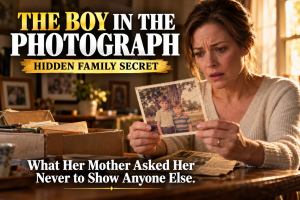
It was a color print from 1974, the colors slightly faded into soft yellows and blues. Two boys stood outdoors near a large oak tree. The taller one was clearly Daniel at about five years old, wearing a striped shirt and looking slightly off to the side. The smaller boy stood close beside him, maybe four, dark hair falling across his forehead, one hand raised as if he had just been speaking. Behind them, a wooden picnic table and the edge of a white house.
Mother pointed to the smaller boy. “That was the summer you two became best friends.”
I looked at the photograph again. Then I looked at it a third time.
The smaller boy was not me. I had never seen him before. Yet something about his face pulled at a memory I could not name. The shape of the eyes. The slight tilt of the mouth. The way the hair fell.
I set the photograph down carefully. “Mom, that’s not me.”
She smiled the way she always smiled when she wanted a conversation to stay light. “Of course it is. You were always following Daniel around that year.”
“I was two in 1974,” I said. “And I don’t remember any best friend who looked like that.”
She reached for the box again, already moving on. “Well, memories get mixed up. There are other pictures in here. Look at these.”
I did not look at the other pictures. I kept staring at the boy who was not me. The longer I looked, the stronger the feeling became. I had seen that face before. Not in any photo of myself. In the old black-and-white pictures of my father as a child that used to sit on my grandmother’s dresser.
The resemblance was not approximate. It was exact.
I asked the question carefully. “Who is the other boy?”
Mother’s hand paused over an envelope. For half a second her shoulders stiffened. Then she shrugged and pulled out a different photograph, one of Daniel on a bicycle. “Just a friend from the neighborhood, I suppose. I don’t remember every child’s name from fifty years ago.”
She stayed another twenty minutes, talking about the attic and the dust and how the roof would need work before winter. She never looked at the 1974 photograph again. When she left, she took the cardboard box with her, but she left the single print on my table.
I sat with it for a long time after her car disappeared down the street.
That evening the phone rang. It was Mother. Her voice was lower than usual.
“About that picture,” she said. “I think I should take it back. It’s not very good quality, and I don’t want it floating around. Some of those old photos are private.”
“You already gave it to me.”
“I know. But I’d rather you didn’t show it to anyone else. Not Daniel, not your uncle, not anyone. Just put it away. Please.”
The word “please” landed differently than it usually did. There was weight in it.
I told her I would put it away. After we hung up I placed the photograph in the drawer of my desk, face down, and tried to go about the rest of the evening as if nothing had shifted.
I lasted until nearly midnight.
Then I took the photograph out again and studied the two boys under the kitchen light. Daniel’s face was unmistakable. The other boy’s face kept pulling me back to the old pictures of my father at the same age. Same eyes. Same mouth. Same quiet way of standing.
Something was wrong. And my mother knew it.
I could not let it go.
Part 2
The next morning I called Daniel. He was at work, distracted, the sound of warehouse noise behind him.
“Do you remember a kid you were friends with in 1974?” I asked. “Someone who looked a lot like Dad when he was little?”
Daniel laughed. “I was five. I barely remember kindergarten. Why?”
“Mom brought over an old picture. You’re in it with another boy. She said the two of you were best friends that summer.”
“Okay. And?”
“The other boy looks exactly like Dad as a kid.”
There was a pause. “That’s weird. Maybe a cousin or something.”
“She wouldn’t say who he was. Then she called last night and asked me not to show the picture to anyone.”
Daniel’s tone shifted slightly. “She can be protective about old stuff. You know how she is.”
I described the photograph in more detail. The oak tree. The picnic table. The white house in the background. Daniel said none of it rang a bell. He promised to look through his own boxes of childhood things when he had time, but he did not sound especially interested.
After we hung up I opened my laptop and began searching.
My father’s name was easy to find in old public records. School enrollment lists from the early 1970s had been digitized by a local historical society in the town where he grew up. According to those lists, in the fall of 1974 my father was enrolled in a school two hundred miles away, in a different county. He was living with his parents at an address I recognized from family stories. There was no record of him attending any school near the town where the photograph appeared to have been taken.
I sat with that information for a while.
The photograph was dated 1974 on the back in my mother’s careful handwriting. Daniel was clearly in it. The other boy looked like my father as a child. Yet my father had been living somewhere else entirely that year.
I searched for the white house and the oak tree next, using landmarks from the background. It took three evenings of comparing old property photos and newspaper archives, but I eventually matched the location. The house had belonged to a family named Ellison in the mid-1970s. They had hosted large gatherings. One of those gatherings appeared in a local newspaper in August 1974 under the headline “Ellison Family Reunion Draws Relatives from Three States.”
I found the article in a digital archive. There was a group photograph. In the far left of the published image, two small boys stood near a tree. The resolution was poor, but the posture matched the print my mother had given me.
Standing just behind the boys was a woman in a light dress. The caption listed many names. Hers was among them: Margaret Ellison.
I had never heard that name in our family. Not once.
I printed the article and placed it beside the original photograph on my desk. Then I opened the drawer where I kept the few remaining albums from my grandmother’s house and pulled out the black-and-white portraits of my father as a boy. I lined them up next to the 1974 print.
The resemblance was not coincidence. It was identity-level. Same bone structure. Same expression. Same way of holding the shoulders slightly forward.
My father had a double who had stood beside my brother in 1974 while my father himself was two hundred miles away.
Or the records were wrong.
Or something else entirely was true.
I did not sleep well that week. Every time I closed my eyes I saw the smaller boy’s face and the careful way my mother had avoided looking at the photograph when she left my house.
On Saturday I drove to my uncle’s place.
Uncle Ray was my father’s younger brother. He lived alone in the same small house he had bought after his divorce twenty years earlier. He kept things simple and did not ask many questions. When I arrived he was in the backyard watering tomato plants. He wiped his hands on his jeans and nodded toward the kitchen door.
“Come on in. Coffee’s still hot.”
I waited until we were sitting at the table with mugs in front of us before I took the photograph out of the envelope I had brought.
I set it between us without speaking.
Uncle Ray looked at it. His expression did not change for several seconds. Then his eyes narrowed slightly, the way they did when he was calculating something. He picked the photograph up, held it closer to the window light, and studied the smaller boy.
When he finally spoke, his voice was quiet and even.
“I always wondered if anyone would ever find this.”
He set the photograph down carefully, as if it might break.
“Your mother was never supposed to keep that picture,” he said. “And she was never supposed to show it to you.”
I waited.
Uncle Ray rubbed a hand across his jaw and looked past me toward the backyard.
“There’s a reason that boy looks like your father,” he said. “And there’s a reason your mother doesn’t want anyone talking about it.”
He paused, then said the words I had never heard anyone in our family speak aloud.
“That boy was your father’s son.”
Part 3
The kitchen went very still. Outside, a lawn mower started somewhere down the street. Uncle Ray kept his eyes on the photograph.
“My father’s son,” I repeated. The words felt heavy and unreal in my mouth.
“From before he met your mother,” Uncle Ray said. “The boy was about four in that picture. Your father would have been twenty-two.”
I stared at the smaller face. The familiar eyes. The familiar mouth. Everything I had noticed suddenly rearranged itself into a different shape.
“Does Daniel know?”
“No. Your mother made sure of that. She made sure of a lot of things.”
Uncle Ray leaned back in his chair. He looked older than he had when I arrived. The lines around his eyes seemed deeper.
“Your father had a relationship with a woman named Margaret when he was young. It didn’t last. She got pregnant. He was scared and not ready. Her family lived in that town where the reunion was held. She kept the child. Your father sent money for a while. Then he met your mother, and everything changed.”
I tried to picture my father at twenty-two, the quiet man I had known as solid and steady, making the kind of choices that left a child behind. The image would not settle.
“Why was Daniel in the photograph?”
“Margaret invited him once. Your father took Daniel to the reunion without telling your mother the full truth. He said it was a distant relative’s gathering. He wanted the boys to meet. Just once. He thought maybe it would ease something in him. After that day he never went back. Your mother found the photograph years later in a box he had forgotten. She nearly left him over it.”
Uncle Ray’s voice stayed flat, as if he had rehearsed the facts many times in his own mind.
“She stayed. But she made him promise the subject would never come up again. The other child would not be part of your lives. She kept the photograph because she didn’t trust him to destroy it. She wanted proof he had told her the truth about the past.”
I looked at the woman standing behind the boys in the newspaper article I had printed. Margaret Ellison. The name that appeared nowhere in our family tree because she had been deliberately kept out of it.
“What happened to the boy?”
Uncle Ray shook his head. “I don’t know. Your father stopped talking about him after that summer. Margaret remarried, I think. Moved. Your father never spoke the boy’s name in this house again.”
“What was his name?”
Uncle Ray hesitated. “David. David Ellison.”
The name landed with a strange softness. David. A brother I had never known existed. Half-brother. Older than me by two years. Standing beside Daniel in a photograph my mother had asked me never to show anyone.
I asked the next question carefully. “Does he know about us?”
“I have no idea. Your father never said. And after he died, your mother made it clear the subject was closed permanently.”
Uncle Ray reached across the table and tapped the edge of the photograph. “She called me the night she left that picture with you. She was upset. She said she had made a mistake. She asked me to talk to you if you came asking questions. She wants you to put it away and leave it alone.”
I looked at the two boys under the oak tree. Daniel and David. Best friends for one summer, according to the story my mother had tried to tell. Brothers who had met once and then been separated by adult decisions and carefully maintained silence.
“I can’t leave it alone,” I said.
Uncle Ray nodded slowly, as if he had expected that answer. “I know. You’re like your father that way. Once something gets under your skin, you dig until you find the bottom of it.”
He stood and carried our empty mugs to the sink. When he turned back, his expression had softened.
“Be careful with your mother,” he said. “This is the one thing that still hurts her. She spent years protecting the life she built. Finding out the truth is one thing. Deciding what to do with it is another.”
I drove home with the photograph on the passenger seat. The afternoon light had turned gold. Ordinary houses passed by the windows. People watered lawns and walked dogs and lived lives that did not suddenly contain secret brothers and hidden reunions.
When I reached my house I placed the photograph and the newspaper article side by side on the kitchen table. Then I opened my laptop and began searching for David Ellison.
The name was common enough to make the search slow. I tried combinations with the town, with Margaret, with approximate birth years. After two hours I found a possible match: a man in his early fifties living three states away, listed in a professional directory. The accompanying photograph was small and professional. Dark hair. Familiar eyes. A mouth that looked like my father’s.
I stared at the screen for a long time.
Then I closed the laptop without saving anything and sat in the quiet kitchen, listening to the refrigerator hum, trying to decide whether I had the right to open a door that had been deliberately closed for fifty years.
Part 4
I did not contact David Ellison that week. Or the next. Instead I went to see my mother.
She was in her garden when I arrived, kneeling among the late tomatoes with a basket beside her. She looked up, shaded her eyes, and smiled the way she always did when one of her children appeared without warning.
“I didn’t expect you,” she said. “Come inside. I’ll make tea.”
We sat at her kitchen table, the same table where I had done homework as a child. The photograph stayed in the envelope in my bag. I did not take it out right away.
I asked about the attic cleaning. She talked about dust and old coats and how the insulation needed replacing. She asked about my work and whether I had spoken to Daniel recently. Ordinary conversation. Protective conversation.
When there was a natural pause I placed the envelope on the table between us.
“I need to talk about this,” I said.
Her face changed. The polite openness closed. She looked at the envelope as if it contained something that might burn.
“I asked you to put that away.”
“I know. I showed it to Uncle Ray.”
She closed her eyes for a moment. When she opened them again they were tired.
“He told you.”
“Yes.”
She stood and walked to the window. Outside, a neighbor’s dog barked once and then fell silent. She kept her back to me.
“Your father made a mistake when he was young,” she said. “He paid for it in ways you will never fully understand. I chose to stay with him. I chose to build this family. That choice required certain things to remain private.”
“The boy in the photograph is my half-brother.”
“Yes.”
“His name is David.”
She turned. “How do you know that?”
“Uncle Ray.”
She nodded once, as if confirming a fact she had always expected would surface eventually.
“Does Daniel know?” I asked.
“No. And I would prefer it stay that way.”
“Why?”
“Because it changes nothing practical about our lives, and it opens a door that has been shut for good reasons. Your father is gone. That other woman is gone from our story. The child grew up without us. Introducing him now serves no purpose except curiosity.”
I kept my voice steady. “It’s not only curiosity. He’s real. He exists. He has a face that looks like Dad’s. Daniel stood next to him when they were little. That matters.”
Mother came back to the table and sat down. She did not reach for the envelope.
“I loved your father,” she said. “I loved the life we made. When I found that photograph I felt something break. Not because of the child. Because of the secret. Because he had taken Daniel there without telling me the truth. Because for one afternoon he had tried to hold two families at the same time. I made him choose. He chose us. Completely. I required that completeness. It was the only way I could stay.”
She looked at me directly. “I am asking you to respect that choice. Put the photograph away. Do not contact that man. Do not tell Daniel. Let the past remain the past.”
The request was clear. It was also impossible for me to accept without at least understanding more.
I left without promising anything. Mother walked me to the car and hugged me the way she always did, firmly, as if physical contact could settle unsettled things. As I drove away I watched her in the rearview mirror standing on the porch, arms folded, watching me go.
That night I opened the laptop again. The professional directory entry for David Ellison was still there. I studied the small photograph for a long time. Then I searched further.
Public records showed a marriage, two adult children, a home address in a quiet suburb. There was a brief mention of him in a local paper in connection with a community project. Nothing dramatic. An ordinary life.
I drafted a message and deleted it. Drafted another and deleted that one too. The third version was short and careful. I introduced myself by full name, mentioned the photograph from 1974, and said I believed we might be related through our father. I included no demands and no expectations. Only a willingness to talk if he wished.
I sat with the cursor hovering over the send button for nearly an hour.
Then I sent it.
The reply came three days later.
It was equally careful. David Ellison wrote that he had known for many years that his biological father had another family. His mother had told him the truth when he was twelve. He had chosen not to seek contact out of respect for the life that man had built. He was surprised to hear from me. He was open to a conversation if I wanted one.
We exchanged a few more messages. Then we agreed to speak by phone.
The call lasted forty minutes. His voice was steady, slightly lower than my father’s had been, but something in the rhythm of his speech felt familiar. He asked about Daniel and about me. He asked whether our mother was still living. He did not ask for anything. He simply answered questions and offered a few of his own.
Near the end of the call he said, “I have a photograph too. From that same day. My mother kept it. I can send you a scan if you want.”
I said yes.
The image arrived that evening. It was clearer than the one my mother had given me. In it, the two boys stood closer together. Daniel had one arm loosely around David’s shoulders. Behind them, Margaret Ellison smiled at the camera. And off to the side, partially cut off by the frame, stood a young man in a light shirt. My father at twenty-two, looking toward the boys with an expression I could not quite read.
I printed the new photograph and placed it beside the original on my desk.
Two pictures. Same afternoon. Same children. Different versions of the truth depending on who had kept the print.
I knew I would have to tell Daniel. And I knew that telling him would change the shape of the quiet family we had always believed we were.
Part 5
Daniel came over on a Sunday afternoon. He brought a six-pack of the beer he liked and sat at the kitchen table the way he had done since we were teenagers. I waited until he had opened a bottle before I placed both photographs in front of him.
He looked at the first one, the print Mother had given me. Then he looked at the second, the clearer scan from David.
“Okay,” he said. “Explain.”
I told him everything. The resemblance. The school records. The newspaper article. Uncle Ray’s admission. The conversation with Mother. The messages and the phone call with David Ellison.
Daniel listened without interrupting. When I finished he picked up the clearer photograph and held it under the light.
“That’s Dad,” he said, pointing to the partial figure at the edge of the frame. “Jesus. That’s actually Dad.”
“Yes.”
He set the photograph down. “And the kid is his.”
“Yes. Our half-brother.”
Daniel was quiet for a long time. He drank from the bottle, stared at the two images, then rubbed the back of his neck the way he did when something unsettled him.
“Mom knew the whole time.”
“Yes.”
“And she wanted us to never know.”
“Yes.”
He let out a slow breath. “I remember that day. Not clearly. But I remember being somewhere with a lot of people and a kid I played with. I thought it was just some cousin’s house. Dad told me we were visiting relatives. I never thought about it again.”
He looked at me. “Have you met him?”
“Only by phone. He’s open to meeting if we want to.”
Daniel turned the photograph over, then back again. “What’s he like?”
“Calm. Careful. He knew about us for a long time and chose not to interfere. He has a family of his own. Two kids. A wife.”
“Does he look like Dad?”
“In the professional photo I found, yes. A lot.”
Daniel stood and walked to the window. Outside, the street was quiet. A child rode a bicycle past the house and disappeared around the corner.
“I don’t know how I feel about this,” he said. “Part of me is angry that Mom kept it from us. Part of me understands why. Part of me wants to meet him. Part of me wants to leave it alone because Dad is gone and nothing we do now changes the past.”
“I felt the same way,” I said. “I still do.”
He came back to the table. “What does Mom want?”
“She wants us to put the photographs away and never speak of it again.”
Daniel gave a short, humorless laugh. “That’s not going to happen. Not now.”
We sat with the photographs between us for another hour. We talked about our father in a way we had not done in years. The quiet competence. The way he avoided certain questions about his early twenties. The occasional distant look that used to appear when he thought no one was watching. Small things that suddenly had context.
Before Daniel left he said, “I want to meet him. Not right away. But I want to. You should tell Mom we’re going to do that. She deserves to hear it from us rather than find out later.”
I agreed.
Telling Mother was harder than I expected.
I went to her house on a weekday morning when I knew she would be alone. She made coffee. We sat in the living room. I told her that Daniel knew, that I had spoken with David, and that both of us intended to meet him.
She listened without speaking. When I finished she set her cup down carefully.
“I cannot stop you,” she said. “You are adults. But I will not be part of it. I will not meet him. I will not discuss him. And I will not pretend that this does not hurt.”
“I’m not asking you to pretend.”
“You are asking me to watch the boundary I spent my life maintaining get crossed. That is not a small thing.”
I reached for her hand. She did not pull away, but she did not return the pressure either.
“I’m sorry this is painful,” I said. “I am not trying to punish you. I am trying to understand the full truth of the family I come from.”
She looked at our joined hands. “The full truth includes the cost of certain choices. Your father paid one kind of cost. I paid another. The child paid a third. Now you and Daniel will pay something too, even if you do not see it yet.”
She withdrew her hand and stood. “Do what you feel you must. Just do not expect me to celebrate it.”
I left her house with the weight of that conversation sitting heavy in my chest. She had not forbidden us. She had simply withdrawn her blessing and her participation. It was the most honest response she could give, and it left a clear space between us that had not existed before.
That evening I wrote to David and asked whether he would be willing to meet Daniel and me in person. He replied the next morning. He suggested a neutral place halfway between our cities, a quiet restaurant he knew. We set a date three weeks out.
I spent those three weeks preparing in small ways. I sorted through the remaining photographs from my grandmother’s collection. I found two more images of my father as a young man that I had never paid close attention to. In one of them he stood beside a car in the early 1970s, looking toward something outside the frame with an expression that now seemed full of unspoken thought.
I also spoke with Uncle Ray again. He offered no new information, only a quiet warning.
“People think secrets are the problem,” he said. “Sometimes the problem is what happens after the secret is told. Be ready for the shape of the family to feel different. That difference does not go away just because everyone means well.”
I nodded. I thought I understood. I did not yet understand how thoroughly he was right.
Part 6
The restaurant was a low brick building with large windows and wooden tables spaced far enough apart for private conversation. Daniel and I arrived first. We chose a table near the back and ordered coffee while we waited.
David Ellison walked in at exactly the agreed time. He was taller than I had expected, with the same dark hair my father had kept until the end, though silvered at the temples. His face was an older, more settled version of the boy in the photograph. He saw us, paused for half a second, then came forward with a calm expression that did not quite hide the careful assessment in his eyes.
We stood. There was an awkward moment of not knowing whether to shake hands or do something more. He solved it by extending his hand first. His grip was firm and brief.
“Thank you for coming,” he said.
We sat. For the first few minutes the conversation stayed on safe ground. The drive. The weather. The restaurant. Then Daniel, never one for prolonged small talk, placed the two photographs on the table.
David looked at them for a long time. He touched the edge of the clearer print, the one his mother had kept.
“I haven’t seen this in years,” he said. “She kept it in a drawer. I found it when I was twelve. That was when she told me the truth.”
“What did she tell you?” I asked.
“That my biological father had been young and unprepared. That he had another family. That he had chosen to stay with them. She never spoke badly of him. She just said the situation was complicated and that I should not expect him to be part of my life.”
David looked up from the photographs. “I didn’t. I was curious sometimes. But I had a stepfather who treated me well. I decided that was enough.”
Daniel leaned forward slightly. “Did you ever try to find him?”
“Once. When I was about twenty-five. I found an address. I drove past the house. I sat in the car for an hour. Then I left. It felt wrong to knock on a door that had never been opened to me.”
The honesty of that statement settled over the table. No bitterness. No demand. Just a man describing a choice he had made and lived with.
We talked for nearly two hours. David asked about our father in careful ways. What he had been like as a parent. Whether he had been happy. Whether he had ever mentioned the past. We answered as truthfully as we could. We told him about Mother’s request that the subject remain closed. We told him she would not meet him.
He nodded as if that news was expected. “I understand. She protected what she built. I don’t blame her for that.”
Near the end of the meal he took out his phone and showed us photographs of his own family. A wife with kind eyes. A daughter in her twenties. A son who looked startlingly like the boy under the oak tree. The resemblance moved through the generations with quiet persistence.
“They’re the reason I never pushed,” David said. “I had what I needed. I didn’t want to disrupt anyone else’s life for the sake of my own questions.”
Daniel looked at the phone screen, then at David. “You’re here now.”
“Because you reached out. That changes the calculation. If the people on the other side of the secret want contact, then the respect runs both ways.”
We exchanged numbers and agreed to stay in touch. No grand plans. No forced closeness. Just an open door.
When we left the restaurant the three of us stood for a moment in the parking lot. The afternoon light was soft. David shook our hands again, then hesitated.
“I’m glad you found the photograph,” he said. “I’m glad you didn’t put it away.”
He walked to his car. Daniel and I watched him drive away. Neither of us spoke for a while.
On the drive home Daniel said, “He seems decent.”
“Yes.”
“Dad would have liked him, I think.”
“Probably.”
Daniel was quiet for several miles. Then he said, “I keep thinking about that day in 1974. Dad taking me there. Introducing me to a brother I didn’t know I had. Then bringing me home and never mentioning it again. What was he hoping for?”
I did not have an answer. I only had the same question sitting in my own chest.
When I reached my house that evening I placed the two photographs side by side again. Daniel and David under the oak tree. Two boys who had been allowed one afternoon of ordinary childhood closeness before the adults closed the door.
I thought about Mother sitting alone in her house, knowing we had gone to meet the person she had spent decades keeping outside the family circle. I thought about the cost she had named, the cost that was now becoming visible.
The secret was no longer a secret. What remained was the work of living with the truth.
Part 7
In the weeks that followed, the shape of ordinary life began to shift in small, persistent ways.
David and I exchanged occasional messages. Nothing frequent. A photograph of his garden. A question about a shared interest in old maps that had surfaced during our conversation. Daniel spoke with him once by phone and reported that the talk had been easy and unforced. No one was trying to manufacture a sudden deep relationship. We were simply allowing the possibility of one.
Mother remained consistent in her distance from the subject. When I visited she asked about work and about Daniel’s job and about the weather. She did not ask about David. I did not offer information. The silence between us on that topic was deliberate and mutual. It was also heavier than any argument would have been.
One afternoon in late October I received a package from David. Inside was a small album and a letter. The album contained photographs his mother had taken over the years: David as a schoolboy, as a teenager, at his wedding, holding his first child. Interspersed among them were a few images from the early 1970s, including one of Margaret Ellison standing alone near the same oak tree that appeared in the reunion photographs. On the back she had written a date and a single sentence: “The day the boys met.”
The letter was brief. David wrote that he had found the album while sorting his mother’s things after her death several years earlier. He had never known what to do with the early pictures. Now that contact existed, he wanted me to have copies. He added that he was not asking for anything in return. He only wanted the images to exist in more than one place.
I sat with the album open on my lap for a long time. The progression of faces was ordinary and moving. A child who had grown up without the father whose features he carried. A man who had built a steady life. The quiet dignity of someone who had chosen not to force a connection he had not been offered.
I called Daniel and told him about the package. He came over that evening. We looked through the album together. When we reached the final pages, Daniel closed it gently.
“I keep waiting to feel angry,” he said. “At Dad. At Mom. At the whole situation. But mostly I just feel sad. Sad for the kid who only got one afternoon. Sad for Dad carrying that. Sad for Mom having to decide what kind of family she could live with.”
“And us?” I asked.
“Us too. We grew up with a missing piece we didn’t know was missing. Now we know. Knowing is better. But it’s still a loss of the simpler version of the story.”
I understood exactly what he meant.
A few days later I drove to Mother’s house with a careful decision in mind. I did not take the new album. I took only the original photograph she had given me and the clearer print from David. I placed them on her kitchen table without commentary.
She looked at them, then at me.
“I already know what these are.”
“I know. I brought them because I want you to see that the boy grew up. He has a family. He is not a threat to anything you built. He is simply a person who shares half of our father’s history.”
Mother’s hands rested flat on the table. She did not touch the photographs.
“I never claimed he was a threat,” she said. “I claimed that opening this door would change the boundaries of the life I chose. It has. You and Daniel have stepped through. That is your right. It does not make my original choice wrong.”
“I’m not saying it was wrong.”
“Then what are you saying?”
I searched for the cleanest version of the truth. “I’m saying the story is larger than the one we were given. I needed to see the larger version. Daniel needed it too. We are not trying to rewrite your marriage or your decisions. We are trying to include a person who was always part of the facts, even when he was absent from the telling.”
Mother was silent for a long stretch. Outside, the light was fading. She stood and turned on the kitchen lamp, then returned to her chair.
“Your father loved you both completely,” she said. “Whatever else is true, that remains true. He did not divide his heart the way some people feared he might. He chose. Every day after that summer, he chose the life inside this family. I needed that certainty. I still need the memory of it.”
“I understand.”
“Do you?” She looked at me with an expression that mixed weariness and something softer. “Then understand this as well. I will not meet David Ellison. I will not look through albums of his life. I will not pretend that the years of silence cost me nothing. But I will also not ask you to stop speaking with him. The cost of forcing that request would be higher than the cost of accepting what I cannot control.”
It was the closest thing to permission she was able to offer. I accepted it as such.
When I left, she walked me to the door and hugged me longer than usual. Neither of us mentioned the photographs still sitting on the table. She would decide what to do with them after I was gone. That, too, was her right.
On the drive home I felt a complicated mixture of relief and lingering sorrow. The secret had been brought into the open. The relationships that could stretch had begun to stretch. The ones that could not had made their limits clear. Nothing was simple. Everything was more honest than it had been the day Mother first placed that photograph in my hands.
Part 8
Winter arrived early that year. The first hard frost came in November, and with it a quieter rhythm to the days. David and I continued our occasional messages. In December he invited Daniel and me to a simple lunch at his home when he would be visiting a nearby city for work. We accepted.
His wife, Ellen, met us at the door with a warm, straightforward manner that put us at ease almost immediately. Their daughter was away at university. Their son, a quiet young man in his early twenties, joined us for the meal and then excused himself with polite ease. The house was comfortable and unpretentious. Photographs of their family covered one wall of the living room. Mixed among them, I noticed, were none of my father. The absence felt intentional and respectful rather than cold.
During lunch the conversation moved easily between ordinary subjects and the careful territory of shared history. Ellen asked about our mother with genuine interest and no pressure. When we explained her position, she nodded.
“I can understand wanting to protect a life you built under difficult circumstances,” she said. “David has always spoken of her with respect, even though they never met.”
David smiled slightly. “My mother taught me that. She said bitterness was a waste of the life I actually had.”
After the meal we sat in the living room. David brought out a small box of additional photographs and letters his mother had saved. Among them was a short note written in my father’s handwriting, dated a few months after the 1974 reunion. It was brief and careful. He thanked Margaret for allowing the boys to meet. He said he hoped David would grow up well. He did not promise further contact. He did not apologize in so many words, yet the restraint of the letter carried its own weight.
Daniel read it twice. When he handed it back, his eyes were damp.
“He was trying,” Daniel said. “In the only way he knew how at the time.”
David nodded. “That’s how I’ve always read it.”
We stayed another hour. Before we left, David walked us to the car. The afternoon was cold and clear. He stood with his hands in his coat pockets and looked at both of us.
“I don’t know what this becomes,” he said. “Maybe we see each other once a year. Maybe more. Maybe less. I’m not trying to insert myself into the center of your family. I just want the door to stay open if that feels right to everyone.”
Daniel answered for both of us. “The door is open.”
On the drive home Daniel was quieter than usual. After many miles he said, “I keep thinking about Mom. Sitting in her house knowing we’re doing this. I wish she could find a way to be part of it without feeling like she’s losing something.”
“I don’t think she can,” I said. “Not yet. Maybe not ever. That doesn’t mean we stop.”
“I know. It just feels incomplete.”
It did. The incompleteness was part of the truth we were learning to carry.
In January I received a letter from Mother. It was written in her precise hand on the stationery she had used for years. She did not mention David by name. She wrote about the weather and about a book she was reading. At the end she added one paragraph that stood apart from the rest.
“I have been thinking about the photograph. I was wrong to ask you to hide it. The asking came from fear, not from wisdom. You and Daniel have the right to know the full shape of your father’s life. I cannot walk that path with you, but I will not stand in the way of it. That is the best I can offer.”
I read the letter several times. Then I called her. We talked about ordinary things for twenty minutes. Near the end of the conversation I thanked her for the letter. She accepted the thanks without expanding on it. The subject closed again, but the tone between us had shifted by a small, important degree.
That night I placed Mother’s letter in the same drawer where I kept the photographs. The collection of paper that had begun with a single forbidden image was growing into a record of choices, consequences, and the slow work of living with what had been revealed.
Spring came. David’s daughter graduated from university. He sent a photograph of the ceremony and an invitation to a small gathering afterward. Daniel and I discussed it and decided to go. We did not tell Mother the specific reason for the weekend trip. She did not ask. The boundary remained, but it no longer felt like a wall that might collapse if touched. It felt like a fence that both sides had agreed to respect.
At the gathering I watched David stand with his wife and children, easy in their company. I watched Daniel talk with David’s son about cars and work. I felt the quiet strangeness of belonging to two versions of a family history at once, and the equal quiet rightness of no longer having to pretend one of those versions did not exist.
On the way home Daniel said, “Dad would have been proud of him. Of all of them.”
“Yes,” I said. “I think he would.”
The road stretched ahead under a soft evening sky. Behind us lay the years of silence. Ahead lay whatever we would make of the opened door. The photograph that had started everything rested in a folder in my bag, no longer a secret, only a beginning.
Part 9
Two years passed. The relationship with David settled into something steady and unforced. We saw one another three or four times a year. Messages traveled back and forth in the ordinary way of people who have decided they belong in one another’s lives without needing constant proof of it. Daniel and David developed an easy rapport that sometimes made me smile; they shared a dry humor and a practical way of looking at problems that felt inherited from the same source.
Mother never met David. She never asked for updates and I never forced them on her. Yet something in her manner toward me softened over time. She began to speak of our father with less careful editing. Once, while we were sorting through a box of his old tools in her garage, she paused with a wrench in her hand and said, “He carried more than I knew how to help him with. I see that more clearly now.”
I did not press. The acknowledgment itself was a kind of movement.
In the third year after the photograph first appeared on my kitchen table, David called with news that felt both ordinary and significant. His son was getting married. He wanted Daniel and me to attend if we could. The invitation was warm and free of pressure. We accepted.
The wedding was held on a clear autumn afternoon in a garden outside the city where David lived. Ellen had arranged everything with quiet elegance. During the ceremony I sat beside Daniel and watched David stand with his son, one hand resting briefly on the young man’s shoulder. The gesture was simple and full of the kind of fatherly presence our own father had given us and had been unable to give David in the same continuous way.
At the reception David found a moment to speak with us alone near a low stone wall.
“Thank you for being here,” he said. “It means more than I can easily say.”
Daniel answered, “We’re family. This is what family does.”
David looked at both of us for a long moment. “I used to wonder what it would have been like to grow up knowing you. I don’t wonder in the same way anymore. What we have now is what we have. It’s enough. It’s good.”
Later that evening, after the toasts and the dancing, I stepped away from the tables and stood under a string of lights. The air was cool. From where I stood I could see David laughing with his daughter, Ellen resting her head briefly against his shoulder, Daniel talking with a group of younger relatives. The scene was ordinary and luminous at once.
I thought of the photograph from 1974. Two small boys under an oak tree. One afternoon of proximity before the adults closed the door. Fifty years later the door stood open again, not because anyone had demanded it, but because a single image had refused to stay hidden and the people who saw it had chosen curiosity over silence.
I took out my phone and sent Mother a message. I did not mention the wedding or David. I simply wrote that I was thinking of her and that I hoped she was well. She replied within an hour with a short note about her garden and a question about my work. The exchange was brief and loving and incomplete in the way our relationship on this subject would always be incomplete. I accepted the incompleteness as part of the truth.
On the long drive home the next day, Daniel drove while I watched the landscape change. After a long stretch of quiet he said, “Do you ever wish we had never seen that photograph?”
I considered the question carefully. “No. I wish the silence had never been necessary. But once the photograph existed, I’m glad we didn’t look away.”
He nodded. “Me too.”
We reached my house in the late afternoon. Daniel came inside for a short while. We stood in the kitchen where the entire sequence had begun. The cardboard box was long gone. The photographs had been placed in a proper album along with the copies David had sent and the letter Mother had written. The collection no longer felt like evidence of a hidden wound. It felt like a record of a family learning, slowly and imperfectly, how to hold a larger story.
Before Daniel left he said, “We should take a new picture sometime. The three of us. Not to replace the old one. Just to add to it.”
I agreed. The idea felt right.
That night I sat alone at the table with the old photograph in front of me. Daniel and David under the oak tree. The woman whose name had appeared nowhere in our family tree standing behind them. The partial figure of our father at the edge of the frame. All of them frozen in a single afternoon that had carried more weight than any of them could have known at the time.
I turned the photograph over. On the back, in my mother’s handwriting from long ago, was the date and the brief note she had once used to explain it away. I added a new line beneath it in my own hand.
“The beginning of the rest of the truth.”
Then I closed the album and turned off the light.
Part 10
Five years after the afternoon my mother first placed the photograph on my kitchen table, the three of us stood together in a park not far from the town where the 1974 reunion had been held. It was early summer. The light was clear and gentle. Daniel had brought a camera. David stood between us, a little taller, a little more silver in his hair than when we first met. We were not trying to recreate the old image. We were simply making a new one.
Ellen took the photograph. In it we are smiling the ordinary, slightly self-conscious smiles of people who know a camera is pointed at them. Behind us a large oak tree spreads its branches, not the same tree, but close enough in spirit. No one is hiding. No one is being asked to look away.
After the picture was taken we walked for a while along a path that followed a small creek. Conversation moved easily between the three of us. Plans for the coming months. News of children and work. A shared memory of our father that David listened to with quiet attention and then answered with a memory of his own mother. The exchange felt natural. The long years of absence had not been erased; they had simply been joined by years of presence that were still unfolding.
Later that day I drove alone to my mother’s house. She was in the garden again, as she so often was. I sat with her on the porch steps and showed her the new photograph on my phone. She looked at it for a long time without speaking. Then she handed the phone back.
“You look like yourselves,” she said. “All three of you.”
It was the closest she had come to acknowledging David directly. I did not press for more. Some boundaries remain even when others soften. The important movement had already happened: she had looked, and she had not turned away.
That evening I returned home and placed a printed copy of the new photograph beside the old one in the album. Two images separated by half a century. One taken in secrecy and later hidden. One taken in the open and freely kept. Between them lay the distance we had traveled—from a single forbidden picture and a mother’s frightened request, through research and difficult conversations and careful meetings, to a quiet afternoon in which three people who shared a father could stand together without apology.
I do not believe every secret should be dragged into the light. Some silences protect more than they harm. But this particular silence had left a child outside the story and had required a lifetime of careful editing from the adults who kept it. When the photograph surfaced, the editing became impossible to maintain. What followed was not dramatic confrontation or sudden perfect reconciliation. It was slower and more ordinary: questions asked, truths told, limits respected, and a new kind of kinship allowed to form at its own pace.
My mother still lives within the boundaries that make sense to her. Daniel and I live with the wider map. David lives with the knowledge that the door, once closed, is now open in both directions. None of us has the complete story. Each of us holds a necessary part of it.
Sometimes I take the old photograph out and study the two small boys under the tree. I imagine the adult conversations that must have happened after the camera clicked, the careful agreements, the decisions about what would be said and what would never be mentioned again. I imagine my father driving home that evening with Daniel beside him, already beginning the work of returning to the life he had chosen. I imagine Margaret Ellison putting her own copy of the picture away, knowing it might be the only evidence her son would ever have of that meeting.
And I imagine the long arc that led from that afternoon to the present—one image refusing to stay buried, one set of questions that would not rest, one family learning that the truth, once faced, can be lived with even when it cannot be made simple.
The boy in the photograph was not my brother’s friend. He was our brother. The discovery did not destroy the family we already had. It enlarged the meaning of the word until it could hold him too.
That is the ending the photograph was always waiting to reach. Not a perfect resolution, but an honest one. Not the erasure of old costs, but the willingness to stop pretending the costs were never paid. And the quiet, ongoing work of standing in the light that remains after the secret is gone.