In 1949 a fourteen-year-old boy vanished from his Missouri home for three days. His family said he ran away in anger. Sixty years later a dusty wooden box and a single handwritten warning revealed that everything they believed about him was carefully built on silence.
Part 1
I was forty-one the spring I finally opened the box.
My grandfather had been gone almost two years by then. The house in Missouri still smelled faintly of motor oil and pipe tobacco whenever the heat came on. My grandmother had moved into a smaller place closer to town, and the rest of us took turns clearing the garage. It was the last place anyone wanted to start. Tools hung in careful rows. Coffee cans of screws lined the shelves. Under the workbench, behind a stack of old tire catalogs, sat the wooden fishing box no one remembered seeing him use.
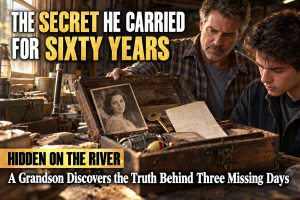
The lid stuck at first. Decades of dust had sealed it shut. When it finally gave, the air that rose smelled of river water and old paper. Inside, resting on a folded scrap of flannel, were three objects: a brass key with a short shank and a worn head, a small black-and-white photograph of a woman none of us recognized, and a scrap of paper with an address written in careful block letters. Beneath them lay one more folded sheet in my grandfather’s unmistakable handwriting.
I read the single sentence twice before the meaning settled.
“If they ever find this box, don’t trust the story they told you about me.”
My father stood in the doorway with a trash bag in his hand. He looked at the note, then at the photograph, and said nothing for a long time. Outside, a mourning dove called from the power line. The ordinary afternoon continued as if nothing important had happened.
That night I spread the items across my kitchen table. The photograph showed a young woman, maybe twenty, standing beside a weathered fence. Her hair was pulled back. She wore a plain dress and looked directly at the camera with an expression that was neither smiling nor sad. On the reverse, in pencil so faint I almost missed it, was a single name: Evelyn.
The address belonged to a place in Mississippi I had never heard of. I typed it into the search bar and found only an old county plat map and a short newspaper notice from the late 1970s announcing that the farmhouse had been abandoned after the last owner died without heirs.
I called my father the next morning.
“He never talked about those three days,” I said.
“No,” my father answered. “And we learned not to ask.”
I told him I was going to drive down in the spring, once the roads were clear of mud. He was quiet for a moment, then said, “Take the box with you. If there’s anything left to find, it should be with the things he kept.”
I spent the winter reading what little I could find about the Mississippi River in 1949. Flood records. Steamboat schedules. Newspaper notices of missing persons. Nothing matched a fourteen-year-old boy from Missouri who had returned home after three days and never spoken of what he had seen.
In March the weather turned. I loaded the fishing box into the passenger seat of my truck, folded the photograph and the note inside a plastic sleeve, and headed south. The road followed the river for long stretches. Cottonwoods leaned over the water. Barges pushed upstream under low gray skies. I kept thinking about the way my grandfather used to stand at the end of his driveway whenever a freight train passed, watching the cars until they disappeared, as if something important might still be riding in one of them.
I arrived at the farmhouse on a Thursday afternoon. The structure had collapsed in places. Vines claimed the porch. The roof sagged. Behind the house, half hidden by honeysuckle, stood a small boat shed with its door hanging open on one hinge. I stepped inside. The air was cooler. Dust motes drifted in the light that came through gaps in the boards. On the far wall, carved deep into the wood at about chest height, was a name.
Evelyn.
The same name written on the back of the photograph.
I stood there for a long time, listening to the wind move through the empty house. Somewhere beyond the trees the river kept moving the way it had in 1949, the year a fourteen-year-old boy disappeared for three days and came home carrying a secret he would keep for the rest of his life.
I touched the carved letters with my fingertips. The wood was smooth where countless hands might have brushed past it over the decades. Then I went back to the truck, opened the fishing box again, and laid the brass key in my palm.
Whatever door it once opened was still waiting somewhere in this place.
Part 2
I spent that first night in a motel fifteen miles down the road. The room smelled of disinfectant and old carpet. I spread the contents of the box across the thin bedspread and studied them under the weak lamp. The brass key was ordinary in every way except for a small notch filed into the edge of the head, as if someone had marked it for a purpose. The photograph of Evelyn had yellowed at the edges. The address was written in the same careful hand as the warning note.
I called my father again.
“There’s a name carved in the boat shed,” I told him. “Same as the photo.”
He was silent for several seconds. Then he said, “Your grandfather kept that box locked for as long as I can remember. Even after he stopped fishing. I always thought it was just old tackle he didn’t want to throw away.”
“He left a message,” I said. “He wanted someone to know the official story was wrong.”
My father exhaled. “I was five when those three days happened. All I remember is the house going quiet and my mother crying in the kitchen. When he came back he looked older. That’s the only word I ever had for it. Older.”
I asked if anyone in the family had ever mentioned a woman named Evelyn. He said no. I asked if the brass key meant anything. He said it looked like the kind used on old tool chests or small lockboxes, nothing special.
After we hung up I sat on the edge of the bed and turned the key over in my fingers. Outside, traffic moved along the highway with a steady low sound. I kept seeing the carved name in the boat shed and the way the light had fallen across it.
The next morning I returned to the farmhouse. The ground was soft from recent rain. I walked the perimeter of the collapsed structure, looking for anything that might still hold a lock the key could open. Most of the interior had fallen in on itself. Wallpaper hung in strips. A cast-iron stove stood half buried in debris. Nothing looked promising.
I went back to the boat shed. The carving was the only deliberate mark on the walls. I ran my hand along the boards below it and felt a slight give. One plank was shorter than the others. I worked it free with a pocketknife and found a narrow cavity behind it. Inside, wrapped in oilcloth that had nearly disintegrated, was a second brass key, identical to the first except that this one had no notch.
I sat on the dirt floor of the shed and held both keys. The morning light coming through the gaps was thin and cool. Somewhere a dog barked once and then fell quiet. I thought about my grandfather at fourteen, standing in this same place, carving a name into wood he must have known might last longer than he would.
I drove into the nearest town that still had a library with local records. The librarian was a woman in her sixties who listened carefully when I explained what I was looking for. She brought out boxes of old tax assessments and property transfer documents. The farmhouse had belonged to a family named Harlan from the 1920s until 1978. The last owner was listed as Thomas Harlan, who died without children. There was no mention of anyone named Evelyn in the available papers.
I asked if there were any old photographs of the property. She found a single faded print from a county fair exhibit in 1951. The house stood intact then, white clapboard, a porch with rocking chairs, a young woman standing near the gate with her hand raised as if she had just been called. The resolution was too poor to be certain, but the shape of her face and the way she held her shoulders looked familiar.
I left the library with a photocopy of the image and a growing sense that the three days my grandfather vanished had not been spent wandering the riverbanks in anger. Something had drawn him south. Something, or someone, had kept him for those days and then sent him home with a secret heavy enough to last a lifetime.
That evening I sat on the motel steps with the fishing box open beside me. The two keys rested side by side. The photograph of Evelyn looked back at me with the same quiet expression she had worn for decades. I thought about the warning note and the careful way my grandfather had written it, as if he expected that someday the official story would no longer be enough.
I decided to stay another week.
There was more to find. I could feel it in the way the river kept moving past the abandoned land, carrying whatever it had carried in 1949, refusing to give up everything it knew.
Part 3
On the third day I walked the riverbank behind the farmhouse. The water was high from spring rain, brown and fast. Cottonwood seeds drifted on the surface like small white boats. I followed an overgrown path that might once have been a trail down to an old landing. The remains of a wooden dock stuck out of the mud at odd angles. Nearby, half buried, was a rusted metal box about the size of a tackle chest. The lock was still attached, green with age.
I tried the notched key first. It did not turn. The second key slid in smoothly and opened with a soft click that seemed too loud in the quiet air.
Inside, protected by layers of tarred canvas, were three items: a small leather-bound notebook, a folded map of the river marked with pencil lines, and a second photograph. This one showed the same woman, Evelyn, standing beside a boy who looked about fourteen. The boy’s face was unmistakable even in the grain of the old print. It was my grandfather.
I sat down hard on the muddy bank.
The photograph was dated on the back in the same careful hand: June 1949. Three months before the days he disappeared, according to the family story. Or three months before the days the family believed he had run away in anger.
I opened the notebook. The first pages were filled with river measurements, water levels, notes about current and sandbars. Then the handwriting shifted. Entries became shorter, more personal.
“She said the river keeps what it takes and gives back only what it chooses.”
“Told her I would come back when I could. She said time on the water doesn’t work the same as time on land.”
“If they find this, tell them I was not running from punishment. I was running toward something I did not yet understand.”
The last entry was dated three days after the official disappearance.
“Going home now. Will not speak of this. The key opens more than one lock. Evelyn knows the rest.”
I closed the notebook and held it against my chest. The river moved past without pause. A heron lifted from the far bank and flew upstream with slow, deliberate wingbeats. I thought of my grandfather as an old man, quiet at family gatherings, changing the subject whenever anyone mentioned the three days. I thought of the way he used to stand watching trains, as if something might still be coming that he had left behind.
I returned to the motel and spread everything across the bed again. The two photographs side by side. The two keys. The notebook. The warning note. A picture began to form that had nothing to do with a boy angry about being punished.
That night I called my father and read him the final notebook entry. He was silent for so long I thought the connection had dropped.
“He was fourteen,” my father said at last. “What could a fourteen-year-old boy have found on that river that he couldn’t tell anyone for sixty years?”
“I don’t know yet,” I answered. “But I’m going to keep looking.”
The next morning I drove to the county courthouse and requested any records related to the Harlan property in 1949. Most of the older files had been damaged in a basement flood years earlier. What remained was thin. A property tax receipt. A note about a small dock repair. No mention of a girl named Evelyn living on the land.
I asked the clerk if there were any local historical societies or people who might remember the families along that stretch of river. She gave me the name of a man in his nineties who still lived in a house overlooking the water a few miles south. His name was Walter.
I found Walter sitting on a screened porch with a glass of iced tea and a view of the current. When I showed him the photograph of Evelyn and the boy, he studied it for a long time.
“I remember her,” he said. “Quiet girl. Lived with her uncle on that place. People said she had a way of knowing things about the river that most folks didn’t. Your grandfather look like the boy in that picture?”
I nodded.
Walter leaned back in his chair. “There was talk that summer. Something about a boy from up north who showed up one day and stayed a few nights. Then he was gone. The girl left not long after. No one ever said where she went.”
“Did anyone know her full name?”
“Evelyn Harlan, I believe. Or maybe she just took the name. Hard to say now.”
I asked if he remembered anything else. He shook his head slowly.
“Only that the river was different that year. High water. Strange currents. Things washed up that hadn’t been seen in a long time. Some people said the river was rearranging itself. Others said it was just weather. Your grandfather would have been the right age to believe either story.”
I thanked him and left the photographs in their plastic sleeve on the porch table while he looked at them one more time. When I retrieved them he said, “If you find out what happened those three days, you might be the first person to know the truth since the boy himself.”
I drove back toward the farmhouse with the notebook open on the passenger seat. The pencil lines on the old map marked a series of points along the riverbank, some of them still visible as slight bends or stands of trees. One mark sat almost directly behind the boat shed. Another was farther south, near a place the map labeled simply “deep hole.”
I decided to follow the marks the next day.
Whatever my grandfather had learned on that river was still written in the land and the water. I only needed to read it carefully enough.
Part 4
The first mark on the map led me to a stand of cypress knees half submerged in the spring flood. I waded out carefully, the water cold against my legs. Nothing remained but the trees and the slow pull of the current. The second mark brought me to a high bank where the soil had eroded in layers. I found no box, no carving, no sign that anyone had stood there with purpose in 1949.
The third mark was different.
It sat near a place where the river bent sharply and the water ran deep and dark. An old fence line still marked the edge of what had once been pasture. At the base of a large sycamore, half covered by roots and leaf litter, I found a small metal plate bolted to the trunk. The plate was green with age. When I cleaned it with my sleeve I could make out faint engraved letters.
“E.H. – June 1949 – The river remembers.”
I sat with my back against the tree and opened the notebook again. One of the later entries mentioned this exact bend.
“She brought me here at dusk. Said this is where the water holds its breath. I asked her what that meant. She said some places on the river are older than the maps. Some places keep secrets the way people keep names.”
I stayed until the light began to fade. The deep water moved past without sound. A fish jumped once and vanished. I thought about a fourteen-year-old boy standing in this same spot with a young woman who spoke of the river as if it were a living thing that could choose what to keep and what to return.
When I walked back to the truck the sky had turned the color of old brass. I drove into town and found a diner that was still open. The waitress was young and curious when she saw the fishing box on the seat beside me. I told her I was looking into family history. She nodded as if that was a common enough reason for strangers to linger in places like this.
After I ate I sat in the truck under a streetlight and examined the brass keys again. The notched one still refused every lock I had tried. The second key had opened the metal box by the old dock. I wondered what the notched key was meant for.
That night in the motel I dreamed of the river at dusk. A boy and a young woman stood on the high bank. The woman pointed at the water and said something I could not hear. The boy nodded as if he understood completely. When I woke the dream stayed with me like a second memory.
In the morning I returned to the library. The librarian had found one more document overnight: a brief notice in a 1950 county paper about a young woman named Evelyn Harlan who had left the area to work in a city farther south. No further details. No photograph. No indication of where exactly she had gone.
I asked if there were any surviving relatives of the Harlan family. She shook her head. The line had ended with Thomas Harlan in 1978.
I left with a sense that the official records had given me everything they intended to give. The rest of the story, if it still existed, lived in the things my grandfather had hidden and in the places the river had chosen to remember.
Back at the farmhouse I walked through the boat shed again. The cavity behind the short plank was empty now. I ran my hand over the carved name and felt the slight roughness where the knife had cut deep. Then I noticed something I had missed before. At the very bottom of the carving, almost worn away, were two small initials.
R.T.
My grandfather’s name had been Robert. Robert Thomas.
He had carved her name and then added his own, small and nearly invisible, as if the act itself was a promise he intended to keep even if he never returned.
I stood in the dim light of the shed and felt the weight of sixty years settle differently around me. The boy who had disappeared for three days had not been running from punishment. He had been standing in this exact place, carving a name into wood, leaving a mark that would outlast the official story his parents told the neighbors.
I took out my phone and photographed the carving carefully. Then I sat on the dirt floor and opened the notebook to a blank page. For the first time since finding the box I wrote something of my own.
“I am here. The keys are still here. The name is still here. Whatever you learned on this river, I am trying to learn it too.”
I did not know if the words were for my grandfather or for the woman named Evelyn or for the river itself. I only knew that the three days in 1949 were no longer a closed chapter in a family history. They had become an open door, and I had already stepped through it.
Part 5
The notched key continued to refuse every lock I could find. I tried the remains of doors in the collapsed farmhouse. I tried old padlocks hanging from rusted hasps on outbuildings that no longer stood. I even drove to a hardware store two towns over and showed the key to an older man who had worked with locks for forty years. He turned it under a bright lamp and said it looked handmade, possibly filed from a blank by someone who knew exactly what it needed to open.
“Not a standard pattern,” he told me. “Whoever made this had a specific lock in mind.”
I left the store with no new answers and a growing certainty that the lock the key belonged to was still somewhere near the river.
That afternoon I followed the last pencil mark on the old map. It led me to a place the local people called the deep hole, a section of the river where the bottom dropped suddenly and the current slowed into a wide, dark pool. An abandoned fishing camp sat on the high bank, its cabin long since stripped of windows and doors. Behind the cabin, half buried in honeysuckle, I found a small concrete pad that might once have supported a generator or a pump. Bolted to the edge of the pad was a heavy metal plate with a single keyhole.
The notched key fit perfectly.
The plate lifted with a grinding sound. Beneath it was a shallow cavity lined with tar. Inside, wrapped in more oilcloth, lay a third object: a thin ledger bound in dark leather. The pages were filled with names, dates, and short notes written in a precise hand that was not my grandfather’s.
Most of the entries concerned river traffic in the late 1940s—barges, small freighters, the occasional private boat. Beside some of the names were small marks that looked like checkmarks or stars. Near the back of the ledger, on a page dated June 1949, I found a single entry that stopped me cold.
“Robert T. – Missouri – three days – returned safely. Evelyn confirms.”
Below it, in different ink, someone had added: “The boy understands. He will not speak.”
I sat on the concrete pad with the ledger open on my knees. The deep hole moved below me, dark and patient. A kingfisher dived and came up empty. The afternoon light slanted through the trees and laid long shadows across the abandoned camp.
Evelyn had known my grandfather would return home. She had known he would keep the silence. And someone—perhaps Evelyn herself, perhaps another person whose name had never entered the official story—had recorded the three days as if they were part of a larger pattern of movement along the river.
I spent the rest of the day photographing every page of the ledger. That night in the motel I compared the handwriting to the notes in my grandfather’s notebook. They were different. The ledger belonged to someone else, someone who had watched the river with careful eyes and kept records that ordinary people never saw.
I called my father and told him what I had found. He listened without interrupting. When I finished he said, “Your grandfather used to say that some debts can’t be paid with money. I never knew what he meant. Maybe this is it.”
I asked if he remembered any stories about people who lived along the river and helped travelers or kept quiet about things that washed ashore. He said no. The family had never talked about the river except as a place to avoid after dark.
After the call I sat with the ledger and the notebook side by side. The official story of a boy who ran away in anger had been a careful construction. Beneath it lay a different account: a fourteen-year-old who had been taken in for three days by people who understood the river in ways the rest of the world did not, who had learned something he was asked to carry in silence, and who had kept that silence for the rest of his life.
I wondered what the something had been.
The next morning I returned to Walter’s porch. He was there again with his iced tea and his view of the current. When I showed him the ledger entry he studied it for a long time.
“There were always people along this stretch who knew more than they said,” he told me. “Some of them helped folks who needed to move quietly. Others just watched. The girl Evelyn was one of the quiet ones. Your grandfather must have been trusted enough to be let go with the knowledge he carried.”
I asked if he had any idea what kind of knowledge that might have been.
Walter shook his head. “The river doesn’t explain itself. People who live close to it learn that early. Your grandfather learned it at fourteen. That’s a hard age to carry something that big.”
I left the photographs and the ledger with him for an hour while I walked down to the water. When I returned he had a small story of his own.
“I remember a night in the summer of forty-nine. Lights on the water that weren’t barges. Voices that carried farther than they should have. Next morning everything was quiet again. Nobody talked about it much. That’s how things were then.”
I thanked him and drove back to the farmhouse. The boat shed waited in the late light. I stood inside and looked at the carved name once more. Robert Thomas had stood here at fourteen and left his mark beside Evelyn’s. He had returned home and built an ordinary life on top of an extraordinary three days. And he had left the tools for someone else to find the truth when the time was right.
I was that someone. The time was now.
Part 6
I spent the following days moving between the farmhouse, the deep hole, and the places marked on the old map. Each visit added small details. A rusted hinge that matched no door still standing. A fragment of blue glass the same color as the dress Evelyn wore in the second photograph. A length of rope still knotted in a way my grandfather had once shown me for securing a boat in high water.
None of these things explained the three days. They only confirmed that the boy and the young woman had moved through this landscape with purpose.
On the sixth day I received a call from the librarian. She had found one more item in a box of uncatalogued papers donated years earlier by a local family. It was a short letter written in 1951, addressed to no one in particular, signed only with the initial E.
“The boy from Missouri kept his word. The river is quieter now. I am leaving before the questions start. If anyone ever comes looking, tell them the key opens the place where the water holds its breath. They will understand if they are meant to.”
I sat in the library parking lot and read the letter three times. The handwriting matched the careful script in the ledger. Evelyn had left a final message for anyone who might one day follow the same path my grandfather had taken.
That afternoon I returned to the sycamore tree at the deep bend. I stood on the high bank and looked down at the water that held its breath. The surface was smooth and dark. No birds moved. The current seemed to pause in that one place before continuing on its way.
I did not know what I expected to find. I only knew that Evelyn had pointed my grandfather here, and that he had returned home carrying whatever understanding the place had given him.
I sat with my back against the tree until the light began to fail. The metal plate with its faded engraving was cool under my hand. I thought about the boy at fourteen, listening to a young woman explain that some places on the river were older than the maps. I thought about the man he had become, a mechanic who raised four children and never spoke of the three days except to say he had learned something he could not tell.
When I finally stood to leave, the sky had turned the soft gray of early evening. I walked back to the truck with the letter folded in my pocket and a new certainty forming. The secret was not a single event. It was a relationship—with a place, with a person, with a silence that had been chosen rather than forced.
That night I dreamed again. This time the dream was clearer. The boy and the young woman stood at the edge of the deep water. She handed him something small that caught the last light. He closed his fingers around it and nodded. When he turned to leave, she remained at the water’s edge, watching the current as if it might speak.
I woke with the sense that the object in the dream was important. I went through every item in the fishing box again. The keys. The photographs. The notebook. The warning note. Nothing matched the small bright thing I had seen in the dream.
Perhaps it had never been physical. Perhaps it had been a piece of knowledge, a way of seeing the river that could not be carried in a pocket.
I drove to Walter’s house the next morning and told him about the letter. He listened with his eyes on the water.
“She left clean,” he said. “That’s how the quiet ones did it. No goodbyes that could be traced. Just a note left where someone might find it years later if they were looking hard enough.”
I asked if he thought my grandfather had ever tried to find her again.
Walter considered the question. “A man who keeps a secret that long usually keeps the people in it close, even if only in memory. Your grandfather may have carried her with him every day and never said her name out loud. That’s a kind of loyalty the rest of us don’t always understand.”
I left Walter’s porch with the letter and the growing understanding that the three days had been a hinge in my grandfather’s life. Everything after them had been shaped by what he chose not to say.
Back at the motel I laid out the entire collection on the bed. The fishing box. The two keys. The two photographs. The notebook. The ledger. The letter. The warning note. Together they formed a map of a silence that had lasted more than sixty years.
I was no longer simply investigating a family story. I was standing inside the silence itself, learning its shape, feeling the weight my grandfather had carried so that the rest of us could live without it.
The river outside the town kept moving. Somewhere along its length the places where the water held its breath still existed. I had found one of them. I suspected there were others.
In the morning I would begin looking for the rest.
Part 7
The search for other places where the water held its breath took me farther along the river than I had planned. Local people pointed me toward quiet bends and abandoned landings. Some of the locations matched the faint pencil marks still visible on the old map. Others were new, known only by those who had lived beside the current for decades.
At one landing I found another carved initial, small and nearly worn away: E.H. At another I found a length of chain still fastened to a concrete post, the kind used to secure a small boat when the water rose. None of these places offered new documents or photographs. They offered only the sense that Evelyn and the people she moved among had known the river as a network of quiet spaces rather than a single destination.
On the ninth day I received a call from my father. He had been going through boxes in the attic of the old Missouri house and had found something I needed to see. A small envelope, never opened, addressed to my grandfather in a hand that matched Evelyn’s letter. The postmark was from a city in southern Mississippi, dated 1953.
I drove north the next morning. The envelope was waiting on the kitchen table of the house I had grown up visiting. My father had not opened it. He said it felt like something that belonged to the three days more than to the rest of the family history.
I opened it carefully. Inside was a single sheet of paper and a small brass token, the size of a coin, with a river wave etched on one side and the letters E.H. on the other.
The letter was short.
“Robert – The river is quieter than it was. I have made a life here that does not require explanations. If you ever need the last key, it is where we stood the night the water held its breath. You will know the place. Keep the silence. It has protected more than either of us. – E.”
I held the brass token in my palm. It was warm from the afternoon light coming through the kitchen window. My father watched me without speaking.
“She wrote to him,” I said. “Four years later. And he never opened it.”
My father nodded slowly. “Or he opened it and put it back. Either way, he kept it. That says something.”
I drove south again that same day, the envelope and the token in the fishing box beside me. The deep bend with the sycamore tree felt different when I arrived near dusk. The water was lower than it had been the week before. The place where the current seemed to pause was clearer.
I stood at the edge and looked down. Something small and metallic caught the last light near the base of the tree roots, half buried in the soft earth that the dropping water had exposed. I climbed down carefully and dug with my hands.
It was a third key, smaller than the others, with the same handmade quality and a wave pattern filed into the head that matched the etching on the brass token.
I sat on the bank with the key in one hand and the token in the other. The letter had been right. The last key was where they had stood the night the water held its breath.
I did not yet know what lock it opened. I only knew that Evelyn had trusted my grandfather enough to leave him the means to find it, and that he had chosen, for reasons of his own, never to use it.
That night I slept in the truck near the farmhouse. The river moved past in the dark with a sound like quiet breathing. I dreamed of the boy and the young woman standing in this exact place. She pressed the small key into his hand and closed his fingers around it. He looked at her for a long time. Then he nodded, turned, and began the long walk north toward Missouri and the life that waited for him there.
When I woke the sky was just beginning to lighten. I opened the fishing box and laid the three keys side by side. The notched key. The key from the boat shed. The small key from the deep bend. Together they felt like the final pieces of a mechanism that had been waiting sixty years to be completed.
I spent the morning searching the farmhouse ruins more carefully than before. In a section of collapsed wall that had once been a pantry I found a small iron box bolted to the remaining studs. The lock was old and heavily rusted. The small key turned with difficulty, then gave.
Inside the iron box was a final notebook, thinner than the others, written entirely in my grandfather’s hand. The first page carried a single sentence.
“If you have found this, then the silence has lasted long enough.”
The pages that followed told the story of the three days in clear, careful detail. I sat on the broken floorboards of the abandoned house and read every word as the morning light strengthened around me.
Part 8
The notebook began with the morning my grandfather left home.
He had not been angry about a punishment. He had been restless in a way he could not name. A neighbor had spoken of work farther south along the river. He had taken a small amount of money from the jar his mother kept for emergencies and started walking. By the second day he had reached a stretch of water he did not recognize. A young woman found him sitting on the bank with blistered feet and a look of someone who had walked farther than he intended.
Her name was Evelyn. She lived with an uncle who kept to himself and asked few questions of the people who passed through. She brought the boy food and a place to sleep in the boat shed. She asked why he had left. He said he did not know. She said the river sometimes called people who needed to learn something they could not learn at home.
Over the next two days she showed him the quiet places. The deep hole where the water held its breath. The high bank where the current rearranged itself after every flood. The old landings where people who needed to move without being noticed sometimes waited for the right boat. She did not explain the larger purpose of these places. She only showed him how to see them.
On the third night she took him back to the deep bend. The water was high and dark. She told him that some knowledge had to be carried in silence or it lost its power to protect. She gave him the small key and the token and told him that if the time ever came when the silence was no longer needed, the key would open the last record. Then she walked with him to the edge of the property and pointed him north.
He walked home. His parents accepted the story of a runaway who had learned his lesson. He never corrected them. He kept the keys and the photographs and the knowledge of the quiet places. He built a life that did not require explanations. He married. He raised children. He watched trains pass and wondered sometimes whether the river still remembered the boy who had stood at its edge and learned to keep a secret.
The final pages of the notebook were written much later, in a hand that had grown slower with age.
“I never saw her again. I never tried to find her. The silence was the promise. If someone finds this box and these words, then the promise has lasted long enough. The river is still there. The places are still there. The people who needed the quiet paths may no longer need them. Tell the truth if it will not harm anyone still living. I was not running from punishment. I was learning how to carry something larger than myself.”
I closed the notebook and sat for a long time in the ruined pantry. The iron box stood open beside me. Sunlight moved across the broken floor. Outside, a breeze stirred the honeysuckle that had claimed the boat shed.
The official story had been a kindness of sorts. It had protected a fourteen-year-old boy from questions he could not answer and a young woman from attention she did not want. It had allowed a family to believe that the three days were an ordinary act of teenage rebellion rather than the beginning of a silence that would shape an entire life.
I packed the notebook carefully into the fishing box with the rest of the objects. Then I walked down to the river one more time. The water moved past the deep bend with the same quiet patience it had shown in 1949. I stood at the edge and spoke aloud, though no one was there to hear.
“I found it. The silence lasted long enough.”
I did not know if the words were for my grandfather or for Evelyn or for the river itself. I only knew that they needed to be said.
That evening I called my father and told him everything. He listened without interruption. When I finished he was quiet for a long time.
“He carried that alone,” my father said at last. “All those years. And he left us the means to understand it when we were ready.”
“Are we ready?” I asked.
“I think you are,” he answered. “The rest of us will catch up.”
I stayed one more night near the farmhouse. In the morning I would begin the drive north with the full story in the fishing box beside me. The three days were no longer a mystery. They were a completed chapter, heavy with loyalty and silence and a kind of love that did not require constant presence to remain true.
The river kept moving. Somewhere along its length the places where the water held its breath still waited for anyone who knew how to find them. I had found enough. The rest could remain with the current.
Part 9
The drive north took two days. I stopped often, sometimes at overlooks where the river was visible through the trees, sometimes at small towns that had grown up since 1949 and no longer remembered the quiet paths that had once existed along their edges. The fishing box rode on the passenger seat like a passenger who had waited a long time for this particular journey.
When I reached the old Missouri house my father was waiting on the porch. We carried the box inside and laid everything on the kitchen table under the same light that had once fallen across family dinners and homework and ordinary evenings. My grandmother came over from her smaller place in town. She sat with her hands folded and listened while I read the final notebook aloud.
No one spoke for several minutes after I finished.
Then my grandmother said, “He was always careful with what he said about the river. I thought it was just a man’s way of keeping hard memories private. I never imagined it was a promise.”
My father turned the brass token over in his fingers. “He kept every part of it. The keys. The photographs. The letter he never answered. And he left it where we would find it when the time was right.”
We spent the afternoon deciding what to do with the collection. The official story had served its purpose for sixty years. The true story, now that it was known, belonged to the family in a different way. We agreed that the notebooks and the letter and the photographs should be kept together, safe, available to anyone who wanted to understand the three days as they had actually happened.
That evening I walked the length of the driveway the way my grandfather had done so many times, watching the place where the freight trains used to pass. The tracks were quieter now. The river was hundreds of miles south. Yet the silence he had carried felt present in the ordinary air of the place he had chosen to live out the rest of his life.
I thought about Evelyn. The letter from 1953 suggested she had made a life that did not require explanations. I hoped that life had been a good one. I hoped the quiet paths along the river had protected the people who needed them and then, when they were no longer needed, had simply returned to being quiet places where the water held its breath.
In the days that followed I wrote down everything I had found in careful order. The fishing box. The keys. The photographs. The notebooks. The ledger. The letter. The carved name in the boat shed. The places on the map. I wrote it as a continuous account so that the next person who needed to understand would not have to reconstruct the path from fragments.
When the account was finished I placed it in the fishing box with the original objects. Then I closed the lid.
The box no longer felt like a container of secrets. It felt like a completed story, heavy with the weight of a promise kept and then, at the right time, released.
My father asked if I planned to return to the farmhouse.
“Someday,” I said. “Not to look for more. Just to stand at the deep bend again and remember that the silence lasted exactly as long as it needed to.”
He nodded. We both understood that some places do not require repeated visits once their meaning has been received.
That night I dreamed one final time. The boy and the young woman stood at the edge of the water. She handed him the small key. He closed his hand around it. This time, instead of turning north alone, he looked back once. She raised a hand in a quiet farewell. Then the dream shifted and I was standing in their place, the key already in my possession, the river moving past with its ancient patience.
I woke knowing the story was complete.
The three days in 1949 had never been about running away. They had been about learning how to carry a silence that protected more than one life. My grandfather had carried it with fidelity. I had been allowed to set it down.
In the morning the ordinary world continued. Coffee. Conversation. The small tasks of a family that now knew a deeper truth about one of its own. The fishing box sat on a high shelf in the garage, no longer hidden, no longer locked. Anyone who wanted to open it could. The warning note remained inside, but its urgency had softened. The story they had told about him was no longer the only story. The true one had taken its place.
I stood in the driveway for a while before leaving, watching the place where the trains no longer passed as often. Somewhere far to the south the river kept its quiet places. Somewhere the water still held its breath. And somewhere the memory of a fourteen-year-old boy and a young woman named Evelyn remained, not as a secret any longer, but as a completed chapter in the long, patient history of a family and a river that had learned how to keep faith with each other across more than sixty years.
Part 10
Two years passed before I returned to the farmhouse.
The structure had settled further into the earth. The boat shed still stood, though more of the roof had given way. The carved name remained legible on the wall. I traced the letters with my fingers the way I had the first time, then the smaller initials beneath them.
I walked to the deep bend and stood under the sycamore. The water was lower than it had been during that first spring. The place where the current seemed to pause was still visible if you knew how to look. I sat with my back against the tree and opened the fishing box one last time.
Everything was there. The keys. The photographs. The notebooks. The letter. The token. The account I had written so that the path would remain clear for anyone who came after. I did not need to reread the words. I knew them by heart now.
I thought about my grandfather as a fourteen-year-old boy standing in this exact place, receiving a trust he did not fully understand and choosing to honor it for the rest of his life. I thought about Evelyn, who had seen something in him worth trusting and who had left a final message that reached across decades. I thought about the official story that had protected them both, and about the quieter truth that had waited patiently inside a dusty wooden box until the right hands opened it.
The silence had done its work. It had allowed a boy to become a man without the weight of explanations he could not give. It had allowed a young woman to move through the world without drawing attention she did not want. It had allowed a family to live ordinary lives built on a foundation they did not know was extraordinary.
Now the silence was complete. The promise had been kept and then released. The story belonged to us in a different way—not as a burden to carry, but as a history to remember with care.
I closed the box and left it open on the high bank for a while, the way one might leave a door ajar after a long conversation. The river moved past without comment. A heron lifted from the far side and flew upstream with the same deliberate wingbeats I had seen on my first visit. The light shifted across the water in patterns that had nothing to do with human time.
When I finally stood to leave I placed the box back in the truck. I did not take anything from the land. The carved name remained. The deep bend remained. The places where the water held its breath remained. They did not need me to keep them. They had kept themselves for longer than any single life.
On the drive north I stopped at an overlook where the river was visible for miles. I thought about the boy who had walked this direction in 1949 with blistered feet and a secret already forming in his chest. I thought about the man he became, quiet at family gatherings, changing the subject when the three days were mentioned, standing at the end of his driveway to watch trains that might still carry some echo of the life he had briefly touched and then released.
I thought about my own place in the story—the grandson who had found the box, followed the keys, read the notebooks, and learned that some silences are not absences but acts of loyalty.
The ordinary world waited at the end of the drive. Work. Family. The small conversations that make up most of a life. I returned to them with a deeper understanding of how much can be carried without being spoken, and how much can be released when the time is finally right.
Years from now someone else may open the fishing box and read the account. They will find a story of a boy who did not run away in anger, a young woman who trusted him with a silence, and a river that kept its quiet places for those who needed them. They will find that the official story was never the whole truth, and that the whole truth, when it finally surfaced, did no harm to anyone still living.
They will find, as I did, that some promises last exactly as long as they need to, and that the ending of a long silence can be as quiet and complete as the silence itself.
I keep the memory of the deep bend the way my grandfather kept the memory of those three days—not as a weight, but as a place inside the larger story of a life. When I stand at any river now I look for the spots where the current seems to pause. Sometimes I find them. Sometimes I only remember that they exist. Either way, the knowledge is enough.
The boy who ran away down the Mississippi never ran away at all. He walked toward a brief and necessary education in loyalty, silence, and the patient ways of water. He came home carrying that education for the rest of his days. And when the time came for the education to be shared, it was shared cleanly, without damage, with the full weight of a promise kept.
That is the story the box contained. That is the story I carry now. And that is the story that ends here, complete, on the far side of sixty years of careful quiet.