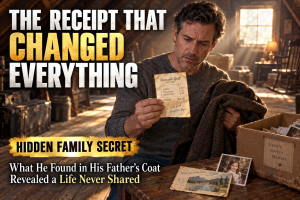
When my wife pulled that faded receipt from my father’s old coat, I expected nothing more than a forgotten scrap of paper. Instead I found a date, a place he swore he never visited, and a second name that made my mother walk out of the room without a word. The postcard that followed only deepened the silence he left behind.
Part 1
The coat still smelled faintly of tobacco and cedar, even after all these years. My wife, Elena, had been clearing the attic so we could finally turn it into a guest room for her parents. She called me up the narrow stairs with that particular tone she used when something unexpected turned up among the boxes.
“Daniel, come look at this.”
I climbed the steps, brushing dust from my sleeves. Elena stood near the single dormer window, holding a heavy wool overcoat that had belonged to my father. The fabric was a deep charcoal, the kind of solid, practical coat he had worn every winter of my childhood. She had already checked the pockets. In one hand she held a small folded square of paper, yellowed at the edges.
“It was in the inside pocket,” she said. “Tucked behind a handkerchief.”
I took the paper and unfolded it carefully. The print was faded but still legible. A restaurant receipt from a place called The Harbor Light in a town I had never heard of in Maine. The date sat clearly at the top: August 17, 1998. Two names were written in the guest line. One was my father’s. The other I did not recognize.
I stood there longer than I meant to, the paper trembling slightly between my fingers. Elena watched my face.
“What is it?” she asked.
“He told us he was in Chicago that summer,” I said. “Working on a long consulting job. He called every Sunday. He sent postcards of the skyline.”
Elena glanced at the receipt again. “That’s not Chicago.”
I carried the coat and the receipt downstairs. My mother was in the kitchen, rinsing blueberries for a pie she had decided to bake that afternoon for no particular reason. She looked up when I entered, her hands still under the running water.
“Mom, do you remember Dad being in Maine in 1998?”
She turned off the faucet and dried her hands on a dish towel. “Maine? No. He was in Chicago that year. The big project for the firm. Why?”
I held out the receipt. She took it, read the date, then the names. Her expression did not change at first. Then her eyes settled on the second name. She set the paper on the counter as if it had grown warm in her hand.
“I need to check something,” she said, and walked out of the kitchen without another word.
I heard her footsteps on the stairs, then the soft close of her bedroom door. Elena and I looked at each other across the quiet kitchen. The blueberries sat in a colander by the sink, dripping water onto the stainless steel.
That was the moment I understood the receipt was not a simple leftover. Something about that second name had moved my mother in a way ordinary forgetfulness never did.
Later that evening I sat at the dining table with a stack of old bank statements I had pulled from a metal file box in the garage. My father had kept meticulous records. Three days before the restaurant date, on August 14, 1998, he had withdrawn four thousand two hundred dollars in cash from a savings account he rarely touched. The money never reappeared in any later deposit.
I called my uncle the next morning. Uncle Ray had always been the one who remembered family trips and odd jobs my father took. He answered on the second ring.
“Maine?” he repeated when I explained. “Yeah, he went up there once. Summer of ninety-eight, I think. Said he needed a few days alone after the Chicago job wrapped early. Drove up by himself. Called me from a pay phone near the coast. Said the air smelled like salt and pine.”
“He went alone?”
“That’s what he told me. Why?”
I did not answer right away. The second name on the receipt sat in my mind like a stone.
The following afternoon Elena found the postcard. It had been slipped into the same inner pocket of the coat, pressed flat against the lining. The front showed a black-and-white photograph of a little girl, maybe six or seven years old, standing on a rocky shore with wind in her hair. On the back, in my father’s careful handwriting, were six words:
I hope she never learns my real name.
I turned the card over and over in my hands. The girl looked ordinary and bright, the way children do when someone they trust is holding the camera. There was no address, no stamp, no indication it had ever been meant to leave the coat.
Elena rested her hand on my shoulder. “What are you going to do?”
I did not know yet. All I knew was that the story my father had told us about that summer no longer held together, and the pieces that remained pointed somewhere I had never been allowed to look.
Part 2
My mother stayed in her room most of the next day. When she finally came down she moved through the house with the careful quiet of someone trying not to disturb a fragile truce. I waited until evening, after Elena had gone upstairs to call her sister, before I sat across from her at the kitchen table.
“Mom,” I said. “The name on the receipt. Who was it?”
She looked at the window rather than at me. The glass reflected the soft yellow of the overhead light. Outside, the street was empty.
“I don’t want to talk about this tonight,” she said.
“You left the room the moment you saw it.”
“I needed a moment. That’s all.”
I placed the postcard on the table between us. The photograph of the little girl faced upward. My mother’s eyes moved to it and stayed there for several long seconds. Her hands rested flat on the wood, fingers slightly spread.
“Where did you find that?”
“Same coat. Same pocket.”
She reached out, then stopped short of touching the card. “Your father kept things. He always did. Old maps, ticket stubs, receipts. It doesn’t mean—”
“He wrote on the back,” I said. “About a real name. About hoping she never learns it.”
My mother closed her eyes briefly. When she opened them again her voice was quieter. “Daniel, some things are better left where they were. Your father is gone. Whatever happened in 1998 is finished.”
“It doesn’t feel finished,” I said. “Not when you’re still walking out of rooms over a name on a piece of paper.”
She stood up, collected the empty tea cups from earlier, and carried them to the sink. The sound of running water filled the silence. I stayed at the table with the postcard and the receipt, the two objects that had somehow survived twenty-eight years in a coat my father never threw away.
Elena found me still sitting there an hour later. She pulled out the chair beside me and looked at the photograph of the girl.
“She has his eyes,” she said softly. “Or maybe I’m imagining it.”
I studied the image again. The girl was squinting slightly against the coastal light, one hand raised as if to push hair from her face. The resemblance, if it existed, was faint. Or perhaps it was only the way my mind had begun searching for connections.
That night I lay awake listening to the house settle. My father had been a careful man, the kind who balanced checkbooks to the penny and labeled every toolbox drawer. The idea that he had driven alone to Maine, withdrawn a large sum of cash, shared a meal with someone whose name he wrote on a receipt, and then kept a photograph of a child with a note about real names—none of it fit the man I thought I knew.
I got up before dawn and opened my laptop. Searching for the restaurant was easy enough. The Harbor Light still existed, a small place on the water in a town called Camden. Their website showed white clapboard siding, blue awnings, and tables set with simple white plates. Nothing about the photographs suggested secrets. I stared at the images until the sky outside began to lighten.
Elena came downstairs while I was still looking. She poured coffee and stood behind my chair, reading over my shoulder.
“You’re going there, aren’t you?” she said.
I nodded. “I need to see the place. Talk to someone who might remember.”
“And the name on the receipt?”
I had not spoken it aloud yet. The second name was Eleanor Vance. Ordinary enough. Easy to overlook if you were not looking for it. I wrote it on a scrap of paper and folded it into my wallet beside the original receipt.
My mother appeared in the doorway as we were packing an overnight bag. She did not try to stop me. She only said, “Be careful what you decide to bring home.”
I promised nothing. The drive north would take most of a day. By the time we reached the Maine coast I expected the questions would only have multiplied.
Part 3
The road into Camden curved between tall pines and sudden glimpses of water. Elena drove the last stretch while I watched the shoreline appear and disappear through the trees. The town itself felt smaller than I had imagined, a cluster of white buildings and wooden docks where lobster boats rocked gently against their moorings.
We found The Harbor Light without difficulty. It sat close to the water, exactly as the website photographs had shown. A wooden sign hung above the door, painted with a simple lighthouse silhouette. Inside, the lunch service was winding down. A woman in her sixties wiped tables and glanced up when the bell over the door chimed.
“Afternoon,” she said. “Kitchen’s still open if you’re hungry.”
I told her we were looking for information more than food. I showed her the receipt. She took it carefully, the way people handle old paper, and read the date and the names.
“Nineteen ninety-eight,” she said. “That’s a long time. I wasn’t working here then. Place has changed hands twice since.”
She suggested I speak with the previous owner, a man named Harold who still lived a few streets inland. She wrote his address on a napkin and handed it to me with a small shrug.
“He keeps everything. If anyone remembers a couple from that summer, it might be him.”
Harold’s house was a weathered Cape Cod with a garden full of late-summer roses. He answered the door in a flannel shirt and reading glasses perched on his forehead. When I explained why we had come, he invited us into a kitchen that smelled of coffee and old wood. Boxes of restaurant ledgers lined one wall.
“August of ninety-eight,” he repeated, pulling a thick binder from a lower shelf. “I was still running the place then. Quiet summer, mostly. Locals and a few tourists.”
He flipped pages slowly. When he reached the week of the seventeenth he paused, ran a finger down a list of guest names, and stopped.
“Here. Two covers. Name on the reservation was Vance. Second name listed as Thomas Hale. That’s your father?”
I nodded. Thomas Hale had been his full name. Hearing it spoken in this kitchen, far from the house where he had raised me, felt strangely formal.
Harold leaned back in his chair. “I remember them a little. Not the faces so much as the way they sat. Quiet. Not tourists, exactly. More like people who had somewhere else to be but weren’t in a hurry to get there. The woman paid in cash. Left a decent tip. That’s about all I’ve got.”
“Do you remember anything about a child?” I asked.
He shook his head. “No children that I recall. Just the two of them.”
We thanked him and left with the sense that the trail had both narrowed and opened at the same time. Outside, the air carried the sharp scent of the harbor. Elena slipped her arm through mine as we walked back toward the car.
“Someone named Eleanor Vance sat across from your father in that restaurant,” she said. “And three days earlier he took out four thousand dollars that never came home. And he kept a picture of a little girl with a note about real names.”
I looked out at the water. A fishing boat was heading in, its engine a low steady thrum. The pieces still refused to form a complete picture, but they no longer felt random. My father had come here deliberately. He had met someone. He had spent money that left no further record. And he had carried the evidence of that meeting in a coat pocket for the rest of his life.
That evening we checked into a small inn overlooking the bay. After dinner I sat on the narrow balcony with the postcard in my lap. The little girl’s face looked back at me under the porch light. I tried to imagine my father holding a camera, framing that shot, then writing those six words on the reverse side and tucking the card away where no one would find it until long after he was gone.
Elena joined me, wrapping a sweater around her shoulders against the evening chill.
“Whatever this is,” she said, “you don’t have to solve it alone.”
I reached for her hand. The truth was that I no longer knew whether solving it would bring relief or something heavier. But the silence my mother had chosen, and the careful way my father had hidden these objects, made one thing clear: the story he left us was incomplete, and the missing pages were beginning to surface whether anyone wanted them or not.
Part 4
The next morning I drove to the local library while Elena walked the shoreline. The librarian, a young woman with a practical ponytail, helped me search old town directories and newspaper archives for the name Eleanor Vance. There were two listings from the late 1990s. One belonged to a woman who had moved away years earlier. The other led to a post office box that no longer existed.
I asked about school records, thinking of the little girl in the photograph. The librarian explained that student files from that period were not public, but she suggested the historical society might have class photographs or community event albums.
The historical society occupied a former schoolhouse two blocks from the harbor. A volunteer named Margaret unlocked a cabinet of albums and left me at a long table with a stack of yearbooks and local newsletters. I turned pages slowly, looking for any child who resembled the girl on the postcard. Most faces blurred together after a while. Then, in a newsletter from the fall of 1999, I found a short article about a community art show. A photograph accompanied the piece. In the background, slightly out of focus, stood a girl with the same windblown hair and the same slight squint against the light.
The caption listed local children who had contributed drawings. One name caught my eye: Claire Vance, age seven.
I sat very still. Claire Vance. The last name matched the woman who had shared a meal with my father. The age matched the child in the postcard. I photographed the page with my phone and closed the album carefully.
Outside, the sky had turned a soft gray. Elena was waiting on a bench near the water. When I showed her the newsletter photograph she studied it for a long time.
“She’s the same girl,” she said. “Or close enough that it can’t be coincidence.”
We sat in silence for several minutes, watching a pair of gulls argue over something on the rocks. The possibility that my father had known this child—had perhaps cared enough to keep her photograph and write a private hope on the back—settled over us like a change in weather.
I called my uncle again that afternoon. This time I told him about the second name and the postcard. He was quiet for so long I thought the connection had dropped.
“Ray?” I said.
“I’m here.” His voice sounded older than it had two days earlier. “Your father never talked about Maine after that summer. Not to me. Not to anyone I know. If there was a woman, or a child, he kept it locked up tight.”
“Did he ever mention the name Vance?”
“Never.”
After the call I walked alone along the harbor path. The water was calm, reflecting the low clouds. I tried to picture my father as he had been in 1998—forty-three years old, successful enough in his work, married to my mother for fifteen years, father to a twelve-year-old son who believed every story he was told. What had drawn him to this quiet coastal town? What had the four thousand two hundred dollars purchased or protected? And why had he hoped a little girl would never learn his real name?
That evening Elena and I ate dinner at a small place near the docks. The food was simple and good, but I barely tasted it. My mind kept returning to the way my mother had left the kitchen the moment she saw the name on the receipt. She knew something. Or she feared something. Either way, the knowledge sat between us now like an unopened letter.
Before bed I wrote a short note in the small notebook I had brought. I listed the facts as cleanly as I could:
Receipt: August 17, 1998. The Harbor Light, Camden, Maine. Names: Thomas Hale and Eleanor Vance.
Withdrawal: $4,200 on August 14, 1998. Never returned.
Uncle’s memory: Father claimed he went alone.
Postcard: Photograph of a little girl. Note in father’s handwriting: “I hope she never learns my real name.”
Newsletter: Claire Vance, age seven, fall 1999. Resemblance strong.
I closed the notebook and turned off the light. Outside the open window the harbor made soft continuous sounds against the pilings. Somewhere in this town, or somewhere that had once been connected to it, lived the rest of the story my father had chosen not to tell.
Part 5
We stayed in Camden one more day. I spent the morning at the town clerk’s office, requesting any public records that might mention Eleanor or Claire Vance. The clerk was polite but limited in what she could share. Property records showed that an Eleanor Vance had rented a small house on a side street for two years beginning in the spring of 1997. The lease ended in 1999. No forwarding address was listed.
A neighbor from that street, an elderly man watering plants on his porch, remembered a quiet woman and a little girl who kept to themselves. “Nice enough,” he said. “The girl liked to draw. Always had a sketchbook. They left suddenly one autumn. Packed up a U-Haul and were gone by the weekend. No big goodbyes.”
I thanked him and walked back toward the center of town. The pieces were beginning to form a shape, though the center remained unclear. My father had been in Camden in mid-August 1998. He had dined with Eleanor Vance. He had withdrawn a large sum of cash days earlier. A child named Claire Vance had lived in the same town around the same time and matched the photograph he kept. And then, sometime the following year, the woman and child had left without leaving a trail.
Elena met me at the car. We drove the short distance to the address where Eleanor had rented. The house was still there, painted a pale blue, with a small garden in front. A different family lived there now. I stood on the sidewalk for a few minutes, trying to imagine my father walking up those same steps, perhaps carrying the cash in an envelope, perhaps holding a camera he would later use to photograph a child on the shore.
That night I called my mother. She answered on the third ring, her voice carefully neutral.
“I’m in Maine,” I said. “Camden. I found the restaurant. I found a name that matches the receipt. There was a little girl named Claire.”
Silence stretched across the line. Then she said, “Come home, Daniel. Please. Just come home.”
“I need to understand what happened.”
“Some things don’t get clearer by digging,” she said. “They only get heavier.”
I told her I would be back in two days. When I hung up, Elena was watching me from the other side of the room.
“She’s scared,” she said.
“I know.”
“Of what you’ll find, or of what you’ll do with it?”
I did not have an answer. All I knew was that the careful life my parents had built around me had contained a sealed room, and I had just found the key still in the lock.
The next morning we began the drive south. The coastal road gave way to inland highways, then to the familiar exits that led toward home. I kept the postcard in the glove compartment, face down. Every time I glanced at the closed compartment I felt the weight of the six words written on the back.
We arrived after dark. My mother was waiting in the living room with a single lamp lit. She looked smaller somehow, as if the days of my absence had drawn something inward. Elena went upstairs to give us privacy. I sat across from my mother and placed the receipt, the postcard, and the printed newsletter photograph on the coffee table between us.
She looked at each object in turn. When she spoke, her voice was steady but low.
“I knew there was someone,” she said. “Not the details. Not the child. But I knew he had gone somewhere that summer that had nothing to do with Chicago. He came back quieter. Different around the edges. I asked once. He said it was nothing I needed to carry. I chose to believe him because the alternative felt like it would break something we both needed to keep intact.”
“And the name on the receipt?”
“I saw it years ago. He left the coat hanging in the hall one winter and the receipt fell out when I was brushing it. I put it back. I never asked. I told myself it was better that way.”
I leaned forward. “There’s a little girl in that photograph, Mom. Claire Vance. She would be in her thirties now. My father wrote that he hoped she never learned his real name. Why would he write that?”
My mother’s eyes filled, but she did not look away. “Because some truths protect the people who never asked for them. And some protect the people who already know too much.”
She stood, walked to the window, and stared out into the dark yard. I remained seated with the objects that had forced the conversation into the open. The house felt different now, as if the walls themselves had shifted slightly to make room for the things that had always been there, waiting.
Part 6
The following weeks moved in a strange double rhythm. Outwardly our lives continued—work, grocery lists, the ordinary conversations that fill a marriage. Underneath, I kept searching. I wrote letters to possible addresses. I checked public databases for Claire Vance and Eleanor Vance. Most trails ended in privacy walls or outdated listings. One, however, led to a small art gallery in a different coastal town two states away. The gallery’s website listed a Claire Vance as a featured local artist. The style of the work—seascapes and portraits of children on rocky shores—felt familiar in a way I could not immediately explain.
I showed Elena the website. She studied the artist’s statement and the handful of available photographs of the work.
“Do you want to go?” she asked.
I did. We made the drive on a Saturday in early autumn, when the leaves along the highway had just begun to turn. The gallery occupied the ground floor of an old brick building. Inside, the light was soft and the walls held paintings that seemed to breathe salt air. A woman in her mid-thirties stood near the back, speaking with a customer about a large canvas of a girl standing at the edge of the tide.
When the customer left I approached. Up close, the resemblance to the postcard photograph was unmistakable—the same shape of the eyes, the same slight lift at the corner of the mouth when she listened.
“Claire Vance?” I said.
She smiled politely. “Yes. Can I help you?”
I introduced myself by first name only at first. I told her I had come because of a photograph and a receipt from a long time ago. I did not mention my father’s name yet. I simply took out the postcard and handed it to her.
She looked at the image for a long moment. Her expression changed by degrees—curiosity, recognition, then something quieter and more complicated.
“Where did you get this?” she asked.
“It belonged to my father. Thomas Hale. He kept it in an old coat for almost thirty years. On the back he wrote a note.”
I turned the card so she could read the six words. Her hands tightened slightly on the edges of the paper.
“I never knew his last name,” she said finally. “My mother called him Tom. She said he was a friend who helped us once when we needed it most. He visited a few times that summer. Brought groceries. Fixed the porch steps. Took me to the shore and let me draw while he sat on the rocks. Then he stopped coming. My mother never explained why.”
I felt the room tilt slightly. The man she described was both my father and someone I had never met.
Claire looked up from the postcard. “Is he still alive?”
“No. He died four years ago.”
She nodded slowly, absorbing the information. “I’m sorry.”
We stood in the quiet gallery while the afternoon light shifted across the floor. I told her about the restaurant receipt, the cash withdrawal, the way my mother had reacted to the second name. Claire listened without interrupting. When I finished she set the postcard down carefully on a nearby table.
“My mother died two years ago,” she said. “She left me a box of papers. There’s a letter in it I never fully understood. It might make more sense now.”
She invited us to her apartment above the gallery. The space was filled with canvases and the clean smell of linseed oil. From a wooden chest she withdrew a sealed envelope addressed simply to Claire in a woman’s handwriting. Inside was a single sheet of paper, dated the year before Eleanor’s death.
Claire read it aloud. The letter explained that in the summer of 1998 Eleanor had been struggling—recently divorced, short on money, trying to keep a stable home for her daughter. A man named Tom had appeared through a mutual acquaintance. He had given her enough money to cover several months of rent and to keep Claire in the local school. He asked for nothing in return except that Claire never be told his full name or how to find him. He said he had a family of his own and that the help was meant to be quiet and final.
The letter ended with a simple sentence: He was kind when kindness was scarce. That is all you need to know.
Claire folded the paper and looked at me. “Your father was that man.”
I sat with the knowledge for a long time. The four thousand two hundred dollars. The shared meal. The photograph taken on the shore. The note written on the back of a postcard that was never mailed. All of it formed a single, private act of care that my father had chosen to keep entirely separate from the life he shared with us.
Elena reached over and rested her hand on mine. Claire watched us both with an expression that held neither accusation nor claim—only a quiet recognition that something long unfinished had finally found its other half.
Part 7
We talked for hours that afternoon. Claire made tea. I told her what I remembered of my father—the way he checked homework at the kitchen table, the careful way he packed a suitcase, the rare times he laughed hard enough to make his eyes water. She shared the few clear memories she still carried: a man who listened when she talked about the drawings she made, who never promised to return and therefore never broke a promise, who once bought her a set of colored pencils and said they were better than any store-bought toy.
As the light faded outside the gallery windows, Claire asked the question I had been turning over since the moment I saw the newsletter photograph.
“Why do you think he hoped I would never learn his real name?”
I considered the possibilities. Protection, certainly—protection for her, for my mother, for the careful balance of the life he had built. Perhaps also a kind of humility. He had stepped into a difficult moment, offered what he could, and then stepped back so completely that even the memory of his full identity was meant to remain sealed.
“I think he wanted the help to stand on its own,” I said. “Without me, or my mother, or any claim that might complicate the quiet he tried to leave behind.”
Claire nodded. “My mother respected that. She never tried to find him after he stopped coming. She just kept the memory of the kindness and moved us forward.”
Before we left, Claire walked us downstairs and locked the gallery door. On the sidewalk she hesitated, then asked if she could keep a copy of the postcard photograph. I said yes. She took a careful picture with her phone and handed the original back to me.
“If you ever want to talk again,” she said, “you know where to find me.”
On the drive home Elena and I spoke little at first. The highway unrolled under the headlights. Eventually she said, “He did a good thing. A hard, quiet, good thing. And he carried the weight of it alone so no one else would have to.”
I agreed. Yet the knowledge still sat uneasily. My father had kept an entire chapter of his life sealed away. He had allowed my mother to sense the presence of something unspoken and then asked her, without words, to leave it untouched. He had written a hope on the back of a photograph and then hidden the photograph where only time and chance would eventually reveal it.
When we reached the house my mother was already in bed. I left the receipt, the postcard, and a printed copy of Claire’s letter on the kitchen table with a short note of my own. In the morning she would find them. I did not know what she would choose to do with the truth once it was fully in front of her, but I no longer felt I had the right to keep it from her.
That night I dreamed of the rocky shore in the photograph. In the dream my father stood a short distance away, watching a child draw in a sketchbook. He did not look unhappy. He looked like a man who had made a decision and was living with its quiet consequences.
I woke before dawn and sat at the window until the sky began to lighten. The house was still. Somewhere inside it, the objects that had started everything waited for the next conversation they would force into the open.
Part 8
My mother read everything. I found her at the kitchen table the next morning with the letter, the postcard, and the receipt spread in a careful row. Her coffee had gone cold. She looked up when I entered and gestured for me to sit.
“She has his patience,” she said, nodding toward the photograph of Claire as a child. “The way she sits with a question instead of rushing past it.”
I waited.
“I was angry for a long time,” she continued. “Not because of the money or the trip. Because he carried it alone. Because he decided what I could and could not hold. And then, after a while, the anger turned into something else. A kind of respect for the choice, even if I never fully agreed with it.”
She touched the edge of the letter. “This woman—Eleanor—she needed help. He gave it without turning it into a story he could tell at dinner. That was the man I married. Capable of large quiet things.”
“I met Claire,” I said. “She’s an artist. She remembers him kindly.”
My mother’s eyes softened. “I’m glad.”
We sat together while the morning light strengthened across the floor. For the first time since the receipt had surfaced, the air between us felt less charged with unspoken fear. The secret had not destroyed anything. It had simply asked to be seen.
Later that week I wrote to Claire. I told her my mother knew everything now and that she had spoken of the choice with a complicated but genuine respect. Claire wrote back a short, careful reply. She said she was grateful to understand the full shape of the kindness she had received as a child. She included a small sketch of the rocky shore from the postcard, drawn from memory and from the photograph I had shared. In the corner she had written a single line: Some names are gifts we never ask for.
I framed the sketch and hung it in the hallway near the photographs of my own childhood. It did not replace anything. It simply took its place among the other pieces of a life that had always been more layered than I knew.
Elena and I talked often in those weeks about what it meant to keep a secret for the sake of someone else’s peace. We agreed that my father’s decision had been imperfect and human. He had protected one family by creating a quiet distance from another. He had given help that mattered and then removed himself so completely that the help could not become a claim.
One evening my mother joined us on the back porch. The air was cool with the first real turn toward autumn. She brought a small box I had never seen before. Inside were a few more items from the same period—train ticket stubs, a folded map of the Maine coast with a single location circled in pencil, and a short note in my father’s handwriting that simply read: Done what I could. Leave it there.
She handed the note to me. “I found this in his desk years ago. I put it back and never mentioned it. I think he wanted the same thing for all of us—to leave the quiet parts quiet.”
I held the note carefully. The handwriting matched the postcard exactly. The same measured letters. The same refusal to explain more than necessary.
“I’m going to keep these with the receipt and the postcard,” I said. “Not hidden. Just kept.”
My mother nodded. “That’s enough.”
In the days that followed, the intensity of the search gradually eased. The questions that remained were smaller, more personal. I no longer needed every detail. I needed only to understand that my father had been capable of a private generosity that asked for no recognition, and that the people he loved had been asked, in different ways, to live with the space that generosity created.
Part 9
Autumn deepened. The leaves along our street turned and fell. Life resumed its ordinary pace, yet something fundamental had shifted. The story of the receipt no longer felt like a rupture. It felt like a completed sentence that had been waiting decades for its final words.
Claire and I exchanged occasional messages. She sent photographs of new paintings. I sent news of ordinary days. Neither of us pressed for more than the connection already allowed. One afternoon she called to say she had decided to include a small written reflection in her next gallery show—nothing that named my father, only a short note about a kindness received in childhood and the quiet way it had shaped the artist she became. She asked if I minded. I told her I did not.
My mother began to speak of that summer more easily. Not in dramatic revelations, but in small, matter-of-fact comments. She remembered how my father had returned from the trip thinner, quieter, and somehow more present in the weeks that followed. She remembered the way he had checked on me more carefully that fall, as if the act of helping one child had sharpened his attention to the child already in his care.
Elena and I talked late one night about the nature of the choices people make when they believe they are protecting others. We agreed that my father’s silence had been both a burden and a gift. It had left my mother carrying an unspoken knowledge for years. It had also allowed Claire to grow up free of complicated claims or divided loyalties. The balance was imperfect, as most human balances are.
I returned once more to the attic where the coat had been found. The guest room was nearly finished now—fresh paint, a new bed, curtains that let in the afternoon light. I stood in the center of the room and thought about the objects that had started everything. They no longer felt like evidence of a hidden life so much as evidence of a complete one. My father had been the man who balanced checkbooks and the man who withdrew cash to help a stranger. He had been the father who called every Sunday from Chicago and the man who sat on Maine rocks while a little girl drew. Both were true. The coat had simply held the proof of the second truth until the right moment arrived to reveal it.
On a quiet Sunday I took the receipt, the postcard, the letter, and the small collection of notes and placed them in a single archival box. I labeled it with the year 1998 and nothing more. I set the box on a shelf in the study where other family papers lived. It was neither hidden nor displayed. It simply belonged now to the larger record of a life.
That evening my mother, Elena, and I sat together after dinner. No one mentioned the receipt. We talked instead about ordinary plans—an upcoming visit from Elena’s parents, a repair needed on the back fence, the first frost expected later in the week. The conversation moved easily. The silence that had once surrounded the subject of Maine no longer required careful navigation. It had become simply another part of the landscape we all shared.
Before bed I stood at the window of our bedroom and looked out at the dark street. Somewhere far to the north, the same water that had appeared in the postcard still moved against the rocks. Somewhere in another town, Claire was likely preparing for sleep after a day of painting. And here, in the house where I had grown up and where my father had kept his private decision for so many years, the story had finally found its resting place.
I turned away from the window. The questions that remained were smaller now, and they no longer kept me awake. The important ones had already been answered by the simple facts of kindness given, silence kept, and truth eventually allowed to surface in its own time.
Part 10
Winter arrived early that year. Snow covered the yard by the second week of December. The guest room was finished and waiting. Elena’s parents came for the holidays and filled the house with the comfortable noise of people who have known each other a long time. My mother moved through the days with a lighter step than I had seen in years. She never spoke of the receipt during those visits, but once, while helping her carry dishes to the kitchen, she paused and said quietly, “I’m glad you went looking. Some things need to be brought into the light so they can stop casting shadows.”
In the new year I received a small package from Claire. Inside was a finished painting—no larger than a sheet of paper—of a man sitting on rocks overlooking the water, seen from behind. The figure was not detailed enough to be a portrait, yet something in the set of the shoulders felt familiar. A short note accompanied it: For the quiet ones who help and then step back. Thank you for finding the rest of the story.
I hung the painting in the study near the archival box. It did not demand attention. It simply completed a circle that had begun with a receipt in an old coat pocket.
Years later, when my own children asked about their grandfather, I told them the ordinary stories first—the ones about homework checked at the kitchen table and careful lists and Sunday phone calls. When they were older, I told them the rest. I showed them the postcard and the letter and the painting. I explained that people are rarely only one thing, and that sometimes the kindest acts are the ones that ask for no audience.
My mother lived long enough to meet her great-grandchildren. In her final years she spoke more openly about the summer of 1998, not with regret but with a clear-eyed acceptance of the choices made by the man she had loved. She said once that the receipt had been a door she never wanted to open, and that I had opened it carefully enough that nothing important was lost in the process.
Elena and I still walk the shoreline when we visit the coast. We do not go looking for anything in particular. We simply stand where the water meets the rocks and let the wind do what it has always done. Sometimes I think of the little girl with the sketchbook and the man who sat nearby without making promises. Sometimes I think of the mother who chose silence for the sake of a peace she believed was necessary. Mostly I think of the way a single folded piece of paper can hold an entire hidden chapter, waiting patiently for the day someone is ready to read it.
The coat still hangs in the back of a closet. We never threw it away. On certain winter mornings I take it out and run my hand along the heavy wool. The pockets are empty now. Everything they once held has found its proper place—not erased, not dramatized, simply known.
That is the ending I needed. Not a revelation that undid a life, but a quiet completion that allowed the life to be seen whole. My father had been a man who kept careful records and a man who once chose to leave no record at all. Both truths remain. The receipt from 1998 no longer asks questions. It simply rests among the other papers, a small, ordinary object that once carried an extraordinary silence, and that silence has finally been allowed to rest as well.